You don’t need the tallest tower. You need the right one.
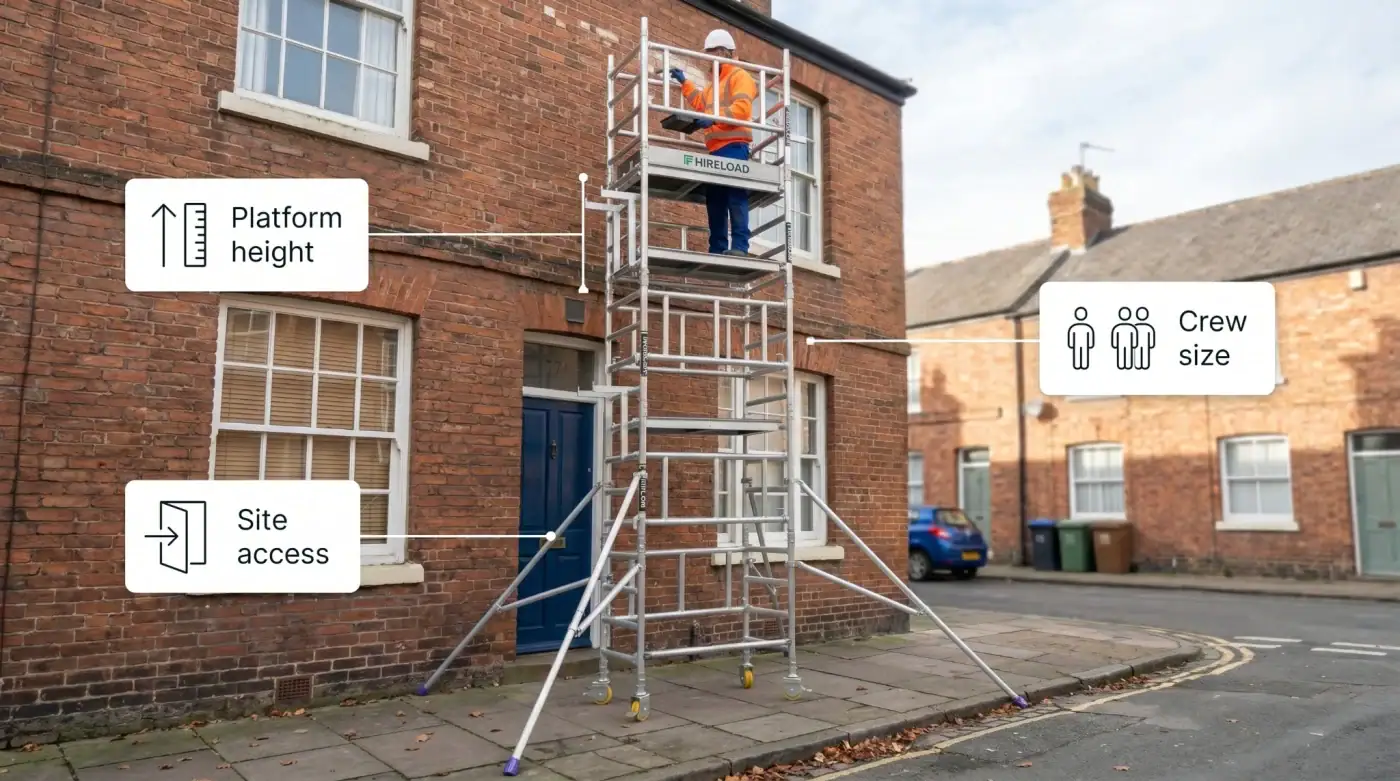
Picking a scaffold tower is usually framed as a height question — “how high do I need to go?” — and most guides start there. It’s the wrong first question. Height narrows your options, but it doesn’t pick the tower. Two 10m jobs can need two different towers. One solo job and one two-person job at 6m need two different towers too.
Three questions decide it. Walk through them in this order.
Question 1 — How high does the platform need to be?
Not how high you want to reach. How high you need to stand.
Scaffold towers list two numbers:
platform height (where your feet go) and
working height (your feet plus roughly 2m of average reach above). A tower with “6m working height” puts your platform at about 4m. If your job is on a 6m ceiling, that’s fine — you’ll be reaching up to the ceiling from a 4m deck. If your job is on a 6m signboard mounted at eye level 6m up, you need a platform at 6m, not a tower whose working height says 6m.
This catches people out all the time. If you’re not sure which number you need to match, read
Working height vs platform height — which number should you trust? before you pick.
Rough ranges:
- Up to 4m platform / 6m working — ceilings in most three-storey hallways, top of a standard shopfront, first-fix electrics on loft conversions. The MiTower and Miniscaff Solo cover this band.
- 4–6m platform / 6–8m working — two-storey facades, retail signage, commercial maintenance at height. The Folding Tower is the pre-assembled fast-deploy option here.
- 6–8m platform / 8–10m working — upper-storey render, three-storey facades, large sign work. The 3T Tower covers this range.
- 8–12m platform / 10–14m working — tall facades, four-storey refurb, continuous two-person work. The Twin-Access is the tower for this band.
Question 2 — Where is the tower going?
The site decides the tower type more than the height does.
Through a doorway? You need a tower that folds or breaks down narrow enough to pass through. The MiTower (solo-build, compact frames), Miniscaff Solo, and Folding Tower all pass through standard UK doorways.
Up or on a staircase? Only one tower. The
Stairwell Tower has four independently adjustable legs with a 300mm threaded shaft — it levels across the step between a landing and the stair below. No other tower on the site is rated for this. Don’t improvise a standard tower on a staircase.
On a sloping driveway or uneven ground? Same answer — Stairwell Tower. Adjustable legs compensate up to 300mm of height difference.
On the pavement in London? Any tower. But you’ll need a pavement licence from the local council (the naming varies — scaffold licence, highways permit, footway licence). That’s on you as the hirer. We’ll supply documented tower compliance.
Inside a working commercial unit (shop, office, warehouse)? Speed matters more than spec. The Folding Tower unfolds from a rolling base in under five minutes, so disruption time is minimal.
Question 3 — Who’s building it, and how many are working on it?
Solo operator? Look at solo-build towers first. The MiTower clip-frames together without tools. The Miniscaff Solo is a proper single-operator tower with a 250kg deck rating if you need more than operator weight on the platform.
Two-person crew? The key question is whether both people need to be on the deck at once — or more importantly, whether both need to climb and descend independently through the working day. If yes, the
Twin-Access has two integrated ladder faces, and on a full-day two-person job that extra access saves real time. If the second person is just passing materials up and you only ever have one person on the deck, the 3T is lighter and cheaper.
DIY building the tower yourself? Hire a solo-build or folding tower and read the manual carefully. For work use, the UK standard is PASMA training — HSE expects trained operators. For your own property, follow the supplied instructions and don’t exceed stated loads.
By job type — quick reference
If you recognise your job in the list below, this is where to start.
- Painting / decorating a three-storey hallwayMiTower or Miniscaff Solo (solo, 6m working height, doorway access)
- Render or facade on a two-storey house3T Tower (up to 10.2m, build in from outside)
- Shopfront sign installFolding Tower (fast deploy, minimal shop disruption) or Miniscaff Solo (heavier load for brackets and fixings)
- Four-storey facade paintTwin-Access (12.2m, two climb faces for continuous two-person work)
- Stairwell ceiling in a houseStairwell Tower (only valid option)
- Commercial unit ceiling / sprinkler / lighting maintenanceFolding Tower (speed) or 3T (taller runs)
- Retail refurb with the shop openFolding Tower (in/out in minutes, minimal public exposure to build)
- Loft conversion first-fix electricsMiTower (sub-6m, solo, doorway access)
What about load capacity?
Load matters when you’re putting more than an operator and hand tools on the deck.
- 150kg SWL (MiTower) — one operator plus hand tools. Fine for painting, inspection, light first-fix.
- 250kg SWL (Miniscaff Solo) — operator, tools, and materials (plaster bag, paint set, hardware). Fine for most finishing trades.
- 275kg SWL (3T, Twin-Access) — two operators or one operator plus heavier materials. Required for any job carrying significant weight onto the deck.
If you’re putting a mixer, a large material reservoir, or multiple trades on the deck, call the hire desk and we’ll spec it against point-load limits as well as distributed load.
Still unsure?
Call us with a one-line description of the job — “painting a 4m ceiling in a hallway, solo, can get through a 750mm doorway” — and we’ll pick the tower for you. If two towers would both work, we’ll say which is faster to build.
Or browse the full range here:
Scaffold Tower Hire


 Drone Services
 Access Equipment
 Breaking & Drilling
 Cleaning Equipment
 Drying & Heating
 General Site Tools

 Drone Survey & Mapping
 Drone Inspections