
 Drone Services
 Access Equipment
 Breaking & Drilling
 Cleaning Equipment
 Drying & Heating
 General Site Tools
Equipment Hire Guides
Dry a Room Faster: Dehumidifier + 2 Air Movers (London Hire Guide)
Dry a Room Faster: Why You Need a Dehumidifier + 2 Air Movers (London Hire Guide)
If you’ve had a leak, water ingress, or you’re drying plaster after decoration work, the instinct is to reach for a dehumidifier. But here’s what most people discover: a dehumidifier alone can feel frustratingly slow.
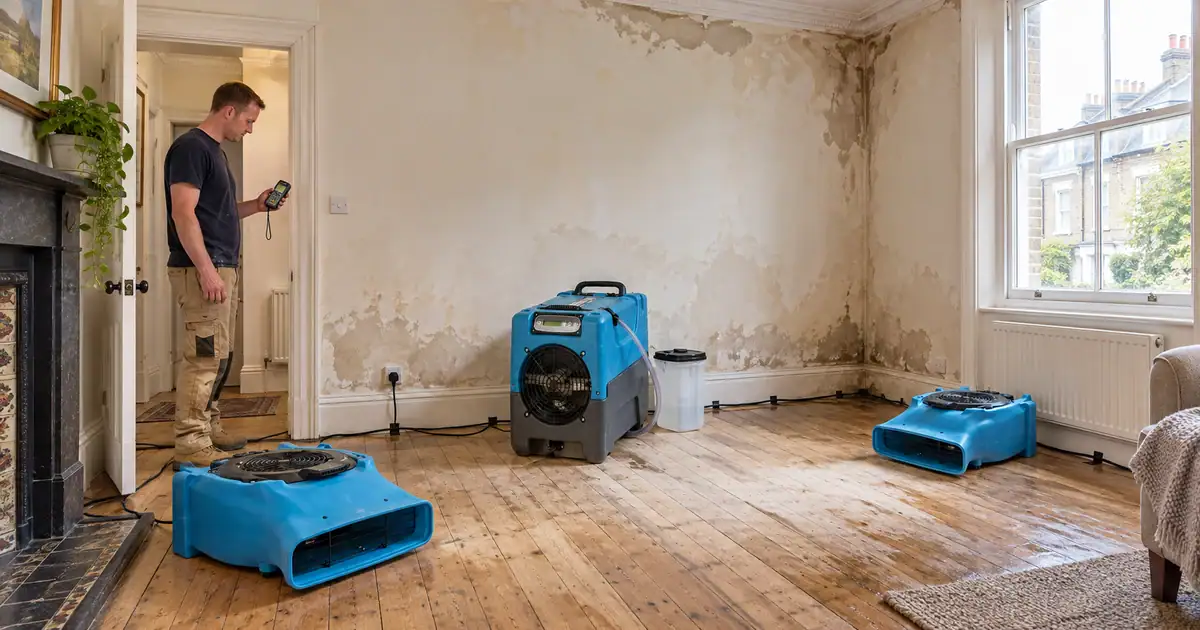
The fastest practical setup for drying a room after a leak is straightforward:
- 1x Industrial Dehumidifier
- 2x Air Movers (Carpet Dryers)
- Optional: a heater if the space is cold or the job is time-critical
This isn’t upselling. It’s how professional drying works. Air movers accelerate evaporation at the surface, while the dehumidifier extracts the moisture from the air — allowing drying to continue without stalling.
Short version: a dehumidifier on its own dries a wet room slowly. Add two air movers and the same room usually dries in a fraction of the time, because the water has to get out of the surface before the dehumidifier can take it out of the air.
The standard one-room setup — a 38L dehumidifier at £59.99 + VAT for up to a week and two air movers at £29.99 each — comes to £119.97 + VAT. Delivered across London, or collect free from Greenford UB6.
Browse drying equipment · Not sure what you need? Call 020 3375 4048 or message us on WhatsApp.
Drying Setup Comparison at a Glance
| Setup | Drying Speed | Best For | Limitation | Recommendation |
|---|---|---|---|---|
| Dehumidifier only | Slow | Background humidity control | No surface airflow — evaporation stalls | OK for minor damp, not active drying |
| Air movers only | Fast surface movement | Moving air across wet surfaces | No moisture extraction — humidity rises | Not effective alone for drying |
| Dehumidifier + 2 Air Movers | Fast | Most room drying jobs | May slow in cold conditions | Recommended starting setup |
| Dehumidifier + 2 Air Movers + Heater | Fastest | Cold rooms, winter drying, urgent jobs | Higher energy use | Best when speed or warmth is critical |
Why a Dehumidifier Alone Can Be Slower Than You Expect
Wet materials — carpets, plaster, damp walls — release moisture into the air directly above their surface. That thin layer of air quickly becomes saturated and effectively acts as a barrier, slowing further evaporation.
High-velocity airflow sweeps away that saturated boundary layer and restores faster evaporation. This is why professional drying setups rely heavily on airflow, particularly in the early stages. (In the restoration industry, you’ll hear this described as “removing the boundary layer”.)
What Each Machine Does (In Plain English)
- Dehumidifier: pulls moisture out of the air and lowers humidity, so wet surfaces can keep releasing moisture efficiently.
- Air mover (carpet dryer): pushes fast airflow across wet walls, floors, and carpets to accelerate evaporation — especially critical in the first 24–48 hours.
- Heater (optional): raises the air temperature to improve evaporation potential, keeping the drying process consistent in cold conditions.
Use air movers without extraction, and you simply redistribute moisture. Use a dehumidifier without airflow, and drying takes significantly longer than it should. The combination is what makes the difference.
The Single-Room Setup That Works in Practice
If you’re drying a typical bedroom, living room, or kitchen after a leak, this is the setup to start with:
- 1x Industrial Dehumidifier
- 2x Air Movers (one alone is rarely enough for corners and wall/floor junctions)
Equipment Placement Guide
| Machine | Where to Place It | Why It Matters |
|---|---|---|
| Air Mover 1 | Low to the ground, aimed along the skirting line or wall/floor junction | The lower wall and carpet edge are the hardest areas to dry — direct airflow here makes the biggest impact |
| Air Mover 2 | Opposite side or corner, pointing in the same circulation direction | Creates consistent airflow across the full room — prevents dead spots behind furniture or corners |
| Dehumidifier | Central or open area, not blocked behind furniture | Needs good air circulation to extract moisture efficiently — keep intake and exhaust clear |
| Heater (if used) | Away from direct contact with wet surfaces, aimed into the room | Raises ambient temperature evenly — avoid pointing directly at one wall |
Keep doors mostly closed if you’re focusing on drying one room. This concentrates the dehumidifier’s effect where it’s needed most.
Why 2 air movers? The hardest area to dry is typically the lower wall where it meets the floor. That’s where you need consistent, fast airflow — and a single air mover rarely covers the full perimeter.
How Many Air Movers Do You Need?
There’s practical guidance used across the drying industry: position air movers to achieve continuous rapid airflow across all wet surfaces, especially along the lower wall/floor line. A common rule referenced in professional drying guidance is roughly one air mover per 3–5 linear metres of affected wall, then reduce airflow after the first phase as surface moisture disappears.
Drying Calculator
Two quick questions and we'll size the right dehumidifier — and tell you how long to hire it.
In a single room, that typically means 2 air movers as a realistic starting point — particularly when both walls and flooring are involved.
When Does a Heater Help?
If the space is cold — winter months, unheated properties, garages, or basements — drying can stall. Controlled warmth increases evaporation potential and keeps progress steady. It’s not always necessary, but when you’re working to a deadline, heat can be a smart addition.
A simple rule: if the room feels genuinely cold and you’re chasing a deadline (decorating schedule, reopening a room, tenant handover), adding a heater is worth considering.
Which dehumidifier you pair with the air movers depends on the room as much as on the moisture. On a ground floor with a drain nearby, any of our units will do the job. In a flat, an upstairs room, or anywhere the nearest waste is a sink rather than a gully, choose one that pumps — the compact Cube with built-in pump-out is 22.7 kg and discharges through a 6 m hose, so the setup runs unattended.
Recommended Hire Bundles (London)
Quick Bundle Comparison
| Bundle | Includes | Best For | When to Choose It |
|---|---|---|---|
| Single Room Drying Kit | 1x Dehumidifier + 2x Air Movers | One room after leaks, damp patches, wet carpet, decoration drying | Standard room drying in mild-to-warm conditions |
| Rapid Dry + Warmth Kit | 1x Dehumidifier + 2x Air Movers + Heater | Cold rooms, winter drying, time-critical refurb jobs | When speed matters or the space is unheated |
Bundle 1: Single Room Drying Kit
Includes: 1x 38L dehumidifier + 2x air movers
Best for: one room drying after leaks, damp patches, wet carpet edges, decoration drying support.
What it costs: hired separately, £59.99 + £29.99 + £29.99 = £119.97 + VAT for up to a week. A refundable deposit applies and comes back in full when the equipment returns undamaged.
If you would rather book it as one item, the Entry Drying Package (a dehumidifier and an air mover together) is £84.99 + VAT for up to five days, £15.99 a day from day six, with a £150 refundable deposit. One air mover instead of two, so it suits a smaller or less saturated room.
Hire this setup · WhatsApp a photo for a quick recommendation
Bundle 2: Rapid Dry + Warmth Kit
Includes: the same 38L dehumidifier and two air movers, plus an Andrews DE25 2.8kW electric heater from £39.99 + VAT for a day.
Best for: cold rooms, winter drying, time-critical refurb jobs. Warm air holds more moisture, so in an unheated room the heater is often what makes the dehumidifier work at its rated speed rather than well below it.
Hire this setup · Call 020 3375 4048 and we will size it with you.
What Hireload Customers Typically Hire
In practice, customers often hire dehumidifiers for longer periods — a week or more — because drying isn’t instant. If you want to shorten the overall hire period, improving airflow early on can make a noticeable difference to total drying time.
If you’re unsure what you need, send us:
- a photo of the affected room
- rough room size (or just “small / medium / large”)
- what happened (leak, damp, fresh plaster, etc.)
…and we’ll suggest a sensible setup based on what we’d use ourselves.
FAQ
Ready to Hire?
Browse Dehumidifiers or message us a photo and we’ll tell you what we’d hire if it was our own place.
One Dehumidifier, Two Air Movers — Delivered Today
£119.97 + VAT for up to a week, across London. Refundable deposit, returned in full when the kit comes back undamaged.
Browse Drying EquipmentSend us a photo and the room size and we will tell you exactly what to hire. Call 020 3375 4048 or message us on WhatsApp.

 Drone Survey & Mapping
 Drone Inspections