
 Drone Services
 Access Equipment
 Breaking & Drilling
 Cleaning Equipment
 Drying & Heating
 General Site Tools
Equipment Hire Guides
How to Dry a Room After a Leak — Equipment, Setup, and Timeline
Room wet right now? Drying starts working from the moment the equipment is running, and every day the room stays wet is a day closer to swollen skirting, lifting floors and mould behind the plaster.
A 38L dehumidifier is £29.99 + VAT for a day and £59.99 for up to a week, an air mover £19.99 a day or £29.99 for up to a week — the two together are the standard one-room drying setup. Delivered across London, or collect free from Greenford UB6.
Browse drying equipment · Not sure what size? Call 020 3375 4048 or message us on WhatsApp.
First Response — Stop the Water and Make the Room Safe
Turn off the water supply. The stopcock is usually under the kitchen sink or near the front door. If an appliance caused the flood, isolate it and unplug it. For roof leaks, contain what you can with buckets and towels, and call a roofer.
Check the electrics. If water has reached sockets, light fittings, or the consumer unit, do not touch any switches. Call an electrician before doing anything else. Water and mains electricity are a lethal combination.
Document everything. Take photos and video of all water damage before you start cleaning up. Your insurance company will need this. Photograph the source of the leak, the extent of the water spread, and any damaged belongings.
Remove Standing Water
Wet and dry vacuum first. If there is visible standing water on the floor, a wet and dry vacuum is the fastest way to remove it. A standard household vacuum cannot handle water — it will damage the motor and create an electrical hazard.
Towels and mops for smaller amounts. If the water is limited to a thin film or localised puddle, towels and mops work. Wring them out into a bucket and keep going until no more water lifts from the surface.
Move furniture out of the wet area. Wooden furniture legs sitting in water will stain the floor beneath them. Upholstered furniture absorbs water from below and becomes a mould risk. Move everything you can to a dry room.
Pull up saturated carpet if possible. Carpet holds water like a sponge and prevents the subfloor beneath from drying. If the carpet is soaked through, peeling it back to expose the underlay and subfloor dramatically speeds up drying. The underlay is usually the worst culprit — it absorbs several times its weight in water.
The Right Equipment — Dehumidifier, Air Mover, or Both?
Both. A dehumidifier and an air mover work together as a system. Using one without the other is significantly slower.
The dehumidifier extracts moisture from the air. As wet surfaces evaporate, the air in the room becomes saturated. Without a dehumidifier, the air reaches 100% humidity and evaporation stops — the room stays wet regardless of airflow.
The air mover pushes high-velocity air across wet surfaces, accelerating evaporation from floors, walls, and underlay. It forces moisture out of materials and into the air, where the dehumidifier catches it.
| Equipment | What It Does | Used Alone | Used Together |
|---|---|---|---|
| Dehumidifier | Removes moisture from air | Slow — waits for natural evaporation | Fast — processes moisture the air mover lifts |
| Air mover | Accelerates surface evaporation | Limited — air saturates quickly | Fast — dehumidifier keeps air receptive |
| Windows open (no equipment) | Relies on outside air exchange | Very slow — weather dependent | N/A |
Setting Up the Drying Equipment
Step 1 — Close the room. Shut all doors and windows. The dehumidifier works by processing the air in a contained space. Open windows introduce outside humidity and make the machine work harder for less result.
Step 2 — Position the dehumidifier centrally. Place it in the middle of the room if possible, away from walls. It needs airflow around the intake and exhaust. Keep it at least 30cm from any wall.
Drying Calculator
Two quick questions and we'll size the right dehumidifier — and tell you how long to hire it.
Step 3 — Aim the air mover at the wettest surface. Point it at a 45-degree angle toward the floor or wall that took the most water. The air should flow across the wet surface, not straight down onto it.
Step 4 — Set both to run continuously. 24 hours a day until drying is complete. Turning equipment off overnight extends the drying time significantly — moisture migrates back out of walls and floors while the room sits idle.
Step 5 — Empty the dehumidifier tank regularly. Most hire-grade dehumidifiers have large tanks (10–15 litres), but in the first 24–48 hours of a serious leak, they fill quickly. Check twice a day. If the tank is full and the machine stops, drying stops.
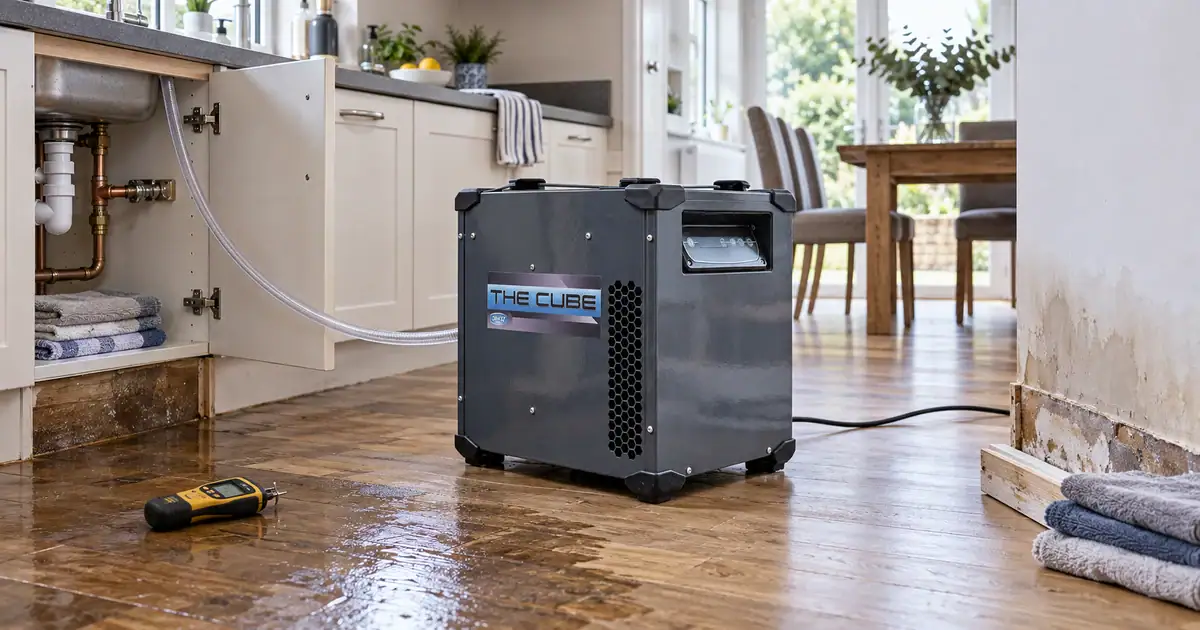
Drainage is the one part of this that changes completely upstairs. In a house you can run a hose out to a gully; in a flat or a first-floor bedroom every waste outlet sits above the machine, so you either empty a tank by hand or use a dehumidifier that pumps. Our guide to drying a flat or upstairs room after a leak covers that version of the job, and the Dri-Eaz Cube is the machine built for it, with built-in pump-out and a 6 m hose.
How Long Does Drying Take?
| Scenario | With Equipment | Without Equipment |
|---|---|---|
| Small leak (basin overflow, limited area) | 1–2 days | 5–7 days |
| Moderate leak (burst pipe, one room) | 3–5 days | 2–3 weeks |
| Serious flood (multiple rooms, soaked subfloor) | 5–10 days | 3–6 weeks |
| Ceiling leak (water in wall cavities) | 5–7 days | 3–4 weeks+ |
Variables that affect drying time: Room size, ventilation, season (winter is slower), building materials (plaster walls hold more moisture than plasterboard), and whether the underlay and subfloor were exposed.
How to Tell If the Room Is Actually Dry
Touch test. Press your hand flat against the wall at skirting board height for 10 seconds. If it feels cool or damp, the wall still holds moisture.
Dehumidifier output. Track how much water the dehumidifier collects daily. In the first 48 hours, a serious leak produces 10–15 litres per day. As drying progresses, this drops to 2–3 litres. When collection drops below 1 litre per day, the room is approaching dry.
Moisture meter (best method). A pin-type moisture meter gives an objective reading. Wood and plaster should read below 15–17% to be considered dry. Some hire companies include a meter with drying packages — ask when booking.
Smell. A musty or damp smell means moisture is still present, even if surfaces feel dry to the touch. Hidden moisture in wall cavities or under floors can produce odour before visible signs appear.
Preventing Mould After a Leak
Speed is the main defence. If you start drying within 24 hours and use proper equipment, mould is unlikely to establish. Beyond 72 hours without intervention, visible mould growth becomes increasingly likely.
Keep the dehumidifier running until readings confirm dry. Stopping early because the room “looks dry” is the most common mistake. Surfaces dry first; the moisture trapped in plaster, timber, and subfloor takes longer.
Treat any visible mould immediately. If you see dark spots forming on walls, skirting boards, or ceiling edges, apply a mould treatment spray before they spread. Small patches caught early are easy to treat. Established colonies require professional removal.
Monitor for 2 weeks after equipment removal. Check the room daily for any returning damp patches, musty smell, or condensation on windows. If moisture reappears, the drying was not complete — run the equipment again.
When to Call a Professional
Most single-room leaks from a burst pipe or appliance are manageable with hired drying equipment. But some situations need professional water damage restoration:
Contaminated water. If the flood involves sewage, grey water from a washing machine drain, or water that has been standing for more than 48 hours, the contamination risk is serious. Professional sanitisation is needed.
Structural involvement. If water has penetrated between floors, into wall cavities across multiple rooms, or affected the building structure, a restoration company can assess with thermal imaging and industrial-scale equipment.
Insurance requirement. Some insurers require a professional drying certificate before approving repairs. Check your policy before deciding whether to self-dry or hire a restoration service.
FAQ
How long does it take to dry a room after a leak?
Do I need a dehumidifier and an air mover, or just one?
Should I open or close windows when drying a room?
Will my insurance cover drying equipment hire?
How much does it cost to hire drying equipment?
Related guides: Dehumidifier comparison | How to use a carpet cleaner | End-of-tenancy cleaning equipment
If the leak has only just happened, start here instead. Read: the first 24 hours after a burst pipe.
Not sure what size you need? Call 020 3375 4048 or message us on WhatsApp — tell us the room size and how long it has been wet.

 Drone Survey & Mapping
 Drone Inspections