
 Drone Services
 Access Equipment
 Breaking & Drilling
 Cleaning Equipment
 Drying & Heating
 General Site Tools
Drying & Heating, Equipment Hire Guides
Dehumidifier vs Air Mover: What Drying Equipment Do You Actually Need?
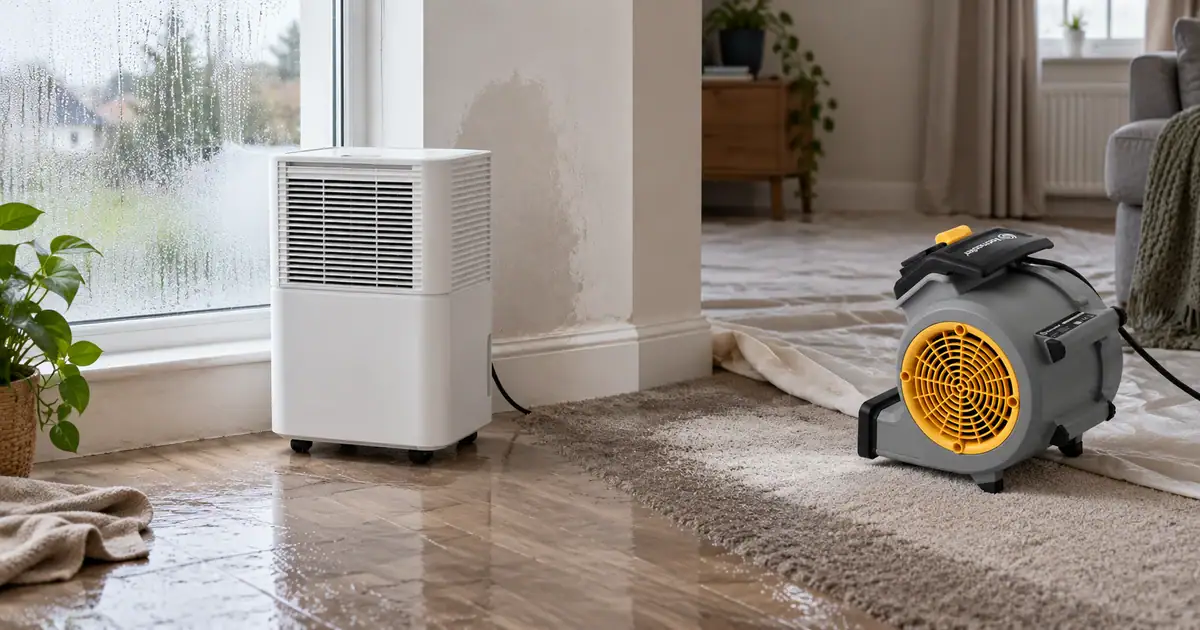
If you’ve got a wet building and need to dry it out, you’re probably weighing up whether to hire a dehumidifier, an air mover, or both. The short answer: for most serious drying work, you need both. They do different things, and one without the other usually means slower results or a job half done.
This guide covers when each machine works on its own, when you need both running together, and how to match the right setup to your specific job.
What Does Each One Actually Do?
Dehumidifiers pull moisture out of the air. They draw in damp air, extract the water, and release drier air back into the space. That’s how they bring humidity levels down and stop moisture from sitting in walls, floors and materials. Industrial hire units extract between 20 and 95 litres per day depending on capacity — far more than a domestic unit from a high-street retailer.
Air movers push high-speed airflow across wet surfaces. They don’t remove moisture from the air — they accelerate evaporation by breaking the layer of damp air that sits on top of wet floors, walls and carpets. Think of them as turbocharging the drying process at surface level, while the dehumidifier handles what’s in the air.
When a Dehumidifier Alone Is Enough
A dehumidifier on its own only makes sense for light, contained moisture problems — persistent condensation in a single room, mild damp from poor ventilation, or humidity control during redecoration. If there’s no standing water and no saturated materials, a 20L compact dehumidifier can bring a small space under control within a few days.
This is the lightest end of the drying spectrum. Anything involving actual water damage, wet building materials, or multiple rooms is a different job entirely — and that’s where air movers come in.
When Air Movers Alone Are Enough
If surfaces are wet but the air isn’t heavily moisture-laden — for example, after carpet cleaning or a light spill — air movers on their own can handle it. A high-airflow carpet dryer positioned to blow across the wet area speeds up surface drying without needing a dehumidifier running alongside.
This is the minority case. Most situations where something is properly wet — not just damp — benefit from both.
When You Need Both — and Why
Most real drying jobs need both machines working together. Here’s why: a dehumidifier on its own pulls moisture from the air, but if wet surfaces aren’t getting airflow, the evaporation that feeds the dehumidifier happens slowly. An air mover on its own pushes damp air around, but if nothing is extracting that moisture, you’re just circulating humidity.
Together, the air mover accelerates evaporation from wet surfaces and the dehumidifier catches the moisture before it settles elsewhere. That’s how professional drying works — it’s the combination that gets results.
This includes flood recovery, burst-pipe damage, construction drying after plastering or screeding, any job where the building fabric is saturated, and most insurance-related drying work.
Which Setup Fits Your Job?
| Your situation | What you likely need | Practical note |
|---|---|---|
| Leak in one room — burst pipe, radiator, contained damage | Dehumidifier + 1–2 air movers | Remove standing water first. A mid-capacity dehumidifier (38–55L) and a standard air mover will handle most single-room jobs |
| Damp wall or persistent condensation | Dehumidifier only | An air mover won’t fix a structural damp issue. A compact dehumidifier reduces ambient moisture — step up to a 38–43L unit for larger rooms |
| Carpet drying after cleaning or a spill | Air movers (light cases) or both (soaked carpet) | Surface-wet carpet dries with air movers alone. If water has reached the underlay, add a dehumidifier |
| Flood recovery — multiple rooms, saturated structure | Both — multiple units, industrial capacity | Don’t underspec. Industrial dehumidifiers (55–95L) with multiple air movers across all wet surfaces. Domestic units won’t cope |
| Plaster, paint or wet-trade drying | Both — dehumidifier essential | Fresh plaster releases heavy moisture as it cures. Dehumidifier prevents condensation elsewhere. Air movers help — but don’t blast directly at fresh plaster |
| Commercial property — offices, warehouses, multi-room | Both — scaled to the space | Treat each room or zone separately. A 95L LGR dehumidifier suits large open areas — very large spaces may need multiple units |
Leak in one room
Burst pipe, radiator, contained damage
What you need:
Dehumidifier + 1–2 air movers
Remove standing water first. A mid-capacity dehumidifier (38–55L) and a standard air mover will handle most single-room jobs
Damp wall or persistent condensation
What you need:
Dehumidifier only
An air mover won’t fix a structural damp issue. A compact dehumidifier reduces ambient moisture — step up to a 38–43L unit for larger rooms
Carpet drying after cleaning or a spill
What you need:
Air movers (light cases) or both (soaked carpet)
Surface-wet carpet dries with air movers alone. If water has reached the underlay, add a dehumidifier
Flood recovery
Multiple rooms, saturated structure
Drying Calculator
Two quick questions and we'll size the right dehumidifier — and tell you how long to hire it.
What you need:
Both — multiple units, industrial capacity
Don’t underspec. Industrial dehumidifiers (55–95L) with multiple air movers across all wet surfaces. Domestic units won’t cope
Plaster, paint or wet-trade drying
What you need:
Both — dehumidifier essential
Fresh plaster releases heavy moisture as it cures. Dehumidifier prevents condensation elsewhere. Air movers help — but don’t blast directly at fresh plaster
Commercial property
Offices, warehouses, multi-room
What you need:
Both — scaled to the space
Treat each room or zone separately. A 95L LGR dehumidifier suits large open areas — very large spaces may need multiple units
Setting Up for Effective Drying
Position the dehumidifier centrally in the wettest area. Point air movers across wet surfaces — floors, walls, carpets — so the airflow breaks the moisture layer and feeds damp air toward the dehumidifier.
As a general rule, professional drying uses roughly one dehumidifier for every two to four air movers, depending on room size and how saturated the materials are. For a single room after a burst pipe, one dehumidifier and one or two air movers is usually enough. For a multi-room flood, you’ll need more of each — if you’re not sure how many, call us and we’ll help you work out the right setup.
Keep windows and doors closed while the equipment is running. Dehumidifiers work by recirculating indoor air — opening windows lets in more moisture from outside and slows the whole process down.
Hireload’s drying equipment runs on standard 240V domestic sockets — no site transformer or special wiring needed for most setups. Check the product page for the specific unit you’re hiring to confirm power requirements.
How to Avoid Hiring the Wrong Size
The main number to look at for dehumidifiers is extraction rate — how many litres of water it pulls from the air per day. For a single damp room, a 20L unit is usually enough. For active water damage or wet-trade drying, a 55L unit is the workhorse most hire customers need. For large or severely affected spaces, a 95L LGR gives you the highest extraction rate in the range — though very large multi-room jobs may still need more than one unit.
For air movers, the key figure is CFM — how much air the unit moves per minute. A standard air mover handles most single-room and mid-size jobs. For bigger floor areas or heavy carpet drying, a higher-output unit covers more ground.
If you’re not sure which capacity suits your job, each product page includes full specs and job-fit guidance.
What each costs to hire
The two do different jobs, and they are priced differently too. Rates are ex-VAT and match each product page.
| Machine | 1 day | 2 days | Up to a week | Longer |
|---|---|---|---|---|
| 19L compact — one room, standard plug | £19.99 | £24.99 | £34.99 | £4.50/day |
| 38L commercial — a flat or a floor | £29.99 | £44.99 | £59.99 | £8.40/day |
| 43L Dri-Eaz Cube — stacks in tight spaces | £39.99 | £59.99 | £74.99 | £11.20/day |
| 63L LGR — cold rooms, heavy saturation | £59.99 | £89.99 | £119.99 | £16.80/day |
| Air mover — per unit | £19.99 | £24.99 | £29.99 | £4.80/day |
Prices are ex-VAT and match each product page. A refundable deposit applies and comes back in full when the equipment returns undamaged. Delivery is £35 + VAT next working day, £59 before 11am, £69 same day, or collect free from Greenford UB6.
A worked example. The standard one-room recovery setup — one 38L dehumidifier and two air movers for up to a week — is £119.97 + VAT. The air movers are the cheap half of that and the half that decides how fast it dries.
FAQ
Can I dry a room with just a dehumidifier?
For mild damp or condensation, yes. For anything involving actual water damage — a leak, flood, or burst pipe — a dehumidifier alone is too slow. Adding air movers cuts drying time significantly.
How many air movers do I need per dehumidifier?
As a rough guide, two to four air movers per dehumidifier for most jobs. It depends on room size and how wet the materials are. For a single room, one of each is usually enough to start.
How long does it take to dry out a flooded room?
It varies. Light damp may improve within a few days. A properly flooded room with saturated walls and floors can take one to two weeks of continuous running with the right equipment. Skimping on equipment to save on hire costs usually means longer drying times and a higher risk of mould.
Do I need industrial equipment or will a domestic dehumidifier do?
For anything beyond mild condensation, industrial hire equipment is worth it. A domestic dehumidifier from a retailer extracts 10–12 litres per day at best. An industrial unit extracts 55–95 litres per day. That’s the difference between drying a flooded room in days versus weeks.
What power supply do I need?
Most of our drying equipment runs on standard 240V domestic sockets. No transformer or generator needed for typical setups. Check the product page for the unit you’re hiring to confirm.
Related guides
The pairing that dries a room fastest. Read: running a dehumidifier alongside two air movers.
Need Drying Equipment for a Leak, Flood, or Damp Property?
Browse our full range of dehumidifiers and air movers, or call us if you need help matching the right setup to your job. We deliver drying equipment across London.

 Drone Survey & Mapping
 Drone Inspections