
 Drone Services
 Access Equipment
 Breaking & Drilling
 Cleaning Equipment
 Drying & Heating
 General Site Tools
Equipment Hire Guides
How to Clean Your Driveway — Pressure Washer, Chemicals, or Both?
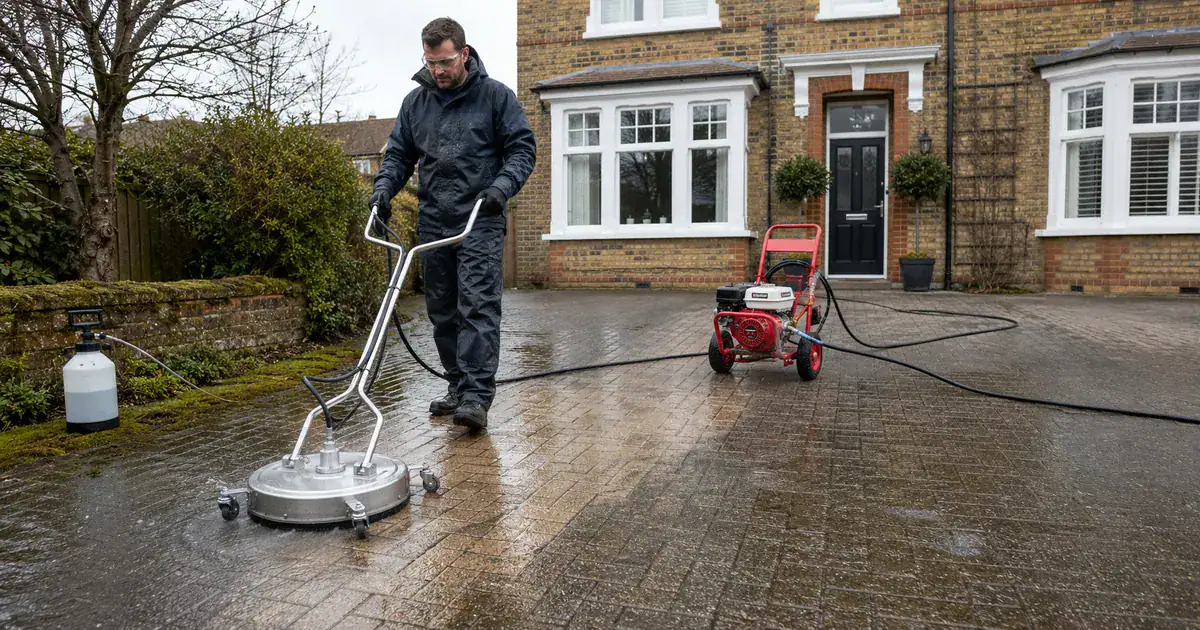
Three Methods — Pressure Washer, Chemicals, or Both
Pressure washing only: Removes surface dirt, moss, algae, and loose contamination quickly. Results are immediate and satisfying. However, biological growth returns faster because the root system is still in the surface pores.
Chemical treatment only: Moss killers and algae treatments kill biological growth at the source. The driveway gradually improves over 2-4 weeks as dead growth breaks down and washes away in rain. Slower but longer-lasting. No equipment needed.
Pre-treatment + pressure washing (recommended): Apply chemical treatment 24-48 hours before pressure washing. The treatment kills and loosens biological growth, then the pressure washer removes it completely. This delivers the best immediate result AND the longest-lasting clean because the root system has been killed before removal.
Surface-by-Surface Guide
Block paving
PSI: 2,000-2,500 with green (25) nozzle or rotary surface cleaner
Pre-treatment: Moss/algae killer into the joints 24 hours before
After care: Re-sand joints with kiln-dried sand, compact, consider polymeric sand for longer-lasting joint fill
Concrete driveways
PSI: 2,000-3,000 with green (25) nozzle
Pre-treatment: Degreaser for oil stains, moss killer for biological growth
After care: Optional concrete sealant for long-term protection
Concrete is the most forgiving driveway surface for pressure washing. It handles high pressure well and responds to both chemical and mechanical cleaning. Old, stained concrete often looks dramatically better after a single clean.
Tarmac / asphalt
PSI: 1,500-2,000 — lower than concrete
Pre-treatment: Moss killer only — avoid harsh degreasers which can soften tarmac
After care: Tarmac restorer product if the surface looks faded after cleaning
Gravel driveways
PSI: Not suitable for pressure washing
Method: Rake to redistribute gravel, hand-weed, apply weed killer to problem areas
Resin-bound driveways
PSI: 1,500-1,800 maximum with wide (40) nozzle
Pre-treatment: Gentle moss killer, no acidic products
After care: Resin-safe sealant if recommended by the installer
The Best Approach — Pre-Treat Then Pressure Wash
Day 1 — Apply treatment: Apply moss/algae killer to all affected areas. Concentrate on joints, edges, and shaded patches where biological growth is heaviest. Apply degreaser to any oil stains. Leave to soak according to product instructions. Do not pressure wash yet — the chemicals need time to penetrate and kill root systems.
Day 2 — Pressure wash: Connect the pressure washer to water and power. Start at the highest point of the driveway and work downhill so dirty water flows away from cleaned areas. Use a 25-degree green nozzle for direct lancing, or a rotary surface cleaner for even coverage. Maintain 20-30cm distance from the surface. Work in straight, overlapping passes.
Day 3+ — After care (optional): Allow the driveway to dry completely (1-2 dry days minimum). Re-sand block paving joints if sand has been displaced. Apply sealant if desired (concrete, natural stone, or resin surfaces).
Dealing with Oil Stains
Oil is the most stubborn driveway contamination. It penetrates porous surfaces and resists water-only cleaning.
Fresh oil (less than 24 hours): Absorb as much as possible with cat litter, sawdust, or paper towels. Then apply a degreasing solution and leave for 30 minutes before pressure washing at 2,500+ PSI.
Old oil (set-in): Apply a specialist driveway degreaser. Leave for the recommended time (usually 30-60 minutes). Agitate with a stiff brush. Then pressure wash at maximum available PSI. Stubborn stains may need 2-3 treatment cycles.
Very old, deep oil stains: These may never fully remove from porous concrete or stone. Multiple degreaser applications and pressure washes will fade them significantly, but complete removal from absorbent surfaces is often not achievable without resurfacing.
Degreaser + 2,500 PSI: Breaks down the oil chemically before pressure washing removes it. Noticeably better result, especially on porous surfaces.
After Cleaning — Protection and Maintenance
Re-sand block paving joints within 48 hours of cleaning. Open joints allow weed regrowth and water penetration that undermines the sub-base. Polymeric sand hardens after wetting and resists washout better than standard kiln-dried sand.
Consider sealing. An impregnating sealant on concrete or natural stone reduces water absorption, slows algae regrowth, and makes future cleaning easier. Apply only to a completely dry surface — typically 2-3 dry days after cleaning.
Ongoing maintenance. A quick sweep and weed check monthly prevents the heavy buildup that requires a full pressure wash. Spot-treat moss and algae as they appear rather than waiting for annual cleaning.
| Driveway Type | Recommended Method | PSI Range | Pre-Treatment |
|---|---|---|---|
| Block paving | Pre-treat + pressure wash | 2,000-2,500 | Moss killer in joints |
| Concrete | Pressure wash (+ degreaser if oily) | 2,000-3,000 | Degreaser for oil, moss killer for bio |
| Tarmac | Pre-treat + gentle pressure wash | 1,500-2,000 | Moss killer only |
| Resin-bound | Gentle pressure wash | 1,500-1,800 | Gentle moss killer |
| Gravel | Manual — rake and weed | N/A | Weed killer only |
| Natural stone | Pre-treat + pressure wash | 1,500-2,000 | Moss killer, test first |
What it costs to hire the machine
Driveways need more pressure than patios and take longer, so the week rate usually beats the day rate. These are our own rates, ex-VAT, matching each product page.
| Machine | 1 day | 2 days | Up to a week | Longer |
|---|---|---|---|---|
| Karcher HD 5/11 — 110 bar, mains 230V; patios, paving, property maintenance | £24.99 | £29.99 | £39.99 | £6.90/day |
| 240V electric washer — patios and driveways, mains powered | £29.99 | £34.99 | £49.99 | £8.99/day |
| KEW commercial cold water — Danish trade pump, 240V socket | £39.99 | £69.99 | £99.99 | £13.99/day |
| Petrol 2450 PSI — no mains needed, heaviest work | £62.39 | £89.99 | £119.99 | £16.80/day |
| Surface cleaner attachment — flat discs, no stripes | £19.99 | £29.99 | £49.99 | £7.00/day |
Prices are ex-VAT and match each product page. A refundable deposit applies and comes back in full when the equipment returns undamaged. Delivery is £35 + VAT next working day, £59 before 11am or £69 same day, or collect free from our Greenford UB6 depot. A heavy-duty 240V trade washer is also available from £59.99 + VAT a day if you need more flow than the machines above.
A worked example. A two-car block-paved driveway over a weekend: the 240V electric washer at £34.99 for two days plus the surface cleaner at £29.99 comes to £64.98 + VAT. On oil-stained concrete, step up to the petrol 2,450 PSI machine at £62.39 a day.
FAQ
How often should I clean my driveway?
Can I clean my driveway without a pressure washer?
Will pressure washing damage my driveway?
What’s the best time of year to clean a driveway?
Related guides: What PSI do I need? | How to pressure wash a patio | Can you pressure wash decking? | 5 pressure washing mistakes

 Drone Survey & Mapping
 Drone Inspections