
 Drone Services
 Access Equipment
 Breaking & Drilling
 Cleaning Equipment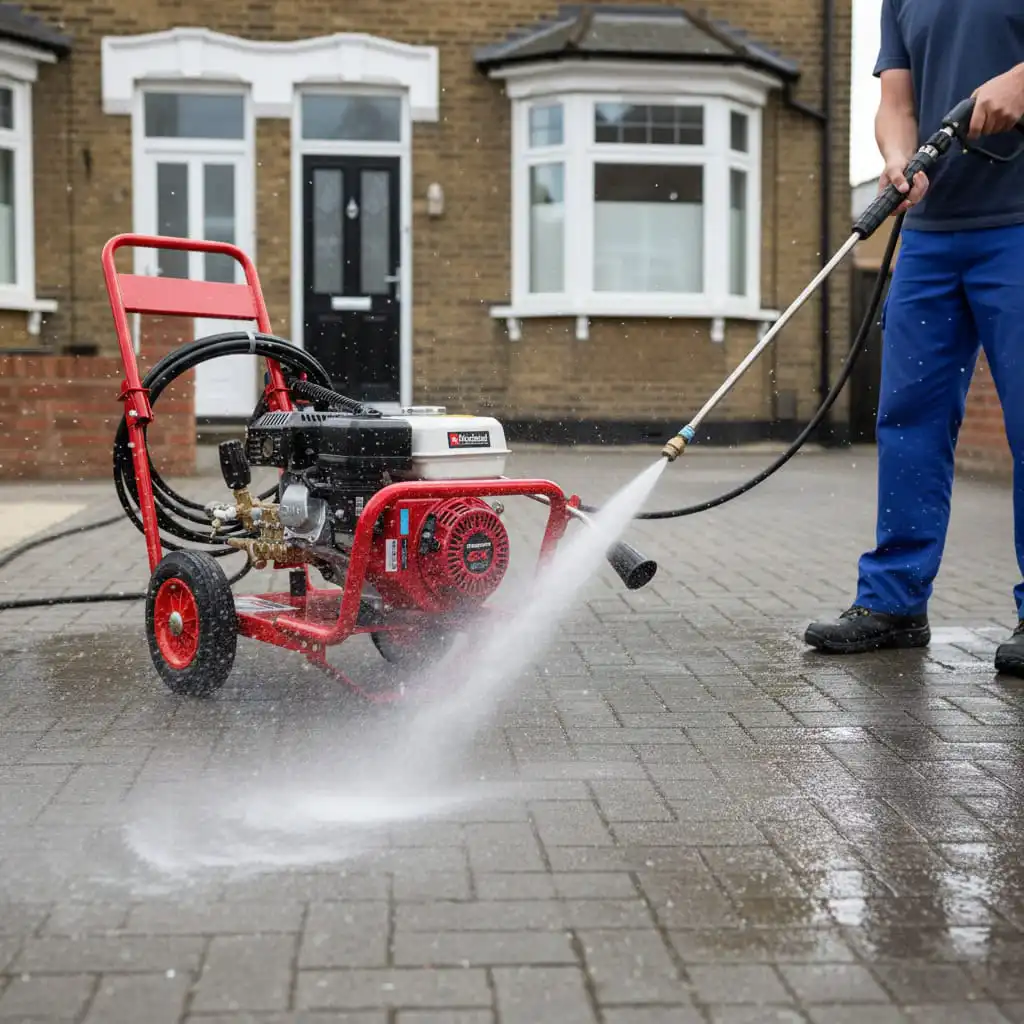
 Drying & Heating
 General Site Tools
Equipment Hire Guides
How to Pressure Wash a Patio Without Damaging It
Before You Start — Check Your Patio
Not every patio can be pressure washed the same way. Five minutes of inspection saves hours of damage repair.
Identify your stone type. Natural sandstone and limestone are significantly softer than porcelain or concrete. The same pressure setting that gives a porcelain patio a perfect clean will permanently scar a sandstone one.
Check the pointing. Run a finger along the mortar joints between slabs. If pointing is crumbling, loose, or missing in places, pressure washing will blast out more of it. Repoint damaged areas before cleaning, or accept that you’ll need to repoint afterward.
Check for cracks and lifting. Water forced under a cracked or lifted slab accelerates the damage. Note any problem areas and clean around them carefully, or fix the slab position first.
Choose the Right PSI and Nozzle
| Stone Type | PSI Range | Best Nozzle | Notes |
|---|---|---|---|
| Indian sandstone | 1,500-1,800 | Green (25) or white (40) | Very easily etched — test first |
| Limestone / York stone | 1,500-1,800 | Green (25) or white (40) | Soft stone, same caution as sandstone |
| Porcelain | 1,800-2,200 | Green (25) | Hard surface, handles pressure well |
| Concrete pavers | 1,800-2,200 | Green (25) | Durable, standard cleaning |
| Slate | 1,500-2,000 | Green (25) | Layered structure can flake at high pressure |
| Granite | 2,000-2,500 | Green (25) | Very hard, tolerates high pressure |
The Step-by-Step Cleaning Method
Step 1 — Clear the patio. Move furniture, pots, and anything that will get in the way. Sweep off loose leaves and debris.
Step 2 — Pre-treat if needed. For heavy moss, algae, or lichen, apply a patio cleaner or diluted bleach solution 15-30 minutes before pressure washing. This loosens biological growth so the pressure washer can remove it in fewer passes.
Step 3 — Connect and test. Connect the pressure washer to your water supply and power source. Before starting on the main patio, test on an inconspicuous slab — a corner, the edge behind a planter. Check that the pressure isn’t marking the stone.
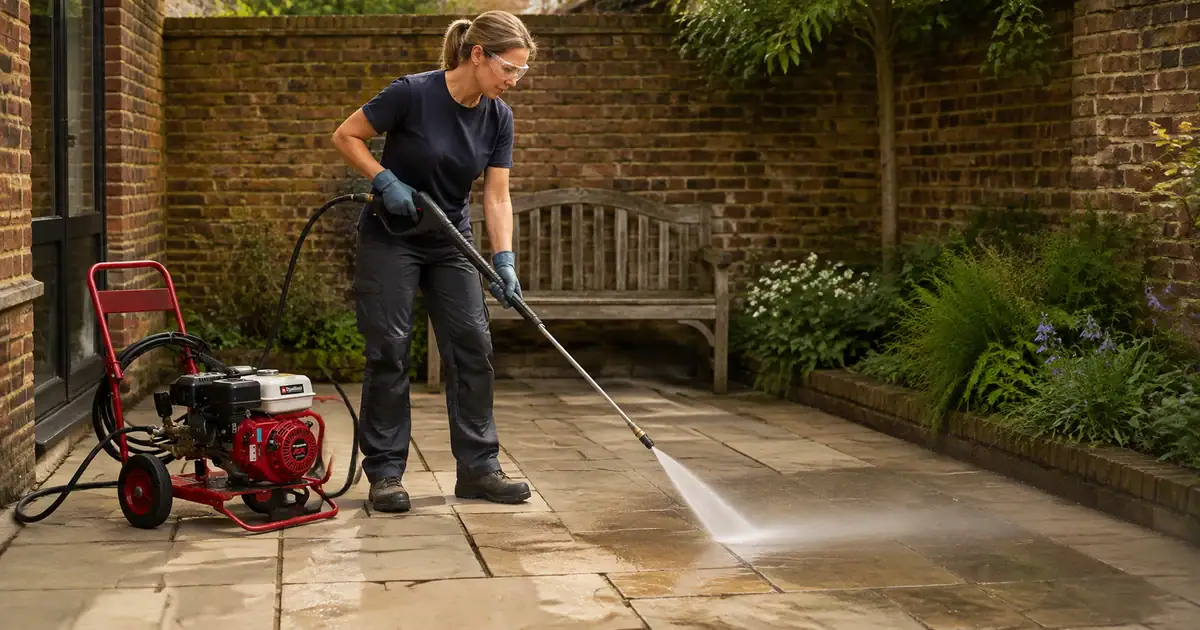
Step 4 — Clean in sections. Work in straight lines, one section at a time. Keep the lance 20-30cm from the surface. Overlap each pass by 10cm. Move at a steady pace — not so fast that dirt remains, not so slow that you dwell on one spot.
Step 5 — Work toward drainage. Point your passes so dirty water flows toward the garden, drain, or edge — not back across cleaned areas.
Step 6 — Rinse. After the main clean, do a final rinse pass at lower pressure to remove any remaining dirty water or detergent residue.
Dealing with Stubborn Stains
Oil stains: Apply a degreasing spray directly to the stain. Leave for 10-15 minutes, then pressure wash at medium-high pressure. Multiple treatments may be needed for old oil.
Moss and algae (heavy): Pre-treat with a moss killer 24 hours before cleaning for best results. Pressure washing alone removes surface growth but the roots may regrow within weeks without pre-treatment.
Rust stains: These come from metal furniture legs or fertiliser. Standard pressure washing won’t remove them — you need a specialist rust remover applied directly to the stain.
Black spots (lichen): The small black spots common on sandstone patios are notoriously difficult. A specialist black spot remover applied 24-48 hours before cleaning softens them enough for the pressure washer to lift.
After Cleaning — Sealing and Maintenance
Allow the patio to dry completely before considering any sealant. This typically takes 2-3 dry days. Sealing a damp patio traps moisture and causes white haze or peeling.
Consider sealing. A quality impregnating sealant reduces water absorption and makes future cleaning easier. It doesn’t change the appearance of the stone. Reapply every 3-5 years.
Re-sand joints if needed. If polymeric jointing sand has been displaced during cleaning, brush kiln-dried sand into the joints while the patio is dry, then compact lightly.
What it costs to hire the machine
A patio does not need the biggest washer on the shelf — it needs the right pressure and a surface cleaner. These are our own rates, ex-VAT, matching each product page.
| Machine | 1 day | 2 days | Up to a week | Longer |
|---|---|---|---|---|
| Karcher HD 5/11 — 110 bar, mains 230V; patios, paving, property maintenance | £24.99 | £29.99 | £39.99 | £6.90/day |
| 240V electric washer — patios and driveways, mains powered | £29.99 | £34.99 | £49.99 | £8.99/day |
| KEW commercial cold water — Danish trade pump, 240V socket | £39.99 | £69.99 | £99.99 | £13.99/day |
| Petrol 2450 PSI — no mains needed, heaviest work | £62.39 | £89.99 | £119.99 | £16.80/day |
| Surface cleaner attachment — flat discs, no stripes | £19.99 | £29.99 | £49.99 | £7.00/day |
Prices are ex-VAT and match each product page. A refundable deposit applies and comes back in full when the equipment returns undamaged. Delivery is £35 + VAT next working day, £59 before 11am or £69 same day, or collect free from our Greenford UB6 depot. A heavy-duty 240V trade washer is also available from £59.99 + VAT a day if you need more flow than the machines above.
A worked example. A typical London back garden patio, one weekend: the Karcher HD 5/11 at £29.99 for two days plus the surface cleaner at £29.99 for two to three days comes to £59.98 + VAT — and the surface cleaner is what keeps the finished slabs even instead of striped.
Will a pressure washer damage my patio?
How often should I pressure wash my patio?
Do I need detergent or just water?
What’s the best pressure washer to hire for patio cleaning?
Related guides: What PSI do I need? | How to clean a driveway | Can you pressure wash decking? | 5 pressure washing mistakes

 Drone Survey & Mapping
 Drone Inspections