
 Drone Services
 Access Equipment
 Breaking & Drilling
 Cleaning Equipment
 Drying & Heating
 General Site Tools
Equipment Hire Guides
5 Pressure Washing Mistakes That Damage Surfaces (And How to Avoid Them)
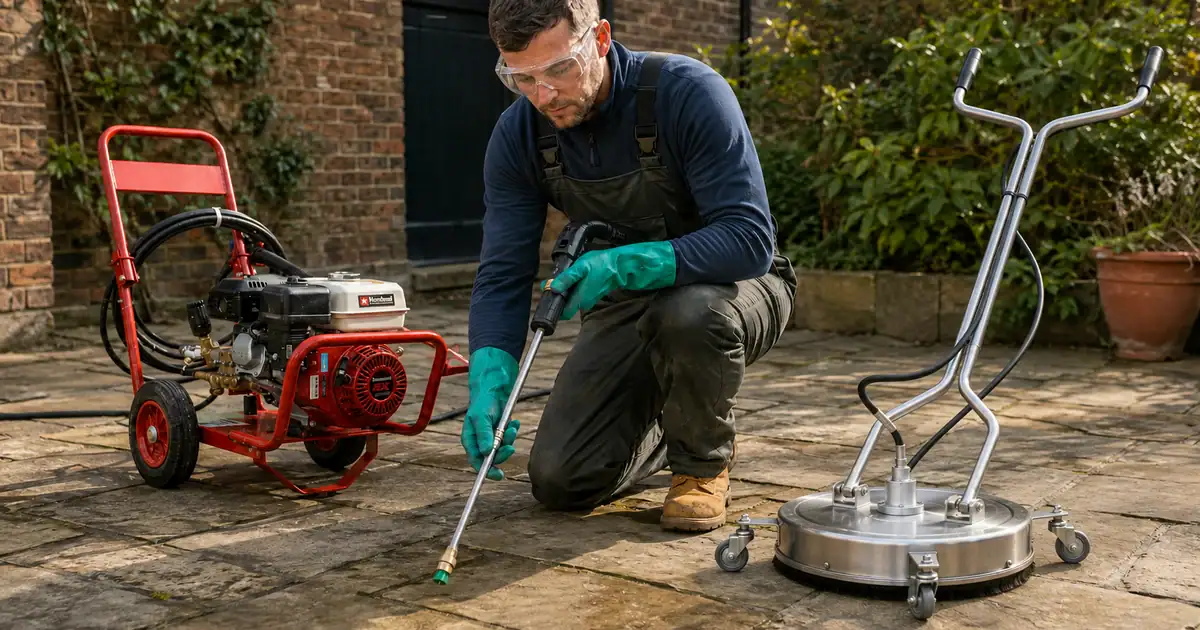
Too Much Pressure on Soft Stone
What happens: Indian sandstone, limestone, and York stone are softer than they look. Anything above 2,000 PSI on these surfaces etches visible marks into the stone — lines, gouges, and surface roughening that only professional resanding will fix.
How to avoid it: Stay between 1,500-1,800 PSI for natural stone. For a full PSI guide by surface type, see our PSI selection guide. Use a 25-degree (green) or 40-degree (white) nozzle. Test an inconspicuous area first — a corner slab, the edge behind a planter. If the surface looks rougher after a test pass, reduce the pressure.
Using the Wrong Nozzle
What happens: The zero-degree (red) nozzle focuses all the machine’s pressure into a pencil-width jet. On any flat surface — stone, wood, render, tarmac — this creates visible lines and cuts into the material. It’s designed for extremely targeted work (stripping paint from metal, clearing blocked drain holes), not surface cleaning.
How to avoid it: Use the 25-degree (green) nozzle for general cleaning. It spreads pressure across a wider fan, giving even cleaning without the concentrated damage. Save the red nozzle for specific stubborn spots only, and always keep it moving — never hold it in one place.
Holding the Lance Too Close
What happens: At 10cm distance, even a moderate PSI setting becomes destructive. Water impact force increases dramatically as distance decreases. Close-range lancing etches concrete, splits wood grain, cuts into render, and strips paint.
How to avoid it: Maintain 20-30cm between the nozzle and the surface. This gives enough impact to clean effectively while spreading the force enough to avoid damage. If you’re not getting results at this distance, increase PSI slightly rather than moving closer.
Pressure Washing Damaged Pointing
What happens: The mortar joints between bricks, pavers, and slabs are often softer and more crumbly than the surrounding surface — especially in older properties. Pressure washing blasts loose mortar out of the joints, creating gaps that allow water infiltration, weed growth, and further structural movement.
How to avoid it: Before starting, check the pointing condition by running a finger along several joints. If mortar crumbles or falls out easily, the pointing is already failing. Either repoint before cleaning, or reduce pressure to the minimum that still cleans the surface and avoid directing the jet along joint lines.
After cleaning: If some pointing has been displaced, repoint the affected areas within a week. Open joints deteriorate quickly once exposed to weather and foot traffic.
Pressure Washing Timber Without Adjusting Settings
What happens: Wood fibres absorb water and swell. High pressure forces water deep into the grain, raising fibres, creating splinters, and leaving the surface rough and uneven. Soft woods (pine, spruce) are particularly vulnerable. The result is decking or fencing that looks and feels worse than before cleaning.
How to avoid it:
– Maximum 1,200-1,500 PSI on timber
– Use a 40-degree (white) nozzle — the widest angle available
– Maintain 30cm+ distance
– Follow the grain direction — never go across the grain
– Single pass only — repeated passes over the same area compound the damage
After understanding this: 1,200 PSI, white nozzle, 30cm distance, one pass following the grain — clean surface, no damage.
A Quick Safety Note
Beyond surface damage, pressure washers can cause serious injury to people. Never point the lance at anyone, keep feet clear of the spray path, wear closed-toe shoes, and be aware that the recoil force when you first pull the trigger can jerk the lance unexpectedly. Safety glasses are worth wearing, particularly when cleaning at close range where debris can ricochet.
What it costs to hire the right machine
Most of the mistakes above come from using the wrong machine rather than using it wrongly. These are our own rates, ex-VAT, matching each product page.
| Machine | 1 day | 2 days | Up to a week | Longer |
|---|---|---|---|---|
| Karcher HD 5/11 — 110 bar, mains 230V; patios, paving, property maintenance | £24.99 | £29.99 | £39.99 | £6.90/day |
| 240V electric washer — patios and driveways, mains powered | £29.99 | £34.99 | £49.99 | £8.99/day |
| KEW commercial cold water — Danish trade pump, 240V socket | £39.99 | £69.99 | £99.99 | £13.99/day |
| Petrol 2450 PSI — no mains needed, heaviest work | £62.39 | £89.99 | £119.99 | £16.80/day |
| Surface cleaner attachment — flat discs, no stripes | £19.99 | £29.99 | £49.99 | £7.00/day |
Prices are ex-VAT and match each product page. A refundable deposit applies and comes back in full when the equipment returns undamaged. Delivery is £35 + VAT next working day, £59 before 11am or £69 same day, or collect free from our Greenford UB6 depot. A heavy-duty 240V trade washer is also available from £59.99 + VAT a day if you need more flow than the machines above.
The commonest false economy is skipping the surface cleaner at £19.99 + VAT a day. Lance striping is the single most visible mistake on a finished patio or driveway, and it is the one attachment that prevents it.
FAQ
Can a pressure washer crack concrete?
Will a pressure washer damage car paint?
What should I do if I’ve already damaged a surface?
Related guides: How to pressure wash a patio | How to clean a driveway | What PSI do I need?
If you are weighing up a one-off job against owning one. Read: hiring versus buying a pressure washer.

 Drone Survey & Mapping
 Drone Inspections