
 Drone Services
 Access Equipment
 Breaking & Drilling
 Cleaning Equipment
 Drying & Heating
 General Site Tools
Equipment Hire Guides
How to Clean a Warehouse Floor — Equipment, Schedule & Method
Why Warehouse Floor Cleaning Matters More Than You Think
A dirty warehouse floor isn’t just an appearance problem. It’s a health and safety liability, an insurance risk, and — if you’re audited — potentially a compliance failure.
Slip and trip risk. Dust, oil, and moisture on concrete create slip hazards. The HSE reports that slips and trips account for over 30% of workplace injuries. A visibly clean, dry floor is the simplest risk reduction available.
Forklift and equipment safety. Loose debris, spilled liquids, and dust buildup reduce traction for forklifts and pallet trucks. On polished concrete, this becomes dangerous quickly.
Audit and compliance. Food storage, pharmaceutical, and regulated warehouses require documented cleaning schedules. Even general warehouses face scrutiny during insurance assessments and landlord inspections.
Equipment You Actually Need
For daily maintenance (small-medium warehouse, under 500m2): Industrial push sweeper or wet & dry vacuum, spot mop for spills. 15-20 minutes per day.
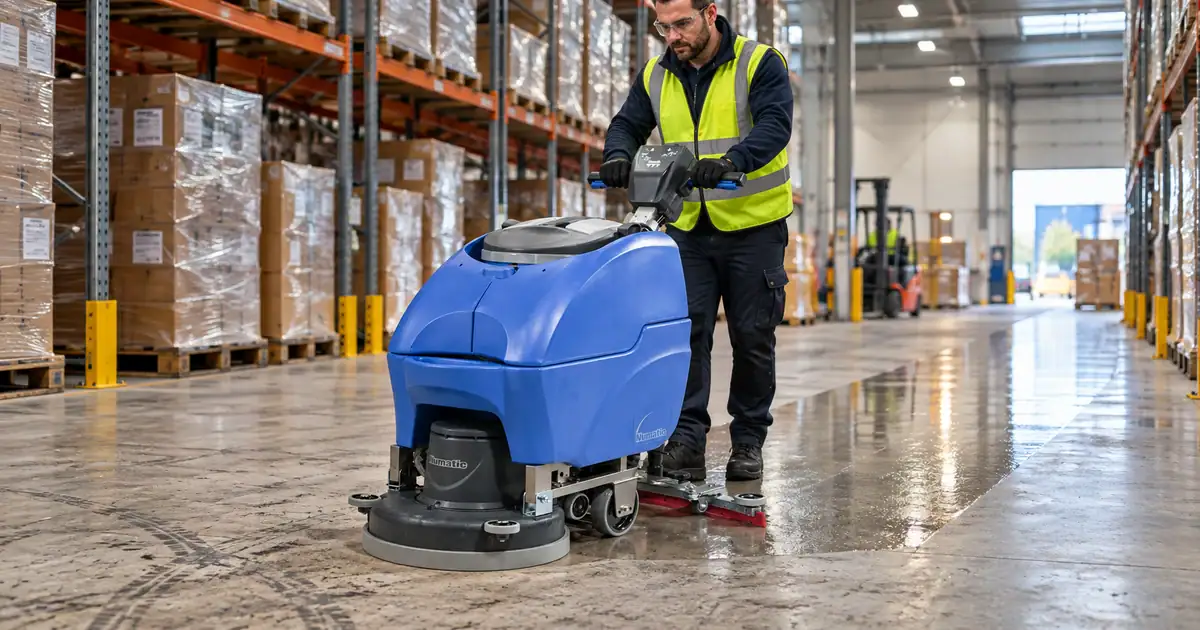
For weekly thorough cleaning: Walk-behind floor scrubber (rotary type), general-purpose or degreasing floor solution. 1-2 hours for a typical 500-1,000m2 warehouse.
For quarterly or annual deep cleans: Industrial floor scrubber with aggressive brush, degreasing solution (stronger concentration), wet & dry vacuum for edge detail and drainage areas. 4-8 hours depending on floor condition and size.
Cleaning Frequency — Daily, Weekly, and Deep Clean
Daily (10-20 minutes)
Sweep or vacuum high-traffic zones and loading areas. Spot-clean any spills immediately (especially oil, coolant, or food). Check and clear drainage areas.
Weekly (1-2 hours)
Full floor scrub with a walk-behind scrubber. Degreasing solution on loading bays and forklift routes. Mop or vacuum edges and areas the scrubber can’t reach. Empty and rinse the scrubber’s recovery tank.
Quarterly deep clean (half day to full day)
Full scrub with stronger degreasing solution. Attention to expansion joints and floor drains. Check for damaged floor coating and mark for repair. Clean racking base areas (usually skipped in weekly cleans).
The Step-by-Step Method
This applies to a weekly clean using a walk-behind floor scrubber.
Step 1 — Clear and sweep. Remove pallets, loose items, and packaging from the floor area. Sweep or vacuum loose debris. Scrubbers handle dust and light grit, but bolts, cable ties, and packaging tape jam the brush and block the squeegee.
Step 2 — Mix cleaning solution. Fill the scrubber’s clean water tank with warm water and add floor cleaning solution at the correct dilution ratio. For general maintenance, a neutral detergent at 1:50 is usually sufficient. For greasy areas, use a degreasing solution at 1:20 to 1:30.
Step 3 — Scrub in straight, overlapping passes. Start at the far end of the warehouse and work toward the exit. Walk at a steady, moderate pace. Overlap each pass by 10cm.
Step 4 — Handle edges separately. Most walk-behind scrubbers can’t reach the last 5-10cm against walls, racking, and columns. Mop these areas or use a wet & dry vacuum after the main scrub.
Step 5 — Check the result. Walk the floor after scrubbing. Any areas that still show staining may need a second pass with stronger solution, or manual treatment with a scrubbing brush and degreaser.
Step 6 — Clean the machine. Empty the recovery tank, rinse both tanks, remove and rinse the squeegee blade, and leave the tank open to air-dry.
Floor Type Considerations
Sealed concrete (most common)
The standard warehouse floor. Tolerates all cleaning methods and solutions. Use medium brush pressure and standard degreasing solution.
Polished concrete
Increasingly common in modern warehouses and showrooms. Use a soft pad or fine-grit brush rather than an aggressive scrubbing brush. A neutral pH solution protects the surface finish.
Resin-coated floors (epoxy, polyurethane)
Common in food, pharmaceutical, and clean-room environments. Use soft brushes only — stiff bristles scratch the coating. Non-abrasive, pH-neutral solution only.
Uncoated concrete
Older warehouses with unsealed concrete absorb liquid. Floor scrubbing still works but expect more solution consumption and slightly longer drying times.
Common Mistakes
| Warehouse Size | Best Equipment | Cleaning Time | Frequency |
|---|---|---|---|
| Under 200m2 | Wet & dry vacuum + mop | 30-60 mins | Weekly |
| 200-500m2 | Walk-behind floor scrubber | 1-2 hours | Weekly |
| 500-1,000m2 | Walk-behind scrubber + vacuum for edges | 2-3 hours | Weekly |
| 1,000m2+ | Large walk-behind or ride-on scrubber | 3-5 hours | Weekly + daily sweeping |
| Loading bay / vehicle area | Scrubber + degreasing solution | 1-2 hours | 2x weekly |
Scrubbing without sweeping first. Loose debris clogs the squeegee and scratches the floor. Five minutes of sweeping before scrubbing prevents both problems.
Using too much detergent. Excess solution leaves a sticky residue that attracts dirt faster. Follow dilution ratios — more soap is not more clean.
Ignoring expansion joints. The gaps between concrete slabs collect dirt, water, and debris. Use a stiff brush or vacuum nozzle to clean joints during deep cleans.
Never cleaning the scrubber itself. A recovery tank full of yesterday’s dirty water breeds bacteria and smells. Five minutes of cleanup after each use keeps the machine effective.
What the machines cost to hire
Warehouse floor cleaning is priced by how long the job runs, not by floor area — and past a week the daily rate drops sharply, which is why a monthly hire often costs less than four separate weekly ones. These are our own rates, ex-VAT.
| Machine | 1 day | 2 days | Up to a week | Longer |
|---|---|---|---|---|
| Rotary floor scrubber / polisher — scrub, strip and polish, mains powered | £44.99 | £64.99 | £84.99 | £10.99/day |
| Scrubber dryer — washes and dries in one pass, floor walkable straight away | £99.99 | £149.99 | £199.99 | £17.99/day |
| Wet & dry vacuum — spills, grit and post-clean pickup | £24.99 | £32.99 | £44.99 | £7.00/day |
Prices are ex-VAT and match each product page. A refundable deposit applies and comes back in full when the equipment returns undamaged. Longer commercial hires drop again — the scrubber dryer is £319.99 + VAT for up to 14 days and £499.99 for up to 28 days. Delivery is £35 + VAT next working day, or collect free from Greenford UB6.
A worked example. A 1,000 m² unit needing a quarterly deep clean over two days: the scrubber dryer at £149.99 + VAT, floor walkable behind the machine so the unit keeps operating. For a rolling contract-clean, the 28-day rate of £499.99 works out at under £18 a day.
How often should I clean a warehouse floor?
Can I just use a pressure washer on a warehouse floor?
What cleaning solution should I use?
How long does it take to scrub a warehouse floor?
Do I need a ride-on scrubber or a walk-behind?
Related guides: How to use a floor scrubber | Walk-behind vs ride-on | Floor scrubber hire costs | Post-construction cleaning

 Drone Survey & Mapping
 Drone Inspections