
 Drone Services
 Access Equipment
 Breaking & Drilling
 Cleaning Equipment
 Drying & Heating
 General Site Tools
Equipment Hire Guides, Scaffold Towers
Scaffold Tower Safety & Compliance: What Hirers Need to Know
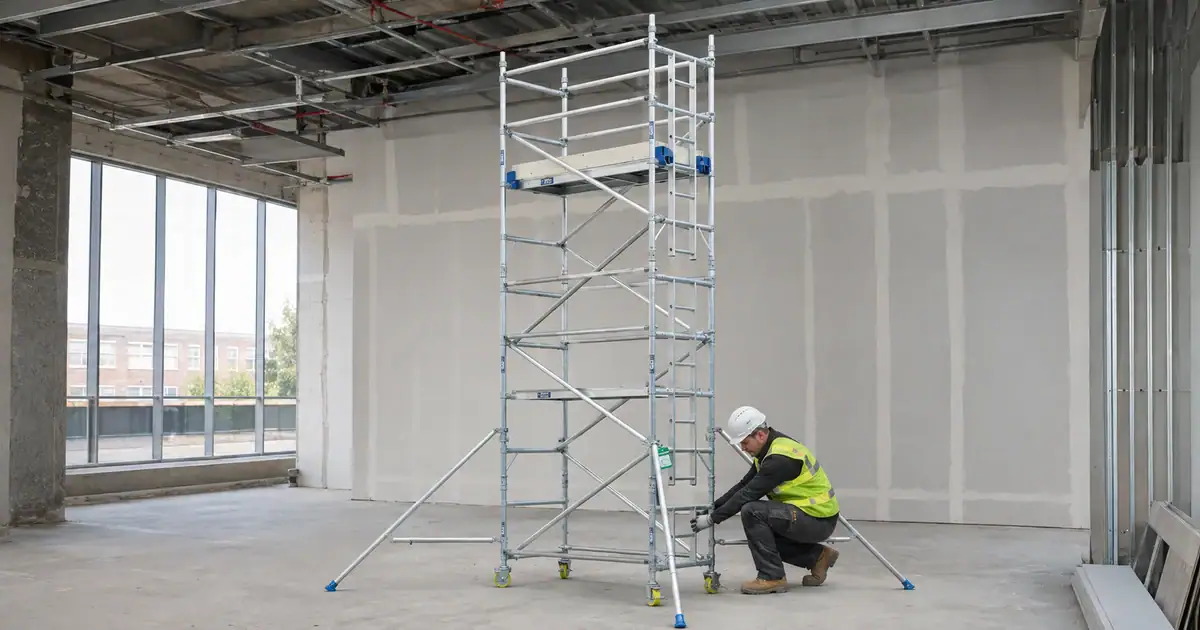
Safe is not a feeling — it is a standard, a law, an inspection routine and a complete kit. This page explains all four in plain English, and exactly where the responsibility sits when you hire a tower from us.
The product standard: BS EN 1004-1:2020
BS EN 1004-1:2020 is the current British and European standard for mobile access towers built from prefabricated elements. It sets the requirements a tower must meet: guardrails, bracing, stabilisers, platform decks, access, and the loads the structure must carry. It replaced the older EN 1004:2004, which has been withdrawn.
The standard covers towers with platform heights up to 12m used indoors and up to 8m used outdoors. That is why serious hire and safety guidance treats 8m platform height as the outdoor ceiling for freestanding towers — it is not a preference, it is the scope of the standard itself.
Every industrial tower we hire out is an EN 1004-1:2020 tower supplied as a complete kit. A tower can only meet the standard when every required component is present — which is why we publish the exact component schedule for every height on each product page, and why your delivery is checked against it.
The law: Work at Height Regulations 2005
If the tower is used for work, the Work at Height Regulations 2005 apply. They require work at height to be properly planned, appropriately supervised and carried out by competent people, using equipment that is suitable for the task and properly inspected. The duty sits with employers, the self-employed and anyone who controls work at height — not with the equipment supplier alone.
Hiring at home? The regulations cover work, not private DIY. But the safe methods exist because falls do not care why you were up there — we supply the same complete kit and the same build manual to every customer, and we would rather talk you through the build than have you guess.
Inspections: what the rules say, and what we do
HSE guidance is specific. A tower must be inspected after assembly and then at suitable regular intervals by a competent person. If it is used for construction work and a person could fall 2m or more from the platform, it must be inspected after assembly and then at least every 7 days, and the result must be recorded and kept until the next inspection. A tower must also be re-inspected after anything likely to affect its safety — bad weather, a knock, or any substantial alteration.
Our side of the line: every tower is inspected at the depot between hires — frames, braces, castors, decks, welds and locking parts — and delivered as a complete, checked kit with the manual. Your side of the line: the on-site inspections above during your hire, keeping the tower within its manual, and telling us immediately if anything is damaged. We replace damaged components; we do not expect you to improvise.
Safe assembly: 3T, AGR and PASMA
There are two recognised ways to build a mobile tower safely. The 3T method (Through The Trapdoor) has you adding guardrails while standing inside the trapdoor of the deck below, so you are never stood on an unprotected platform — our 3T and Industrial towers are designed around it. Advanced Guard Rail (AGR) systems lock the guardrail in place before you step onto the new level — our Miniscaff Solo works this way. Both methods are taught by PASMA, the UK industry body for mobile access towers.
We do not require a PASMA card to hire. But if the tower is used for work, whoever builds and uses it must be competent — and on most professional sites a PASMA card is the expected proof. A step-by-step build manual is supplied with every hire, and the hire desk will talk you through anything unclear before you book.
What a complete kit means at Hireload
Cut-down tower kits are how accidents start: missing diagonal braces, single guardrails where there should be double, stabilisers that were never in the van. Every Hireload tower ships with the full component schedule for its exact height and width — colour-coded horizontal and diagonal braces, double guardrails, trapdoor decks, toe boards, and stabilisers sized to the build height. The full list is printed on each product page under What’s in the kit, so you can count what arrives against what is published.
Why this matters
In 2024/25, 124 workers were killed at work in Great Britain, and falls from height were once again the single biggest cause — 35 deaths, more than a quarter of the total (HSE annual statistics). In construction, falls account for over half of all deaths across the last five years. Every rule on this page traces back to that number.
The rules, at the source
- HSE — Tower scaffolds guidance
- Work at Height Regulations 2005 — legislation.gov.uk
- PASMA — mobile tower product standards
Frequently asked questions
Related guides
A practical checklist for the handover. Read: what to check before you take a tower on hire.
A Complete, Compliant Kit — Delivered
Towers go out as complete EN 1004-1:2020 kits with nothing missing. Hire from £45.49 + VAT across London.
Browse Scaffold TowersTell us the height, the site and the ground and we will spec it. Call 020 3375 4048 or message us on WhatsApp.

 Drone Survey & Mapping
 Drone Inspections