
 Drone Services
 Access Equipment
 Breaking & Drilling
 Cleaning Equipment
 Drying & Heating
 General Site Tools
Equipment Hire Guides
Damp in a Rented Property? Your Rights and What to Do Right Now
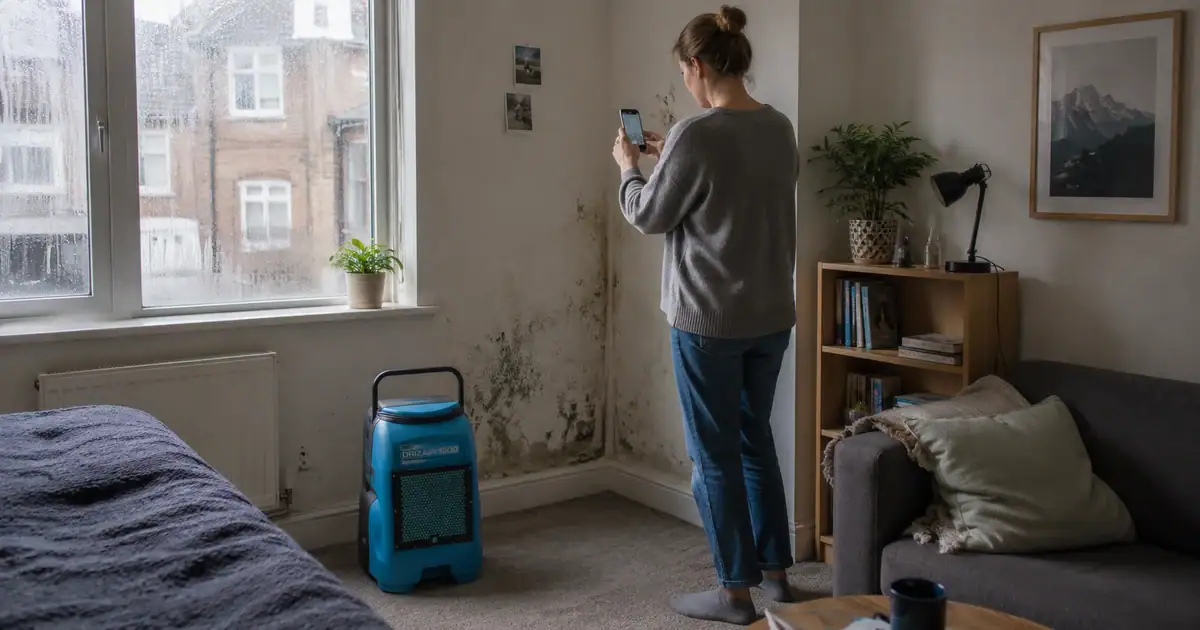
Damp in a Rented Property? Your Rights and What to Do Right Now — what your landlord is usually responsible for, how to report damp and mould properly, and the practical steps you can take to protect your home while you wait for repairs.
Hireload delivers equipment across London from our Greenford / UB6 operating area. View full London delivery areas.
This article is general guidance to help you act quickly. It is not legal advice, and how the law applies can depend on your tenancy and circumstances. For help with your own situation, Shelter, Citizens Advice, or your local council can give tailored advice, free of charge.
Your Landlord’s Responsibility — In Plain English
If your rented home has damp or mould, the landlord is usually responsible for fixing the structural cause. Under the Homes (Fitness for Human Habitation) Act 2018, rented homes in England are generally expected to be fit to live in throughout the tenancy, and damp and mould are among the hazards it covers. Exactly how the law applies to your particular tenancy can vary, so treat this as a starting point rather than the final word.
What this means in practice: if the damp is caused by a leaking roof, broken guttering, defective plumbing, or inadequate ventilation that the building should have, that is normally the landlord’s responsibility to put right. You should not have to live in a damp home. Since 1 May 2026, private landlords in England can no longer use section 21 “no-fault” evictions — to end a tenancy they need a legal ground and, if you do not leave, a court order. If you receive any notice after reporting damp, get advice from Shelter or Citizens Advice straight away.
What to Do When You First Notice Damp
Step 1 — Report It in Writing
Tell your landlord or letting agent about the problem in writing — email is fine. Describe what you are seeing (condensation, damp patches, mould), where it is, and when you first noticed it. Take dated photographs.
Written reports matter because they create a timeline. If the problem escalates and you need to take further action, having a clear record of when you reported it and what response you received is essential.
Step 2 — Give Your Landlord Reasonable Time to Respond
Your landlord should acknowledge the report and arrange an inspection. What counts as “reasonable” depends on the severity — a ceiling dripping water is urgent; mild condensation on a bathroom window is not.
For social housing tenants, Awaab’s Law (in force since late 2025) sets specific timescales for damp and mould: the landlord must investigate within 10 working days, provide a written summary of findings within 3 working days of that investigation, and complete work to make the home safe within 5 working days where a significant hazard is found — with emergency hazards addressed within 24 hours. For private tenants, equivalent fixed statutory timescales are not in force in the same way at present, but the general obligation to deal with serious damp under fitness-for-habitation rules still applies. The Government has said it intends to extend Awaab’s Law-style timescales to the private rented sector through the Renters’ Rights Act in the future, though the detail and timing are still being worked out. If you are not sure which rules apply to you, Shelter or Citizens Advice can confirm.
Step 3 — Escalate If Nothing Happens
If your landlord does not respond within a reasonable time, you have options:
Private and housing association tenants: contact your local council’s Environmental Health team. An Environmental Health Officer (EHO) can inspect the property, assess the damp under the Housing Health and Safety Rating System (HHSRS), and take enforcement action, such as serving an improvement notice on the landlord.
Social housing tenants (council or housing association): if your landlord is not acting, you can complain to the Housing Ombudsman once you have been through the landlord’s own complaints process.
Keep records. Every email, every phone call logged, every photo. If you eventually need a court order or a compensation claim, your evidence trail is everything.
Drying Calculator
Two quick questions and we'll size the right dehumidifier — and tell you how long to hire it.
What You Can Do Right Now — While You Wait
Reporting the problem and waiting for the landlord to act does not mean you have to sit in a damp room. There are practical steps you can take to protect yourself and your belongings while repairs are being arranged.
Reduce Moisture in the Air
- Open windows for 10-15 minutes twice a day, even in winter
- Run extractor fans in the kitchen and bathroom when cooking or showering
- Avoid drying clothes on radiators — this releases litres of moisture into the air
- Keep lids on pans when cooking
- Wipe condensation off windows in the morning
Control Humidity with a Dehumidifier
If the damp is making the property uncomfortable or you are seeing mould appear, a dehumidifier brings humidity under control while you wait for structural repairs.
A compact dehumidifier (19-20L) handles a single room. For persistent dampness across multiple rooms, a larger commercial unit extracts moisture faster and more effectively.
Important note: a dehumidifier is a temporary measure. It manages the symptom (excess humidity) but does not fix the cause (a structural defect, poor ventilation, or water ingress). Your landlord still needs to make the repair. In the meantime, a dehumidifier helps stop mould spreading, protects your furniture and belongings, and makes the property more liveable.
Clean Existing Mould Safely
Wipe mould off hard surfaces with a mould and mildew remover (available from any hardware shop). Wear gloves and open a window while cleaning. Do not dry-brush mould — it releases spores into the air.
For mould on soft furnishings, clothes, or curtains, professional cleaning may be necessary. Document everything — if the mould was caused by the landlord’s failure to maintain the property, you may be able to claim compensation for damaged belongings.
Can You Claim Equipment Costs from the Landlord?
Possibly. If you hired drying equipment because the landlord did not act within a reasonable time, you may be able to include the cost in a compensation claim. Whether that succeeds depends on your circumstances, so there is no guarantee.
Keep the hire receipt, take photographs of the equipment in use, and note the dates. This can help show you took reasonable steps to limit damage while waiting for repairs.
It is worth discussing this with Shelter or Citizens Advice before making a formal claim — they can advise on your specific situation.
Where to Get Free Advice
Shelter — free housing advice for England. Covers tenant rights, landlord obligations, and how to escalate complaints, with a helpline available.
Citizens Advice — free, impartial advice on housing, tenant rights, and how to deal with landlords who will not act. Walk-in and phone services available.
Your local council Environmental Health team — search your council’s website for “environmental health” or “housing complaints.” They can inspect the property and enforce standards.
What the equipment costs
Our hire rates, including VAT at 20%. Business customers can see ex-VAT prices on each product page.
| Machine | 1 day | 2 days | Up to a week | Longer |
|---|---|---|---|---|
| 19L compact — one room, standard plug | £23.99 | £29.99 | £41.99 | £5.40/day |
| 38L commercial — a flat or a floor | £35.99 | £53.99 | £71.99 | £10.08/day |
| 43L Dri-Eaz Cube — stacks in tight spaces | £47.99 | £71.99 | £89.99 | £13.44/day |
| 63L LGR — cold rooms, heavy saturation | £71.99 | £107.99 | £143.99 | £20.16/day |
| Air mover — per unit | £23.99 | £29.99 | £35.99 | £5.76/day |
All prices above include VAT. A refundable deposit applies and comes back in full when the equipment returns undamaged. Delivery and collection is £42 next working day, £70.80 for guaranteed delivery before 11am, or £82.80 same day (subject to stock) — or you can collect free from Greenford UB6.
Worth knowing. A week with a 19L dehumidifier is £41.99 including VAT. Keep the invoice and note the dates you used it, so you have a clear record if you later raise the cost with your landlord.
Frequently Asked Questions
Protect Your Home While You Wait
A hired dehumidifier keeps damp under control and helps stop mould spreading. Browse our range — we deliver across London, typically next working day.
Browse DehumidifiersRelated reading: if you are a landlord wanting to understand your obligations on damp and mould timescales, see our guide to Awaab’s Law and landlord damp deadlines.

 Drone Survey & Mapping
 Drone Inspections