
 Drone Services
 Access Equipment
 Breaking & Drilling
 Cleaning Equipment
 Drying & Heating
 General Site Tools
Equipment Hire Guides
Landlord? Here’s How to Meet Awaab’s Law Damp Deadlines
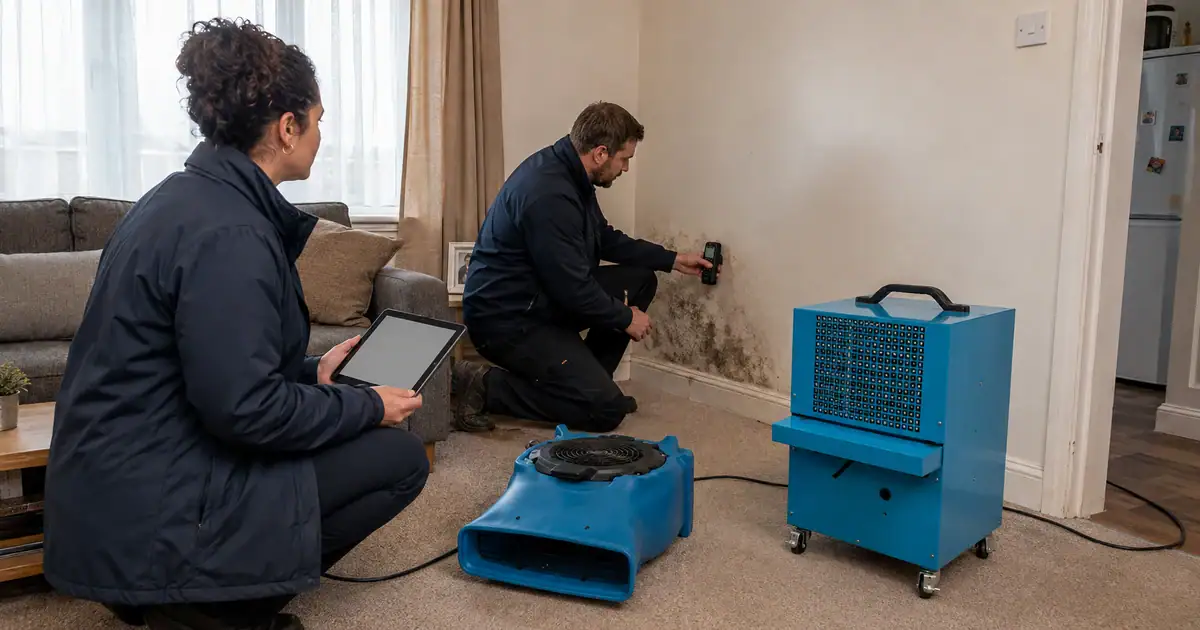
Landlord? Here’s How to Meet Awaab’s Law Damp Deadlines — the fixed timescales social landlords now face for damp and mould, what counts as compliance, and how to act fast.
Hireload delivers drying equipment across London from our Greenford / UB6 operating area. View full London delivery areas.
Quick answer: Awaab’s Law came into force for social housing on 27 October 2025. Once a tenant reports significant damp or mould, you must investigate within 10 working days, send a written summary within 3 working days of finishing that investigation, and make the hazard safe within 5 working days of the investigation finishing. Emergency hazards must be addressed within 24 hours.
What Is Awaab’s Law?
Awaab’s Law is named after Awaab Ishak, a two-year-old who died in December 2020 from a respiratory condition caused by prolonged mould exposure in his family’s housing association flat in Rochdale. The law exists to make sure no tenant is left living in damp, mouldy conditions while a landlord delays action.
It came into force for the social rented sector on 27 October 2025 and applies to registered providers of social housing in England. The government has confirmed the requirements will expand to cover a wider range of hazards during 2026, and equivalent standards for the private rented sector are expected to follow under the Renters’ Rights reforms.
For landlords, the key change is simple: you now have fixed legal timescales to investigate and fix damp and mould. Miss them and tenants have clear routes to the Housing Ombudsman, the Regulator of Social Housing, and the courts.
The Deadlines You Need to Know
Awaab’s Law sets specific timescales that run from the moment a tenant reports a problem. These are working days, not calendar days.
| Stage | Timeframe |
|---|---|
| Emergency hazards (significant and immediate risk of harm) | Investigate and make safe as soon as possible, within 24 hours |
| Investigate significant damp and mould | Within 10 working days of the report |
| Written summary of findings to the tenant | Within 3 working days of finishing the investigation |
| Make the hazard safe | Within 5 working days of the investigation finishing |
Where a damp or mould hazard cannot be made safe within 5 working days, you must begin the work within that window, complete it within a reasonable period, and keep the tenant informed throughout. The full timescales are set out in the official Awaab’s Law guidance for social landlords on GOV.UK.
What Counts as Compliance
Meeting the timescales isn’t just about starting the clock — it’s about demonstrable action. The Regulator and Housing Ombudsman expect:
Proper investigation. A quick look round may not be enough. Identify whether the cause is structural (roof leak, failed DPC, plumbing fault), environmental (poor ventilation, condensation), or a combination — and document it.
An actionable plan. “We’ll monitor the situation” is not a plan. A compliant response identifies the cause, specifies the remedy, sets a timeline, and arranges the equipment or trades to deliver it.
Evidence of remediation. This is where equipment matters. If the damp needs active drying — and it usually does — running commercial drying equipment is evidence of action. Telling a tenant to open a window is not.
Drying Calculator
Two quick questions and we'll size the right dehumidifier — and tell you how long to hire it.
Follow-up. After remediation, check the problem hasn’t returned. A one-off fix that fails within weeks leaves you exposed again.
Where Drying Equipment Fits In
Most damp and mould complaints involve excess moisture that needs active extraction before any lasting repair can happen. You can’t paint over damp walls and call it remediated, and you can’t re-plaster a wall that hasn’t dried out.
Pro tip: document moisture readings before and after, and photograph the equipment in situ. Hire receipts with delivery dates are part of your compliance paper trail.
Step 1 — Fix the source. Stop the leak, repair the plumbing or roof, address ventilation. Equipment doesn’t help while water is still getting in.
Step 2 — Dry the property. Deploy commercial dehumidifiers to pull trapped moisture from walls, floors and materials. A 38L commercial dehumidifier handles a single room; an industrial 63L unit or the 43L Dri-Eaz Cube covers larger or multi-room jobs.
Step 3 — Accelerate where needed. If carpets or subfloor are saturated, add air movers to speed surface drying. Dehumidifier plus air mover is the combination professional drying companies use. If you’re then re-plastering, our guide on drying new plaster covers doing it without cracking.
Step 4 — Document everything. Moisture readings, dated photos, hire records. This is your evidence of compliance. For sizing the kit to the property, see how many dehumidifiers you need, and how to dry a room after a leak for the full method.
Why Speed Matters Beyond the Deadlines
Mould colonises quickly. In warm, damp, still air it can establish within 24-48 hours. Every day of delay increases the remediation scope and cost.
Tenant trust and liability. A landlord who responds visibly — equipment delivered, problem being treated — retains trust and reduces legal exposure if a tenant’s health is affected during inaction.
Cost control. Damp left untreated destroys plaster, rots timber and damages electrics, eventually requiring full strip-out. A week of dehumidifier hire now prevents months of building work later.
Who This Applies To
Awaab’s Law currently bites hardest for:
- Housing associations and council housing teams managing social tenancies
- Registered providers with older stock prone to condensation and damp
- Managing and letting agents handling damp complaints on behalf of social landlords
- Private landlords preparing for equivalent rules expected under the Renters’ Rights reforms
What it costs to act inside the deadline
Awaab’s Law sets the clock; equipment cost is what decides how quickly a landlord can start. These are our own rates, ex-VAT, matching each product page.
| Machine | 1 day | 2 days | Up to a week | Longer |
|---|---|---|---|---|
| 19L compact — one room, standard plug | £19.99 | £24.99 | £34.99 | £4.50/day |
| 38L commercial — a flat or a floor | £29.99 | £44.99 | £59.99 | £8.40/day |
| 43L Dri-Eaz Cube — stacks in tight spaces | £39.99 | £59.99 | £74.99 | £11.20/day |
| 63L LGR — cold rooms, heavy saturation | £59.99 | £89.99 | £119.99 | £16.80/day |
| Air mover — per unit | £19.99 | £24.99 | £29.99 | £4.80/day |
Prices are ex-VAT and match each product page. A refundable deposit applies and comes back in full when the equipment returns undamaged. Delivery is £35 + VAT next working day, £59 before 11am, £69 same day, or collect free from Greenford UB6.
What that means against the deadlines. Putting a 19L dehumidifier into a flat within the investigation window costs £34.99 + VAT for the week — materially less than the cost of a missed deadline, and it produces something you can evidence: the tank output falling as the property dries. Delivery across London is same-day or next working day where scheduling allows.
Frequently Asked Questions
Related guides
What the law means for you if you are the one renting. Read: your rights as a tenant living with damp.
Need to Act Fast on a Damp Complaint?
Browse our drying equipment range, or call 020 3375 4048 and we’ll get the right kit to the property — typically next working day across London.
Browse Drying Equipment
 Drone Survey & Mapping
 Drone Inspections