
 Drone Services
 Access Equipment
 Breaking & Drilling
 Cleaning Equipment
 Drying & Heating
 General Site Tools
Equipment Hire Guides
How Many Dehumidifiers Do I Need? A Practical Sizing Guide by Room and Job Type
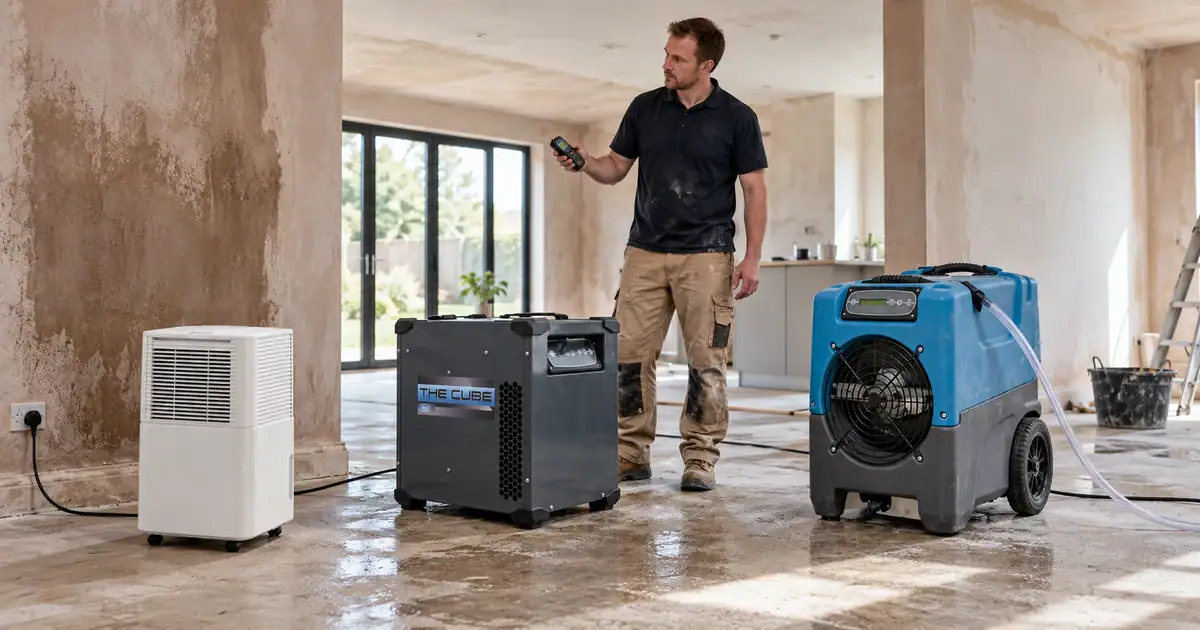
How Many Dehumidifiers Do I Need? — a practical sizing guide matching extraction capacity and number of units to your room size, damage level, and job type.
Hireload delivers dehumidifiers and air movers across London from our Greenford / UB6 operating area. View full London delivery areas.
The Quick Answer — Capacity Matters More Than Quantity
Most people assume they need multiple dehumidifiers when what they actually need is the right capacity. One commercial-grade unit extracting 38 litres per day will outperform three domestic units combined — and cost less to hire.
The key number is litres per day (L/day): how much water the machine pulls from the air in 24 hours. Match that number to the severity of your situation, and you’ll avoid both underpowering the job and overspending on equipment you don’t need.
What the Extraction Rates Mean
Up to 20L/day — Light condensation control. Single small rooms with mild damp. Maintenance drying after the main job is done.
38-43L/day — The workhorse range for most hire jobs. Handles active leaks in a single room, burst pipe aftermath, and plaster drying. This is where most residential hires sit.
55-70L/day — Multi-room damage, full-floor flooding, and commercial spaces. LGR (Low Grain Refrigerant) units in this range keep extracting moisture even as humidity drops — important for getting a space properly dry, not just “feels dry.”
70-90L/day — Large-scale flood recovery, warehouses, multi-zone restoration projects. These are the units professional drying companies use.
One thing to note: manufacturer ratings are tested under specific lab conditions (typically 30°C, 80% RH). Real-world extraction will be lower — especially in cooler UK properties. Don’t treat the stated figure as a guarantee.
Sizing by Situation
Single Damp Room — Condensation or Mild Moisture
Typical scenario: Bedroom with condensation on windows, bathroom that never quite dries out, kitchen with persistent dampness.
What to hire: 1x compact dehumidifier (around 19-20L/day)
Duration: 3-7 days usually brings humidity under control
Air movers needed? Not usually — this is moisture management, not active water damage
A compact domestic dehumidifier handles this comfortably. Run it with internal doors open for the best air circulation.
One Room After a Leak — Burst Pipe, Radiator, or Appliance
Typical scenario: Burst pipe under the sink, radiator leak soaking one room, washing machine overflow.
What to hire: 1x commercial dehumidifier (38-43L/day) + 1-2 air movers
Duration: 5-10 days depending on how much water went in and what absorbed it
The 38L Broughton CR40 is the standard choice for most single-room leaks. If space is tight — a bathroom or utility cupboard — the 43L Dri-Eaz Cube packs similar extraction into a more compact frame.
Pair either unit with a standard air mover to speed up surface drying. The air mover pushes moisture out of carpets and plaster into the air; the dehumidifier captures it.
For a step-by-step setup process, see our guide on how to dry a room after a leak.
Drying Calculator
Two quick questions and we'll size the right dehumidifier — and tell you how long to hire it.
Multiple Rooms or a Whole Floor After a Flood
Typical scenario: Burst mains pipe, roof leak affecting several rooms, ground-floor flooding from external water.
What to hire: 1-2x industrial dehumidifiers (63-90L/day) + 3-4 air movers
Duration: 1-3 weeks depending on severity, building materials, and ventilation
Key point: Each room or zone needs its own airflow setup. One air mover in a hallway won’t dry three adjoining rooms. Treat each space as a separate drying zone with at least one air mover pointed across the wettest surface.
A 63L LGR dehumidifier handles multi-room jobs efficiently. For larger properties or severe flooding, the 70-90L industrial unit delivers the highest extraction rate in the range.
At this scale, if you’re unsure about how many units you need, call us. We’d rather help you size it correctly than have you under-equip and extend the hire.
Construction Drying — Plaster, Screed, Wet Trades
Typical scenario: Newly plastered walls, freshly laid screed, concrete finishing, post-renovation moisture.
What to hire: 1x industrial dehumidifier (55-90L/day) per large room or zone
Duration: Varies significantly. Fresh plaster needs a minimum 3-7 days even with equipment. Screed can take weeks depending on thickness and type.
Important: Don’t blast fresh plaster directly with air movers for the first 48 hours. Plaster needs to cure naturally before you accelerate drying — otherwise you risk surface cracking. After the initial cure, position dehumidifiers centrally and let them work steadily.
Commercial Property — Offices, Warehouses, Retail
Typical scenario: Large open-plan office, warehouse with humidity damaging stock, retail unit with persistent damp.
What to hire: Multiple industrial units — treat each zone separately
A single dehumidifier in a 500m² warehouse won’t make a measurable difference. Divide the space into zones, assess each zone’s moisture level, and size accordingly. For very large spaces, contact us for a sizing recommendation — getting this right saves time and money.
Sizing Reference Table
| Situation | Room Size | Recommended Unit | How Many | Air Movers? |
|---|---|---|---|---|
| Condensation / mild damp | Up to 20m² | 19-20L compact | 1 | No |
| Single room leak | Up to 40m² | 38-43L commercial | 1 | 1-2 |
| Multi-room / full floor | 60-100m² | 63-90L industrial | 1-2 | 2-4 |
| Construction drying | Per large room | 55-90L industrial | 1 per room | After cure |
| Large commercial space | 100m²+ | 70-90L industrial | 2+ | 3-6+ |
These are starting points, not guarantees. Temperature, ventilation, building materials, and the amount of water involved all affect drying time and equipment needs.
Common Sizing Mistakes
Hiring a domestic unit for an industrial job. A 10-12L unit from Argos extracts a fraction of what a 38L commercial dehumidifier does. The domestic unit might take three weeks to do what the commercial unit does in five days — and three weeks of domestic hire costs more than one week of commercial hire.
Underspeccing to save money. Slower drying means longer hire. A slightly larger unit for fewer days often costs the same or less than a smaller unit running for twice as long.
Using only dehumidifiers without air movers. Dehumidifiers pull moisture from the air. Air movers push moisture out of materials and into the air. Without air movers, you’re waiting for moisture to evaporate naturally from carpets and walls — which roughly halves your drying speed.
Running one unit with doors closed between rooms. A dehumidifier dries the room it’s in. If three rooms are wet and the doors are shut, only one room is drying. Either open all doors or put equipment in each room.
What the machines cost
Once you know how many units the job needs, this is what they cost. Rates are ex-VAT and match each product page.
| Machine | 1 day | 2 days | Up to a week | Longer |
|---|---|---|---|---|
| 19L compact — one room, standard plug | £19.99 | £24.99 | £34.99 | £4.50/day |
| 38L commercial — a flat or a floor | £29.99 | £44.99 | £59.99 | £8.40/day |
| 43L Dri-Eaz Cube — stacks in tight spaces | £39.99 | £59.99 | £74.99 | £11.20/day |
| 63L LGR — cold rooms, heavy saturation | £59.99 | £89.99 | £119.99 | £16.80/day |
| Air mover — per unit | £19.99 | £24.99 | £29.99 | £4.80/day |
Prices are ex-VAT and match each product page. A refundable deposit applies and comes back in full when the equipment returns undamaged. Delivery is £35 + VAT next working day, £59 before 11am, £69 same day, or collect free from Greenford UB6.
A worked example. Three rooms after a burst pipe, one week: two 38L units at £59.99 each plus two air movers at £29.99 each comes to £179.96 + VAT. One machine trying to cover three rooms usually costs more in the end, because the hire runs for two or three weeks instead of one.
Frequently Asked Questions
Related guides
Sizing a commercial space is a different job to sizing a room. Read: humidity in a warehouse or office unit.
Not Sure Which Unit or How Many?
Browse our dehumidifier range by capacity, or call us and we’ll help you work out the right setup for your space.
Browse Dehumidifiers
 Drone Survey & Mapping
 Drone Inspections