 Drone Services
 Access Equipment
 Breaking & Drilling
 Cleaning Equipment
 Drying & Heating
 General Site Tools

Day 1
Assess & start
Room may still feel damp. Isolate the area, position the Cube, and confirm drainage.
HighRH

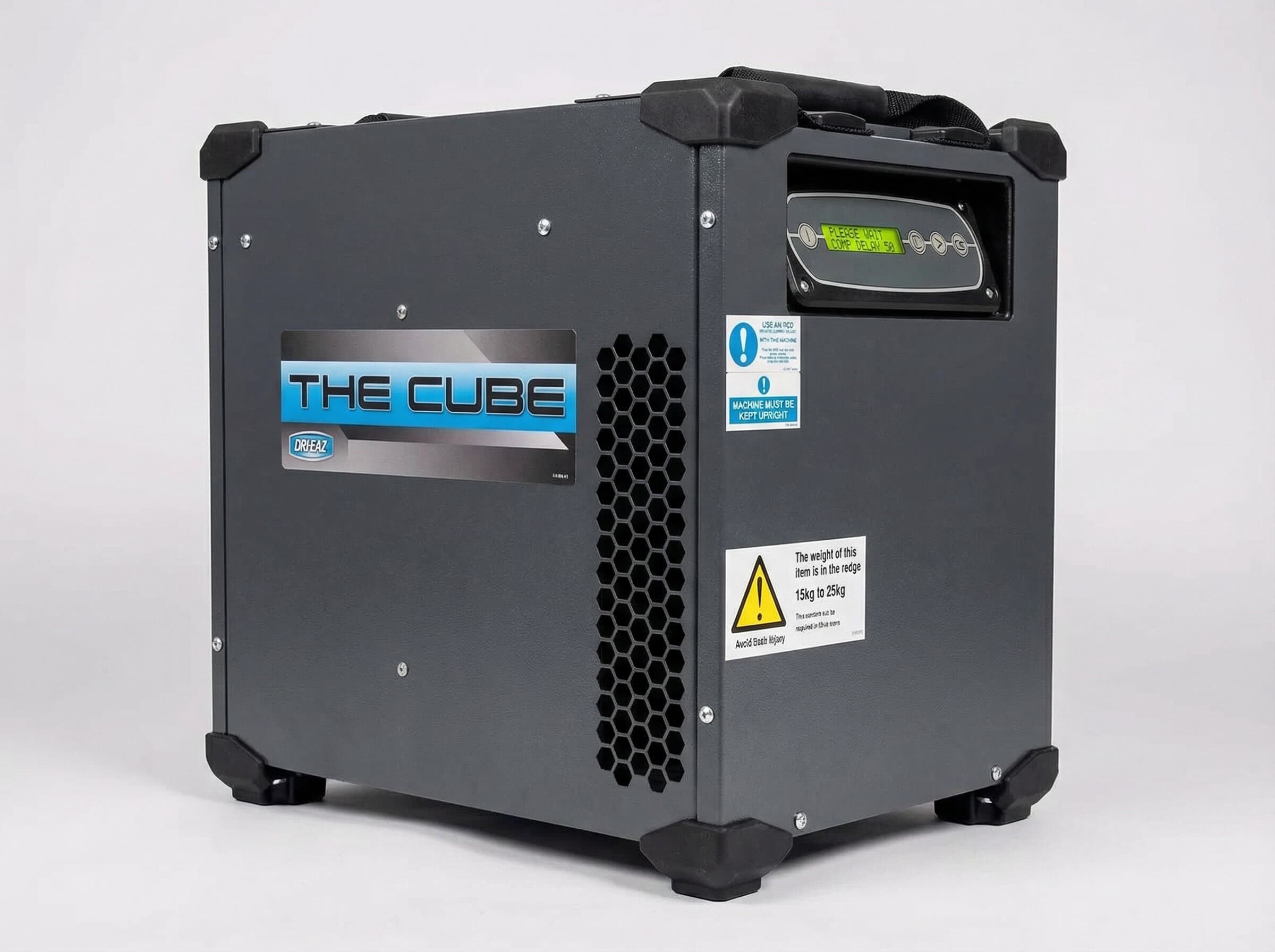
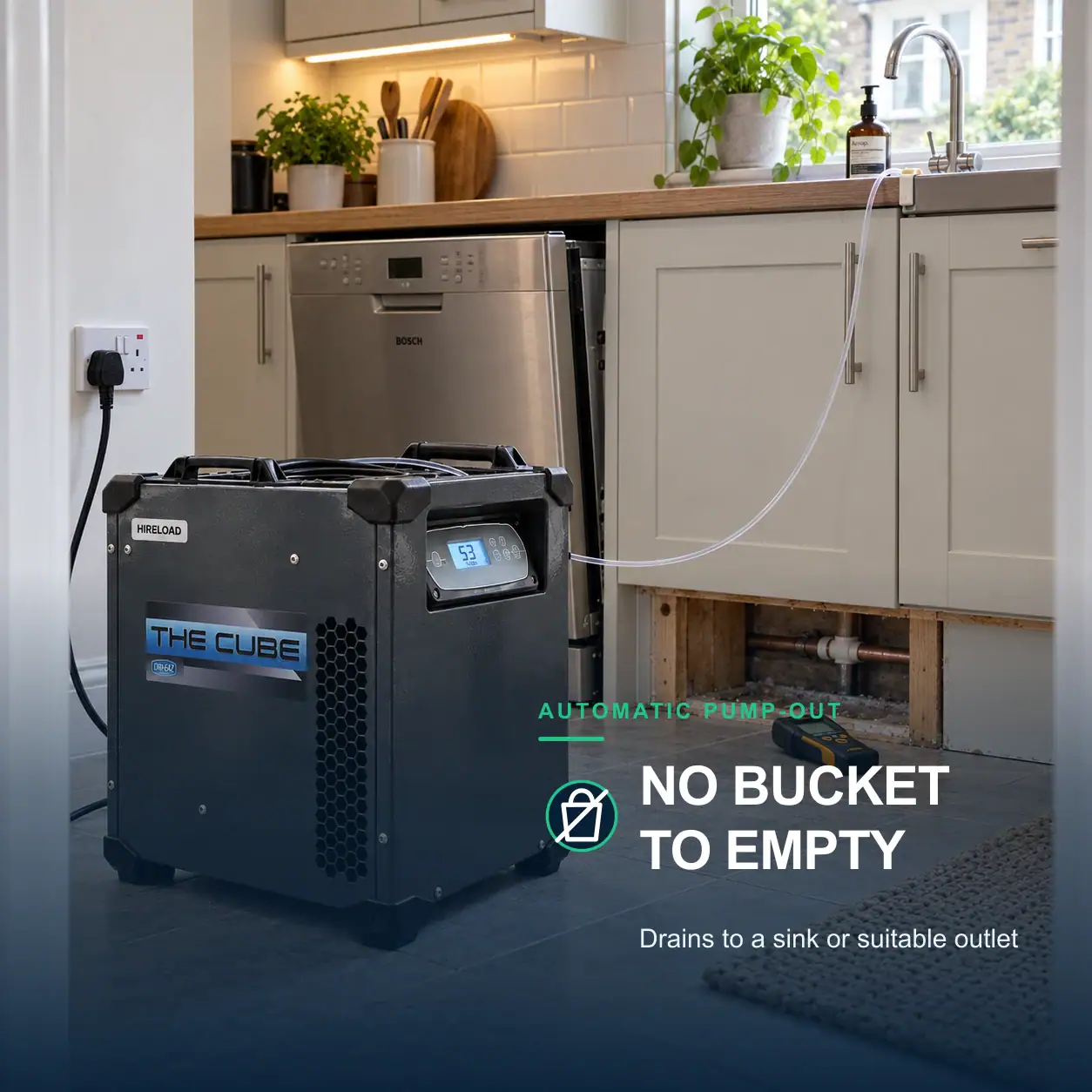
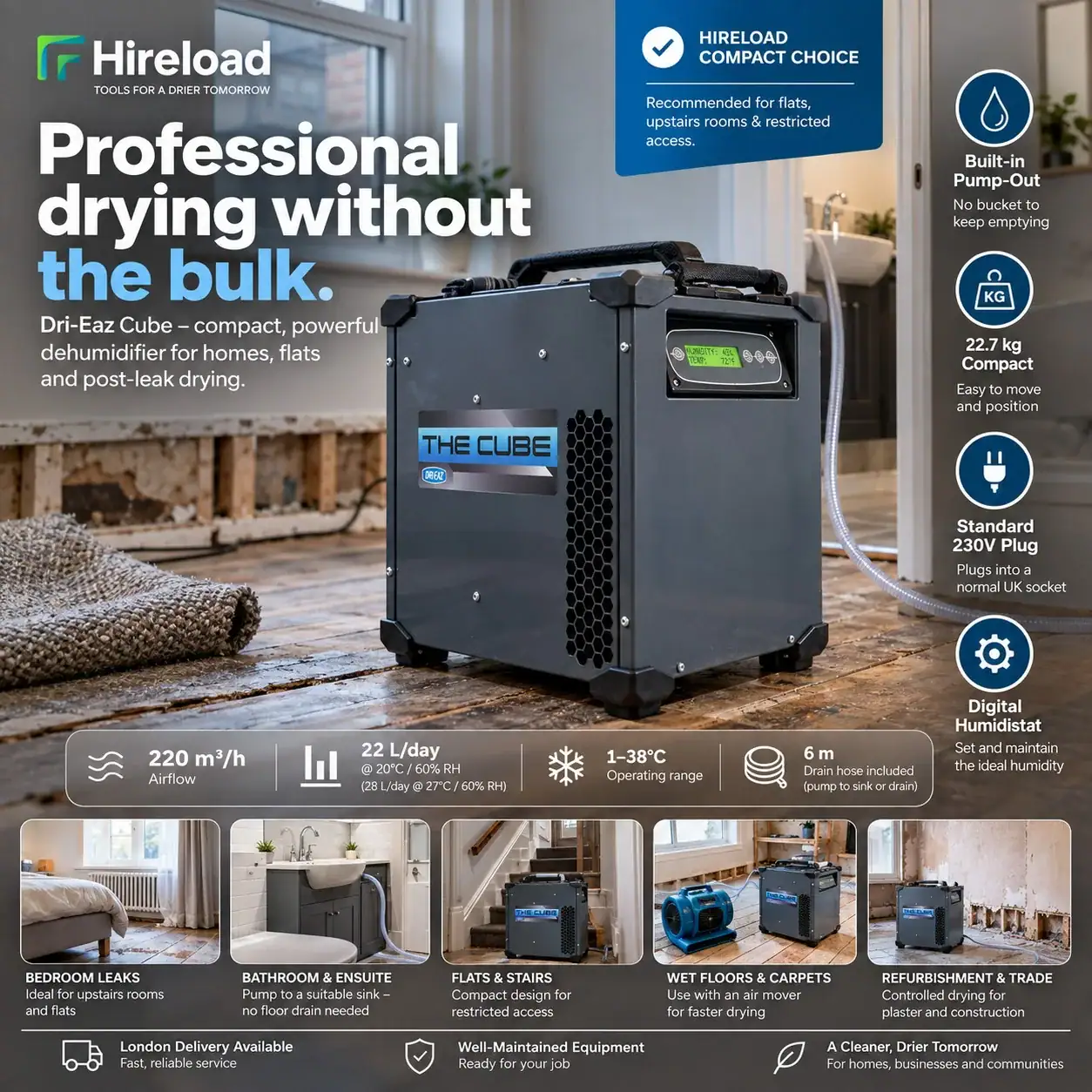
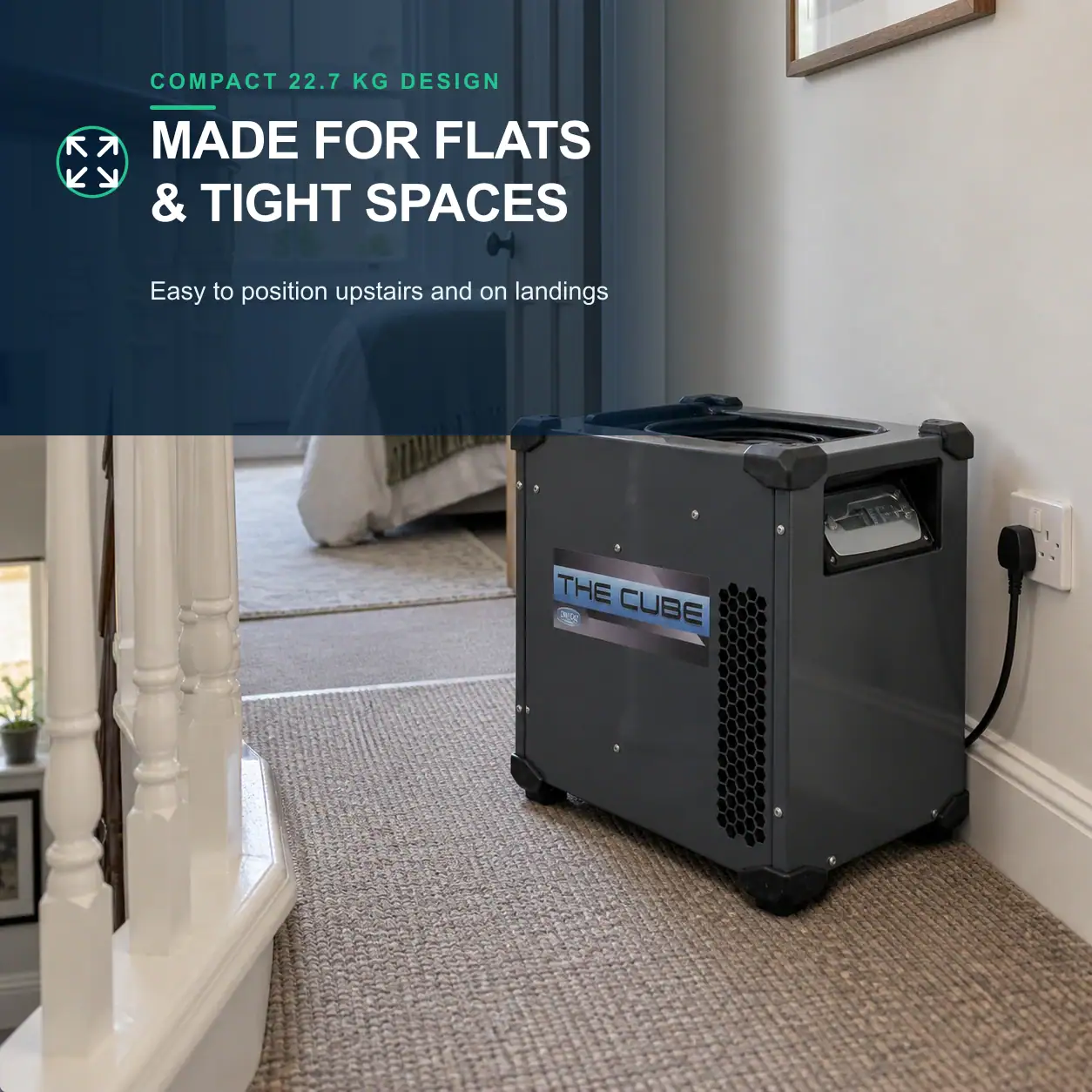
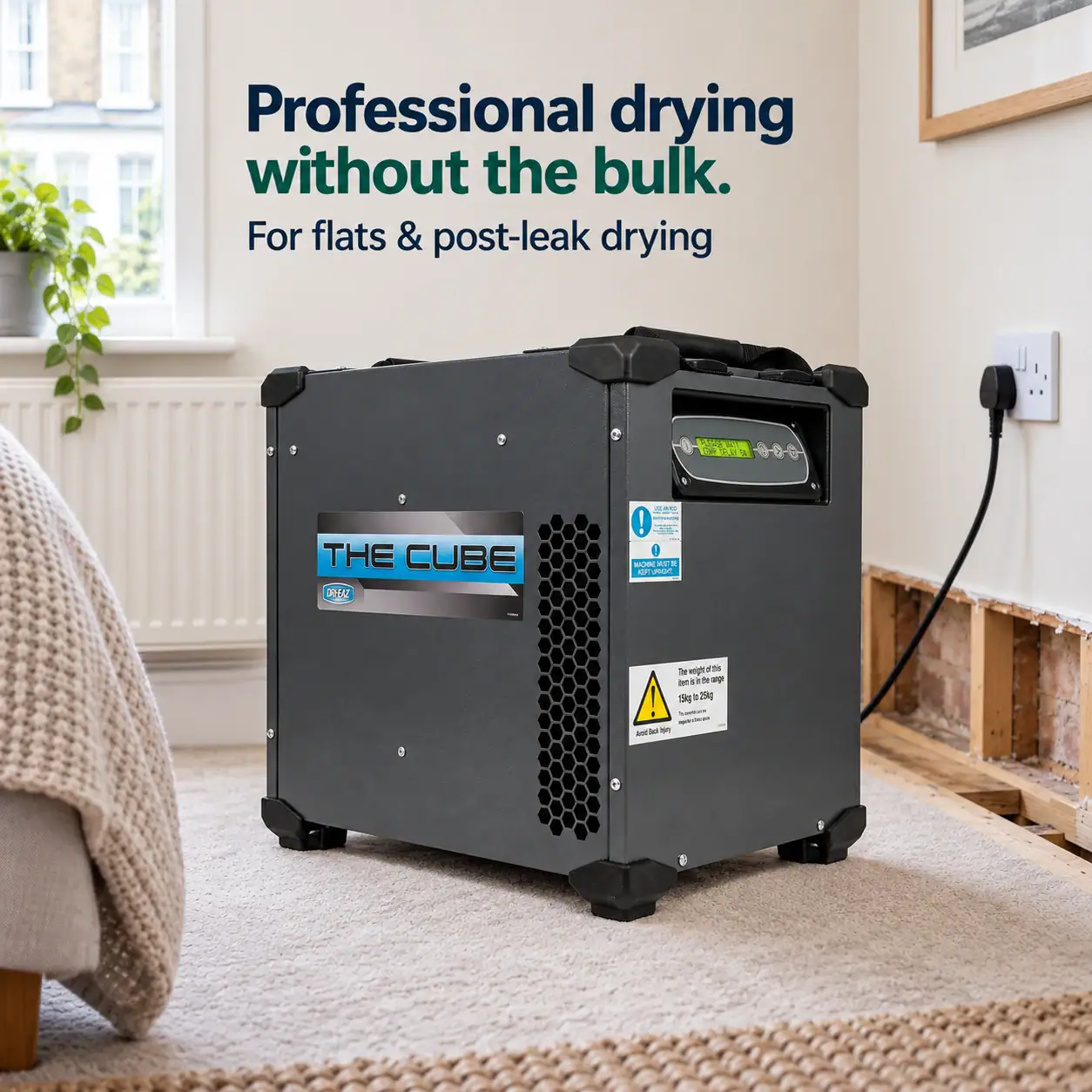
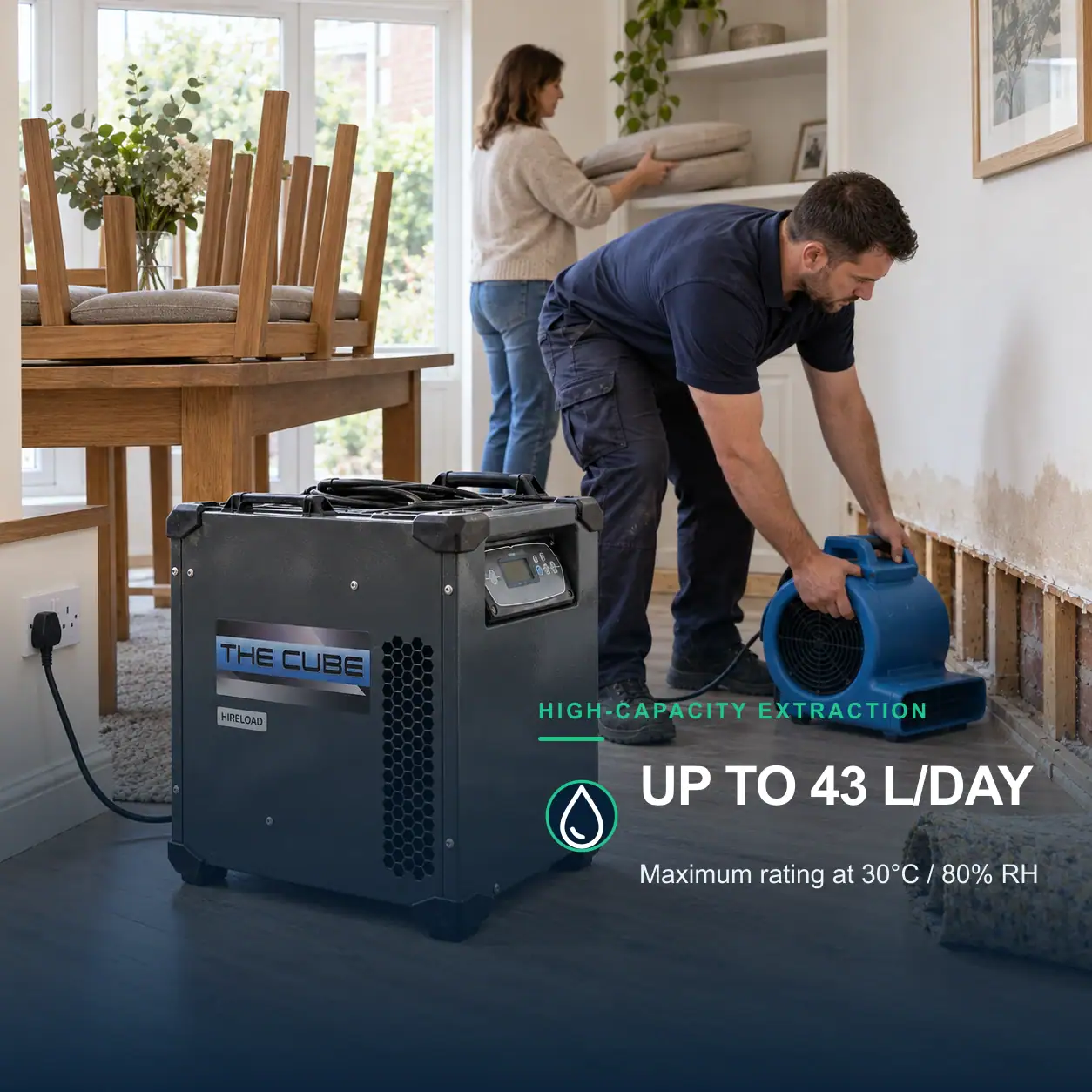
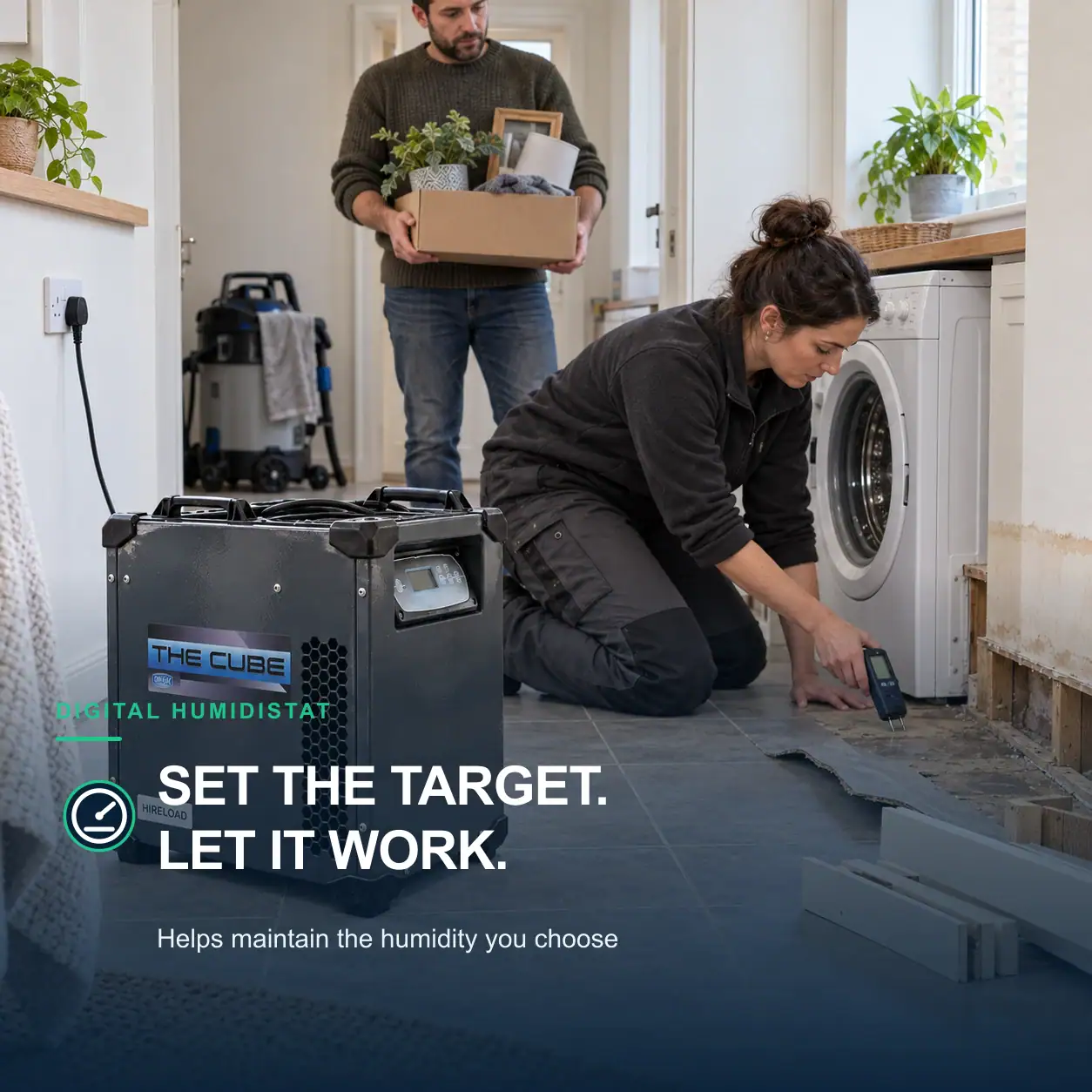
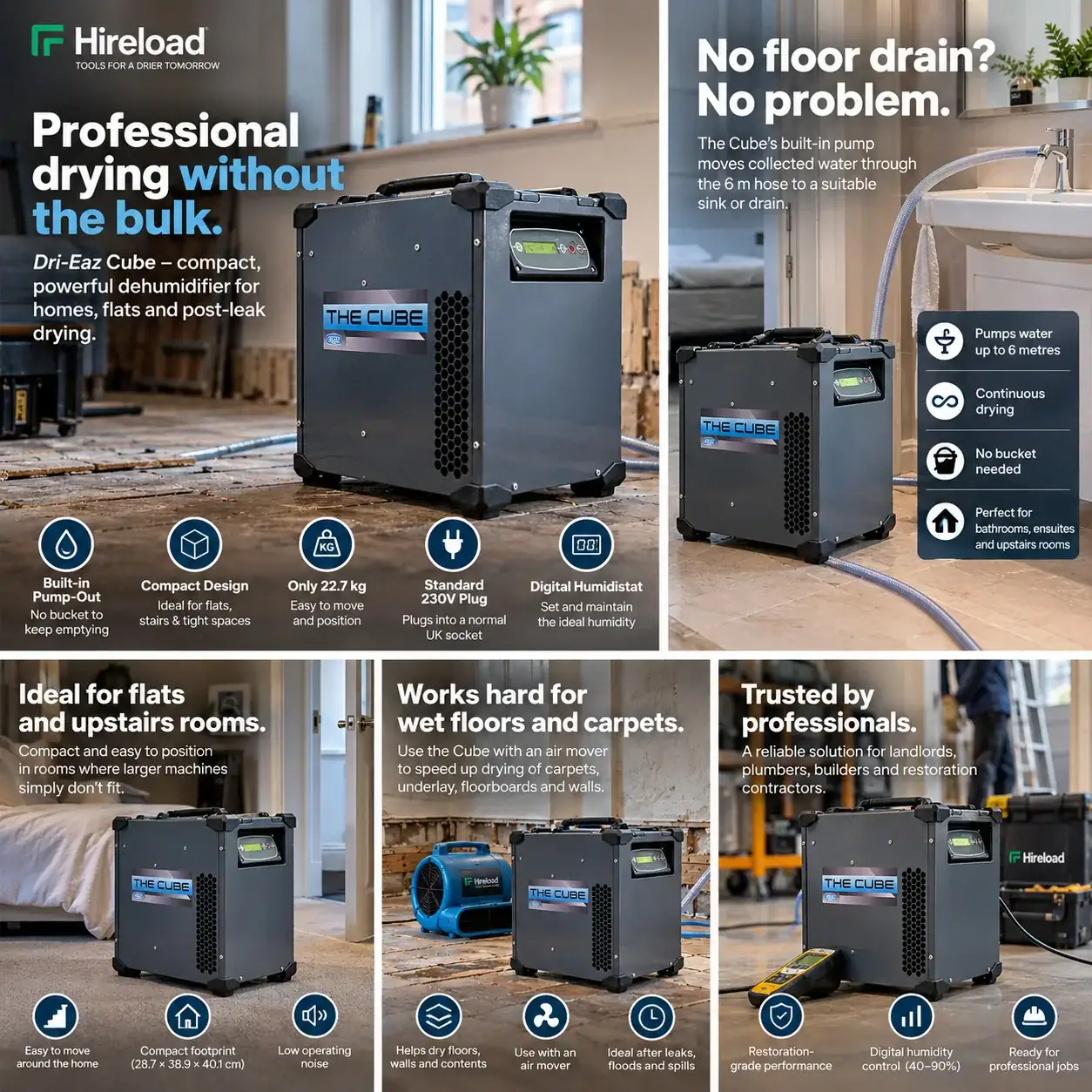
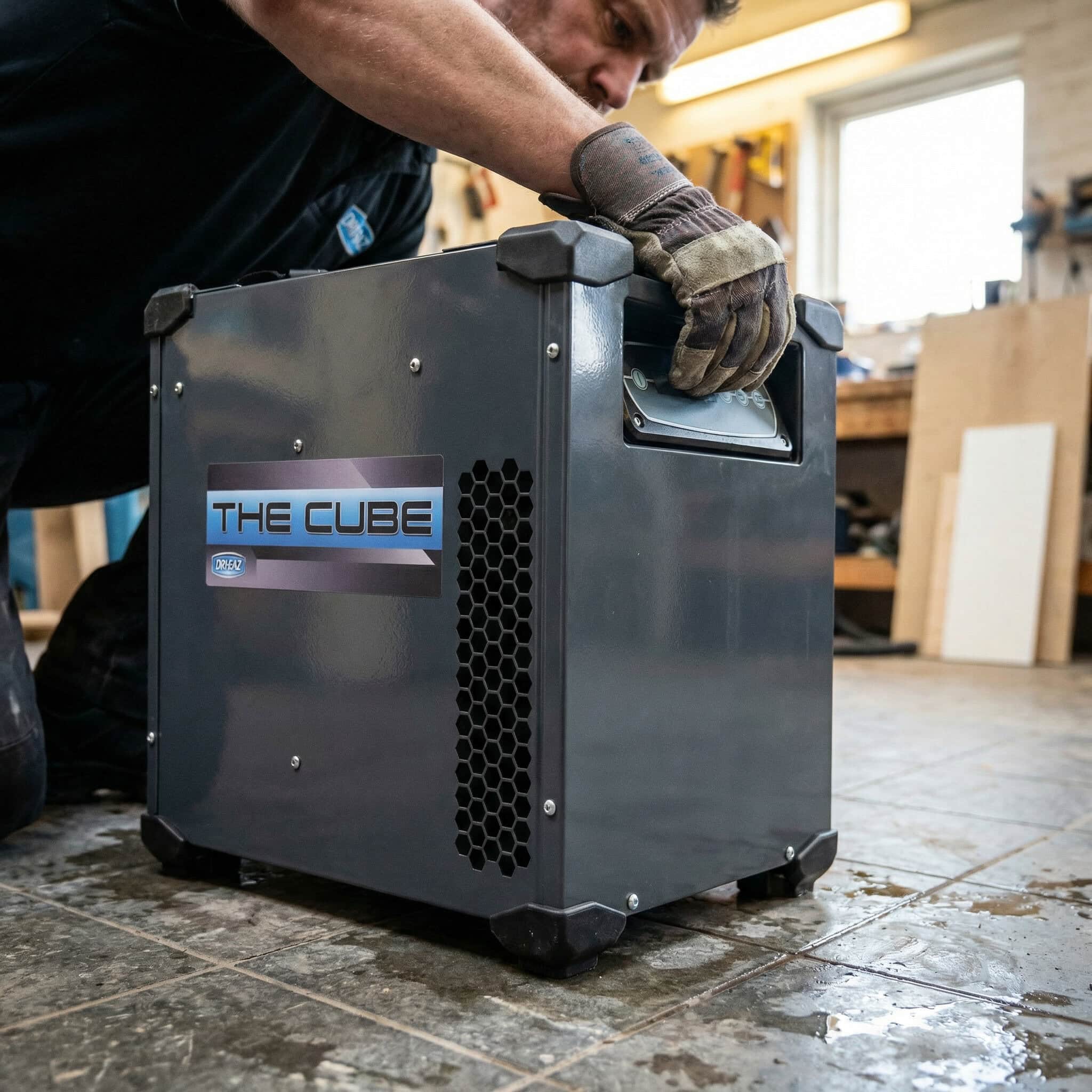
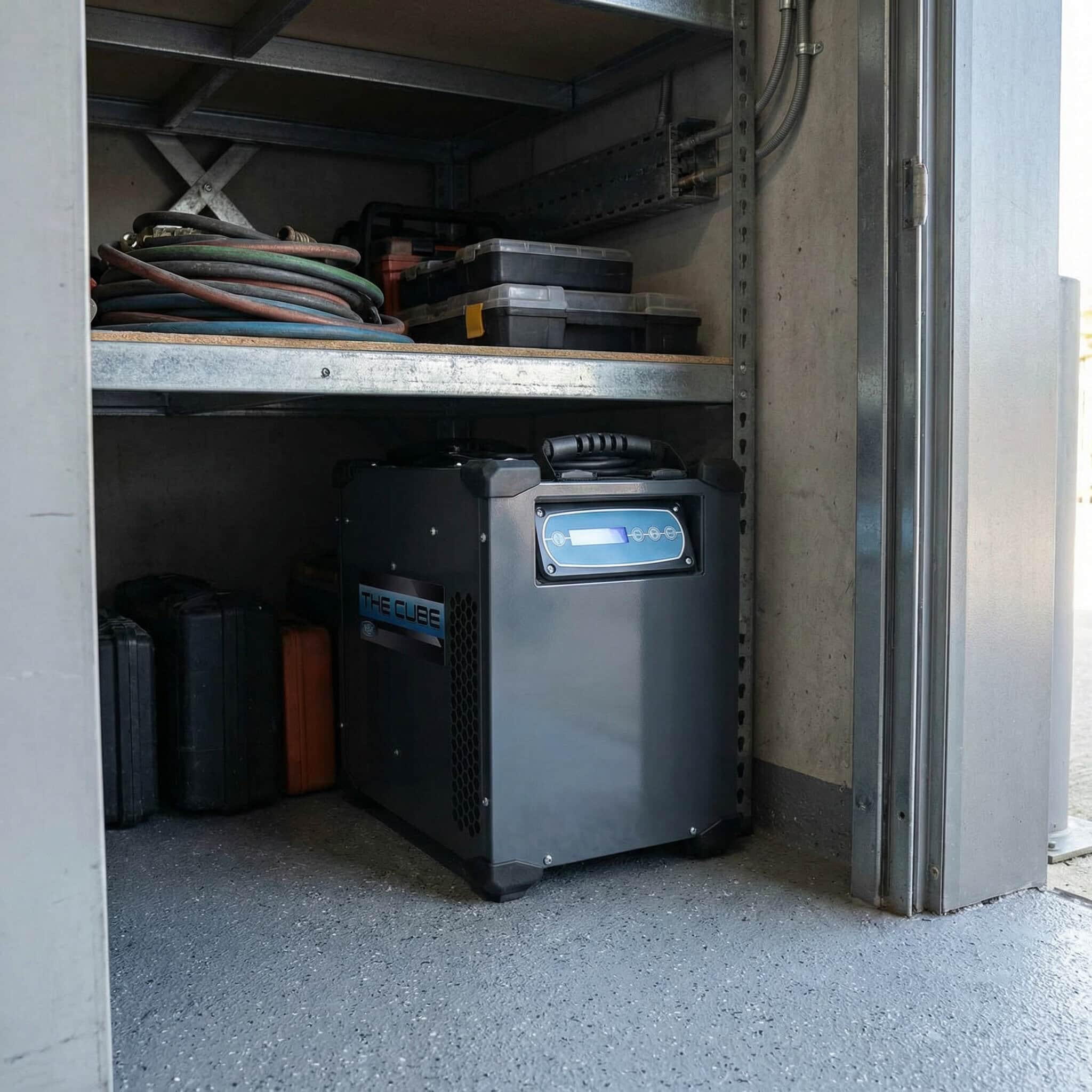
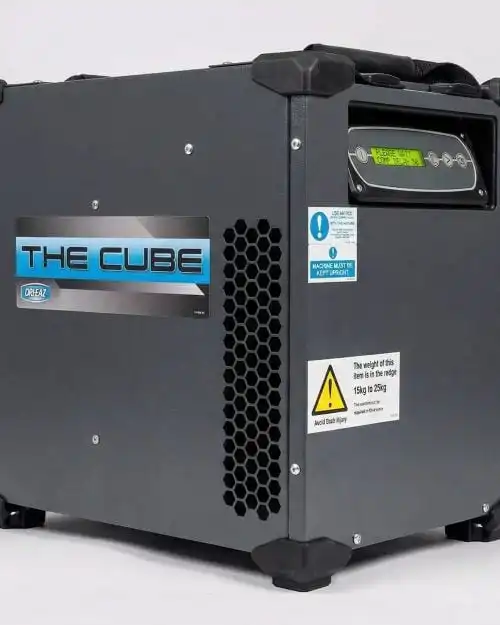
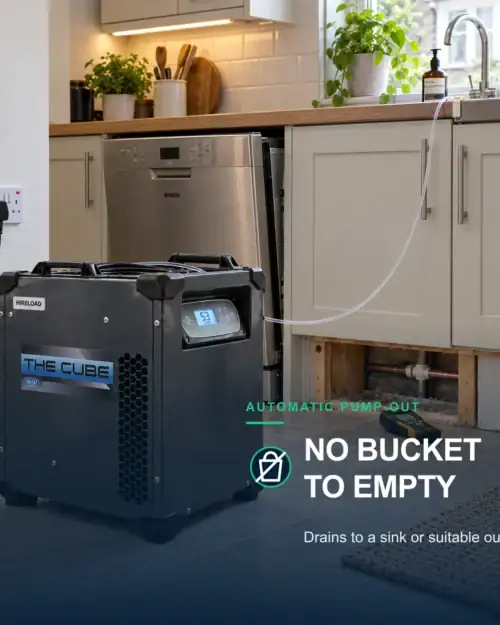
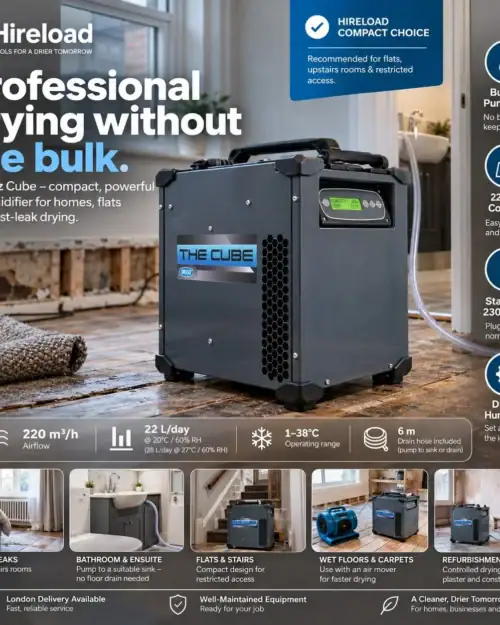
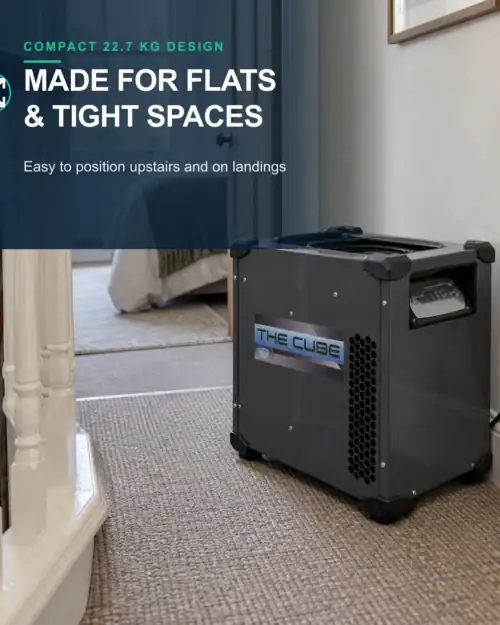
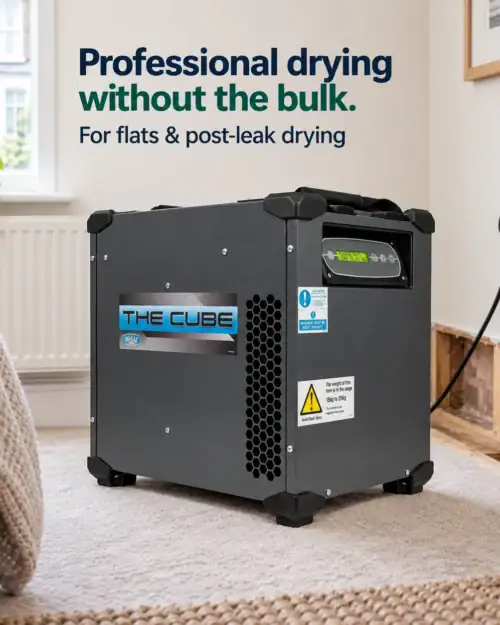
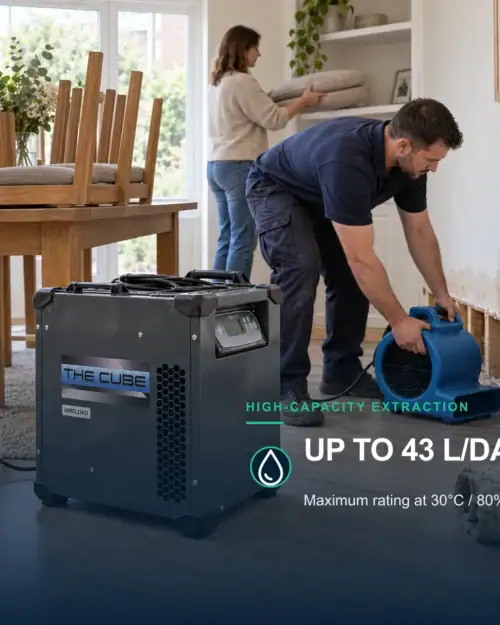
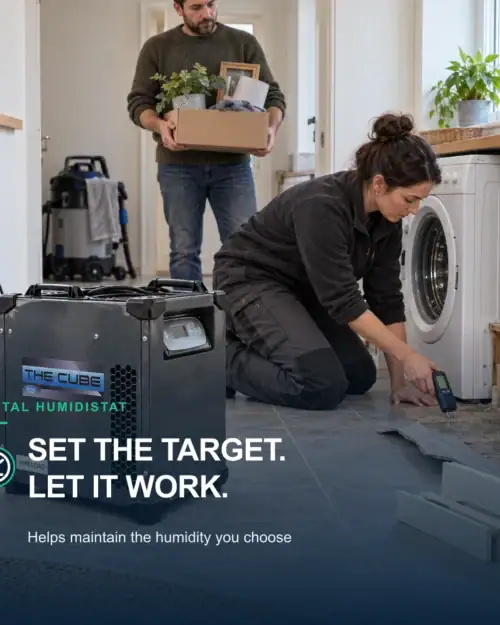
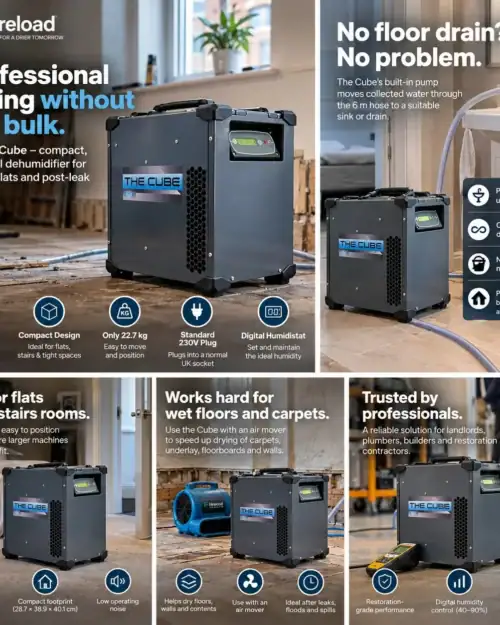
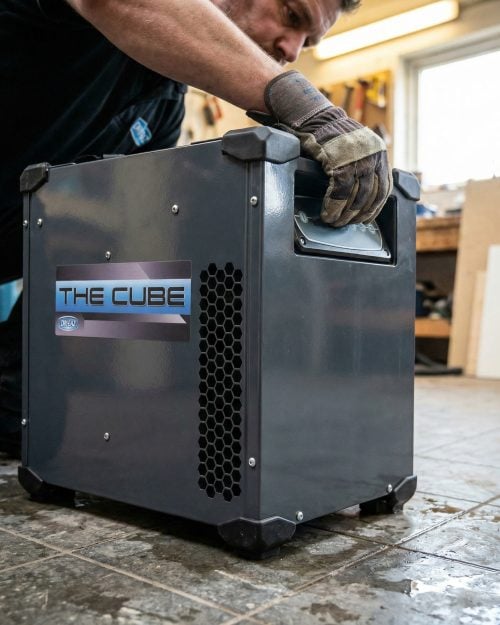
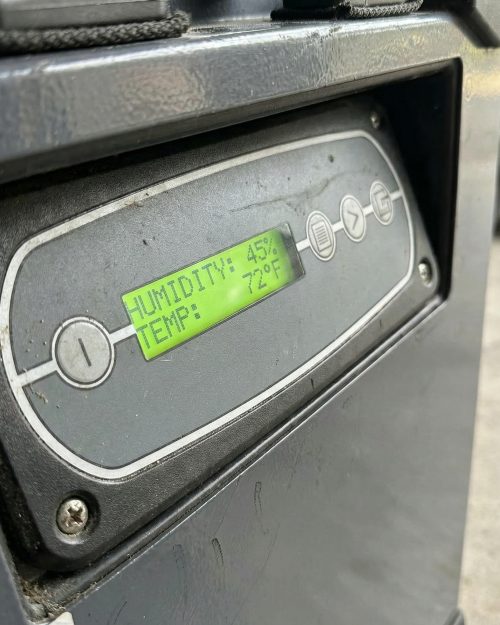
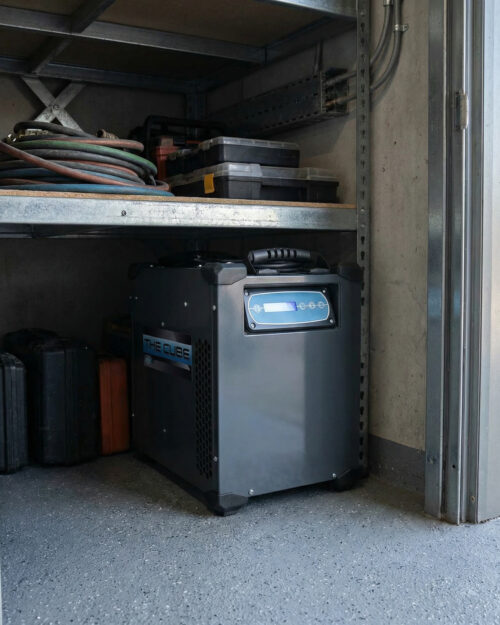
A compact industrial dehumidifier (Dri-Eaz Cube · F571) rated at 43L/day class, with a built-in pump and no tank to empty, so it keeps drying overnight and while you are out. Runs from a standard 230V plug on an RCD-protected supply. Auto pump-out through a 6 m hose to a sink or drain. Best for flats and single rooms after a leak, damp or condensation.
 CHAS Verified
 WhatsApp Support
Dri-Eaz The Cube · F571
Mould can start within 24 to 48 hours of a leak, so the hours you lose overnight matter. A dehumidifier with a tank stops as soon as that tank is full. The Cube has no tank — it pumps its own water away through a drain hose, so it keeps running unattended through the night and while you are at work.
What the Cube actually does
The Cube is a refrigerant industrial dehumidifier — it does not dry walls or remove mould directly. It can help lower a room’s relative humidity so moisture can move out of walls, carpet and plaster into the air, where the unit can collect it.
Bringing a damp space closer to a common comfort range may help reduce condensation, musty smells and the moisture conditions that can contribute to mould growth. Results vary depending on room temperature, airflow, room size and moisture level.
Refrigerant performance varies with room temperature. Output may reduce noticeably below ~15°C. For cold sites and demanding drying jobs, an LGR option may be more suitable depending on conditions. See the larger options below.
Indicative drying progress
Example only. Drying time depends on room size, temperature, airflow, moisture level and whether the source of moisture has been resolved.
Room may still feel damp. Isolate the area, position the Cube, and confirm drainage.
Humidity may start reducing if the room is warm, closed off and airflow is managed.
Walls, carpet or plaster may continue releasing moisture into the air. Air movers can help where appropriate.
Condensation and musty smells may reduce as humidity lowers, depending on conditions.
Keep monitoring humidity. For heavy moisture, cold rooms or multi-room jobs, a larger / LGR setup may be more suitable.
The Cube drying system
Used correctly, the Cube can support drying by lowering room humidity while airflow helps moisture move from wet materials into the air.
Drying performance varies depending on temperature, airflow, room size and moisture level.
Close doors and windows so the unit works on one space.
The Cube can help lower relative humidity in the contained space.
Pair with an air mover to direct airflow at affected materials.
Continuous drainage where set up correctly with a suitable drain.
Why customers choose the Cube
Compact format with industrial-class output — used by drying contractors and homeowners with larger jobs alike.
43 L/day lab class in a hire-grade format. Commonly chosen where a domestic unit is undersized.
Cube format places where a larger floor-standing unit may not — through doorways, up stairs, into tight refurb rooms.
Auto condensate pump-out via hose can support unattended runs where set up correctly with a suitable drain.
Hire-grade equipment used on real drying jobs. Designed for hire environments where steady operation and serviceability matter more than lightweight consumer styling.
Choose the Cube when…
Compact format places where larger units may not fit.
Once leak source is fixed and surface water is cleared.
Helps control humidity in warm, ventilated rooms.
Closed-off, managed offices or shop spaces.
Refrigerant output may reduce below ~15°C.
Multi-room or heavy moisture loads.
Below ~15°C, refrigerant output reduces.
A dehumidifier supports drying — it doesn’t fix the source.
Cube setup blueprint
Confirm with our team
Pre-book
Room setup checklist
On site
Best paired with
Available separately where applicable. Ask us at booking if you’d like to combine items.
Air mover
Why pair it: directs airflow at carpets and soft furnishings so air can reach wet surfaces.
Heater
Why pair it: warm room conditions can support refrigerant performance below typical temperatures.
Drainage route
Why pair it: hose connection to a sink, gully or floor drain supports continuous unattended drainage.
LGR step-up
Why pair it: for cold sites or demanding drying jobs, LGR may be more suitable.
FAQ
Answers to common questions about industrial dehumidifier hire, tight-access drying, post-leak drying support and choosing the right capacity.
Commonly used by drying contractors for compact industrial drying support — refurbishment work, post-leak rooms (where the source has been resolved), tight-access spaces, hallway drying and small commercial spaces. Hire-grade equipment used on real drying jobs. Drying performance varies with conditions.
It is a different class. The Cube is hire-grade industrial (43L/day class at 30°C / 80% RH) used by drying contractors, while the 20L Compact Domestic is sized for a single domestic room. For larger jobs, tight-access industrial drying or refurbishment work, the Cube may be the more sensible choice depending on conditions.
Yes, where the leak source has been fixed and surface water has been cleared. Place the Cube in the affected room and consider pairing with an air mover for soft furnishings. For multi-room flooding or whole-property situations, a higher-capacity refrigerant or LGR option may be more suitable depending on conditions.
It is commonly used for plaster and refurbishment drying support in heated, ventilated rooms (typically above ~15°C) by helping to reduce humidity around wet plaster or paint. For cold rooms or larger schedules, an LGR option may be more suitable. Drying time depends on temperature, ventilation, plaster thickness and original moisture level.
Refrigerant performance may reduce noticeably below ~15°C. For unheated garages, lock-ups, warehouses or building sites in winter, an LGR option such as the 63L Dri-Eaz Revolution may be more suitable depending on conditions.
No. The Cube runs from a standard UK 230V supply. No three-phase or specialist wiring is required.
Yes. The Cube has an automatic condensate pump-out feature with a 6 m drainage hose. Connected to a sink, gully or floor drain, continuous drainage can support longer unattended runs where set up correctly with a suitable drain.
It varies. Drying performance depends on room size, temperature, ventilation, moisture level, the cause of the damp and whether the source has been resolved. We don’t guarantee specific drying times. Speak to us if you’d like advice on sizing for a deadline.
Often yes for post-leak jobs. Where carpets, underlay or soft furnishings are affected, pairing the Cube with an air mover can help direct airflow to the wet surfaces. Ask us if you’d like to add one to the booking.
Yes. London delivery and collection are available, booked into route slots based on availability. Free collection from our Greenford depot (UB6 7JD) is also available. Kerbside delivery is standard, with indoor placement options where access allows. Confirm at booking.
Speak to our team before you book
Tell us the room size, moisture issue, access, temperature and timeframe — we’ll help you choose a sensible option from the Hireload drying range.
Every figure here is from the manufacturer’s own documentation, not reseller copy. Where a spec depends on the individual hire unit, we say so rather than guess.
Litres-per-day ratings are quoted in warm lab conditions. In a real UK room you’ll see less, and that’s normal. For most flood, leak and damp jobs in a normal room, the Cube is the one we reach for first.
A single damp room, a bit of condensation, a cupboard or small ensuite. Domestic-to-light commercial.
A whole flooded room, a burst pipe, drying-out after a leak, new plaster in a warm room. Powerful and reliable, yet compact at 22.7 kg.
Multiple rooms, deep-soaked masonry, restoration-grade drying, or a lower target humidity.
Not sure? Send us the room size and what happened on WhatsApp — we’ll tell you the right unit, not the biggest one.
| Compact 20–38L | Cube 43L (this) | High-capacity 55–95L | |
|---|---|---|---|
| Best for | One small damp room | A whole room, flood or leak | Multiple rooms, deep saturation |
| Realistic water / day | ~8–15 L | ~22 L (43L lab max) | ~30–60 L |
| Through doorways / up stairs | Yes, easily | Yes — one person | Harder — bigger & heavier |
| Drainage | Tank or hose | Pumps out — no tank | Pumps out — no tank |
| Warm rooms (>15°C) | Good | Ideal | Ideal |
| Cold rooms (<15°C) | Weak | Weak — consider desiccant | Helps; desiccant best |
| Typical job | Condensation, small ensuite | Burst pipe, drying-out, plaster | Whole-house flood, restoration |
Different drying technologies suit different conditions. Here’s the plain-English version of which is which — and which of our units it points to.
| Technology | Works best | Good for | Our unit |
|---|---|---|---|
| Refrigerant | Warm rooms above ~15°C | Everyday flood & damp drying | Cube 43L & compact range |
| LGR | Warm rooms, lower target humidity | Restoration-grade, stubborn moisture | 63L Revolution LGR |
| Desiccant | Cold rooms below ~15°C | Garages, cellars, winter drying | Ask us — condition-dependent |
Your machine: Dri-Eaz Cube (F571) · 43L class · pumps its own water out · standard 230V plug
No experience needed. Follow the cards in order — most jobs are set up in under five minutes.
It travels flat. If it’s been stood on end, leave it 30 minutes before switching on.
Firm, level spot — middle of the room if you can, 30cm clear all round.
Clip on the drain hose to a sink, drain or gully. It pumps — so it reaches across the room. No kinks.
The machine can only dry air it can keep hold of. Seal the room.
Any standard 230V socket. Press the ON/OFF key on the panel.
The screen shows a short start-up countdown, then it runs. Warm air out = working. Leave it 24/7.
That’s it. It runs continuously and empties itself — you don’t need to do anything else.
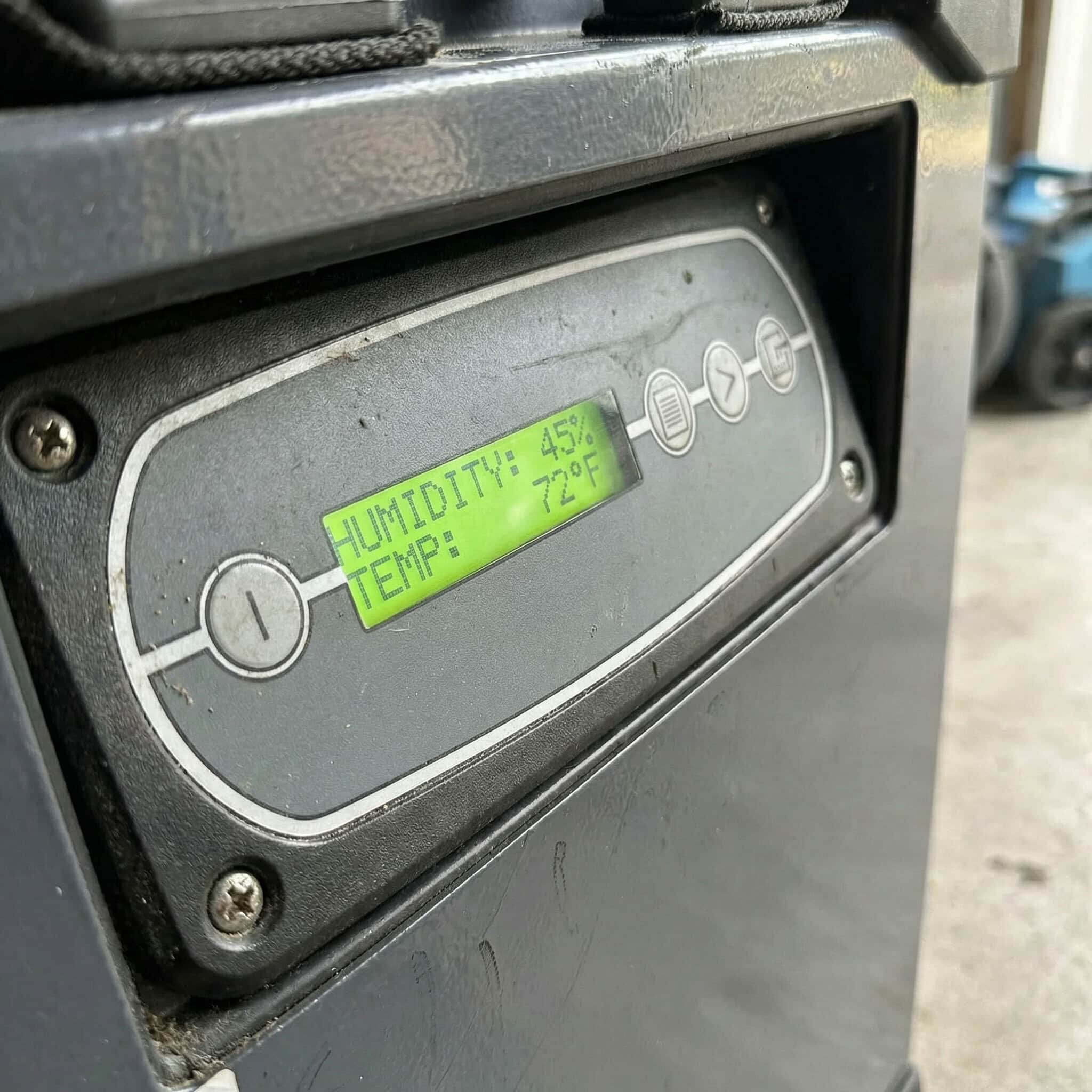
The Cube has a small digital screen and four buttons. There are no warning lights — everything shows as text on the screen.
ON / OFF. Starts and stops the machine. On shutdown it runs a short drying cycle before it’s safe to move — let it finish.
Display / Menu. Cycles the screen through status and the humidity setting. Leave it on the default to just run.
Select / Up. Changes the humidity target, and clears a “Power Failure” message after a power cut.
Purge Pump. Manually clears water out through the hose. It also does this by itself now and then.
Pump-out hose. Water leaves here through the long drain hose. Uncoil it fully and keep it free of kinks. The built-in pump lifts water, so the hose does not have to run downhill.
Intake filter. Pulls damp air in. Keep it clear — a clogged filter is the number-one cause of “no water”.
Most “it’s broken” calls are one of these six. None of them is a fault — the screen is just telling you what it’s doing.
That’s the drying process. It gently warms the room, which speeds things up.
It’s melting frost off the coil. Water pauses for a bit, the fan keeps going, then it carries on.
A short countdown that protects the compressor. It happens every time you switch on.
There is no tank. It pumps water straight out through the hose, so an empty machine is correct.
On a wet job it’s meant to run non-stop for days. Running day and night is what it’s built for.
“PUMP PURGING” on the screen — the pump clearing itself out. You’ll hear it now and then.
Written the way people actually describe it. Each fix takes about a minute.
Nearly always normal: there’s no tank, so it drains through the hose. Otherwise the humidity is set too high, or the filter is clogged.
Check water is running from the hose end. Set the humidity target to its lowest (or continuous). If the air filter looks blocked, tell us – it is replaced, not washed.
It’s running a normal defrost — melting frost off the coil so it can keep working.
Nothing needed. The fan stays on, water pauses for a short while, then it resumes on its own.
By design. This type of dehumidifier returns warm, dry air to the room.
Leave it be. The gentle heat helps the room dry faster.
The power was interrupted. The machine flags it so you know it happened.
Press the Select key to clear the message and it carries on. If a socket has tripped, reset your fuse board, wait a moment, switch it back on. Dead with no screen or sound? Call us.
The most common one, and easily fixed: the hose is kinked, the end is raised too high, or the pump float is stuck.
Straighten the hose and drop the end below the machine. Press Purge Pump. Still showing? Switch off, unplug, check the pump inlet is clear, then restart.
The hose isn’t seated, runs uphill, or the machine was unplugged mid-shutdown and dripped when moved.
Reseat the hose, uncoil it fully and clear any kinks or trapped loops. Always let “WAIT FOR UNIT DRYING” finish before you unplug or move it.
All yes and still stuck? Two minutes on WhatsApp usually sorts it.
Press OFF and let “WAIT FOR UNIT DRYING” finish, then unplug.
Press Purge to clear the pump, disconnect the hose, let it finish dripping.
Coil the cable and hose loosely over the unit; wipe the filter if it’s easy.
Leave it level and dry, ready by the door if access is tight.
Handed back like this, your deposit goes straight back — no questions, no delays.
Clear, honest answers for the questions we hear most about hiring an industrial dehumidifier.
The Cube is £39.99 a day, or £74.99 for 3–7 days, with longer hires tapering to £11.20/day. London delivery is from £35. That covers a genuine 43L commercial unit — comparable to what larger firms charge, with clearer pricing.
For a single small damp room, a 20–38L compact is plenty. For a whole flooded room, a burst pipe or drying-out, the Cube’s 43L is the sensible all-rounder. Multiple rooms or deep-soaked masonry call for a 55–95L unit.
Surface and air usually clear in a few days; a fully wet room takes considerably longer; deep-soaked walls and floors take longer — we can’t promise a fixed timescale. Fix the source of water first, keep the room closed, and judge by the readings, not by how the air feels.
Yes, but dry it gradually. Let fresh plaster firm up for a day or two first, then dry gradually — forcing it bone-dry too soon is what causes cracks. The Cube is well suited to this once the room is warm and sealed.
Below about 15°C, refrigerant dehumidifiers like the Cube lose output, and near freezing they struggle. For cold spaces a desiccant unit is the right tool — tell us the conditions and we’ll point you to it.
No tank. The Cube has a built-in pump that pushes water out continuously through a long drain hose to a sink, drain or gully — so you can reach across a room. You never empty a bucket, just leave it running.
ID Required
Valid photo ID at delivery. Hire terms
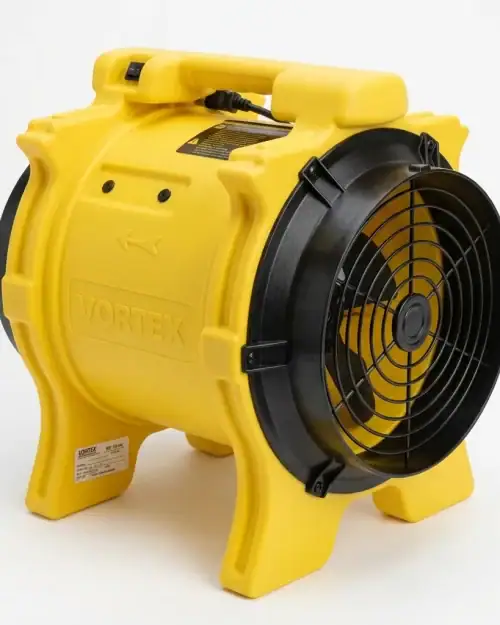
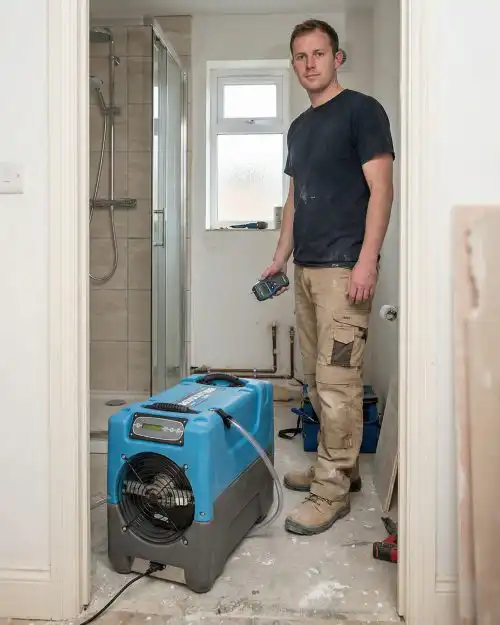
Dehumidifier Hire London
Industrial Dehumidifier Hire London | 230V Low Grain (LGR) Building Dryer (63L)
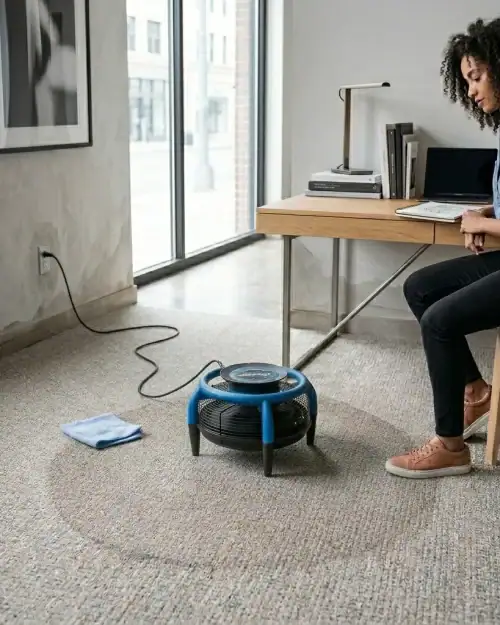

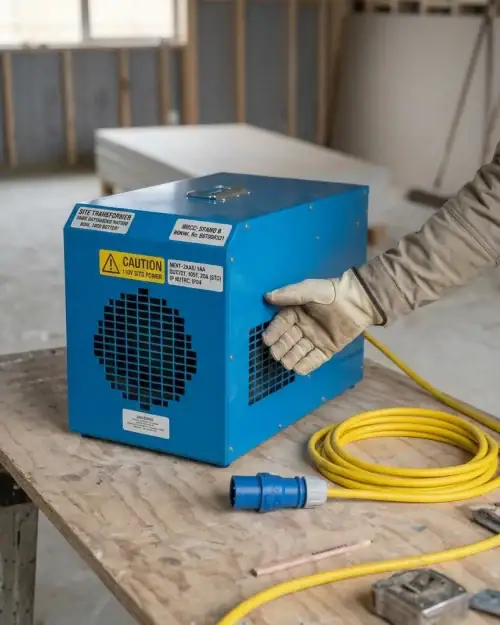
Drying & Heating
3kW 110v Fan Heater Hire London | 110V 32A Industrial Site Heater
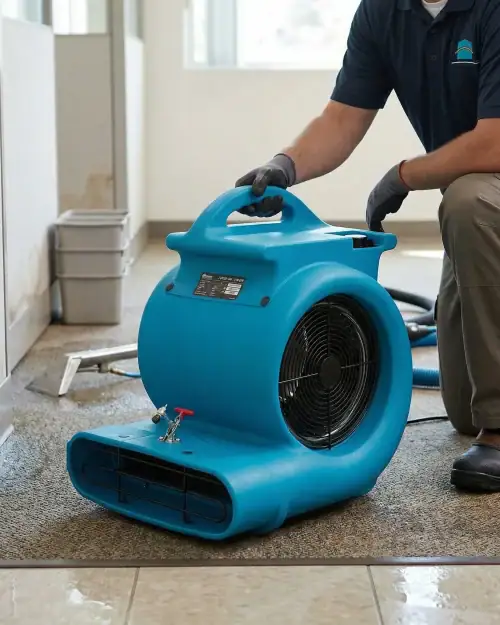
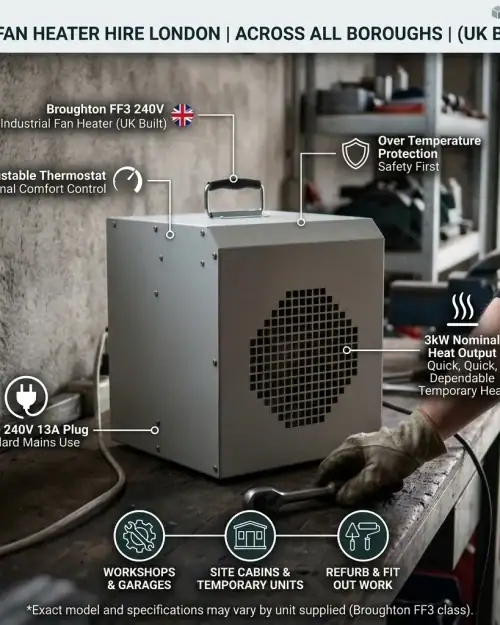
Drying & Heating
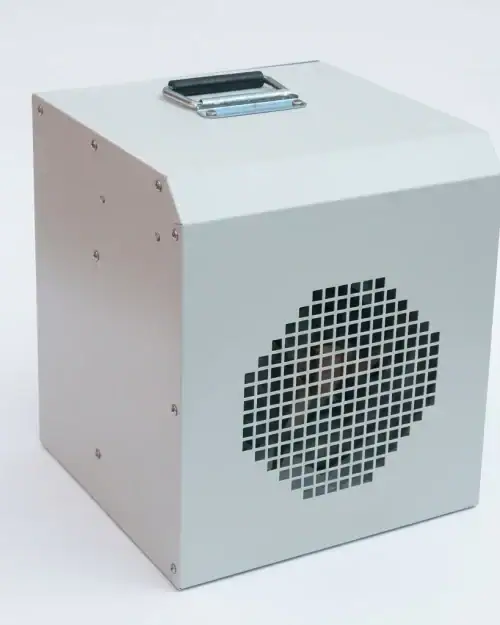
3kW Fan Heater Hire London | Broughton Industrial 240V (UK Built)
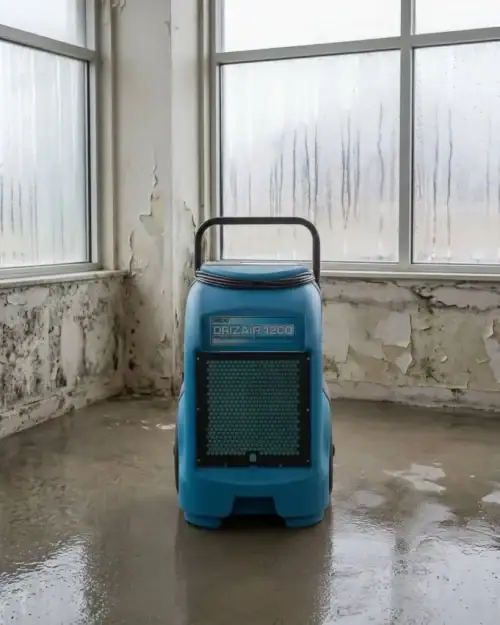
Dehumidifier Hire London
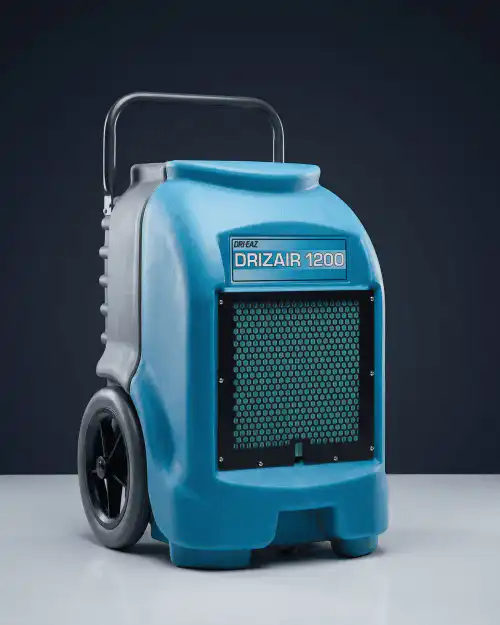
55L Industrial Dehumidifier Hire London | Dri-Eaz DrizAir 1200 (230V)
If you hired from Hireload without an account, enter the email you booked with. We’ll email you a link to set up your account, where you can see your hires and extend them online.
 Drone Survey & Mapping
 Drone Inspections