
 Drone Services
 Access Equipment
 Breaking & Drilling
 Cleaning Equipment
 Drying & Heating
 General Site Tools
Equipment Hire Guides
How Long Does It Take to Dry Out a Room? Real Timelines by Situation
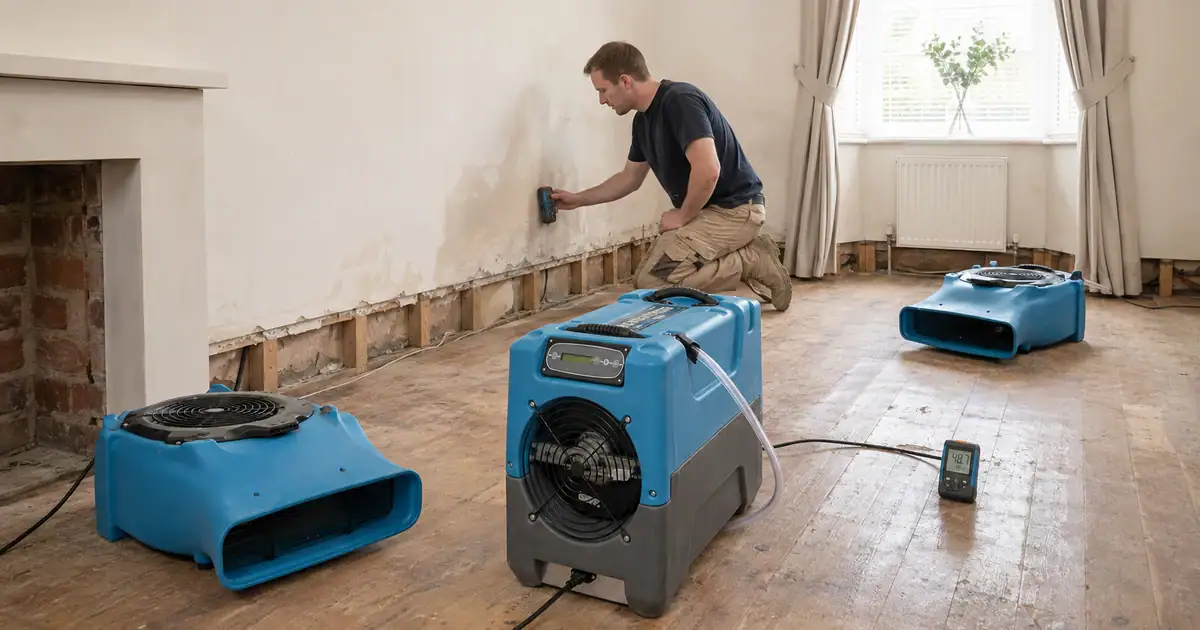
How Long Does It Take to Dry Out a Room? — Real drying timelines for leaks, floods, plaster, and persistent damp, with the right equipment for each situation.
Hireload delivers equipment across London from our Greenford / UB6 operating area. View full London delivery areas.
Why Nobody Gives You a Straight Answer
Every drying company, forum post, and insurance assessor says “it depends.” They’re not wrong — but they’re not helpful either.
The truth is that drying times vary based on four things: how much water got in, what materials absorbed it, what equipment you’re running, and how the room is ventilated. You can’t predict it to the hour, but you can get a realistic range for your specific situation.
That’s what this guide does.
Drying Timelines by Situation
Light Leak — Small Spill, Caught Quickly
What happened: Washing machine overflow, minor pipe drip caught within hours, small roof leak during rain.
Typical drying time: 2–4 days with a commercial dehumidifier.
Equipment: 1x 38L dehumidifier. Air movers optional but speed things up.
Why this is fast: The water didn’t have time to soak deep into building materials. Surface moisture is the easiest to extract. If you caught it within a few hours, carpet underlay and plaster probably aren’t saturated.
Single Room Leak — Burst Pipe or Radiator
What happened: Pipe burst under the sink, radiator joint failed, overflow from upstairs bathroom. Water was on the floor for several hours or overnight.
Typical drying time: 5–10 days with a commercial dehumidifier and 1–2 air movers.
Equipment: 1x 38–43L dehumidifier + 1–2 air movers.
What extends the time: Carpet and underlay that fully saturated. Plasterboard that absorbed water from the back. MDF kitchen units that swelled. If water was standing for more than 12 hours, expect the upper end of this range.
What shortens it: Hard floors with no underlay. Quick extraction of standing water before equipment went in. Good ambient temperature (18°C+).
Multi-Room Flooding — Mains Burst or External Water
What happened: Mains supply burst, severe roof leak across several rooms, ground-floor flooding from outside.
Typical drying time: 1–3 weeks with industrial dehumidifiers and multiple air movers.
Equipment: 1–2x industrial dehumidifiers (63–90L) + 3–4 air movers per floor.
Drying Calculator
Two quick questions and we'll size the right dehumidifier — and tell you how long to hire it.
What extends the time: Contaminated water (sewage, external flooding) requires cleaning before drying. Multiple material layers — carpet, underlay, screed, plaster — each hold moisture at different depths. Poor ventilation in Victorian or period properties.
Important: At this scale, consider a professional drying assessment. Insurance companies typically appoint drying specialists for large claims, and they’ll monitor moisture levels with specialist meters throughout the process.
Plaster Drying After Renovation
What happened: Walls freshly plastered during renovation. You need them dry enough to paint or wallpaper.
Typical drying time: 5–10 days with a dehumidifier, after an initial 48-hour natural cure period.
Equipment: 1x industrial dehumidifier (55–90L) per large room. No air movers for the first 48 hours — direct airflow on wet plaster causes surface cracking.
What affects the timeline: Plaster thickness, number of coats, ambient temperature, and the time of year. Winter plastering dries significantly slower without equipment. Two-coat systems take longer than single skim.
The rule: Don’t paint until the plaster has changed from dark to uniformly light across the entire surface. If patches remain darker, it’s still drying.
Persistent Damp or Condensation
What happened: No single event — the room has been damp for weeks or months. Condensation on windows, musty smell, possibly visible mould.
Typical drying time: 3–7 days with a compact dehumidifier, but the damp may return unless the underlying cause is fixed.
Equipment: 1x compact dehumidifier (19–20L).
Key point: A dehumidifier treats the symptom. If the root cause is poor ventilation, a leaking pipe behind a wall, or rising damp, the moisture will return after you stop running the equipment. Use the dehumidifier to get the room under control, but investigate why the damp is there in the first place.
What Slows Drying Down (and What Speeds It Up)
Slows it down:
- Leaving windows open (introduces outdoor humidity)
- Running equipment without air movers (halves evaporation rate)
- Keeping furniture and carpet in place over wet subfloor
- Low ambient temperature (below 15°C reduces dehumidifier efficiency)
- Dehumidifier tank filling up and shutting the unit off overnight
Speeds it up:
- Using dehumidifier and air movers together
- Lifting carpet edges to expose underlay
- Running continuous drain hose so the dehumidifier never stops
- Keeping the room at 18–22°C (dehumidifiers work best in this range — if the space is cold, adding a heater can make a significant difference)
- Removing saturated materials that can’t be saved (MDF units, ruined underlay)
How Do You Know When It’s Actually Dry?
You can’t always trust how a room feels. Surfaces might feel dry while moisture is still trapped behind plaster or under flooring. Here’s a practical checklist:
Good signs it’s dry: The dehumidifier tank is barely collecting water after 24 hours. No condensation forming on cold surfaces. No musty smell. Walls feel the same temperature as the rest of the room — not cooler.
Signs it’s not dry yet: The tank is still filling noticeably. Patches of wall are visibly darker or feel cool to touch. Skirting boards are still swollen. The musty smell returns when equipment is switched off.
For certainty: A moisture meter reading confirms what your senses suspect. Professional drying companies use pin-type and non-invasive meters to check moisture content in walls, floors, and timber. For insurance claims, a “drying certificate” is issued based on these readings.
What the equipment costs while it runs
Drying time and hire cost are the same question asked twice. These are our own rates, ex-VAT, matching each product page.
| Machine | 1 day | 2 days | Up to a week | Longer |
|---|---|---|---|---|
| 19L compact — one room, standard plug | £19.99 | £24.99 | £34.99 | £4.50/day |
| 38L commercial — a flat or a floor | £29.99 | £44.99 | £59.99 | £8.40/day |
| 43L Dri-Eaz Cube — stacks in tight spaces | £39.99 | £59.99 | £74.99 | £11.20/day |
| 63L LGR — cold rooms, heavy saturation | £59.99 | £89.99 | £119.99 | £16.80/day |
| Air mover — per unit | £19.99 | £24.99 | £29.99 | £4.80/day |
Prices are ex-VAT and match each product page. A refundable deposit applies and comes back in full when the equipment returns undamaged. Delivery is £35 + VAT next working day, £59 before 11am, £69 same day, or collect free from Greenford UB6.
Reading the table against the timelines above. A single-room leak drying in five to seven days sits inside the one-week band, so a 38L unit and an air mover is £89.98 + VAT for the whole job. Plaster drying over three weeks is better hired on the longer-term daily rate — £8.40 a day rather than three separate weekly hires.
Frequently Asked Questions
A whole flooded property runs on a different clock to a single damp room. How long a flooded house takes to dry uses the UK government drying figures, including why a solid wall takes around four times as long as a single skin.
Get the Right Equipment for Your Drying Job
Browse our drying range, or call us on 020 3375 4048 if you’re not sure what you need for your situation.
Browse Drying Equipment
 Drone Survey & Mapping
 Drone Inspections