
 Drone Services
 Access Equipment
 Breaking & Drilling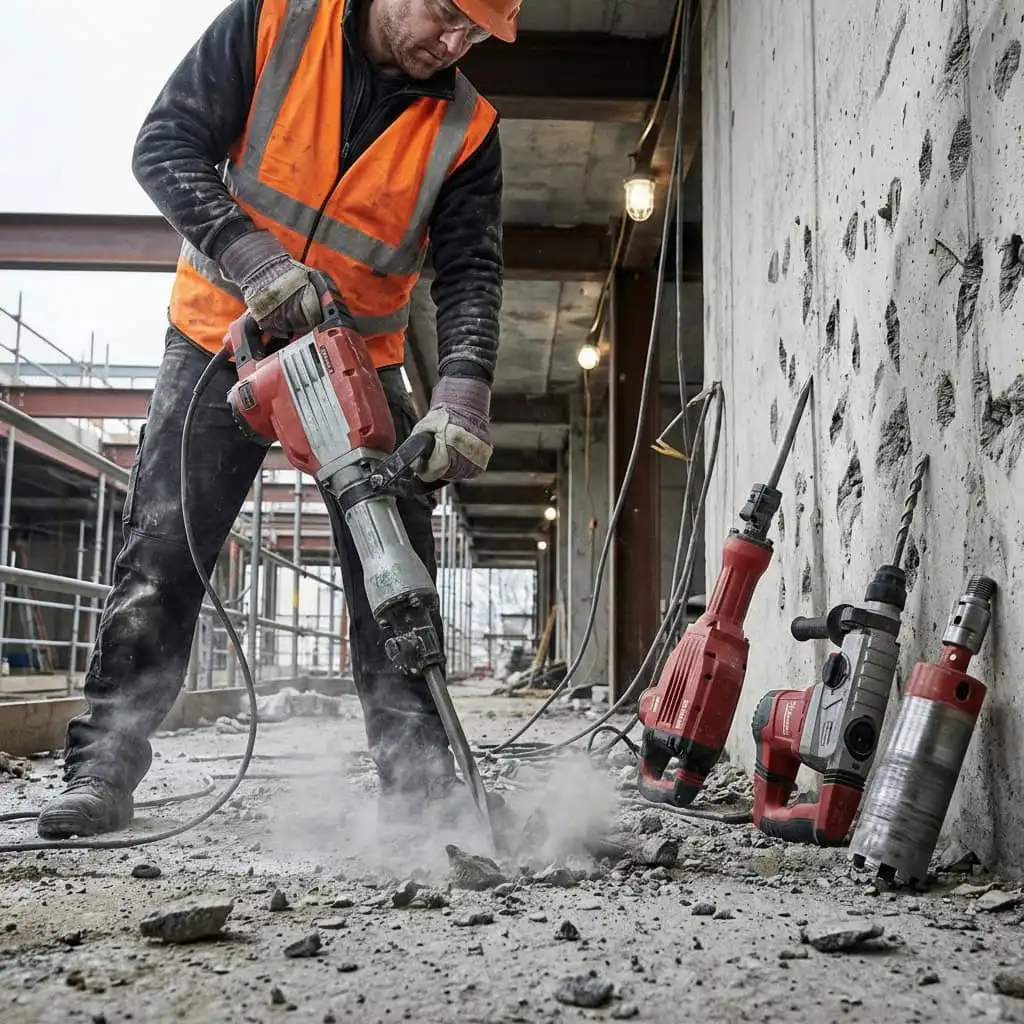
 Cleaning Equipment
 Drying & Heating
 General Site Tools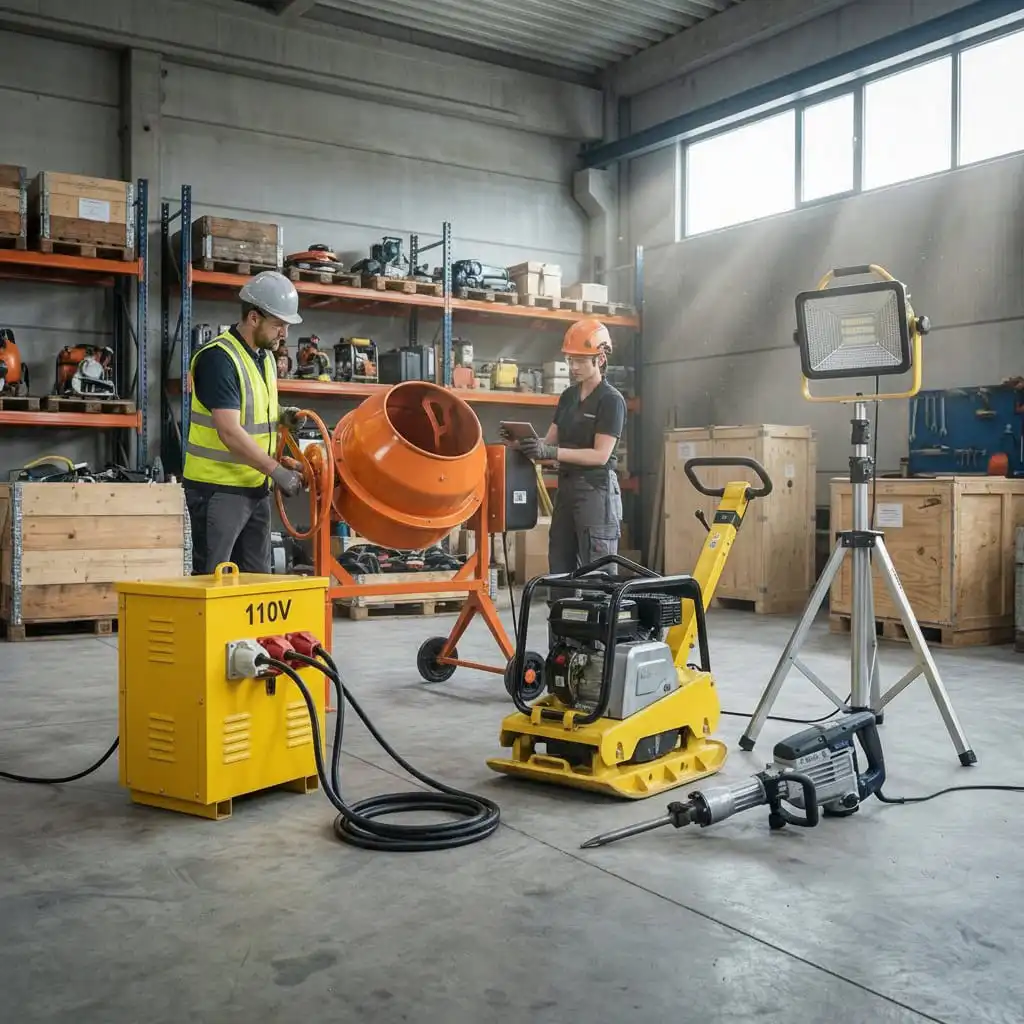
Equipment Hire Guides
What Size Breaker Do I Need? Light, Medium, and Heavy Duty Explained
Why Choosing the Right Size Matters
A breaker that is too light for the job bounces off the surface and barely chips it — the operator exhausts themselves and the work takes three times longer than it should. A breaker that is too heavy for the job is harder to control, damages surrounding material you wanted to keep, and increases the risk of hand-arm vibration injuries.
Getting the size right is not about power for its own sake. It is about matching the impact energy to the material you are breaking, the depth of the break, and how long the operator needs to work.
Light Breakers: When to Use Them
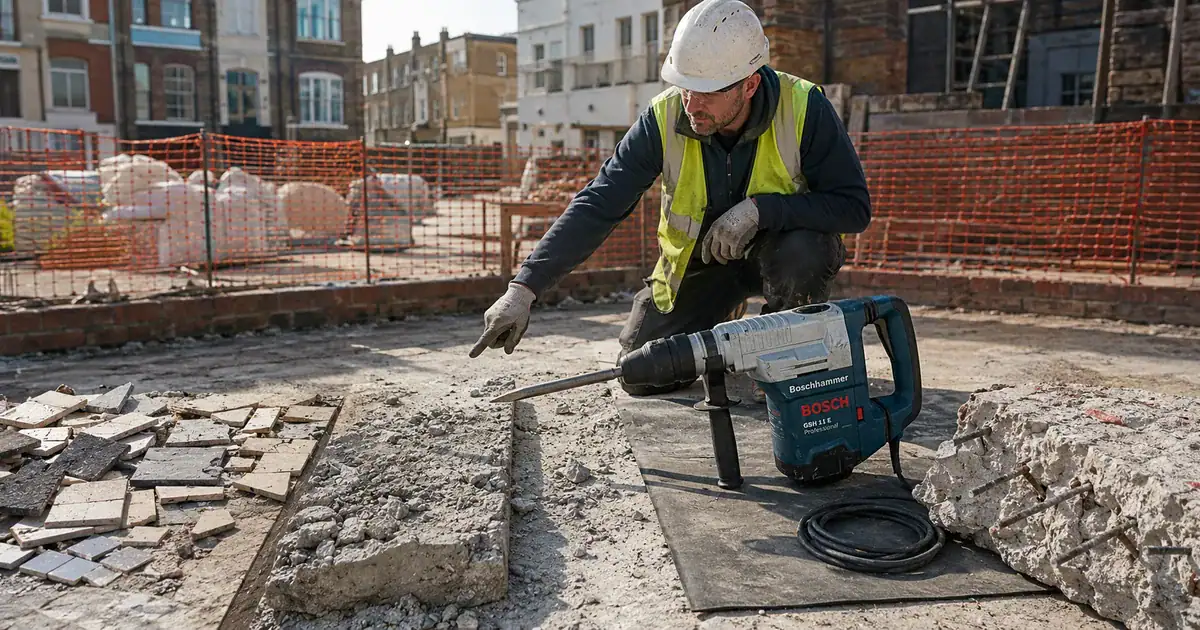
Light breakers are SDS Max demolition hammers weighing roughly 5–10 kg. They deliver enough impact to break through tiles, thin screed, plaster, render, brickwork mortar joints, and light concrete — but they are not designed for thick structural concrete or road surfaces.
Best for: bathroom and kitchen strip-outs, chasing channels in walls for pipes and cables, removing old floor tiles and adhesive, knocking out door or window openings in single-skin blockwork, and breaking up thin concrete paths under 75 mm.
Light breakers run on 110V and plug into a standard 32A site transformer outlet. They are easy to handle one-handed in some positions, making them the first choice for overhead and vertical work where a heavier machine would be dangerous.
Medium Breakers: The All-Rounder
Medium breakers weigh roughly 10–16 kg and deliver significantly more impact energy than a light demolition hammer. They handle concrete up to about 150 mm thick, dense blockwork, paving slabs, and asphalt overlays.
Best for: breaking up concrete garden paths and patios, removing paving slabs bedded in concrete, demolishing internal concrete block walls, cutting through dense mortar and brickwork, and general renovation demolition where a light breaker would be too slow.
Medium breakers are the most commonly hired size because they cover the widest range of jobs. For most domestic renovation and small commercial work, this is the size to start with. If it struggles, step up to a heavy-duty unit. If it feels overpowered, drop to a light breaker.
Heavy Duty Road Breakers: When You Need Serious Impact
Heavy duty road breakers are built for one job: breaking thick, reinforced material that lighter tools cannot handle. If you are working on mass concrete over 200 mm, reinforced foundations, tarmac road surfaces, or compacted rock, a heavy breaker is the only realistic option.
These machines weigh 25-30 kg and deliver impact energy in the range of 40-60 joules per blow. That extra mass and force is what separates a heavy breaker from a medium — it does not just chip at the surface, it drives through it. On a road reinstatement job or foundation removal, a medium breaker would take three or four times as long and burn through chisels in the process.
The trade-off is weight and fatigue. A 30 kg breaker held at waist height for an hour will exhaust most operators. Plan your work in shorter bursts, rotate operators where possible, and always check your site’s HAV exposure limits before starting.
Power Supply: Why 110V Matters on Site
Every breaker in our hire range runs on 110V via a centre-tapped transformer — not 240V mains. This is not optional. UK construction site regulations (BS 7671 and HSE guidance note GS24) require 110V reduced-voltage supply for portable tools used outdoors or in wet conditions.
The reason is safety. A 110V centre-tapped system delivers a maximum of 55V to earth. If a cable is cut or a tool develops a fault, 55V is survivable. 240V in the same situation can kill. Every construction site should have a suitable step-down transformer before any power tools are connected.
If you do not have a transformer on site, we hire those too. A 3 kVA or 5 kVA 110V site transformer plugs into a standard 240V supply and gives you the safe, regulation-compliant output you need.
Choosing the Right Chisel
The chisel does the actual cutting — the breaker just provides the impact force behind it. Choosing the wrong chisel for the job is one of the most common mistakes, and it either slows you down or damages the material you are trying to preserve.
Point Chisel (Moil Point)
Best for initial penetration and breaking into solid, unreinforced material. The concentrated tip focuses all the impact energy into a small area, cracking concrete or masonry before you switch to a wider chisel to clear the debris. Use a point chisel when starting a hole, breaking into a new area, or working on hard natural stone.
Flat Chisel (Spade)
Best for lifting, scraping, and removing material in layers. A flat chisel works underneath tiles, screed, or tarmac to lift them away from the sub-base. It is also the right choice for cleaning up after a point chisel has done the initial break — levelling rough concrete, trimming edges, or removing a thin topping layer without going deeper than you need to.
Narrow Chisel (Cold Chisel)
Best for cutting channels and chasing. If you need a cable trench, pipe chase, or expansion joint cut into concrete or masonry, a narrow chisel gives you a controlled, straight-sided channel. It removes less material per blow than a flat chisel, which is exactly the point — precision, not speed.
Which Breaker for Which Job
This table covers the most common breaking scenarios. Match your material and task to the right breaker class — oversizing wastes money and increases fatigue, undersizing wastes time and wears out chisels.
| Job | Material | Recommended Breaker | Why |
|---|---|---|---|
| Removing wall tiles | Ceramic on plaster/render | Light breaker | Enough force to pop tiles without damaging the wall behind |
| Chasing cables into block walls | Aerated block / breeze block | Light breaker | Precise channelling without cracking the whole block |
| Breaking up a patio | Concrete slabs 50-75 mm | Medium breaker | Slabs crack cleanly with medium impact; light would be too slow |
| Removing floor screed | Sand/cement screed 50-100 mm | Medium breaker | Flat chisel lifts screed in sections without going into the slab below |
| Breaking a concrete drive | Reinforced concrete 100-150 mm | Medium or heavy breaker | Medium handles unreinforced; if there is mesh or rebar, go heavy |
| Foundation removal | Mass concrete 200 mm+ | Heavy duty road breaker | Only a heavy breaker delivers enough energy to crack mass concrete at depth |
| Road reinstatement / tarmac removal | Tarmac + sub-base 150-300 mm | Heavy duty road breaker | Tarmac is flexible and absorbs lighter blows; heavy force cuts through cleanly |
Common Breaker Hire Mistakes
These are the issues we see most often when customers hire breakers for the first time. Avoiding them saves time, money, and frustration.
Hiring too small. A light breaker on a concrete driveway will technically chip away at it — but it will take all day, burn through chisels, and exhaust the operator. If the material is thicker than 75 mm of unreinforced concrete, start with a medium at minimum.
Hiring too big. A heavy road breaker on bathroom tiles will destroy the wall, the floor, and your deposit. Match the tool to the material, not to your enthusiasm. Light breaking jobs need light breakers.
Wrong chisel for the task. Using a point chisel to lift tiles wastes time — you need a flat spade. Using a flat chisel to penetrate solid concrete wastes energy — start with a point. Ask when you collect and we will make sure you have the right chisel fitted.
Ignoring HAV exposure. Vibration is cumulative. Two hours on a heavy breaker in the morning plus an hour on a compactor in the afternoon adds up. If you are managing a site, track exposure across all vibrating tools, not just the breaker.
No 110V transformer. Breakers are 110V tools. If you turn up on site with only a 240V supply, you cannot safely use the breaker. Order a site transformer at the same time — it is a common add-on and saves a wasted trip.
Breakers Available for Hire
We carry light, medium, and heavy breakers for delivery across London. All units are 110V, PAT tested, and supplied with a standard chisel fitted. If you need a specific chisel type, let us know when you book.
Related Guides
If you are planning a project that involves breaking, these guides cover related equipment and decisions.
What breaker hire costs
The jump between classes is mostly about weight and blow energy, and the price follows it. These are our own rates, ex-VAT, matching each product page.
| Breaker | 1 day | 2 days | Up to a week | Longer |
|---|---|---|---|---|
| Light breaker (110V) — tiles, screed, thin slab | £24.99 | £37.79 | £49.00 | £6.99/day |
| Bosch GSH 11E medium — walls, floors, general demolition | £28.60 | £39.99 | £55.00 | £7.70/day |
| Medium-duty SDS-max — reinforced slab, footings | £57.99 | £82.99 | £109.99 | £15.39/day |
| Heavy-duty road breaker — driveways, hardstanding, concrete bases | £77.99 | £112.99 | £149.99 | £20.99/day |
Prices are ex-VAT and match each product page. A refundable deposit applies and comes back in full when the equipment returns undamaged. 110V tools need a site transformer — tell us at booking and one goes on the same delivery. Delivery is £35 + VAT next working day, or collect free from Greenford UB6.
A worked example. Lifting a domestic concrete driveway over a weekend: the heavy-duty road breaker at £112.99 + VAT for two days. Taking up bathroom screed and tiles: the light 110V breaker at £24.99 for the day — going heavier here just means a heavier tool to hold overhead, not a faster job.
Frequently Asked Questions
What is the difference between a light breaker and an SDS drill?
Can I use a 240V breaker on a construction site?
How long can I use a breaker before HAV limits kick in?
Do I need different chisels for different jobs?
Can a medium breaker handle reinforced concrete?

 Drone Survey & Mapping
 Drone Inspections