
 Drone Services
 Access Equipment
 Breaking & Drilling
 Cleaning Equipment
 Drying & Heating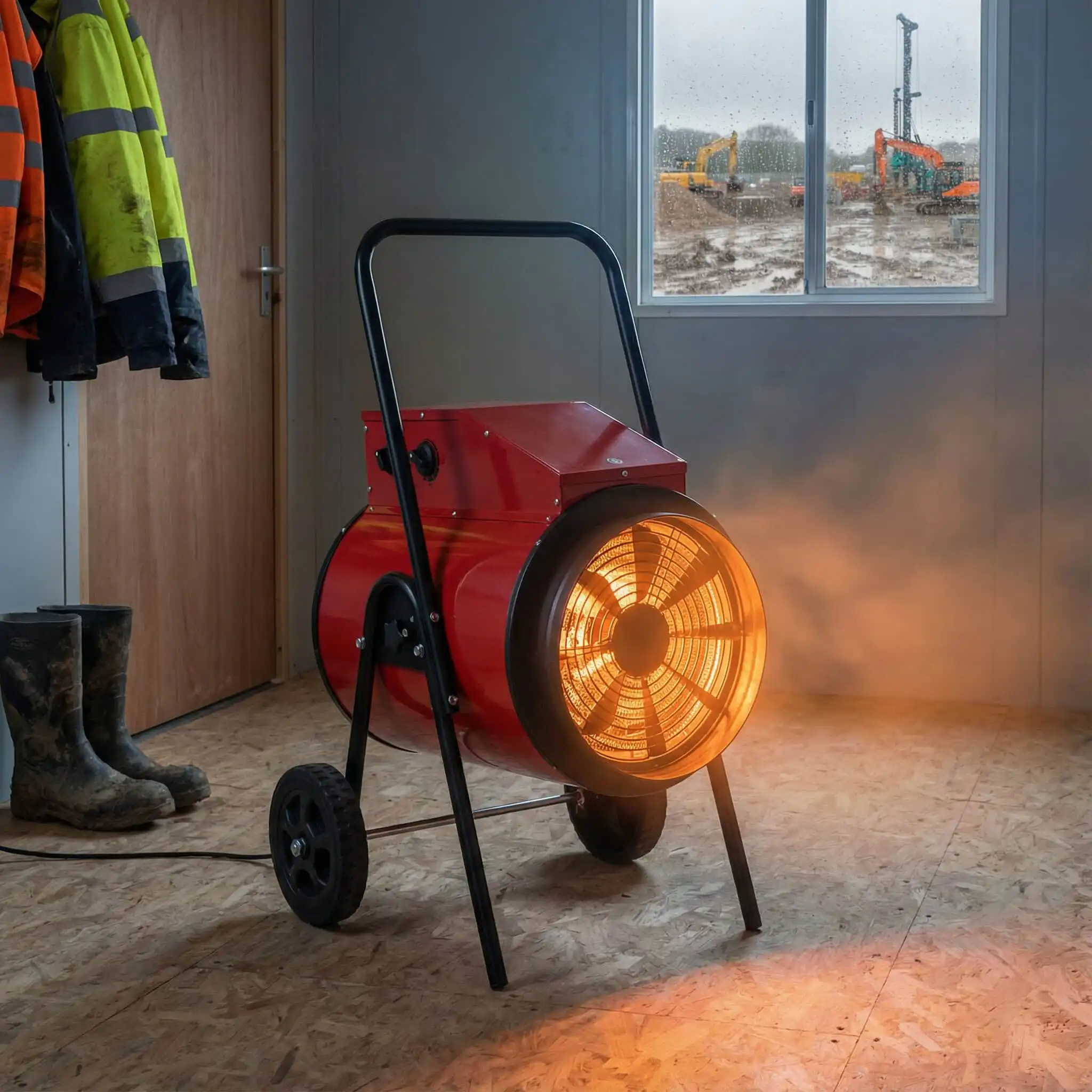
 General Site Tools
Equipment Hire Guides
What Size Heater Do I Need for a Site, Workshop, or Warehouse?
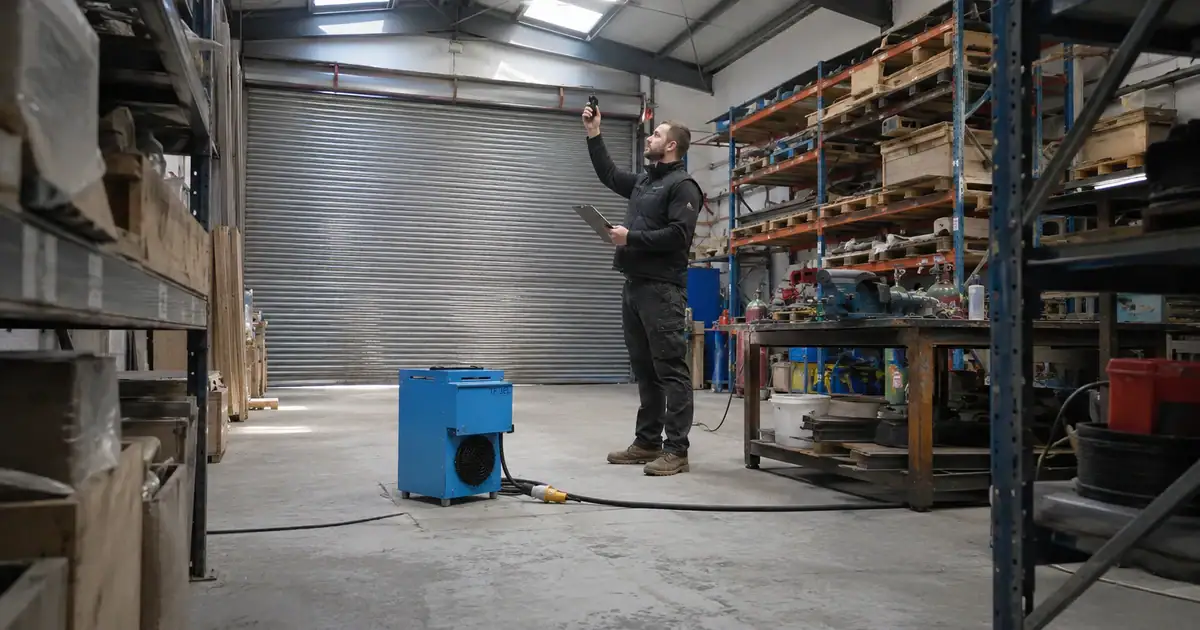
Why Getting the Size Right Matters
An undersized heater runs flat out and never reaches a comfortable temperature. An oversized heater wastes money on hire costs and electricity you did not need. Both are common on construction sites, workshops, and warehouses across London — and both are avoidable with a two-minute calculation.
The Health and Safety Executive recommends a minimum of 16°C for sedentary work and 13°C for physically active work. On a construction site in winter, ambient temperatures can sit below 5°C. That gap is what your heater needs to bridge — and the size of the gap depends on the volume of space, how well it is insulated, and how much air escapes through doors, openings, and gaps.
How to Calculate the Right Heater Size
The calculation is straightforward. Measure the length, width, and height of the space in metres, then multiply them together to get the volume in cubic metres.
Volume (m³) = Length × Width × Height
Next, divide by an insulation factor:
Well-insulated space (sealed workshop, site cabin, office with double glazing): divide by 25. This gives you the kW needed.
Averagely insulated space (warehouse with roller doors closed, partially enclosed site area): divide by 18.
Poorly insulated space (open-sided shed, warehouse with regular door openings, unlined steel structure): divide by 14.
For example, a warehouse measuring 20 m × 10 m × 5 m has a volume of 1,000 m³. With average insulation, that needs roughly 1,000 ÷ 18 = 56 kW. With good insulation, it drops to 1,000 ÷ 25 = 40 kW.
Fan Heater vs Infrared Heater vs Oil-Filled Radiator
Not every heater works the same way, and choosing the wrong type for your environment wastes energy even if the kW rating is correct.
Fan heaters blow warm air into the space. They heat quickly, work well in enclosed areas, and are the most common choice for site cabins, workshops, and sealed warehouse zones. The trade-off is that warm air rises — in a high-ceiling warehouse, the heat collects at roof level where nobody benefits. They also lose effectiveness every time a door opens.
Infrared radiant heaters emit heat as radiation, warming objects and people directly rather than heating the air. This makes them excellent for open-sided spaces, areas with frequent door openings, and outdoor covered work zones. The warmth is felt immediately in the target area without needing to heat the entire air volume. They are also silent, with no moving parts.
Oil-filled radiators are quiet, steady, and suited to occupied indoor spaces where background warmth is needed over long periods — offices, drying rooms, or residential refurbishment sites where noise from a fan heater would be disruptive. They take longer to reach full output but maintain temperature more evenly.
Do I Need a Single-Phase or Three-Phase Heater?
This is one of the most important checks before hiring, and getting it wrong means the heater arrives but cannot be plugged in.
Single-phase (240V) is standard UK domestic and light commercial power. Any 13A plug socket provides it. Heaters up to 3 kW run on single-phase without issue. This covers site cabins, small workshops, residential refurbishment sites, and retail fit-outs.
Drying Calculator
Two quick questions and we'll size the right dehumidifier — and tell you how long to hire it.
110V (via transformer) is the construction site standard for safety. A 3 kW 110V fan heater plugs into a standard 32A 110V outlet fed by a site transformer. If your site runs 110V power, you need a 110V-rated heater — a 240V domestic unit will not work.
Three-phase (415V) is needed for heaters above 9 kW. Most industrial and warehouse sites have three-phase supply, but many smaller workshops and site cabins do not. Heaters rated at 9 kW, 15 kW, and 40 kW typically require a three-phase connection.
Common Scenarios and What You Need
Rather than running the calculation every time, here are the most common setups we see across London sites.
A standard site cabin (6 m × 2.4 m × 2.4 m, roughly 35 m³) needs a single 3 kW fan heater on 240V or 110V depending on site power. One unit is enough. Two would overheat the space.
A small workshop or garage (50–100 m³) needs 3–9 kW depending on insulation. A 3 kW unit handles a well-insulated, sealed workshop. If the roller door opens regularly, step up to 9 kW or use an infrared heater pointed at the work zone.
A medium warehouse or commercial unit (300–600 m³) needs 15–40 kW. At this scale, you need three-phase power and an industrial fan heater. If the space has high ceilings and frequent door openings, consider supplementing with infrared at the occupied work stations.
A large warehouse or open industrial space (1,000+ m³) needs 40 kW or multiple units. A single 40 kW industrial fan heater handles up to roughly 700 m³ of averagely insulated space. Beyond that, you need multiple units or a combination of fan heaters for background warmth and infrared for targeted zones.
A residential refurbishment or office fit-out where noise matters more than speed needs an oil-filled radiator at 3 kW per room. Silent operation, no fan noise, steady warmth for painters, plasterers, or office workers.
Which Heater for Which Job?
| Situation | Recommended Heater | Why |
|---|---|---|
| Site cabin or portable office | 3 kW fan heater (240V or 110V) | Small enclosed space, heats in minutes, plugs into standard socket |
| Workshop with doors that stay closed | 3–9 kW fan heater | Fan heater efficient when air stays in the space |
| Workshop or warehouse with frequent door openings | 3 kW infrared radiant heater | Heats people and surfaces directly, not the air that escapes |
| Medium warehouse (300–600 m³) | 15 kW industrial fan heater (3-phase) | Enough output for mid-size spaces, manageable power draw |
| Large warehouse or industrial unit (600+ m³) | 40 kW industrial fan heater (3-phase) | High-volume output for large open spaces |
| Occupied office or residential refurb | 3 kW oil-filled radiator | Silent, steady warmth without fan noise |
| Outdoor covered work zone or loading bay | 3 kW infrared heater on tripod | Radiant heat works outdoors where fan heaters cannot |
Common Heater Hire Mistakes
Hiring a fan heater for a draughty space. If doors open regularly, a fan heater fights a losing battle. The warm air escapes every time the door opens and the heater starts from scratch. An infrared radiant heater avoids this entirely by heating surfaces and people rather than the air.
Ignoring the power supply. The most common reason a heater sits unused on site is a power mismatch. A 15 kW three-phase heater cannot run on a single-phase supply. A 240V heater cannot plug into a 110V site transformer. Always confirm your available power before ordering.
Using a heater for drying without a dehumidifier. Heat alone does not dry a building. It raises the moisture-carrying capacity of the air, which can actually make condensation worse on cold surfaces. Pair heat with dehumidifiers and air movers for effective drying.
Oversizing for a small space. A 15 kW industrial heater in a site cabin will overheat the space in minutes, trip the thermostat repeatedly, and waste hire costs. Match the heater to the volume.
Heaters Available for Hire
We stock electric heaters across the full range — from 3 kW single-phase units for site cabins to 40 kW three-phase industrial heaters for warehouses. All delivered across London.
3 kW Fan Heater (240V)3 kW Fan Heater (110V)3 kW Infrared Radiant Heater3 kW Oil-Filled Radiator9 kW Industrial Heater (3-Phase)15 kW Industrial Heater (3-Phase)40 kW Industrial Heater (3-Phase)
What heater hire costs
Sizing only helps if the number attached to it is real. These are our own rates, ex-VAT, matching each product page.
| Heater | 1 day | 2 days | Up to a week | Longer |
|---|---|---|---|---|
| 3kW fan heater (240V) — cabins, single rooms | £19.99 | £29.99 | £39.99 | £5.60/day |
| 3kW fan heater (110V site) — transformer supply | £19.99 | £29.99 | £39.99 | £5.60/day |
| 3kW infrared radiant — heats people and surfaces, not air | £19.99 | £29.99 | £39.99 | £5.60/day |
| 9kW industrial (3-phase) — workshops, small units | £24.99 | £39.99 | £49.99 | £6.99/day |
| 40kW industrial (3-phase) — warehouses, large open spans | £64.49 | £99.99 | £129.99 | £18.20/day |
Prices are ex-VAT and match each product page. A refundable deposit applies and comes back in full when the equipment returns undamaged. Delivery is £35 + VAT next working day, or collect free from Greenford UB6.
A worked example. A site cabin through a cold week: a 3kW fan heater at £39.99 + VAT for up to a week. A 400 m² warehouse over the same week: the 40kW three-phase unit at £129.99 — but check you have the three-phase supply before you book, because that is what most often stops a heater working on arrival.
Related Guides
How to Dry a Room After a LeakWhat Size Dehumidifier Do I Need?Browse All Drying and Heating
On a drying job the heater is not there for comfort — it is there to lift the air into the band where the dehumidifier can work. Dehumidifier not working in the cold? explains why, and which pairing to book.
Frequently Asked Questions
How many kW do I need per square metre?
Can I use a 240V heater on a 110V construction site?
Is a fan heater or infrared heater better for a warehouse?
Do I need three-phase power for an industrial heater?
Can I use a heater to speed up plaster or screed drying?

 Drone Survey & Mapping
 Drone Inspections