
 Drone Services
 Access Equipment
 Breaking & Drilling
 Cleaning Equipment
 Drying & Heating
 General Site Tools
Equipment Hire Guides
What Size Dehumidifier Do I Need for a Damp Room or Flood Drying Job?
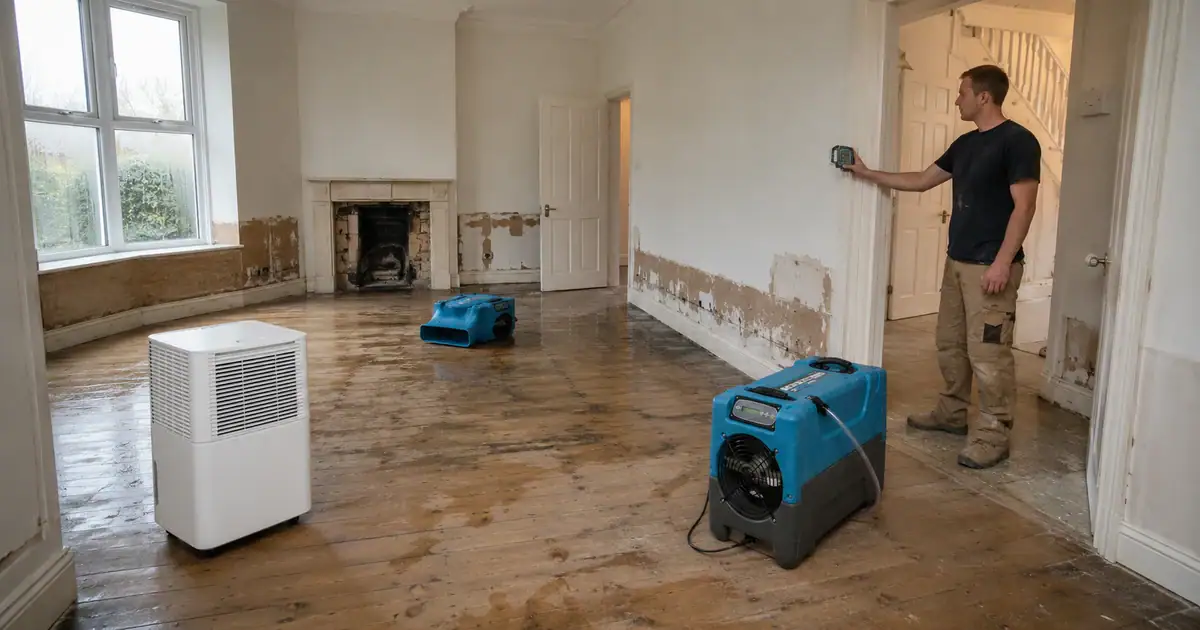
Why Dehumidifier Size Matters More Than You Think
An undersized dehumidifier will run constantly without making progress. It pulls moisture from the air, but the walls, floor, and materials release water faster than the machine can extract it. The room stays damp, drying takes weeks instead of days, and mould gets a head start.
An oversized unit, on the other hand, is rarely a problem. It simply finishes the job faster and cycles off when humidity drops to the target level. For hire, this means fewer days on your booking and lower total cost.
The metric that matters is extraction rate, measured in litres per day (L/day). This tells you how much water the machine can pull from the air in 24 hours. But extraction rate alone is not the full picture. You also need to consider airflow, measured in cubic metres per hour (m³/hr), which determines how much air the machine actually processes.
How to Calculate the Right Size for Your Room
Start with the volume of your space. Multiply the floor area in square metres by the ceiling height. A standard UK room with 2.4 m ceilings and a floor area of 20 m² has a volume of 48 m³.
Next, assess the severity of the damp. There is a significant difference between condensation damp and standing water from a burst pipe. Here is a practical sizing framework:
Condensation or mild damp — humidity is high but there is no visible water. Walls may feel cold and damp to the touch, or you can see mould patches forming. A unit extracting 20–38 L/day will manage this in rooms up to about 30 m².
Minor leak or localised water damage — a section of carpet or underlay is wet, plaster is damp to touch, or there has been a small pipe leak. A professional unit extracting 38–50 L/day is the right range, paired with at least one air mover to accelerate evaporation from surfaces.
Flood or major water ingress — standing water has been removed but the entire floor, underlay, and lower walls are saturated. You need an industrial unit pulling 50–70+ L/day with high airflow (300+ m³/hr), paired with two or more air movers. For larger areas, use multiple units.
Extraction Rate vs Airflow — What Actually Matters
Domestic dehumidifiers sold in retail shops are rated at 10–20 litres per day with airflow around 100–180 m³/hr. They are designed to keep a living space comfortable, not to dry out a room after water damage.
Professional hire units operate at a different level. A mid-range professional dehumidifier extracts 38–43 litres per day and processes 300–400 m³/hr of air. A high-capacity LGR (Low Grain Refrigerant) unit can extract 60+ litres per day and is specifically engineered for deep structural drying.
The airflow difference is critical. A domestic unit might have the rated capacity to handle a room’s moisture load in theory, but it cannot physically move enough air to reach the moisture trapped in walls, underlay, and timber. Professional units solve this with high-volume fans that create the air circulation needed to draw moisture out of materials and into the extraction cycle.
When a Dehumidifier Alone Is Not Enough
A dehumidifier extracts moisture from the air. But if the moisture is locked inside carpets, underlay, plaster, or timber, it needs help getting into the air first. That is where air movers come in.
Air movers (also called carpet dryers or blower fans) direct high-velocity air across wet surfaces, accelerating evaporation. The dehumidifier then captures the moisture from the air. Without air movers, the dehumidifier sits in a room waiting for moisture to slowly migrate from materials into the air — a process that can take weeks.
Drying Calculator
Two quick questions and we'll size the right dehumidifier — and tell you how long to hire it.
For any job beyond mild condensation damp, you should pair your dehumidifier with at least one air mover per 15–20 m² of wet floor area. For flood damage, use two or more.
In cold conditions (below about 15°C), compressor-based dehumidifiers lose efficiency. If you are drying a room during winter or in an unheated property, consider adding a heater to boost the drying process. Warmer air holds more moisture, which means the dehumidifier can extract more per cycle.
Heavy-Duty Dehumidifier (38L/Day)Compact Professional Dehumidifier (43L)LGR Industrial Dehumidifier (63L)Choosing the Right Size — Quick Decision Table
| Situation | Room Size | Recommended Setup |
|---|---|---|
| Condensation damp, single room | Up to 20 m² | 38 L/day dehumidifier, ventilation |
| Minor leak, wet carpet or underlay | 15–30 m² | 38–43 L/day dehumidifier + 1 air mover |
| Moderate leak, damp plaster + floor | 20–50 m² | 43–63 L/day dehumidifier + 2 air movers |
| Flood, whole floor saturated | 30–60 m² | 63 L/day LGR unit + 3–4 air movers |
| Multi-room or commercial flood | 60+ m² | Multiple units + air movers + heater if cold |
Common Sizing Mistakes
Using a domestic unit for water damage. A 12–20 L/day domestic dehumidifier is designed to control humidity in a dry home. It is not built to remove the volume of water left behind by a leak or flood. The tank fills constantly, the compressor runs flat out, and the room barely improves.
Ignoring ceiling height. A 20 m² room with 3.5 m ceilings (a Victorian conversion, for example) has 73 m³ of air volume — over 50% more than the same footprint with standard 2.4 m ceilings. Size by volume, not just floor area.
Forgetting air movers. The dehumidifier handles moisture in the air. Air movers handle moisture in the materials. Without both, drying stalls.
Running in a sealed room with no heat. Compressor dehumidifiers become less efficient below about 15°C. In winter, an unheated room can drop below this threshold, especially overnight. If the room is cold, add a small fan heater to keep the air above 18°C.
Drying Packages — The Easier Way to Get the Right Setup
If you are not sure which individual units to combine, a drying package takes the guesswork out. Packages bundle a dehumidifier with the right number of air movers for a given scenario, so you get a matched setup without having to calculate airflow ratios yourself.
For a single wet room after a minor leak, an entry-level package with one dehumidifier and one air mover covers most situations. For a larger space or heavier water damage, step up to a package with a higher-capacity dehumidifier and additional air movers.
Entry Drying PackageBest Value Drying PackageCompact Pro Drying PackageWhat each size costs to hire
Sizing is only half the decision — here is what each machine costs. Rates are ex-VAT and match each product page.
| Machine | 1 day | 2 days | Up to a week | Longer |
|---|---|---|---|---|
| 19L compact — one room, standard plug | £19.99 | £24.99 | £34.99 | £4.50/day |
| 38L commercial — a flat or a floor | £29.99 | £44.99 | £59.99 | £8.40/day |
| 43L Dri-Eaz Cube — stacks in tight spaces | £39.99 | £59.99 | £74.99 | £11.20/day |
| 63L LGR — cold rooms, heavy saturation | £59.99 | £89.99 | £119.99 | £16.80/day |
| Air mover — per unit | £19.99 | £24.99 | £29.99 | £4.80/day |
Prices are ex-VAT and match each product page. A refundable deposit applies and comes back in full when the equipment returns undamaged. Delivery is £35 + VAT next working day, £59 before 11am, £69 same day, or collect free from Greenford UB6.
A worked example. A two-bedroom flat drying out after a leak, one week: the 38L commercial unit at £59.99 plus one air mover at £29.99 comes to £89.98 + VAT. Going one size up costs less than running an undersized machine for an extra week.
Related Guides
These guides cover the next questions most people have after choosing the right size dehumidifier:
How to Dry a Room After a Leak — full setup guide for positioning equipment and monitoring progress.
How Many Dehumidifiers Do I Need? — when one unit is enough and when to add a second.
How Long Does It Take to Dry Out a Room? — realistic timelines by damage type.
How Much Does It Cost to Run a Hired Dehumidifier? — electricity costs, daily running costs, and how to minimise them.
Pool and spa rooms are sized differently again, on water surface area rather than room volume. Sizing for a pool, spa or hot tub room has the starting points.
Frequently Asked Questions
Can I oversize a dehumidifier?
Will a domestic dehumidifier work after a flood?
What is the difference between compressor and desiccant dehumidifiers?
How do I know when the room is dry enough?
Do I need to empty the water tank during hire?

 Drone Survey & Mapping
 Drone Inspections