
 Drone Services
 Access Equipment
 Breaking & Drilling
 Cleaning Equipment
 Drying & Heating
 General Site Tools
Equipment Hire Guides
What Should I Look for When Hiring a Scaffold Tower?
Why Hiring a Scaffold Tower Beats a Ladder
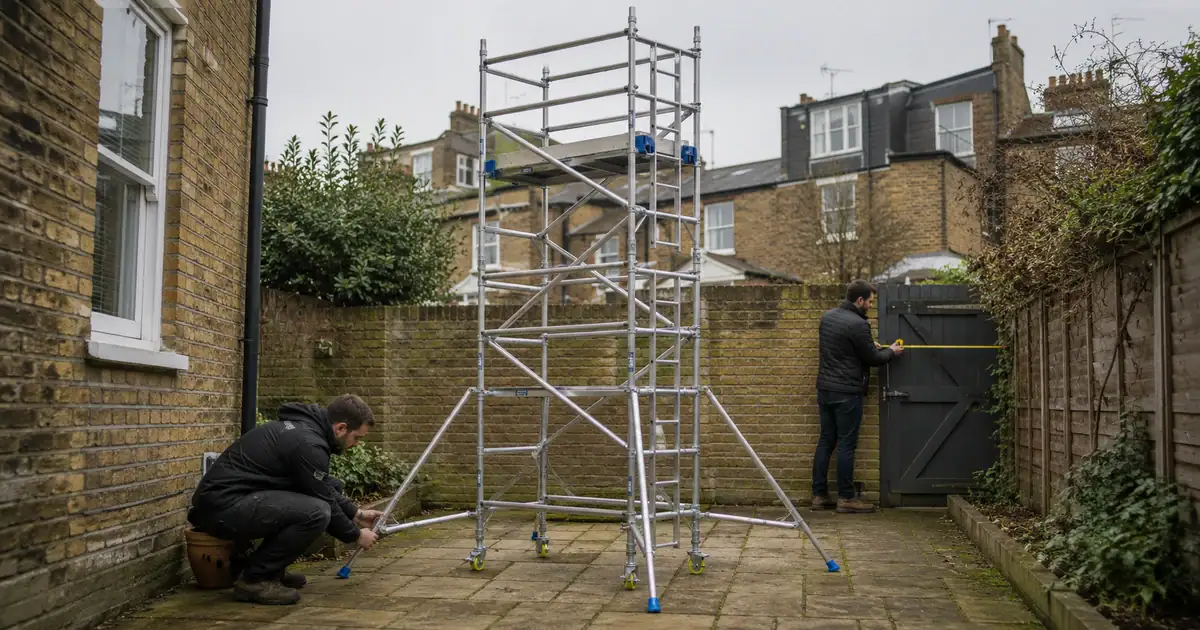
A scaffold tower gives you a stable, level platform at height with guardrails on all sides. You can work with both hands, keep tools and materials next to you, and move along the platform without climbing up and down repeatedly.
Ladders are fine for quick tasks under a few minutes, but anything longer — painting a facade, fitting guttering, repointing brickwork, installing signage — is safer, faster, and less tiring from a tower. The Work at Height Regulations 2005 require employers to use the safest practicable means of working at height. For most sustained tasks above 2 metres, that means a platform, not a ladder.
Height Limits — Indoor vs Outdoor
The maximum safe working height depends on the tower design, the base width, and whether you are working indoors or outdoors. Under BS EN 1004:2020, mobile access towers have two key limits:
Outdoors: Maximum platform height of 8 metres. Wind, uneven ground, and passing traffic all increase risk, so the height limit is lower.
Indoors: Maximum platform height of 12 metres. Controlled conditions allow a taller build, but you still need adequate stabilisation and a level floor.
These are maximum limits. The actual safe height for your specific tower depends on the manufacturer’s instructions, which the hire company should supply. Never build a tower higher than the manufacturer specifies, even if the components physically allow it.
Choosing the Right Tower Type
Scaffold towers come in several configurations. The right one depends on where you are working, how high you need to reach, and how much space you have.
Standard tower (3T type) — the workhorse. A through-the-trapdoor design where you climb inside the tower using built-in ladders. Suitable for most general tasks: painting, rendering, window fitting, signage, external maintenance. Available in different platform heights from about 3 m to 6 m+.
Folding tower — a lighter, more compact option that folds flat for transport and storage. Ideal for indoor work, decorating, ceiling repairs, and any job where you need to move the tower frequently through doorways or between rooms.
Stairwell tower — designed specifically for working in stairwells and over obstacles. The base adjusts to different levels, giving you a level platform even when the floor beneath is not flat. Essential for stairwell painting, light fitting, and maintenance in split-level spaces.
Twin-access tower — has access from both ends, with ladders built into each side of the frame. Useful when multiple workers need to access the platform simultaneously, or when the job requires entry and exit from different sides.
Miniscaff / solo tower — a small, lightweight tower typically reaching 2–3 m platform height. One person can assemble it. Perfect for internal decorating, low-level maintenance, and jobs where a standard tower would be too large for the space.
3T Scaffold TowerFolding Scaffold TowerStairwell TowerWhat a Hire Company Should Provide
When you hire a scaffold tower, the company should supply more than just the frame and platforms. Here is what to expect from a reputable hire operation:
Complete tower with all components — frame sections, platforms with trapdoors, guardrails, toeboards, diagonal braces, locking castors, and stabilisers or outriggers where needed.
Manufacturer’s instruction manual — this is a legal requirement. The manual must cover the assembly sequence, maximum safe height, bracing requirements, and any restrictions on use. Do not accept a tower without instructions.
Pre-delivery inspection — all components should be checked before dispatch. Damaged bracing, worn locking mechanisms, or missing pins compromise the entire structure.
Delivery and collection — most hire companies will deliver and collect. Check whether the tower arrives pre-assembled or in sections, and whether assembly assistance is available if you need it.
Safety Essentials — What the Law Requires
The Work at Height Regulations 2005 apply to all work at height in the UK. For scaffold towers, the key legal requirements are:
Competent assembly. The tower must be erected by someone who is competent — meaning they have sufficient training and experience for the specific tower they are building. On commercial sites, this usually means PASMA-trained.
Inspection after assembly. Once erected, the tower must be inspected before use. If used on a construction site where someone could fall 2 metres or more, it must also be inspected every 7 days and after any event that could affect stability.
Guardrails on all sides. Every working platform must have guardrails at a minimum height of 950 mm with no gap greater than 470 mm between rails. Toeboards should be fitted to prevent tools and materials falling off the platform.
Locking castors. All wheels must be locked before anyone climbs the tower. Never move a tower with anyone on the platform.
Stabilisers or outriggers. These must be deployed when the tower reaches the height specified in the manufacturer’s instructions. They prevent the tower from tipping.
Do I Need PASMA Training?
PASMA (Prefabricated Access Suppliers’ and Manufacturers’ Association) is the recognised training body for mobile access towers in the UK. The course teaches safe assembly, dismantling, inspection, and use of scaffold towers.
There is no specific “licence” required by law to use a scaffold tower. However, the Work at Height Regulations require that anyone assembling or working from a tower must be competent. On most commercial and construction sites, PASMA training is the expected proof of competence. Site managers will check for it.
For private or domestic use — painting your house, for example — PASMA training is not legally required, but the hire company should brief you on safe assembly and use before handover. If you are unsure, ask for a walkthrough.
Choosing the Right Tower — Quick Decision Table
| Job | Tower Type | Why |
|---|---|---|
| External painting, rendering, guttering | 3T standard tower | Full height range, stable outdoor platform |
| Indoor decorating, ceiling work | Folding tower or Miniscaff | Compact, fits through doors, quick to move |
| Stairwell painting, split-level access | Stairwell tower | Adjustable legs for uneven surfaces |
| Multiple workers or two-sided access | Twin-access tower | Ladders on both ends, simultaneous access |
| Quick low-level task, one person | Miniscaff solo tower | Lightweight, one-person assembly, 2–3 m reach |
Common Mistakes When Hiring a Scaffold Tower
Choosing by price alone. The cheapest tower might not include stabilisers, guardrails, or an instruction manual. A tower without safety components is not a tower — it is a liability.
Underestimating working height. Working height is typically 2 metres above the platform height. If you need to reach 6 metres, you need a platform at about 4 metres. Measure the job before you call.
Ignoring ground conditions. A tower on soft ground, a slope, or near a kerb edge needs stabilisers and possibly base plates. If the ground is uneven, a stairwell tower with adjustable legs may be the better option.
Not checking wind conditions. If wind speeds exceed Force 4 (roughly 17 mph), work from the tower should stop. For exposed outdoor sites, check the forecast and plan accordingly.
Related Guides
Do I Need a Licence to Use a Scissor Lift? — training requirements for powered access.
Extension Ladder Hire — for quick tasks under a few minutes where a tower is not needed.
Scissor Lift Hire — when you need powered platform access above 8 metres or for heavier work.
Frequently Asked Questions
Do I need training to use a hired scaffold tower?
How long does it take to assemble a scaffold tower?
Can I move a scaffold tower once it is erected?
What is the maximum height for a scaffold tower?
Is hiring a scaffold tower cheaper than traditional scaffolding?

 Drone Survey & Mapping
 Drone Inspections