
 Drone Services
 Access Equipment
 Breaking & Drilling
 Cleaning Equipment
 Drying & Heating
 General Site Tools
Equipment Hire Guides
How to Dry a Wet Carpet Without Ripping It Up
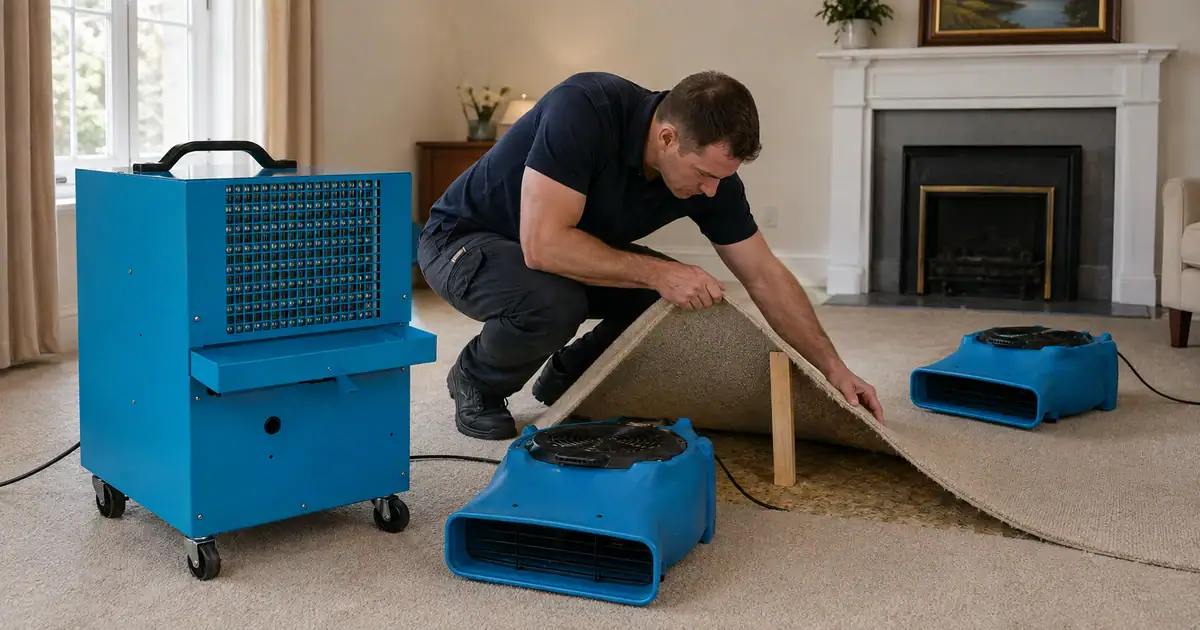
How to Dry a Wet Carpet Without Ripping It Up — act quickly and a soaked carpet can usually be dried in place with air movers and a dehumidifier, no need to pull it up.
Hireload delivers equipment across London from our Greenford / UB6 operating area. View full London delivery areas.
Carpet soaked right now? Water moves into the underlay faster than it evaporates out of it, so the first 24 hours decide whether the carpet is saved or replaced.
An air mover is £19.99 + VAT for a day, £29.99 for up to a week, and a 19L dehumidifier to take the moisture out of the air is £34.99 for up to a week. Delivered across London, or collect free from Greenford UB6.
Browse drying equipment · Not sure what size? Call 020 3375 4048 or message us on WhatsApp.
Can You Save a Wet Carpet?
In most cases, yes — if you act quickly and use the right equipment. A carpet that’s been wet for a few hours from a clean water source (a burst pipe, an appliance overflow, rain ingress) can usually be dried in place without removing it.
The exceptions: sewage or contaminated water, carpet that’s been wet for more than 48 hours, or visible mould growth. In those cases, the carpet and underlay usually need replacing. If the water affected more than just the floor, our guide on how to dry a room after a leak covers walls, skirting and subfloor too.
Step 1 — Remove Standing Water First
Before any drying equipment goes in, get as much water out as possible:
- Use towels to blot surface water
- A wet-dry vacuum is far more effective than towels for larger spills
- If the carpet is squelching underfoot, there’s water in the underlay too
The more water you extract manually, the faster mechanical drying works. A dehumidifier removes moisture from the air — it can’t pump water out of a saturated carpet.
Step 2 — Lift the Carpet Edges
You don’t need to rip the carpet up, but lifting the edges away from the gripper strips makes a significant difference. This allows airflow underneath the carpet and exposes the underlay to drying equipment.
Pull the carpet back 15-30cm along the edges of the affected area. If you can prop it up slightly — a clean piece of timber underneath works well — even better. This lets air circulate on both sides of the carpet.
Step 3 — Position Air Movers
Air movers are the hero piece of equipment for carpet drying. Position them to blow horizontally across the wet surface — the airflow speeds up evaporation from the carpet fibres.
Drying Calculator
Two quick questions and we'll size the right dehumidifier — and tell you how long to hire it.
For best results:
- Place air movers at the edge of the wet area, angled slightly under the lifted carpet edge
- Use 1-2 standard air movers for a single room
- For hallways and corridors, a low-profile air mover fits into tight spaces where upright units won’t
- Point them across the carpet, not straight down into it
Step 4 — Run a Dehumidifier Alongside
The air movers push moisture out of the carpet into the room air. Without a dehumidifier, that moisture just settles on other surfaces — walls, furniture, curtains — and you’ve moved the problem rather than solving it. (If you’re unsure how the two machines differ, our guide on dehumidifiers vs air movers explains why you need both.)
A 38L commercial dehumidifier running alongside the air movers captures that airborne moisture and extracts it. Close the doors and windows, and the combination dries a wet carpet dramatically faster than either machine alone.
One practical note if the carpet is upstairs. The dehumidifier will be collecting litres a day and there is nothing below it to drain into, so a machine with automatic pump-out and a 6 m hose can discharge into a bathroom basin or bath and keep running overnight, rather than stopping the moment a tank fills.
How Long Does Carpet Drying Take?
| Situation | Equipment | Expected Time |
|---|---|---|
| Light spill, caught quickly | 1 air mover + dehumidifier | 1-2 days |
| Moderate leak, carpet and underlay wet | 1-2 air movers + dehumidifier | 3-5 days |
| Heavy flooding, fully saturated | 2-3 air movers + industrial dehumidifier | 5-10 days |
These are rough guides. Wool carpet dries slower than synthetic. Thick underlay holds more water than thin. Concrete subfloors retain moisture longer than timber. Check the carpet daily — if it still feels damp to the touch or smells musty, keep the equipment running.
When You Can’t Save the Carpet
Be realistic. Some situations mean the carpet needs to go:
Contaminated water. Sewage backup, external flood water, or water that’s passed through soil or drains carries bacteria. No amount of drying makes it safe. Replace the carpet and underlay.
Wet for more than 48 hours. Extended saturation allows mould to establish in the underlay and carpet backing. Even if the surface dries, mould spores remain. If you can smell it, it’s too late.
Visible mould growth. Dark spots, fuzzy patches, or a persistent musty smell after drying means mould has colonised the material. Remove and replace.
Underlay that won’t recover. Foam underlay in particular absorbs water like a sponge and rarely dries properly. Even if the carpet survives, you may need to replace the underlay underneath it.
What About Underfloor Heating?
If you have underfloor heating, do not turn it up to maximum to dry the carpet. Excessive heat from below can damage carpet backing, shrink the carpet, and cause adhesive failure. Maintain a moderate temperature (20-22°C) and let the dehumidifier and air movers do the work from above.
What it costs to hire the kit
Drying a carpet in place needs airflow across the surface and something taking the moisture out of the air. Prices are ex-VAT and match each product page. A refundable deposit applies and comes back in full when the equipment returns undamaged.
| Equipment | 1 day | 2 days | Up to a week |
|---|---|---|---|
| Air mover / carpet dryer | £19.99 | £24.99 | £29.99 |
| 19L dehumidifier | £19.99 | £24.99 | £34.99 |
| 38L dehumidifier | £29.99 | £44.99 | £59.99 |
A worked example. One soaked living room, three days: an air mover at £29.99 plus a 19L dehumidifier at £34.99 comes to £64.98 + VAT. Three days sits inside the “up to a week” tier, so you are not charged per day. A badly soaked room usually needs two air movers rather than one.
Delivery and collection is £35 + VAT next working day, £59 before 11am, or £69 same day. Collection from our Greenford UB6 depot is free.
For comparison, replacing the carpet and underlay in an average living room starts well above that — which is why drying in place is worth trying first, as long as the water was clean.
Frequently Asked Questions
Get Your Carpet Dry Fast
Air movers and dehumidifiers — the combination professional drying companies use, available for next-day delivery across London. Call 020 3375 4048 and we’ll match the right kit to your room.
Browse Drying Equipment
 Drone Survey & Mapping
 Drone Inspections