
 Drone Services
 Access Equipment
 Breaking & Drilling
 Cleaning Equipment
 Drying & Heating
 General Site Tools
Equipment Hire Guides
How to Dry Out a Basement or Cellar (What Actually Works)
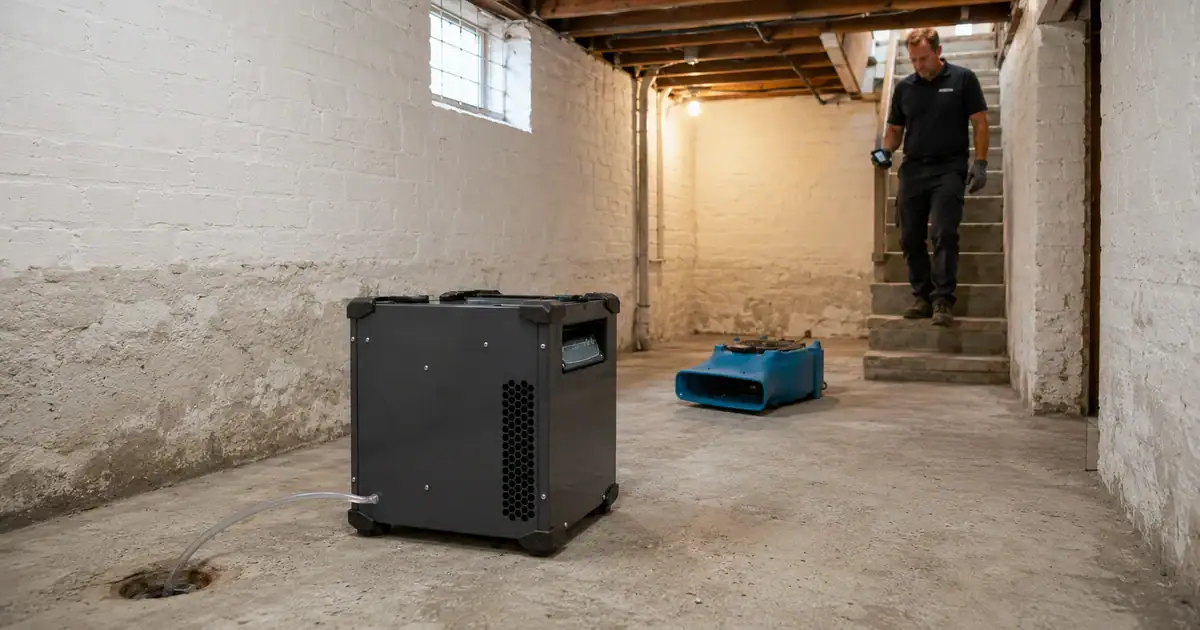
How to Dry Out a Basement or Cellar (What Actually Works) — what keeps basements damp, which equipment genuinely helps, and when the honest answer is a waterproofing specialist rather than a dehumidifier.
Hireload delivers equipment across London from our Greenford / UB6 operating area. View full London delivery areas.
If the basement filled because the property flooded rather than because of long-standing damp, start with the full flood drying guide and come back here for the below-ground detail.
Basement damp or standing water? A basement is the one room in the house where the air will not dry itself out — it is cool, below ground and has almost no natural ventilation, so moisture that gets in stays in.
A 38L commercial dehumidifier is £29.99 + VAT for a day and £59.99 for up to a week, and a 63L LGR unit for cold, heavily saturated cellars is £59.99 a day or £119.99 for up to a week. Delivered across London, or collect free from Greenford UB6.
Browse drying equipment · Not sure what size? Call 020 3375 4048 or message us on WhatsApp.
Why Basements Stay Damp
Basements and cellars sit below ground level, surrounded by earth that holds moisture. Water pressure from the surrounding soil pushes moisture through walls and floors — even through concrete. Add poor ventilation (most basements have small windows or none at all), cool temperatures and limited airflow, and you have conditions where humidity rarely drops below 70-80%.
This is not a fault you can fix with a coat of paint. Basement damp is structural by nature, and managing it starts with working out whether you are dealing with water ingress, rising damp, condensation, or all three.
Identify the Type of Damp First
Water ingress (penetrating damp). Water actively coming through walls or floor — visible wet patches, pooling water after rain, tide marks on walls. This needs waterproofing or drainage solutions before any drying equipment will help.
Rising damp. Moisture travelling up from the ground through capillary action. Typical signs: a damp band along the bottom 30-60cm of walls, salt deposits (white crystalline marks), and peeling paint or plaster at low level. This needs a damp-proof course (DPC) or tanking.
Condensation. Warm, moist air meets cold basement walls and condenses. It is common in winter, when the basement is cooler than the rest of the house. You see water droplets on walls and ceiling, a musty smell, and mould on surfaces.
The practical point: A dehumidifier is effective for condensation and for holding humidity low after waterproofing. It is not a fix for active water ingress — you cannot dehumidify your way out of a leaking wall.
When a Dehumidifier Works
A dehumidifier is the right tool when:
Drying Calculator
Two quick questions and we'll size the right dehumidifier — and tell you how long to hire it.
- The basement has been waterproofed or tanked but still holds residual moisture
- Condensation is the primary issue, not active water ingress
- You need to bring humidity below 60% to prevent mould and protect stored items
- You are drying out after a one-off event, such as a burst pipe or surface water during a storm
- You want to make the space usable for storage, a workshop or living space
For basements, a commercial-grade unit makes a measurable difference where a domestic one struggles. Basement air is cooler, and smaller dehumidifiers lose efficiency below 15C. A 38L commercial dehumidifier holds extraction in cooler conditions. For larger cellars, the Dri-Eaz Cube or a 63L LGR unit keeps working even as humidity drops.
LGR units are particularly effective for basements because they carry on extracting moisture at the lower humidity and temperature levels where standard refrigerant dehumidifiers begin to lose performance.
How to Set Up for Basement Drying
Position the dehumidifier centrally. Do not push it against a wall — it needs air circulating around all sides to work efficiently.
Connect a continuous drain. Basements often have floor drains or sumps. Run a hose from the dehumidifier’s drain outlet to the nearest drain point so the unit can run around the clock without anyone emptying a tank — which matters in a space you do not visit every few hours.
Close windows and external vents during active drying. If you are trying to reduce humidity inside the basement, pulling in damp outside air fights the dehumidifier. Once you have reached target humidity (below 60%), you can introduce controlled ventilation.
Consider air movers for larger spaces. In a long, narrow cellar, air can stagnate at the far end. One or two air movers positioned to push air toward the dehumidifier improve circulation and prevent cold, damp pockets.
Run the equipment for at least 5-7 days before judging progress. Basements hold moisture in thick walls and concrete floors, and it takes time to draw that moisture into the air where the dehumidifier can capture it.
When You Need a Professional Instead
A dehumidifier manages humidity. It does not stop water coming in. If your basement has:
- Active water running down walls or pooling on the floor
- Persistent wet patches that do not respond to dehumidification
- Structural cracks with visible moisture seeping through
- A water table problem, where water rises through the floor during wet seasons
…then you are likely to need a basement waterproofing specialist, not just a dehumidifier. Solutions range from internal tanking and cavity drain membranes to external waterproofing and sump pump systems. These are significant works, so it is worth getting specialist advice and more than one quote before committing.
Once waterproofing is complete, a dehumidifier becomes the finishing tool: extracting residual moisture from the structure and holding humidity at a comfortable level long-term.
Making a Basement Usable
If you are converting a basement into living space, a workshop or quality storage, aim to keep humidity below 55-60%. At that level mould cannot grow, timber stays stable, and stored items stay dry.
For ongoing humidity management after the initial drying, you have two broad options: a permanently installed dehumidifier (worth it if you use the space daily) or periodic short-term hires when humidity spikes — seasonally, after storms, or during prolonged wet weather.
Not sure how much extraction your space needs? Our guide on how many dehumidifiers you need walks through sizing by room volume and moisture load.
What it costs to hire the kit
Prices are ex-VAT and match each product page. A refundable deposit applies and comes back in full when the equipment returns undamaged.
| Equipment | 1 day | 2 days | Up to a week |
|---|---|---|---|
| 38L dehumidifier | £29.99 | £44.99 | £59.99 |
| 43L Dri-Eaz Cube | £39.99 | £59.99 | £74.99 |
| 63L LGR dehumidifier | £59.99 | £89.99 | £119.99 |
| Air mover / floor dryer | £19.99 | £24.99 | £29.99 |
A worked example. A single-garage-sized cellar after a wet winter, one week: a 38L dehumidifier at £59.99 plus an air mover at £29.99 to keep the air moving in the corners comes to £89.98 + VAT. If the cellar is cold — under about 15°C — the 63L LGR is the one that keeps pulling water at that temperature.
Beyond a week, hire runs at a daily rate: £8.40 a day for the 38L, £16.80 for the 63L LGR. Delivery and collection is £35 + VAT next working day, £59 before 11am, or £69 same day. Collection from our Greenford UB6 depot is free.
Frequently Asked Questions
Get Your Basement Under Control
Hire a commercial dehumidifier built for cooler, high-humidity spaces. Not sure which size fits your basement? Call us on 020 3375 4048 for sizing advice.
Browse Dehumidifiers
 Drone Survey & Mapping
 Drone Inspections