
 Drone Services
 Access Equipment
 Breaking & Drilling
 Cleaning Equipment
 Drying & Heating
 General Site Tools
Equipment Hire Guides
Flooded House: What To Do First and How Long Drying Takes
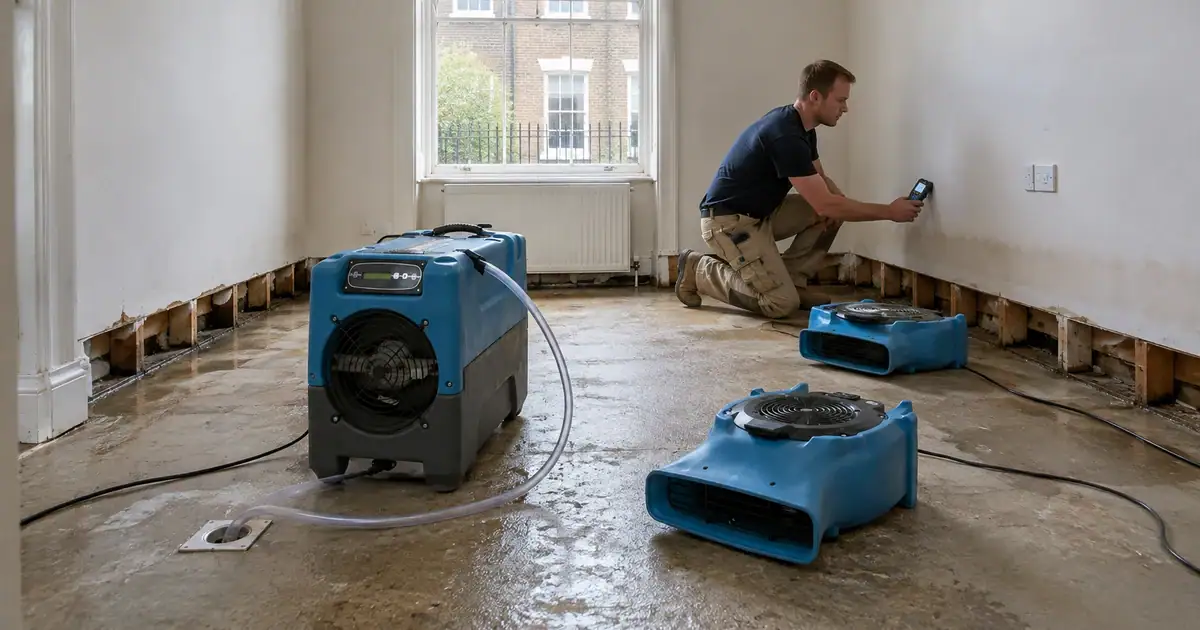
Short answer: get the water out, strip out the soaked material, then dry the building in a closed room with a dehumidifier and air movers running together. Open windows alone will not do it. With proper drying equipment a flooded ground floor typically takes 4 to 8 weeks, with about three weeks as the best realistic case; left to dry naturally it takes months.
For most flooded London ground floors that means one industrial dehumidifier plus two or three air movers, from £99.99 a day as a bundle, with same or next day delivery.
On this page
Around 6.3 million properties in England sit in an area at risk of flooding, and about 4.6 million of those are at risk from surface water — the kind of flooding that arrives in an hour after a storm drain gives up. The Environment Agency expects that number to reach roughly 8 million, or one property in four, by the middle of the century.
If it has just happened to you, the useful thing to know is that the repair does not start when the water goes. It starts when the building is dry, and that is the part almost everyone underestimates. This guide gives you the order of work, honest timescales from UK government drying guidance, the kit that does the job, and the moisture readings that tell you when to stop.
The first 48 hours, hour by hour
Do these in order. Skipping ahead to the drying stage while soaked plasterboard is still on the wall is the single most common way to lose a month.
| Window | Do this | Why it matters |
|---|---|---|
| 0 to 2 hours | Power off at the consumer unit if water has reached sockets or the meter. Do not wade through standing water with the power on. Photograph everything before you move it. | Flood water and electrics is the only genuinely dangerous part of this job. The photographs are also the first thing your insurer will ask for. |
| 2 to 12 hours | Pump or vacuum out standing water. Lift and bin soaked carpet, underlay and any furniture that sat in it. | Standing water and saturated soft material re-load the air with moisture faster than any dehumidifier can pull it back out. |
| 12 to 24 hours | Shovel out silt while it is still wet, then wash the surfaces down. Open windows and doors at this stage only, to flush the worst of the humid air out. | Silt sets like a weak mortar once it dries and seals moisture underneath it. This is the one stage where wide-open windows genuinely help. |
| 24 to 48 hours | Cut plasterboard back above the tide line, pull skirtings, remove wet insulation and lift a few floorboards to open the void. | Insulation left in a wet wall can add 10 to 12 weeks to the drying time. Closed voids dry last, and they are what brings the damp back in month three. |
| 48 hours onward | Close the windows. Set up dehumidifiers and air movers and run them 24 hours a day. Take a moisture reading once a week. | From here the building dries as a sealed system. Every time the windows go open on a cold damp day, the machines lose ground. |
Mould starts at 70% relative humidity. UK building standards guidance treats a sustained 70% RH as the point where mould will germinate and grow on a wall surface. A closed room after a flood sits well above 90%. You are racing the mould, not the water.
Why a flood is not the same as a leak
People use the words interchangeably and then hire the wrong kit. The difference is not the volume of water — it is where the water went and what was in it.
- A leak or burst pipe puts clean water into a known place. It travels down and outward from one point, and it is usually one or two rooms. Our guide to what to do after a burst pipe covers that job.
- A flood puts contaminated water in from outside, across the whole footprint, and it fills the parts of the building you cannot see: the sub-floor void, the cavity, the insulation, the underside of a suspended timber floor. It also brings silt, and often sewage.
That difference drives three decisions. You strip out more than feels necessary, because contaminated material is not worth drying. You dry for longer, because the water is in the fabric, not on it. And you keep drying after the surfaces feel dry, because the void underneath is weeks behind the room above.
The UK government guidance on drying flood damaged buildings puts numbers on how much the construction matters: a double thickness wall takes roughly four times as long to dry as a single one, and insulation left in place can delay things by 10 to 12 weeks. Two houses on the same street, flooded to the same depth, can be six weeks apart purely because of what they are built from.
How a flooded room actually dries
There are only two ways to get water out of a building: carry it out as liquid, or carry it out as vapour. Once the standing water is gone, everything left is the vapour job, and it works in a loop.
- Air movers push air across wet surfaces. Moving air strips the saturated boundary layer off plaster, screed and timber so more moisture can leave. A dehumidifier with no air movement dries the air in the middle of the room and almost nothing else.
- The moisture goes into the room air. Relative humidity climbs. This is supposed to happen — humid air is the moisture on its way out.
- The dehumidifier takes it back out again and drains it away, so the air can pick up the next load.
- The room stays closed. Open a window in the middle of this and you swap dried air for cold outdoor air that is often at 85% RH itself. The loop stalls.
That last point is the one that surprises people. Ventilation is right for the first day and wrong for the next six weeks. If you want the longer version, dehumidifier versus air mover explains what each machine is actually doing.
Find your setup: tap what you are drying
Open the one that matches your property. Each gives the kit that does the job and what it costs to hire from our Greenford depot, with same or next day delivery across London.
How long it really takes
These are the figures from the UK guidance on drying flood damaged buildings, not marketing numbers. They assume the strip-out has been done properly.
| Approach | Time to dry | What it means in practice |
|---|---|---|
| Open windows only | Months | The building dries when the weather allows it. In a British autumn that can mean no progress for weeks at a time. |
| Dehumidifiers and air movers | 4 to 8 weeks | The normal answer for a flooded ground floor. Three weeks is achievable but it is the best case, not the average. |
| Heat plus ventilation plus drying kit | Faster again | Adding controlled heat speeds the process, but pushing too hard cracks screed and plaster and warps timber. Faster is not always cheaper. |
| Real-world flood data | 30 days average | After the 2007 UK floods the average drying time was around 30 days, 50% of properties were dry within three months and 82% within six. |
Two things stretch those numbers more than anything else. A double thickness wall takes about four times as long as a single skin. And insulation left inside a wet wall or floor adds 10 to 12 weeks. If you take nothing else from this page, take that: the strip-out decides the timeline, not the size of the dehumidifier.
For a room-by-room view rather than a whole property, how long it takes to dry out a room has the shorter version.
What the equipment costs
Hire prices from our Greenford UB6 depot, delivered across Greater London. A refundable deposit applies and comes back in full when the equipment returns undamaged.
| Equipment | Per day | Best for |
|---|---|---|
| 20L compact dehumidifier | £19.99 | A single small room, or holding humidity down after the main drying is finished |
| 38L dehumidifier | £29.99 | Larger damp rooms and occupied properties — around 63 dB, quiet enough to live with |
| 43L Dri-Eaz Cube | £39.99 | Tight access, stacked spaces, one flooded room |
| 55L Dri-Eaz DrizAir 1200 | £49.99 | Construction drying and flood recovery, pump-out with a 12.2 m hose for unattended running |
| an LGR unit at 63 litres a day | £59.99 | The workhorse for flood work — keeps extracting as the air gets drier |
| 95L building dryer | £77.99 | Whole ground floors, basements, commercial units |
| Air mover / carpet dryer | from £15.49 | Every drying setup needs at least one. Most need two or three |
| Drying packages (dehumidifier + air movers) | £84.99 to £194.99 | One delivery, matched kit, no guessing — six bundles from a single room up to a flooded ground floor |
Running cost is a fair question and it is smaller than most people expect next to the cost of a delayed repair. What it costs to run a hired dehumidifier works through the electricity side properly.
How you know it is actually dry
“It feels dry” is not a measurement, and it is the reason so many flood repairs fail twice. The official guidance is blunt about it: you cannot define a whole building as dry by one percentage. What you can do is check each material against its own target before you close it up.
| Material | Target | Check it with |
|---|---|---|
| Structural timber and floorboards | 10 to 12% moisture content | A pin-type moisture meter, pushed into the timber, not laid on it |
| Timber-frame wall elements | Around 20% moisture content | Meter readings taken at several heights, not just at eye level |
| Screed, before laying flooring | 75 to 80% relative humidity | A surface box or in-situ hygrometer test left to stabilise, not a quick surface probe |
| Sub-floor soil in a void | Under 24% October to May, under 22% June to September | Sampling in the void once air movers have been through it |
| Room air, as a running check | Below 60% RH, ideally around 50% | A cheap hygrometer left in the room and read weekly |
Take a reading once a week and write it down with the date. That weekly record is what proves the property was dried properly, and it is what a surveyor, a landlord or an insurer will ask to see. It also tells you when to stop, which saves you hire days.
Do not re-plaster early. New plaster on a wet wall traps the moisture behind it and it comes back through as salting and blown finish within months. If you are replastering afterwards, drying new plaster with a dehumidifier covers that second drying job — and why plaster is still wet after a week covers what to do when it stalls.
Five mistakes that add weeks
- Leaving the windows open. Right on day one, wrong from day three. A dehumidifier in a ventilated room is trying to dry London.
- Drying around the insulation. Wet mineral wool in a wall or under a floor holds water for months and adds 10 to 12 weeks. It has to come out.
- One machine, no air movement. A dehumidifier on its own dries the air. Air movers are what get the water out of the fabric. One dehumidifier and two air movers is the setup that actually works.
- Turning everything off at night. Drying is a continuous process. Twelve hours off lets moisture migrate back out of the fabric into the surfaces you just dried, and you start the day behind.
- Rebuilding on a feeling. No meter, no readings, new floor down, and a callback in eighteen months. Ten minutes a week with a moisture meter prevents it.
Flood drying questions, answered
Related guides
- How to dry out a house after a leak — the smaller, cleaner-water version of this job.
- What equipment a professional drying company uses — and how much of it you can hire yourself.
- What size dehumidifier do I need — sizing by room volume rather than guesswork.
- How to dry out a basement — the hardest space in any flooded property.
- Rising damp, condensation or penetrating damp — for when the damp was there before the water was.
- Awaab’s Law and landlord damp deadlines — if you are a landlord, the clock is legal as well as practical.
Drying a flooded property in winter is the hardest version of this job, because the building is cold as well as soaked. Why dehumidifiers stall below 15°C explains what to add so the kit can work.
Flooded? We can have drying kit with you today.
Dehumidifiers, air movers and matched drying packages from £84.99 a day, delivered across Greater London from our Greenford depot.
See drying equipmentTell us the room size and whether the floor is timber or screed and we will tell you exactly what to take. Call 020 3375 4048 or message us on WhatsApp.

 Drone Survey & Mapping
 Drone Inspections