
 Drone Services
 Access Equipment
 Breaking & Drilling
 Cleaning Equipment
 Drying & Heating
 General Site Tools
Equipment Hire Guides, Scaffold Towers
What Size Scaffold Tower Do I Need for a Two-Storey House?
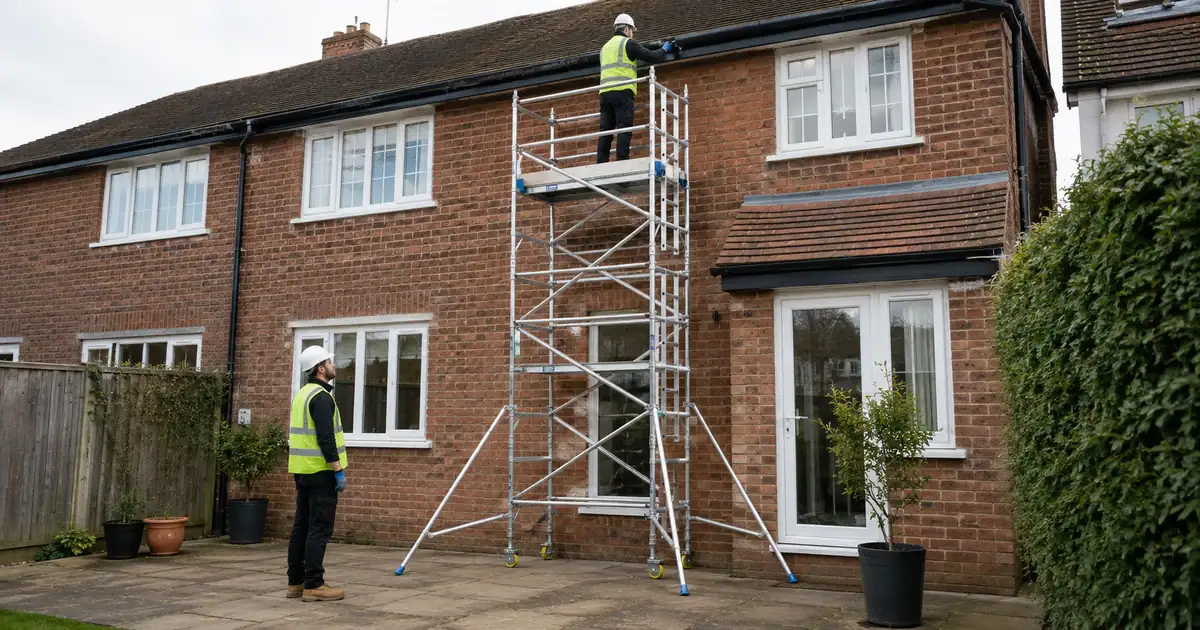
Short answer: for gutters, fascias and windows on a typical two-storey London house you need a tower with a platform around 4.2m, which is sold as a 6.2m working height. That is a 3T scaffold tower at 6.2m — £45.49 to £212.99 + VAT a week depending on the height you pick, with a £100 refundable deposit.
Working on the roof, the ridge or a chimney instead? You need roughly 9.2m. Not sure what your house measures? See the full tower range, or call 020 3375 4048 and describe the job — same and next-day delivery across London.
On this page
Almost everyone books a scaffold tower by guessing the height of their house. It is the single most common reason a tower turns up and the job does not get done — not because the tower was too short to reach, but because the reader confused the two numbers every tower is sold with.
This guide fixes that in about three minutes. Measure one thing, read one table, and you will know exactly which tower to book for your house.
The one rule that decides everything
Every tower is advertised with two numbers:
- Platform height — how high the deck is. This is where your feet stand.
- Working height — platform height plus about 2m, the industry figure for how high an average adult can comfortably reach while standing on the deck.
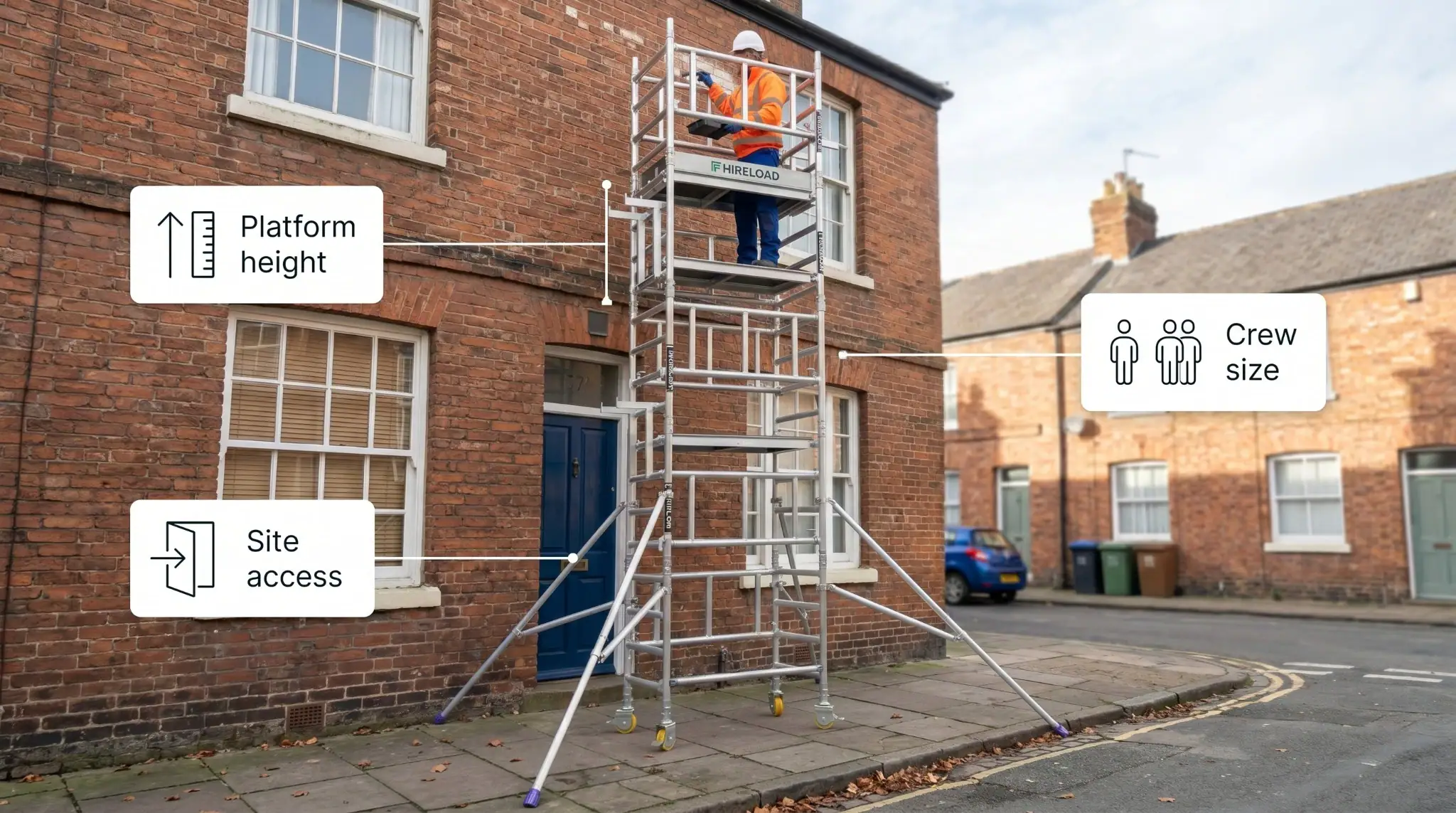
So a tower sold as 6.2m working height has a 4.2m platform. Our Industrial tower spells both out on every option for exactly this reason: 3.2m working height is a 1.2m platform, 6.2m working is a 4.2m platform, and so on up.
Here is the part that trips people up. Working height is a maximum comfortable reach, not where you should plan to work. Nobody does a decent job of painting a fascia or clearing a gutter at full stretch above their head for four hours. In practice you want the thing you are working on sitting somewhere between chest and head height once you are on the deck.
The practical rule: take the height of the thing you are working on, subtract about 1 to 1.5m, and that is the platform height you want. Then add 2m to get the working height number you actually book.
Worked example. Your gutter measures 5.4m from the ground. Subtract 1.2m and you want a platform around 4.2m. Add 2m and you book a 6.2m working height tower. The gutter now sits just above chest height while you stand on the deck — which is where you can actually work.
If that distinction is new to you, our guide on working height versus platform height goes through it in more detail.
Height by building type — measure this first
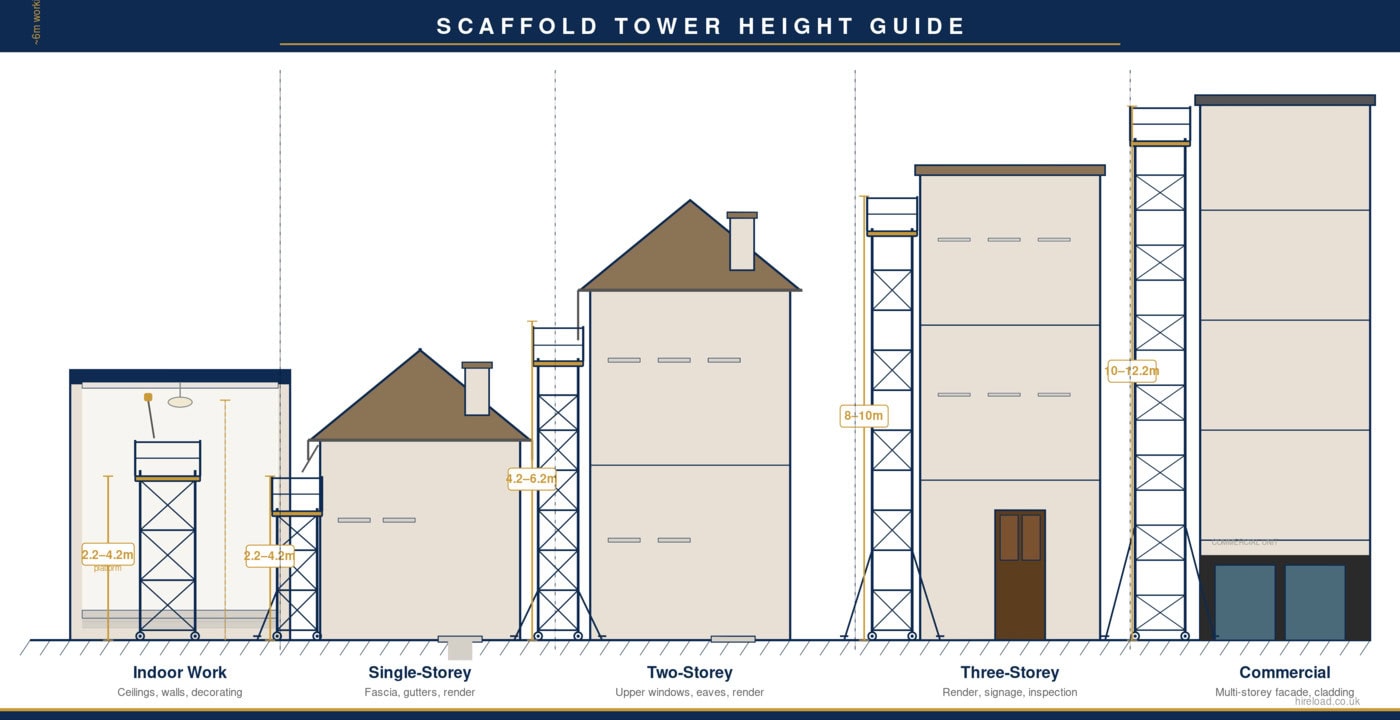
These are typical heights for UK housing. They are a starting point, not a promise: a Victorian terrace with high ceilings runs taller than a 1970s semi, and a sloping garden changes everything. Measure yours if you can — a tape from the ground to the gutter takes two minutes and removes all the guesswork.
| What you are working on | Typical height from ground | Platform you want | Tower to book (working height) |
|---|---|---|---|
| Indoor ceiling, light fitting, decorating | 2.4–3m | 1.2–1.7m | 3.2–3.7m |
| Single-storey gutter, fascia, soffit | 2.4–3m | 1.7–2.2m | 3.7–4.2m |
| Ground-floor windows, porch, low render | 2.5–3m | 1.2–1.7m | 3.2–3.7m |
| Two-storey gutter, fascia, soffit | 5–6m | 3.7–4.7m | 5.7–6.7m |
| Two-storey first-floor windows | 4.5–5.5m | 3.2–4.2m | 5.2–6.2m |
| Two-storey roof edge, ridge or chimney | 8–9m | 6.7–7.7m | 8.7–9.7m |
| Three-storey gutter or render | 8–9m | 6.7–7.7m | 8.7–9.7m |
| Commercial facade, signage, cladding | 10m+ | 8m+ | 10.2m and above |
The short version for a standard two-storey house: gutters and fascias need a 6.2m tower. Roof and chimney work needs 9.2m. Those two numbers cover the large majority of domestic jobs in London.
Find your tower: tap your job
Open the one that matches what you are doing. Each gives the platform height, the tower to book and what it costs.
Will it fit down the side of the house?
Height gets all the attention; width is what actually stops a delivery. Two numbers to check before you book:
- Single width (0.85m) — clears most side gates, alleys and passageways. The right default for a terrace or semi.
- Double width (1.45m) — a much better place to work from, and more stable as the tower goes up. Use it if you have side access or you are working at the front.
Platform length is a separate choice: 1.8m or 2.5m on the 3T and Twin-Access. The 2.5m deck covers more gutter run before you have to move the tower, which on a long two-storey elevation can save an hour of dismantling and rebuilding.
Working alone, or with someone?
This changes the answer more than most people expect.
On your own. The Miniscaff Solo is built to be assembled by one person and carries 250kg — operator, tools and materials. It reaches 4.2m, 5.2m or 6.2m, which covers single-storey and two-storey gutter work. £89.99–£109.99 + VAT a week.
Two of you. The Twin-Access tower has two climb faces and a 275kg rating, so both of you can be on the deck with materials and neither is waiting to get up or down. It is also the tower that goes highest, to 14.2m.
Either way, somebody competent has to build it. We do not require a PASMA card to hire, but for work use you must be competent to assemble and use the tower, and PASMA is the recognised way to prove that. The full picture is in our guide to scaffold tower safety and compliance.
What it costs, and what is included
Towers are hired by the week. Prices are ex-VAT and match each product page — pick your exact height there and the booking calendar shows the price for your dates.
| Tower | Working heights | Best for | From (per week, + VAT) |
|---|---|---|---|
| 3T scaffold tower | 3.2m – 10.2m, in 0.5m steps | The default for houses — single or double width | £45.49 – £212.99 |
| Folding tower | 2.6m – 8.1m | Indoors, through doorways, fast set-up | £45.49 – £120.49 |
| Miniscaff Solo | 4.2m, 5.2m, 6.2m | One-person build, tight spaces | £89.99 – £109.99 |
| Stairwell tower | 2.4m, 4.8m | Stairs, landings, sloping ground | £116.49 – £149.99 |
| Twin-Access tower | 3.2m – 14.2m | Two-person crews, tall elevations | from £41.99 |
| Industrial tower | 3.2m upwards, platform stated per option | Trade and commercial work | £41.99 – £276.49 |
What comes with it. Towers go out as complete kits — frames, braces, platforms, guardrails, toe boards and stabilisers — inspected between hires. Nothing is missing on arrival, which is the failure mode that costs a day.
Deposit and ID. A £100 refundable deposit applies to every tower and comes back in full once it returns undamaged. Photo ID and proof of address are required before delivery.
Getting it to you. Same and next-day delivery across London, or free Click & Collect from our Greenford UB6 depot. There is a full breakdown in our scaffold tower hire cost guide, and if you are weighing a purchase, hire versus buying runs the numbers.
Four mistakes that cost people a day
1. Booking on working height and finding the deck is a metre short. The number on the listing is your reach, not your feet. Take 2m off it before you decide.
2. Measuring the roof when the job is the gutter. A two-storey ridge is three metres above the gutter line. Booking 9.2m to clean a gutter means paying for height you then have to climb past.
3. Not measuring the side gate. Height is the easy problem. A 0.78m gate and a 1.45m double-width tower is the delivery that goes back on the van.
4. Levelling a tower with bricks or timber. If the ground steps or slopes, the answer is the Stairwell tower with its adjustable legs, not packing under the castors. Adjustable legs are engineered for it; a paving slab is not.
Frequently asked questions
Related guides
Which scaffold tower do I need? — the three questions that decide it, beyond height.
Working height vs platform height — the two numbers, explained properly.
Scaffold tower hire cost in London — what each tower costs and what drives the price.
Scaffold tower safety and compliance — the standard, the law, inspections and what a complete kit means.
Painting a two-storey house exterior — the same house, from the decorating side.
Two-Storey House? Book the 6.2m Tower
From £45.49 + VAT a week, £100 refundable deposit, delivered same or next day across London.
Browse Scaffold TowersStill not sure? Tell us the height of the gutter and how you get to the back of the house, and we will tell you which tower to book. Call 020 3375 4048 or message us on WhatsApp.

 Drone Survey & Mapping
 Drone Inspections