
 Drone Services
 Access Equipment
 Breaking & Drilling
 Cleaning Equipment
 Drying & Heating
 General Site Tools
Equipment Hire Guides
Ladder, Tower or Scaffold? How to Choose the Right Access
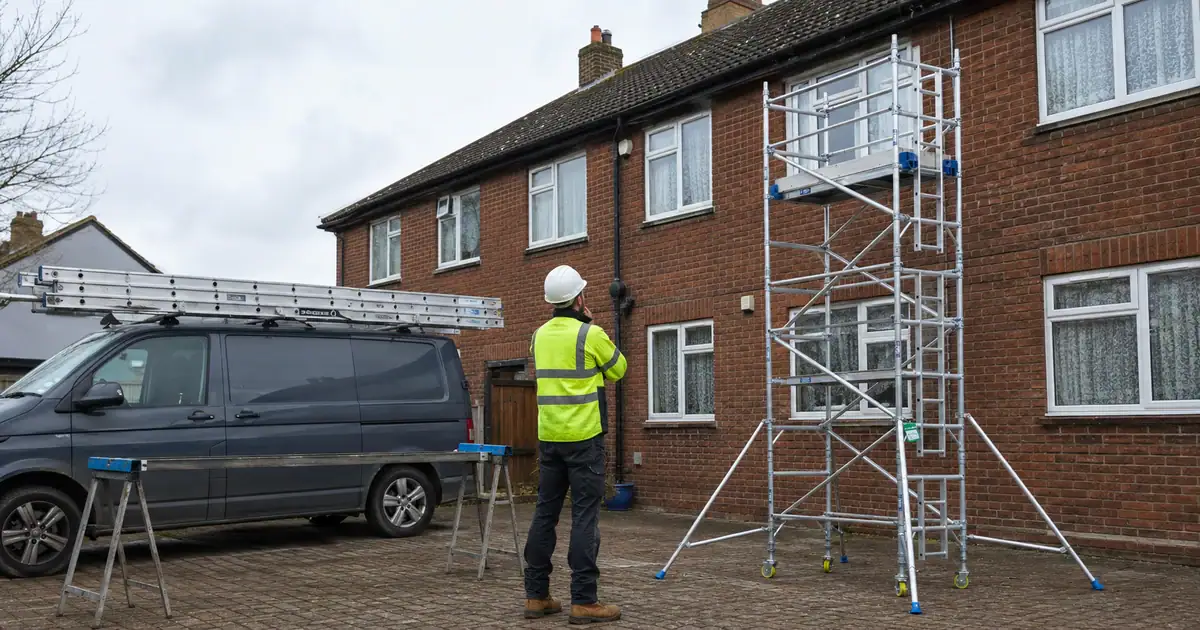
Ladder, tower or scaffold? Pick the wrong one and you either work unsafely off a ladder or overpay for scaffolding you never needed. This guide shows you how to choose — by how high you’re working, how long the job takes, and where the equipment has to stand.
Hireload delivers access equipment across London from our Greenford / UB6 operating area. View full London delivery areas.
The quick answer
Use a ladder for short, light jobs where you only need one hand and a few minutes in one spot. Use a scaffold tower for most two-storey work — painting, gutters, fascias, render patches — where you need both hands, time on a platform, and to move along the wall. Keep full scaffolding for long, heavy or full-elevation work like a re-roof or a whole-house render, which needs a scaffolding contractor. Indoors, a scissor lift beats a tower for high reaches over a big, level floor.
The Quick Rule: Match the Access to the Job
Three questions settle almost every access decision — and none of them is “how high can I reach?”
1. How long will you be up there? A five-minute job and a five-hour job need different equipment. Short, light tasks suit a ladder. Anything sustained needs a stable platform.
2. Do you need both hands? If you’re holding a tool and material at the same time — a roller and a tin, a length of fascia and a drill — a ladder stops being safe. A platform with guardrails lets you work with both hands and set things down.
3. Where does it have to stand? Through a doorway, up a staircase, on an uneven drive, against a full elevation? The site often decides the answer more than the height does.
Pro tip: Measure the platform height you need to stand on, not the height you want to reach. Working height is roughly two metres above the platform, so a 4m platform comfortably serves a ~6m gutter line. Our working height vs platform height guide explains the two numbers in one minute.
Ladders: When They’re Enough (and When They Aren’t)
A ladder is the right tool for short-duration, light work: checking a gutter, swapping a bulb, cutting in at the eaves, a quick look at a tile. Under HSE guidance, ladders are for brief tasks where you can keep three points of contact and don’t have to overreach or lean out.
They stop being the right tool the moment the job needs both hands for a sustained period, or you find yourself stretching sideways to reach the next section. That’s where most working-at-height accidents happen — and falls from height remain the single biggest cause of workplace fatalities in the UK. If you’re tempted to “just balance” a tin on a rung, it’s time for a tower.
For low, quick access, a hired extension ladder or a podium step is fine. For anything longer, read on.
Scaffold Towers: The Sweet Spot for Most Two-Storey Work
A mobile scaffold tower gives you a proper guardrailed platform you can stand on all day, with room for tools and materials. For the vast majority of domestic and light-commercial jobs — painting a two-storey exterior, clearing or replacing gutters, fascias and soffits, patching render, changing windows — a tower is safer than a ladder and a fraction of the cost of erected scaffolding.
Hireload’s towers are aluminium and EN 1004-compliant, with platform heights available up to 12.2m depending on the model. Smaller towers are genuine one-person builds; wider “double-width” towers give a crew room to work with materials. A few examples of where each fits:
- Indoor decorating, ceilings, quick jobs — a compact Miniscaff Solo or a pre-assembled folding tower.
- Two-storey painting, gutters and fascias — the popular 3T single-width tower.
- Narrow sites, facade and signage — an Industrial single-width tower.
- Rendering, plastering, wide facade work — a Twin-Access double-width tower, which also reaches highest.
- Stairwells and uneven ground — a Stairwell tower with adjustable legs. Standard towers are not rated for uneven footings.
Not sure which model? Our which scaffold tower do I need guide matches the tower to the job in a couple of taps.
Full Scaffolding: When You Genuinely Need It
Full scaffolding — the tube-and-fitting or system scaffold a contractor erects around a building — earns its cost on the big jobs: a full re-roof, a complete render or repointing of an elevation, structural repairs, or anything that runs for weeks and carries heavy materials along the whole wall. It’s the safest option when the work is continuous across a large area and several trades need to be up there at once.
The trade-offs are cost and time. Erecting scaffolding for a two-storey elevation typically runs from several hundred to a few thousand pounds and needs a booking and lead time, and on a public footpath it needs a council licence. It also has to be put up and taken down by a competent scaffolder — it isn’t a DIY job.
Honest note: Hireload hires mobile scaffold towers, not erected scaffolding. If your job genuinely needs a full scaffold, you’ll want a scaffolding contractor — we’d rather tell you that than sell you a tower that doesn’t suit the work. For most two-storey access, though, a tower does the job for far less.
Scissor Lifts and Powered Access: Indoor Height and Big Reaches
Indoors, on a level floor, a scissor lift often beats a tower — think warehouse lighting, high racking, signage or ductwork, where you need to reach up repeatedly across a large space. You drive to the spot, raise the platform, and move on, instead of dismantling and rebuilding a tower. Powered access does need the right training (IPAF for operators), and it’s for firm, level ground. Browse the powered access range or ask us which fits your building.
The Safe and Legal Line: PASMA, Licences and HSE
Working at height in the UK sits under the Work at Height Regulations 2005: plan the job, use people who are competent, and pick equipment that suits the task. In plain terms:
- PASMA is the recognised UK training standard for building and using mobile towers. If you’re using a tower at work, you (or whoever builds it) should be trained and competent. For DIY at home, PASMA isn’t a legal requirement — but you must follow the manufacturer’s build manual and use the tower correctly.
- A licence is only needed to place a tower or scaffold on a public highway or pavement, which you’d arrange with the local council. On your own drive or garden, no licence is required.
- Inspection matters: check the tower after assembly and before use, and don’t move it with people, tools or materials on the platform.
Our scaffold tower safety and compliance guide covers EN 1004, WAHR 2005 and PASMA in plain English. If a job is structural, involves a fragile or damaged roof, or you’re not confident it can be done safely, use a qualified professional.
Match Your Job to the Right Access
| The job | Best access | Why |
|---|---|---|
| Quick gutter check, bulb, one-off inspection | Ladder | Short, light, one position |
| Paint a two-storey exterior | Scaffold tower (3T / Industrial) | Both hands, time on the platform, move along the wall |
| Clear or replace gutters, fascias, soffits | Scaffold tower (3T / Twin-Access) | Stable, guardrailed reach along the roofline |
| Render or plaster a wall | Double-width tower (Twin-Access) | Room for materials on a wider deck |
| Indoor decorating, ceilings, quick in-and-out | Folding / Miniscaff Solo | Compact, fast one-person setup |
| Stairwells, split levels, uneven ground | Stairwell tower | Adjustable legs handle the step; standard towers can’t |
| Warehouse lights, high racking (indoor) | Scissor lift | High reach, repeated moves on a level floor |
| Full re-roof, whole-elevation render, structural | Full scaffolding (contractor) | Long, heavy, full-elevation — a scaffolder’s job |
The Towers, at a Glance
Browse all scaffold towers — 7 options
Before You Book
Scaffold towers are hired on a weekly basis, with a £100 refundable deposit and valid photo ID required on every hire. Every tower comes with guardrails, toeboards, stabilisers where the height needs them, and the build manual. Smaller towers are a genuine one-person build; taller and double-width towers go up faster and safer with two people. We deliver from our Greenford (UB6) depot on your chosen day and unload into a specified spot, not at the kerb.
Who This Helps
- Homeowners tackling two-storey painting, gutters or fascias without paying for full scaffolding
- Decorators and small builders who need flexible, movable access
- Landlords and maintenance teams handling roofline and exterior repairs
- Anyone weighing up a ladder against something safer for a sustained job
Once you have decided a tower is right, sizing it for a two-storey house takes about three minutes.
Related Guides
More in this scaffold-access series:
- How to paint a two-storey house exterior (without full scaffolding)
- How to clean high gutters safely
- Do you need scaffolding for fascias & guttering?
- Small & folding scaffold towers for tight access
- Which scaffold tower do I need? A height, space and job guide
- Working height vs platform height — which number should you trust?
- Scaffold tower safety and compliance: EN 1004, WAHR 2005 and PASMA
- Scaffold tower hire vs buying: the honest cost comparison
Frequently Asked Questions
Not sure which access you need?
Send us the job — height, location and access — and we’ll tell you whether it’s a ladder, a tower or a scaffolder’s job. Delivered across London from Greenford (UB6), typically next working day.
WhatsApp the jobor call 020 3375 4048

 Drone Survey & Mapping
 Drone Inspections