
 Drone Services
 Access Equipment
 Breaking & Drilling
 Cleaning Equipment
 Drying & Heating
 General Site Tools
Equipment Hire Guides
Does Insurance Cover Damp? When It Does, When It Doesn’t, and What to Do Either Way
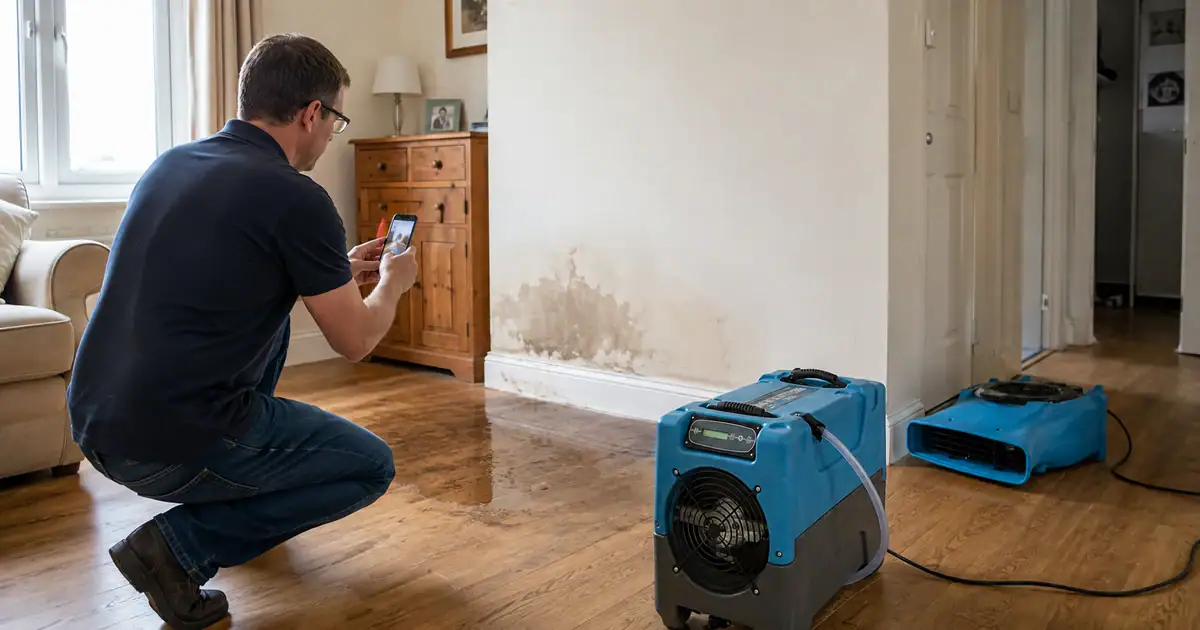
Does Insurance Cover Damp? — when insurers usually pay, when they usually don’t, and how to handle drying equipment either way. Practical general guidance for UK homes, not professional advice.
Hireload delivers equipment across London from our Greenford / UB6 operating area. View full London delivery areas.
For the practical side of a flood claim — the order of work, the weekly readings worth keeping, and what the drying stage actually costs to hire — see flood drying, step by step.
Water damage right now? Tell your insurer first — then start drying. Water does most of its damage in the days you spend waiting for a decision.
A 38L commercial dehumidifier is £59.99 + VAT for up to a week, delivered across London. Keep the invoice — it goes into your claim.
Browse drying equipment · Not sure what size? Call 020 3375 4048 or message us on WhatsApp.
The Short Answer: It Depends on What Caused It
Home insurance in the UK covers damp and water damage in some circumstances and excludes it in others, and policies vary — so your own policy wording is always the final word. As a general rule of thumb:
Typically covered: Sudden, unexpected events — burst pipes, escape of water from appliances, storm damage to the roof, accidental leaks. These fall under “escape of water” or “storm damage” in most policies.
Typically not covered: Gradual deterioration — rising damp, condensation, long-term moisture from poor maintenance, mould that’s been building up over months. Insurers class these as wear and tear or neglect, which are standard exclusions.
The key question your insurer asks: was this a sudden event or a gradual problem?
This article is general guidance, not professional or financial advice. Cover depends entirely on your policy — check your wording, and speak to your insurer or broker about your specific situation.
When Insurance Usually Pays
Burst pipe or leaking plumbing. A pipe that fails suddenly and floods your kitchen floor is usually treated as an insured event. The damage caused by the water — soaked flooring, damaged plaster, ruined possessions — is typically covered under “escape of water”, though the detail always depends on your policy.
Storm damage causing water ingress. If a storm damages your roof and rain gets into the property, the resulting water damage is usually covered. The repair to the roof itself may or may not be covered depending on the cause and your policy terms.
Appliance failure. A washing machine or dishwasher that fails and leaks water across your floor is generally treated the same as a burst pipe — sudden and unexpected.
What’s typically included in the claim: Drying the property, repairing water-damaged materials (plaster, flooring, decoration), replacing damaged contents, and alternative accommodation if the property is uninhabitable. Some policies also cover the cost of tracing the leak.
When Insurance Usually Won’t Pay
Rising damp. Damp travelling up walls from ground level is generally treated as a structural and maintenance issue rather than a sudden insured event, so it’s commonly excluded. Remediation (DPC installation, re-plastering) usually falls under maintenance — check your policy to be sure.
Condensation and mould. Mould caused by condensation — steamed-up windows, poor ventilation, moisture from cooking and bathing — is usually treated as a lifestyle or maintenance issue, and insurers generally expect homeowners to manage ventilation.
Drying Calculator
Two quick questions and we'll size the right dehumidifier — and tell you how long to hire it.
Gradual leaks. A pipe that’s been dripping slowly for months, causing damage you didn’t notice, may be excluded. Insurers distinguish between sudden escape of water and gradual seepage. Some policies cover the resulting damage even if the leak was gradual — check your wording.
Maintenance failures. Blocked gutters, cracked rendering, failed sealant around baths — if the water damage results from something you should have maintained, the insurer may reject the claim.
What About Drying Equipment Costs?
If your claim is accepted, most insurers either provide drying equipment directly (through their appointed restoration company) or reimburse the cost of hiring it yourself. Where the costs are significant, it’s worth telling your insurer before you commit — some policies require you to use their approved restorer or to get the spend pre-authorised, depending on the claim.
If the insurer appoints a drying company: They’ll send commercial dehumidifiers and air movers, monitor moisture levels periodically, and issue a drying certificate when the property is dry enough for restoration to begin. The cost is normally covered under your claim.
If you’re drying it yourself: Keep the hire receipt and take an electricity meter reading before and after running the equipment. Submit these as part of your claim. Most insurers accept reasonable drying equipment hire as part of the loss.
If the claim is rejected: You’re covering the cost yourself — but hiring commercial equipment is still significantly cheaper than leaving damp untreated. Untreated water damage leads to mould, plaster failure, timber rot, and eventually far more expensive repairs.
What hiring the equipment actually costs
The section above talks about cost without giving you a number, so here it is. Prices are ex-VAT and match each product page. A refundable deposit applies and comes back in full when the equipment returns undamaged.
| Equipment | 1 day | 2 days | Up to a week |
|---|---|---|---|
| 19L dehumidifier — a single room | £19.99 | £24.99 | £34.99 |
| 38L dehumidifier — a flat or a floor | £29.99 | £44.99 | £59.99 |
| 63L LGR dehumidifier — heavy saturation | £59.99 | £89.99 | £119.99 |
| Air mover — pulls water out of carpet and plaster | £19.99 | £24.99 | £29.99 |
A worked example. One flooded room, five days: a 38L dehumidifier at £59.99 plus an air mover at £29.99 comes to £89.98 + VAT. The Entry Drying Package bundles the same two machines at £84.99 + VAT for up to five days. Over a full week the two hired separately usually work out cheaper — worth checking both before you book.
Delivery and collection is £35 + VAT next working day, £59 before 11am, or £69 same day. Collection from our Greenford UB6 depot is free.
Keep every receipt. Insurers ask for the hire invoice, and on longer claims for evidence the equipment actually ran — an electricity meter reading before and after is the simplest proof you can give them.
How to Strengthen Your Insurance Claim
Act immediately. Insurers expect you to mitigate further damage. Leaving a flooded room untreated for a week while you wait for the assessor weakens your position. Stopping the water, removing belongings, and deploying drying equipment shows you’ve taken reasonable steps.
Document everything. Photograph the damage before you clean up. Note the date and time you discovered the problem. Keep a log of what you did and when. Save receipts for any equipment hire, emergency plumber, or temporary repairs.
Report the claim promptly. Most policies require notification within a reasonable time — usually days, not weeks. Delayed reporting gives insurers grounds to question the claim.
Take meter readings. Before running drying equipment, note your electricity meter reading. Take another when you return the equipment. This gives you an exact figure for running costs to include in the claim.
Don’t start permanent repairs before the assessor visits. Stop the water, dry the property, protect your belongings — but don’t re-plaster or re-carpet until the loss adjuster has assessed the damage. Repairing before assessment can complicate the claim.
Either Way — Start Drying Immediately
Whether insurance covers the damage or not, the priority is the same: get the property dry as quickly as possible. Every day of delay increases the damage — mould starts within 24-48 hours in damp conditions, plaster deteriorates, timber swells, and remediation costs escalate.
A 38L commercial dehumidifier handles most single-room water damage. For larger areas or severe flooding, an industrial 63L unit provides faster extraction. Pair either with air movers for the most effective drying.
For the full drying process step by step, see our guides on how to dry a room after a leak and how long it takes to dry out a room.
If the affected room is a flat or upstairs, the practical constraint is usually drainage rather than capacity. There is no floor gully, so a pumped machine that discharges into a sink keeps drying without anyone there to empty a tank — the flat and upstairs version of this job sets out how to arrange it.
Frequently Asked Questions
Related guides
Deposits, liability and where you stand. Read: what happens if hired equipment gets damaged.
Start Drying Now — Sort the Claim Later
Don’t let damp sit while the claim is sorted — tell your insurer first, then get the right equipment in, document everything, and protect your property.
Browse Drying EquipmentOr talk it through first — call 020 3375 4048 or message us on WhatsApp. Tell us the room size and how long it has been wet, and we will size it with you.

 Drone Survey & Mapping
 Drone Inspections