
 Drone Services
 Access Equipment
 Breaking & Drilling
 Cleaning Equipment
 Drying & Heating
 General Site Tools
Equipment Hire Guides
Drying a Flat or Upstairs Room After a Leak
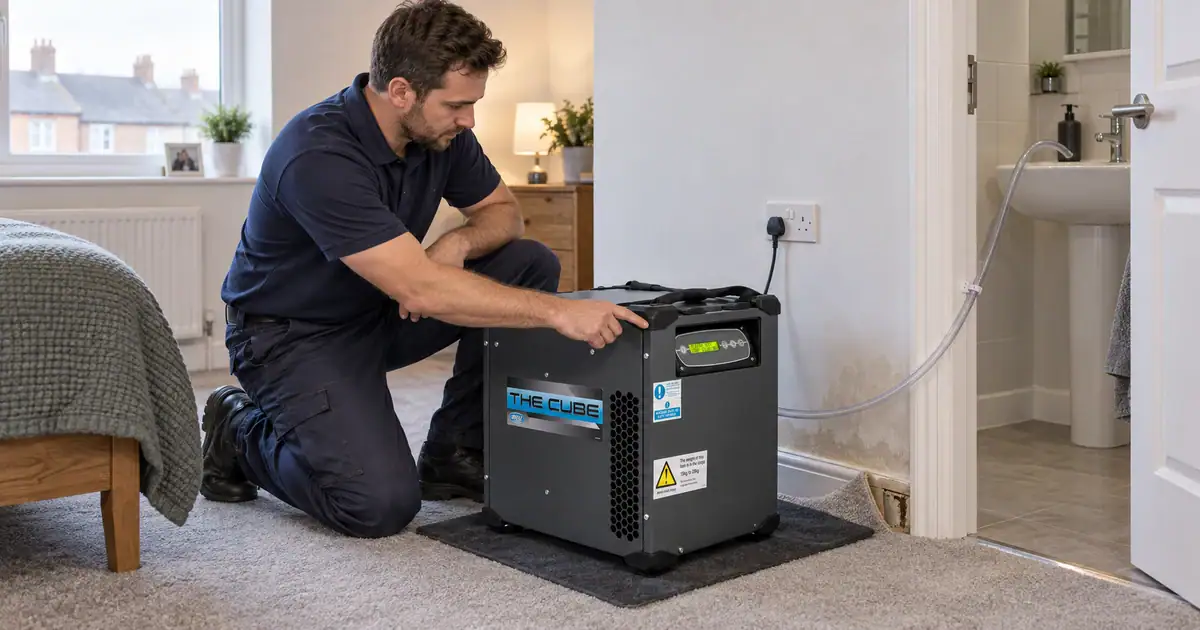
The leak is fixed. Now where does the water go?
Drying one wet room in a flat or an upstairs bedroom is a different problem from drying a house. There is no floor drain to run a hose into, the machine has to come up a staircase, and there is somebody living underneath you. This guide works through what a flat actually needs, how to get the water out when the nearest drain is a bathroom sink, and how to tell whether your job is a drying job at all yet.
How do you dry a flat or an upstairs room after a leak?
Fix the source first and remove any standing water — a dehumidifier removes moisture from the air, not puddles from a floor. Then close the room up, so the machine is drying that room rather than the whole building. Then deal with drainage, which is the part that catches people out upstairs: with no floor drain, either you empty a tank by hand every few hours or you use a dehumidifier with a built-in pump that sends the water through a hose to a basin, a bath or a sink. Finally, set a target humidity and let it run continuously, checking the readings rather than guessing.
For one wet room in a flat, the practical answer is usually a compact pumped machine rather than the biggest dehumidifier available. The Dri-Eaz Cube is 22.7 kg, measures 28.7 × 38.9 × 40.1 cm, plugs into a normal 13A socket and pumps collected water through a 6 m hose to a suitable sink or drain, so there is no tank to keep emptying and no need for a floor gully. It is manufacturer-rated at 22 L/day at 20°C/60% RH and 28 L/day at 27°C/60% RH. If several rooms or a whole property are affected, that is a different job — see the range comparison below.
Three problems a flat has that a house does not
Most drying advice is written for a house: a big machine on the ground floor, a hose out to a gully, and nobody to disturb. Upstairs and in flats, three things change at once, and they are the reason a perfectly sensible plan falls apart on the day.
In a house you can run a hose to an outside gully or a utility-room drain and forget about it. In a first-floor flat the nearest drainage is a basin, a bath, a shower waste or a kitchen sink — all of them above floor level. Gravity will not do it for you. Either you empty a tank by hand, or the machine pumps.
A large floor-standing dehumidifier is a wheeled unit designed to be rolled across a warehouse. On a communal stair, through a fire door, round a landing, it is a two-person carry and a scraped wall. Size and weight stop being spec-sheet trivia and become whether the job happens at all.
Water that reaches a floor void in a flat does not stay in your flat. It also means the drying has a deadline that is not only yours, and that noise at 2am is a real constraint. A machine running continuously in a bedroom has to be something you can live above and beside.
| Factor | House, ground floor | Flat or upstairs room |
|---|---|---|
| Drainage | Hose to an outside gully or utility drain, gravity fed | Nearest waste is a basin, bath or sink — above the machine |
| Getting the machine in | Wheel it through a back door | Carry it up a communal stair and round a landing |
| Room containment | Can often shut off a wing of the house | One room, but doors are shared circulation |
| Consequences of getting it wrong | Your floor | Your floor and the ceiling below |
| Noise | Usually unoccupied space | Often a bedroom, running overnight |
| Machine size that suits | Floor-standing, wheeled, high airflow | Compact enough to carry and to leave in a lived-in room |
None of that changes the physics of drying. It changes which machine is the practical one. If you want the underlying method rather than the flat-specific version, how to dry a room after a leak covers the general sequence and drying out a house after a leak covers the whole-property case.
Where does the water go?
This is the question that decides the hire, and almost nobody asks it until the machine is already in the room. A dehumidifier pulls moisture out of the air and turns it into liquid water. In a room drying out after a leak, that can be litres a day. It has to end up somewhere, and you only get three choices.
| Option | How it works | Upstairs reality |
|---|---|---|
| Collection tank | Water fills an internal tank; the machine stops when it is full and you carry the tank to a sink | Works, but someone has to be there. On a genuinely wet room that can mean emptying every few hours, and every missed emptying is hours of drying lost while the machine sits idle |
| Gravity drain hose | A hose runs from the machine to a drain that is lower than the machine | Rarely possible above ground floor. Every waste in a flat — basin, bath, shower, sink — is at or above floor level, so gravity has nothing to work with |
| Built-in pump | A pump inside the machine pushes the water up and out through a hose to a sink, basin, bath or gully | This is the one that solves the flat. The machine runs continuously without anyone present, and the hose can rise to a basin or sink rather than needing to fall |
That third option is the reason a compact pumped machine often beats a bigger one in a flat. The compact Dri-Eaz Cube dehumidifier has built-in automatic pump-out with a 6 m drain hose, and the discharge point can sit up to 6 m above the base of the machine. In practice that means the machine stands on a dry, level part of the bedroom floor and the hose runs along the skirting, out of the door and into the bathroom basin or the bath. No tank, no rota, no lost hours overnight.
Three things to get right with a pumped hose, because they are the common failures.
A hose left half-coiled in the box holds water in the loops and makes the pump work against a column it does not need to lift. Run it out in full along the floor.
A kink behind a door hinge or under a chair leg will stop the flow. Route it along a skirting board where it will not be trodden on, and if it has to cross a doorway, do not let the door close on it.
The pump has a maximum lift stated by the manufacturer. A basin or a bath is comfortably inside it; running the hose up a staircase to a different floor is not. Keep the outlet secured so it cannot fall out of the basin.
Is it a drying job yet?
This is the honest part, and it is worth reading before you book anything. A dehumidifier is a very good tool for one job and completely the wrong tool for several others. Hiring one at the wrong moment wastes a week.
Five questions that decide it. If you contact us, these are the five things we will ask:
| Situation | Fit | Why |
|---|---|---|
| One wet room in a flat or upstairs | Strong | Contained space, limited access, and drainage that needs a pump rather than gravity |
| A repaired bathroom or ensuite leak | Strong | Small room, a suitable sink close by, and the electrical safety conditions are manageable once the leak is fixed and standing water removed |
| A kitchen or utility leak after repair | Strong | Sink drainage is right there, and continuous pump-out means no tank to empty |
| Wet carpet or floorboards | Strong, paired with an air mover | The dehumidifier takes the moisture out of the air; an air mover moves air across the wet surface so it evaporates faster |
| Plaster or refurbishment drying | Conditional | Works in a warm, contained room with controlled humidity — but follow the plaster or product manufacturer’s guidance, not a general rule |
| A heated loft conversion | Conditional | Fine if it is an insulated, heated room. A raw, cold roof void is a different proposition — ask first |
| A cold cellar or unheated garage | Weak | Refrigerant dehumidifiers lose output as the air gets colder. Below about 15°C performance drops away — here is why |
| A whole house or several rooms | Wrong fit | One compact machine spread across closed rooms does not work. You need more airflow, more units, or a larger machine |
| Standing water or an active leak | Not yet | Fix the source and extract the water first. A dehumidifier does not remove puddles |
| Mould, or damp coming up through a wall | Not the answer | A dehumidifier manages air moisture. It does not fix a structural cause — see rising damp vs condensation vs penetrating damp and getting rid of black mould |
We would rather tell you the answer is “not yet” than take a booking that cannot work. If what you actually have is an active leak or standing water, what to do when a pipe bursts is the right starting point, and what to do after a flood covers the bigger version.
Six situations, and what each one needs
These are the jobs that actually come through. Each one has a limit attached, because the limits are where people get caught out.
01 — A leak in an upstairs bedroom or a flat
The problem. A wheeled floor-standing unit is not practical up a staircase or along a narrow communal corridor, and once it is in the room it dominates a space somebody is still living in.
What works. A compact format. The Cube is 22.7 kg including its cable and hose, in a 28.7 × 38.9 × 40.1 cm body with carry handles — 13.3 kg lighter than our 36 kg 55L machine and roughly half the floor footprint.
The limit. 22.7 kg is still 22.7 kg. Judge your own safe lifting capacity, use two people on stairs if there is any doubt, and take the corners slowly.
02 — An ensuite or bathroom leak that has been repaired
The problem. There is no floor drain, and the nearest waste — the basin — is above floor level. A gravity hose will not run uphill and a tank needs emptying through the night.
What works. Built-in pump-out through the 6 m hose into the basin or bath. The machine stands on a dry, level part of the floor outside the splash zone and runs continuously.
The limit. This is for after the leak is fixed and standing water has been removed. The unit must be kept dry, positioned away from any wet zone, and run from an earthed, RCD-protected supply.
03 — A kitchen or utility leak from an appliance or a pipe
The problem. A washing machine or a pipe has wet one room, and the drying needs to run for days rather than hours while the kitchen stays in use.
What works. Continuous pump-out into the kitchen sink removes the emptying rota entirely, and a digital humidistat lets you set a target and watch the room come down to it.
The limit. If the appliance or pipe is still leaking, stop. Repair comes first.
04 — Wet carpet, underlay or floorboards
The problem. The water is in the material, not the air. A dehumidifier on its own dries the air and then waits for the floor to give up its moisture, which is slow.
What works. A dehumidifier paired with an air mover. The air mover drives air across the wet surface so evaporation speeds up; the dehumidifier takes that moisture out of the room instead of letting it settle somewhere else. Here is how the two differ, and how to combine them.
The limit. Bulk water has to be extracted first — an air mover over a soaked carpet just moves the water around. And no honest supplier can promise you a drying time; it depends on temperature, material, how much water went in and how well the room is contained. Drying a wet carpet goes through it properly.
05 — Plaster or refurbishment drying
The problem. New plaster and new screed need to give up moisture in a controlled way. Too fast and you get problems; too slow and the programme slips.
What works. A warm, closed room with the humidity controlled rather than driven down as hard as possible. A digital humidistat with a target setting is the useful feature here, not raw extraction capacity.
The limit. Follow the plaster or product manufacturer’s drying guidance. Nobody can promise plaster will not crack, and anyone who does is guessing. Our plaster drying guide and what to do when plaster is still wet after a week set out what is realistic.
06 — A converted loft room
The problem. “Loft” covers two completely different spaces, and they need different answers.
What works. A heated, insulated loft conversion behaves like any other upstairs room, and the compact format is ideal because getting anything large up a loft stair is a fight.
The limit. A raw, unheated roof void is cold, awkward to access and often has no safe socket. Refrigerant dehumidifier output falls away in cold air. Ask us before you book one for an unheated loft — the honest answer may be a different approach.
38L, Cube or 55L: choosing without guessing at litres
Dehumidifiers are sold on a headline litres-per-day number, and that number is close to useless on its own, because every manufacturer quotes it at a different temperature and humidity. A figure measured at 30°C and 80% humidity is a laboratory condition, not a bedroom in March. Comparing two machines by their maximum labels tells you almost nothing about which one will dry your room faster.
What actually decides it is: how many rooms, how you are going to get the water out, and how you are going to get the machine into the space. Here are our three, with the test conditions shown.
| 38L Broughton CR40 | Dri-Eaz Cube | 55L DrizAir 1200 | |
|---|---|---|---|
| Position | Best value | Compact, with a pump | Higher airflow and reach |
| Best for | General damp where budget leads | One wet room, flats, stairs, sink drainage | Larger areas, multiple rooms, long pump reach |
| Up to 7 days | £59.99 + VAT | £74.99 + VAT | £89.99 + VAT |
| Weight | 23 kg | 22.7 kg | 36 kg, wheeled |
| Published indoor-condition figure | 11.25 L/day at 20°C/70% RH | 22 L/day at 20°C/60% RH | 28 L/day at 26.7°C/60% RH |
| Maximum label figure | 38.01 L/day at 35°C/100% RH | 43 L/day at 30°C/80% RH | 55 L/day at 32.2°C/90% RH |
| Airflow | Not stated in the source brochure | 220 m³/h | 325 m³/h |
| Drainage | Continuous drain setup — configuration to be confirmed | Built-in pump with 6 m hose | Built-in pump with 12.2 m hose |
| Humidity control | Hire configuration to be confirmed | Built-in digital humidistat | No humidistat |
| Choose it when | Price matters most and the job is general damp | Access, pump-out and one-room control matter | Area, airflow and hose reach matter |
| Do not choose it when | Pumped drainage to a sink is essential | Several rooms, heavy moisture or a cold site | Stairs or tight access make 36 kg impractical |
The comparison worth understanding is the middle row. At broadly similar indoor conditions — around 27°C and 60% humidity — both the Cube and the much larger DrizAir 1200 carry a manufacturer rating of 28 L/day. The 55L still wins clearly on airflow and on hose reach, which is what you want across a larger or multi-room job. But for one contained room, the Cube gives serious single-room extraction in a body that is 13.3 kg lighter and takes up roughly 54% less floor space. That is the trade, stated honestly: the Cube is not “as powerful as the 55L”, it is closer in one-room performance than the maximum labels suggest.
Pick by the job, not by the biggest number on the box.
All prices exclude VAT. A refundable security deposit is taken on every hire and returned once the equipment comes back in the condition it went out. Product suitability and drying time depend on temperature, moisture load, airflow, containment, drainage and whether the source of water has been resolved.
If you are still not sure, what size dehumidifier do I need works through sizing, how many dehumidifiers do I need covers multi-room jobs, and what a drying company actually uses explains how professionals assemble a kit rather than buying one big box.
Setting it up safely in a lived-in room
Six steps, in order. The electrical points are not optional — you are running a machine continuously in a room that has recently had water in it.
| Step | What to do | Why it matters |
|---|---|---|
| 1. Confirm the source is fixed | No active leak, and any standing water removed | A dehumidifier works on air moisture. Running one into an ongoing leak achieves nothing |
| 2. Choose the position | A dry, level part of the floor, clear of the wet zone, with air able to circulate around it | Stability, safe operation, and the machine needs to draw air in and push it out freely |
| 3. Sort the power | A standard 13A socket on an earthed, RCD-protected supply. Do not run the cable through a wet area | 230V at 2.4A. RCD-protected supply is a requirement, not a suggestion, in a room that has been wet |
| 4. Run the hose | Uncoil the 6 m hose completely, remove every kink, and secure the outlet in a basin, bath or sink within the manufacturer’s permitted discharge height | The pump lifts the water. A coiled or kinked hose, or an outlet that falls out of the basin, is the most common failure |
| 5. Close the room | Shut windows and the door. Keep the room reasonably warm | You are drying one contained room. An open window means you are trying to dry the street |
| 6. Set the target and leave it | Set a target humidity on the digital panel and let it run continuously. Check the inlet and outlet readings rather than guessing | Continuous running with a target is what actually dries a room. Switching it on and off resets the progress |
While it is running:
The machine operates between 1°C and 38°C and runs at 70 dB or below. That is quieter than a lot of site equipment but it is not silent, which is worth knowing if it is going to run overnight in a bedroom in a flat.
What it costs, and how long it takes
Two honest answers. The cost is fixed and published. The timeline is not, and anyone who gives you one without seeing the room is guessing.
| Hire period | Price | Typical use |
|---|---|---|
| 1 day | £39.99 + VAT | A quick check, or finishing off a room that is nearly there |
| 2 days | £59.99 + VAT | A small, contained spill |
| 3–7 days | £74.99 + VAT | The usual booking for one wet room after a repaired leak |
| 8 days and over | £11.20 per day + VAT | Longer drying, refurbishment and plaster work |
| Deposit | Refundable security deposit | Taken on every hire and released once the machine is back and checked |
| Delivery | London delivery available, same-day and next-day options | From our Greenford UB6 depot — see delivery and collection areas |
| Collection | Free click & collect from Greenford UB6 | The 22.7 kg body fits in most cars, unlike a 36 kg wheeled unit |
On timeline: drying time varies with temperature, how much water went into the materials, how well the room is closed up, airflow and what the floor is made of. The right way to know whether you are finished is to watch the humidity and the material moisture come down, not to count days. How long it takes to dry out a room explains what to expect, and what a hired dehumidifier costs to run covers the electricity side, which people forget when they compare hire rates.
If this is an insurance claim, check before you spend: does insurance cover damp covers what is normally included, and if you are a tenant, damp in a rented property sets out where responsibility sits.
When a dehumidifier is not the answer
Being clear about this saves people a wasted week.
Extract or remove standing water first. A dehumidifier collects moisture from air, and it will spend days doing what a wet vacuum does in an hour.
Drying against an active source is pouring money into a room. Fix it, then dry it.
One compact machine cannot dry several closed rooms. That is a multi-unit or larger-machine job — talk to us and we will size it honestly.
Refrigerant dehumidifiers lose output as temperature falls. A cold garage or an unheated roof void may need a different approach entirely.
Mould has a cause. Removing airborne moisture helps, but it does not fix a cold bridge, a failed seal or a structural damp problem.
These come through the building fabric. A dehumidifier manages the symptom in the air and leaves the cause in the wall.
Frequently asked questions
How do you dry an upstairs room when there is no floor drain?
Use a dehumidifier with a built-in pump. A pump pushes the collected water up and out through a hose into a basin, bath or sink, so you do not need a drain below the machine and you do not have to keep emptying a tank. The alternative is a machine with a collection tank, which works but needs somebody there to empty it — on a genuinely wet room that can mean every few hours, and every missed emptying is drying time lost.
Can you use a dehumidifier in a bathroom?
After a bathroom or ensuite leak has been repaired and any standing water removed, yes — and the nearby sink is an advantage, because a pumped machine can discharge straight into it. The conditions matter: the unit must stand on a dry, level floor away from any splash zone, be kept dry, and run from an earthed, RCD-protected supply. It is not equipment to place in a wet area or to run while a leak is ongoing.
What is a dehumidifier with a pump, and why does it matter?
It is a dehumidifier that does not rely on gravity or a tank. An internal pump moves the condensate it collects out through a drain hose, so the discharge point can be higher than the machine. The Dri-Eaz Cube has built-in automatic pump-out with a 6 m hose and a manufacturer-stated maximum discharge height, which is why it suits flats and upstairs rooms where every waste outlet is above floor level.
How much water does the Dri-Eaz Cube remove in a day?
The manufacturer rates it at 22 L/day at 20°C and 60% relative humidity, and 28 L/day at 27°C and 60% RH. Its maximum label figure is 43 L/day, measured at 30°C and 80% RH — a laboratory condition rather than a typical room. What you actually get depends on how warm and how wet the room is, so the indoor-condition figures are the more useful ones to plan with.
Is the Cube powerful enough, or should I get the 55L?
It depends on the area, not the label. At broadly similar indoor conditions of around 27°C and 60% RH, both the Cube and the larger DrizAir 1200 carry a manufacturer rating of 28 L/day. The 55L has substantially more airflow at 325 m³/h and a 12.2 m pump hose, which matters across larger or multi-room jobs. For one contained room with restricted access, the Cube gives strong single-room extraction in a 22.7 kg body that is 13.3 kg lighter and takes about 54% less floor space.
Can I carry it upstairs on my own?
The Cube is a 22.7 kg compact format with carry handles, including its cable and hose — 13.3 kg lighter than our 36 kg 55L machine. Whether that is a one-person carry is your call to make: assess your own safe lifting capacity, and use two people on a staircase or through a communal corridor if there is any doubt. We would rather you took an extra pair of hands than a risk.
How long will it take to dry my room?
There is no honest single answer, and you should be wary of anyone who gives you one. Drying time depends on the room temperature, how much water went into the materials, what those materials are, how well the room is closed up, the airflow across wet surfaces and whether the source has been resolved. The right approach is to run the machine continuously and watch the humidity and material moisture readings come down rather than counting days.
Do I need an air mover as well?
If carpet, underlay, floorboards or plaster are wet, yes — the two do different jobs. The air mover drives air across the wet surface so moisture evaporates faster; the dehumidifier removes that moisture from the room air so it does not simply settle somewhere else. For an air-moisture problem with no wet fabric, a dehumidifier on its own is usually enough.
Will it dry out mould or rising damp?
No. A dehumidifier controls moisture in the air, which can help a room feel and behave better, but it does not remove the cause of mould or of damp coming through the building fabric. Those need the cause found and fixed — a failed seal, a cold bridge, a defective damp-proof course, a blocked gutter. Drying the air around the problem is not the same as solving it.
What does the Cube cost to hire in London?
£39.99 + VAT for one day, £59.99 + VAT for two days, £74.99 + VAT for three to seven days, and £11.20 per day + VAT beyond eight days. A refundable security deposit is taken on every hire and released once the machine is returned and checked. We deliver across London from our Greenford UB6 depot with same-day and next-day options, and free click & collect is available — the 22.7 kg body fits in most cars.
Related guides
More on water damage and drying:
Tell us the room and we will tell you the machine
Message us five things and we will size it properly: how many rooms, what happened, whether the leak is fixed and the standing water gone, roughly how warm the room is, and where the nearest sink or drain is. We will recommend the right unit for the job — which is not always the biggest one.
Specifications, sources and limits: Dri-Eaz Cube figures are the manufacturer’s published values for the F571 230V model — 22 L/day at 20°C/60% RH, 28 L/day at 27°C/60% RH, 43 L/day maximum at 30°C/80% RH, 220 m³/h airflow, 28.7 × 38.9 × 40.1 cm, 22.7 kg including cable and hose, built-in automatic pump-out with a 6 m hose, digital humidistat, 230V/2.4A, 1°C–38°C operating range, 70 dB or below. Comparison figures for the Broughton CR40 and the Dri-Eaz DrizAir 1200 are the respective manufacturers’ published values. Published extraction figures use different test conditions and are not a direct laboratory comparison — they are shown here to explain why maximum litre labels alone do not tell the full story. Drying time and product suitability depend on temperature, moisture load, airflow, containment, drainage and whether the source of water has been resolved; no drying timeline is guaranteed. Always follow the machine’s operating manual, and the plaster or product manufacturer’s guidance where relevant. This guide is general information and does not replace a restoration survey or an electrical safety assessment.

 Drone Survey & Mapping
 Drone Inspections