
 Drone Services
 Access Equipment
 Breaking & Drilling
 Cleaning Equipment
 Drying & Heating
 General Site Tools
Equipment Hire Guides
What Equipment Does a Drying Company Use? (And Can You Hire It Yourself?)
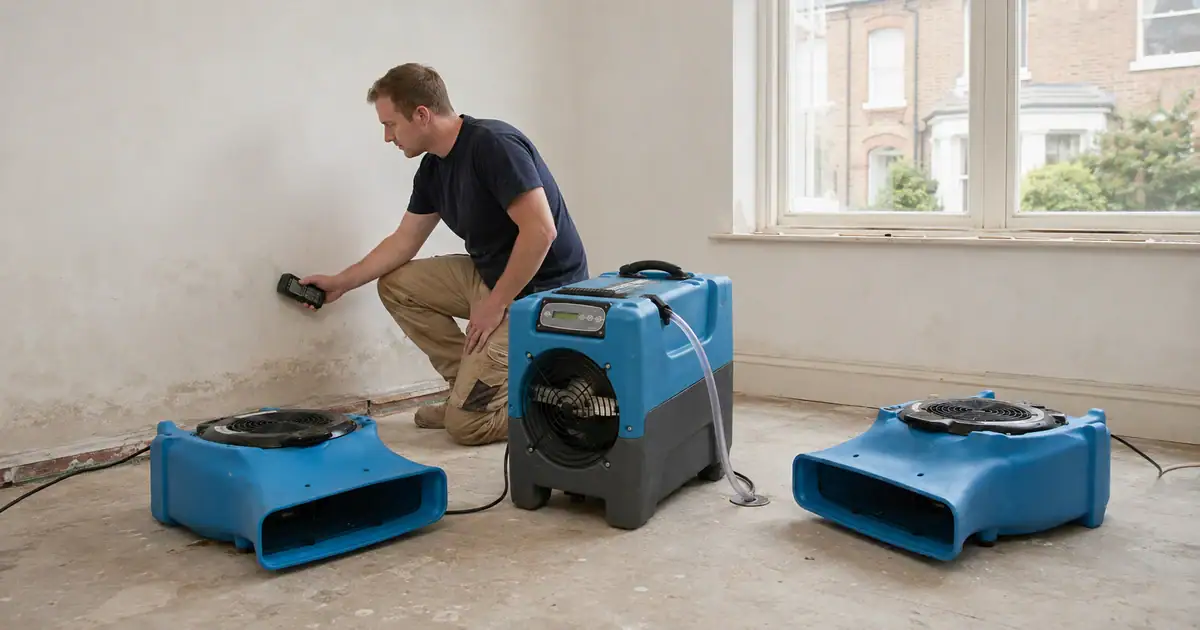
What Equipment Does a Drying Company Use? — exactly what professional drying companies deploy after water damage, how it works, and when you can hire the same kit yourself.
Hireload delivers equipment across London from our Greenford / UB6 operating area. View full London delivery areas.
The Equipment Behind the Invoice
When a drying company arrives at a water-damaged property, they deploy three core types of equipment. The specific models vary, but the categories are always the same.
1. LGR dehumidifiers. Low Grain Refrigerant units that extract large volumes of moisture from the air, even at lower humidity levels where standard dehumidifiers lose efficiency. These are the workhorses — typically 50-90L/day extraction capacity.
2. Air movers. High-velocity fans positioned to blow across wet surfaces (floors, walls, under carpet). They accelerate evaporation by replacing the saturated air layer sitting on wet materials with drier air the dehumidifier can then process.
3. Moisture meters and monitoring equipment. Pin-type and non-invasive meters that measure moisture content in walls, floors and timber. These guide the drying process and determine when the property is officially dry for insurance or warranty purposes.
Some larger jobs also use industrial heaters (to raise ambient temperature for more efficient dehumidifier operation), air scrubbers (to filter mould spores during remediation), and thermal imaging cameras (to locate hidden moisture behind walls and under floors).
What Does a Drying Company Actually Charge?
Professional drying services in the UK typically cost between £150 and £500+ per week, depending on the scale of the job and how many units are deployed. That usually includes equipment hire, periodic monitoring visits, moisture readings, and eventually a drying certificate for insurance purposes.
For a single-room burst pipe, you might be looking at £200-300 for a week of equipment plus a monitoring visit. For a multi-room flood with insurance involvement, costs can run into the thousands over a two to four week drying period.
Most of that cost goes toward two things: the specialist monitoring and the drying certificate. The equipment itself — dehumidifiers and air movers — is the same class of kit available for direct hire.
Can You Hire the Same Equipment?
For the dehumidifiers and air movers — yes, absolutely. The commercial and industrial dehumidifiers available from equipment hire companies are the same class of machines that drying companies deploy.
Drying Calculator
Two quick questions and we'll size the right dehumidifier — and tell you how long to hire it.
What Hireload offers in this category:
- 38L commercial dehumidifier — suited to single-room drying jobs
- 43L Dri-Eaz Cube — compact industrial unit, the same brand used by many restoration companies
- 63L LGR dehumidifier — LGR technology, the same type professional drying companies use for larger jobs
- 95L industrial dehumidifier — top-end extraction for severe water damage
- Air movers — the same high-velocity dryers used in professional setups
The equipment is the same class of kit. What you don’t get with self-hire is the monitoring, the moisture readings and the drying certificate.
When DIY Drying Works
Self-hire drying is practical and cost-effective for:
Clean water damage in a home. A burst pipe, radiator leak, appliance overflow or roof leak — where the water source is clean (not sewage or contaminated) and the affected area is manageable. Our guide on drying a room after a leak walks through the setup.
Single-room or small-area jobs. One room with a wet carpet and damp plaster is well within the scope of a dehumidifier and a couple of air movers.
Renovation drying. Plaster, screed or post-building moisture — you need extraction, not monitoring. A hired dehumidifier does the job.
Condensation or humidity control. Ongoing moisture management doesn’t require professional monitoring.
When You Need the Professionals
Insurance claims that require a drying certificate. If your insurer or loss adjuster requires a formal drying certificate with calibrated moisture readings, a professional drying company provides this. Self-hire equipment does the drying, but the certificate requires specialist monitoring — check what your policy or adjuster asks for.
Contaminated water. Sewage, external flood water, or water that has passed through contaminated ground needs specialist cleaning and biocidal treatment before drying. This is not a DIY job.
Concealed moisture. If water has reached inside wall cavities, under structural floors or into ceiling voids, professional monitoring with non-invasive meters and thermal imaging helps ensure nothing is missed. Surface drying can look complete while moisture remains trapped in hidden areas.
Large-scale or multi-floor damage. When the job needs multiple industrial units, careful zone management and periodic adjustments based on moisture readings, professional oversight helps keep the drying strategy on track.
The Middle Ground: Hire the Equipment, Get a Spot Check
Some people hire the equipment themselves and pay a drying specialist for a single monitoring visit partway through and a final moisture check at the end. This gives you the cost saving of self-hire with the reassurance of professional verification.
It is a pragmatic approach — especially for medium-sized jobs where full professional management feels disproportionate but you want certainty that the property is properly dry before redecorating.
Frequently Asked Questions
Want to see the same kit used on a real flood job rather than a spec list? Flooded house: the first 48 hours and what comes after sets it out room by room, with the equipment each one needs.
Hire the Same Equipment — Without the Professional Price Tag
Commercial and industrial drying equipment, delivered to your door across London. Call us on 020 3375 4048 for sizing advice.
Browse Drying Equipment
 Drone Survey & Mapping
 Drone Inspections