
 Drone Services
 Access Equipment
 Breaking & Drilling
 Cleaning Equipment
 Drying & Heating
 General Site Tools
Equipment Hire Guides
Warehouse and Office Humidity Problems: When You Need Industrial Drying
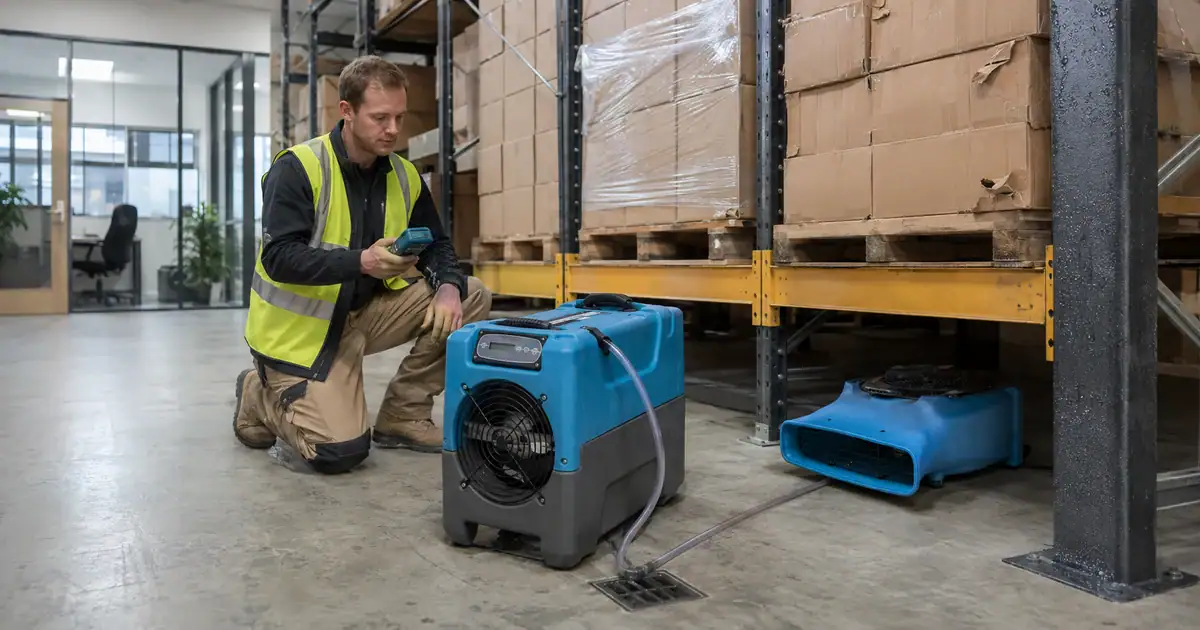
Warehouse and Office Humidity Problems — when high humidity in a commercial building starts costing you money, and how to size industrial drying equipment to fix it.
Hireload delivers equipment across London from our Greenford / UB6 operating area. View full London delivery areas.
Cold buildings change the maths. Dehumidifier performance in cold spaces covers why a unit that copes in summer struggles in an unheated warehouse in January, and what to pair with it.
Leisure buildings are the extreme version of the same problem, because the moisture source never switches off. Pool, spa and hot tub room humidity control covers the numbers those spaces run to and what happens above them.
Damp stock, condensation on steelwork, or a humidity clause in a lease? Commercial buildings hold moisture for the same reason homes do — cool surfaces, poor air movement and no way for the water to leave — but the cost of ignoring it lands on stock, not on decor.
A 63L LGR dehumidifier is £59.99 + VAT for a day, £119.99 for up to a week and £16.80 a day beyond that; a 95L industrial unit is £149.99 for up to a week, £19.99 a day longer term. Delivered across London, or collect free from Greenford UB6.
Browse drying equipment · Not sure what size? Call 020 3375 4048 or message us on WhatsApp.
When Humidity Becomes a Business Problem
High humidity in commercial buildings is more than uncomfortable — it damages stock, corrodes equipment, creates slip hazards from condensation, and makes working conditions unpleasant. In warehouses, offices, retail units and workshops, uncontrolled moisture leads to real financial loss.
Common symptoms: condensation on metal surfaces and machinery, damp cardboard and packaging, mould on walls or stored goods, a musty smell that won’t shift, water pooling on concrete floors in cold weather, and staff complaints about stuffy or clammy conditions.
Why Commercial Buildings Get Humid
Large concrete floors and walls hold moisture. A warehouse concrete slab can absorb and release significant volumes of moisture, especially in buildings without a properly installed damp-proof membrane. Temperature changes cause this moisture to condense on surfaces.
Goods coming in and out. Loading doors open regularly, letting moist outside air flood the space. In autumn and winter, the temperature difference between inside and outside creates immediate condensation on cold internal surfaces.
Drying Calculator
Two quick questions and we'll size the right dehumidifier — and tell you how long to hire it.
Poor or no mechanical ventilation. Many commercial buildings rely on natural ventilation through roller doors and louvres. In damp weather, this brings in more moisture than it removes.
High occupancy or process heat. People, machinery, cooking (in food service) and manufacturing processes all generate moisture. Without adequate extraction, humidity builds up.
What Equipment Solves It
For targeted drying (a short-term problem)
If you are dealing with a one-off moisture event — a roof leak that has been repaired, flooding after a burst main, or post-construction moisture — industrial dehumidifiers deployed temporarily will extract the moisture and restore normal conditions.
A 95L industrial dehumidifier handles large open spaces. For more targeted zones — a specific section of a warehouse, an office within a larger unit, or a retail stockroom — the 63L LGR unit provides high-efficiency extraction even as humidity drops.
How many units? Divide the space into zones. A single industrial dehumidifier effectively covers roughly 150-250m2, depending on ceiling height and humidity level. A 500m2 warehouse with persistent humidity typically needs two to three units. For very large spaces, call us for sizing — getting it right first time saves days of hire.
For ongoing humidity control
If the problem is chronic — the building structure sweats, loading dock operations bring in moisture daily, or the space simply runs at too high a humidity — you need either a permanent installed solution or a recurring hire strategy.
Permanent option: building-mounted dehumidification systems designed for commercial spaces. The capital cost is significant, but running costs are predictable.
Recurring hire option: deploying industrial units for the worst months (typically October to March in the UK) and returning them when conditions improve. This avoids capital expenditure and gives flexibility to scale up or down.
Sizing for Commercial Spaces
| Space type | Typical size | Recommended equipment |
|---|---|---|
| Small stockroom or office | Up to 100m2 | 1x 38-43L commercial dehumidifier |
| Medium warehouse section | 100-300m2 | 1x 63-95L industrial dehumidifier |
| Large warehouse | 300-500m2 | 2x industrial dehumidifiers |
| Very large distribution centre | 500m2+ | Multiple units — call for assessment |
Add air movers in areas with poor air circulation — corners, dead-end aisles, and areas behind racking where air stagnates. If you are unsure how many units your space needs, our guide on how many dehumidifiers you need walks through sizing by volume.
Protecting Stock and Equipment
The financial case for humidity control is often straightforward. Damaged stock, corroded machinery, health complaints from staff and lost working time all carry a cost. A week of industrial dehumidifier hire is typically cheaper than one pallet of water-damaged goods.
Industries particularly affected:
- Food and drink warehousing — humidity causes packaging failure, condensation on products, and hygiene risks
- Textiles and fashion storage — mould and damp odour permanently damage fabric
- Electronics and components — corrosion from moisture exposure causes product failure
- Paper and printing — paper absorbs moisture instantly, causing warping, jamming and print-quality issues
- Construction materials — plasterboard, timber and insulation stored in damp conditions degrade before installation
What commercial dehumidifier hire costs
Prices are ex-VAT and match each product page. A refundable deposit applies and comes back in full when the equipment returns undamaged. For a humidity problem that runs for weeks or a season, the “longer” column is the number that matters — that is the rate you actually pay.
| Machine | 1 day | 2 days | Up to a week | Longer |
|---|---|---|---|---|
| 38L commercial — small unit or office floor | £29.99 | £44.99 | £59.99 | £8.40/day |
| 63L LGR — cold or unheated space | £59.99 | £89.99 | £119.99 | £16.80/day |
| Air mover — moves air across stock and floors | £19.99 | £24.99 | £29.99 | £4.80/day |
A worked example. A cold storage unit that sweats through the winter, hired for a month: a 63L LGR at £16.80 a day is roughly £504 + VAT for 30 days. Set against a single pallet of water-damaged stock, that is usually the cheaper side of the decision — and hiring first tells you what capacity a bought unit would need before you commit to buying one.
Delivery and collection is £35 + VAT next working day, £59 before 11am, or £69 same day. Collection from our Greenford UB6 depot is free. For long hires we can quote a rate against a fixed term — tell us the floor area, the ceiling height and how long you need it.
Frequently Asked Questions
Solve Your Commercial Humidity Problem
Industrial dehumidifiers sized for commercial spaces, delivered across London. Call us on 020 3375 4048 for a sizing recommendation.
Browse Industrial Dehumidifiers
 Drone Survey & Mapping
 Drone Inspections