
 Drone Services
 Access Equipment
 Breaking & Drilling
 Cleaning Equipment
 Drying & Heating
 General Site Tools
Equipment Hire Guides
How to Get Rid of Black Mould on Walls
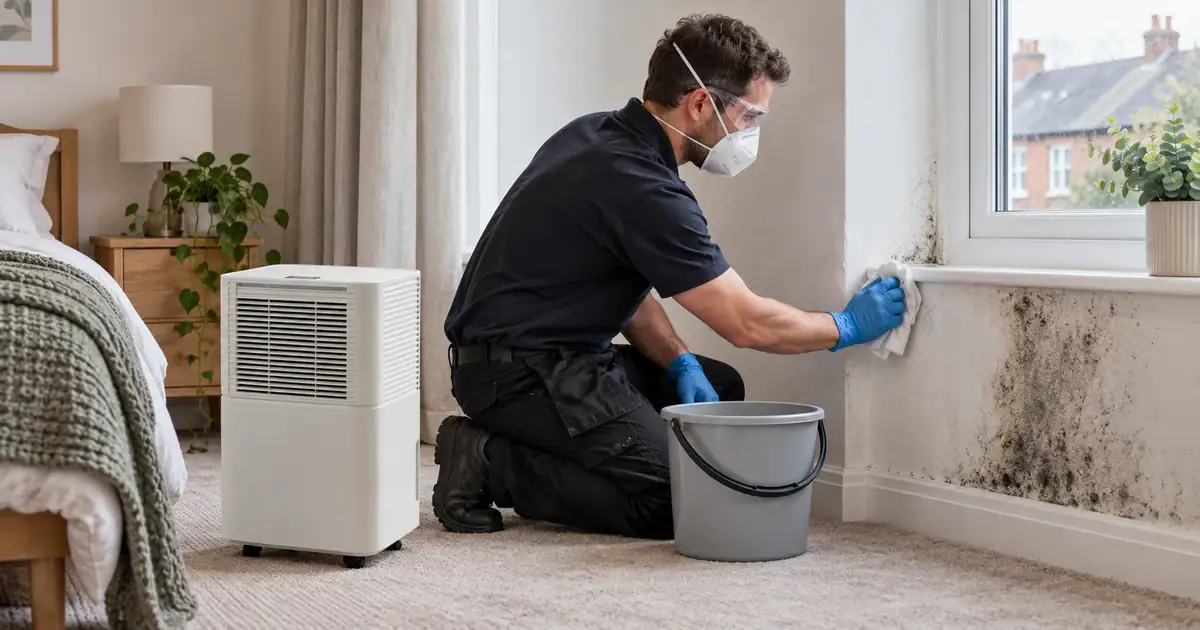
How to get rid of black mould on walls, and stop it growing back
Black mould on a wall is not a cleaning problem. It is a moisture problem that shows up as a stain. You can wash it off in an afternoon, but unless the surface stops being damp it will be back before spring. This guide covers removing it safely, then the numbers that actually keep it away.
How do you get rid of black mould on walls?
Clean it with a fungicidal wash that carries an HSE approval number, wearing gloves, eye protection and a mask. Do not brush, sweep or vacuum it — that throws spores into the air — and do not rely on bleach, which lifts the colour but leaves the growth behind on a porous wall. Let the surface dry fully, then repaint with a fungicidal paint if you are decorating.
Then fix the moisture, or it returns. Mould needs a damp surface, and it multiplies once relative humidity reaches roughly 70–80%. Keep indoor humidity in the 40–65% band, keep rooms above 16°C, ventilate where moisture is produced, and use a dehumidifier through the cold months if the air will not come down on its own. If the patch is bigger than about one square metre, treat it as a job for a professional rather than a Sunday afternoon.
The numbers this guide keeps coming back to
The indoor relative humidity band to aim for. Below it the air is dry enough that surfaces stay clear.
Where mould spores start multiplying. Most London bedrooms sit here on a cold morning with the window shut.
The minimum room temperature to hold. Warm surfaces do not condense, and 18–21°C is the comfortable target.
Above roughly a square metre of mould, PPE is needed and it stops being a DIY job.
Every autumn the same thing happens across London. The heating goes on, the windows stay shut, and within a few weeks a grey-black bloom appears in the corner of a bedroom, along a window reveal, or on the wall behind a wardrobe. It looks like dirt. It is not dirt — it is a living growth, and it is telling you exactly where the cold, damp part of your wall is.
This is not a small or unusual problem. Government guidance puts the number of homes in England affected by damp and mould at somewhere between 962,000 and 6.5 million, and UKHSA estimates around two million people are living in homes with significant damp or mould. So if you are dealing with it, you are dealing with one of the most common housing problems in the country.
Why it grows exactly where it grows
Mould does not appear at random. It appears where a surface is cold enough, for long enough, to hold moisture against it. Three things have to line up, and in a British winter all three usually do.
The three conditions, and why your wall provides all of them
A household puts several litres of water into the air every day — cooking, showering, washing, drying clothes indoors, and simply breathing. With the windows shut, it has nowhere to go.
Warm air holds more moisture than cold air. When that air touches a cold wall, the air right at the surface cools, its relative humidity climbs, and moisture settles there. That is why it is always the coldest patch.
A wall that is damp for an hour is fine. A wall that sits damp every night from October to March is a growing medium. Mould needs sustained dampness, not a one-off.
External corners lose heat two ways at once, so they are the coldest point in a room. Furniture against an external wall stops warm air reaching it. Both create a cold patch, and the mould finds it.
This is also why wiping it off never works on its own. The stain is the symptom. The cold, damp surface is the cause, and it is still there after you have cleaned.
First, work out which kind of damp you have
Treating condensation as if it were rising damp wastes money, and treating a leak as if it were condensation wastes a winter. These tell them apart.
| Type | What it looks like | Where you find it | What fixes it |
|---|---|---|---|
| Condensation | Black speckled mould, often in a fan-shaped patch. Water beads on windows in the morning | Cold corners, window reveals, behind furniture, north-facing walls, ceilings above bathrooms | Warmth, ventilation and lowering indoor humidity — the subject of this guide |
| Penetrating damp | A defined damp patch that grows after rain, often with staining and salts | Any height on the wall, matched to a defect outside — a cracked gutter, failed pointing, a leaking overflow | Fix the defect outside, then dry the wall |
| Rising damp | A tide mark up to roughly a metre, sometimes with a salt band and blown plaster | Ground floor only, at skirting level | A survey. Genuine rising damp is far rarer than it is diagnosed |
| A leak | Damp that appeared quickly and does not follow the weather | Under a bathroom, near pipework, around a shower tray | Find and fix the leak first, then dry it properly |
If you are not sure which you are looking at, the full comparison of rising damp, condensation and penetrating damp walks through the tells one by one. If water appeared suddenly, deal with drying out after a leak first — there is no point managing humidity while a pipe is still weeping.
Removing it safely, step by step
Before you start: if the affected area is larger than roughly one square metre, or if anyone in the house has asthma, a respiratory condition or a weakened immune system, get it done professionally. Disturbing a large area of mould puts a lot of spores into a room that people then sleep in.
The order that works, and the bits people skip
Three things people get told to do that do not work
It takes the colour out, so the wall looks clean. On a porous surface it does not reliably lift the growth, and the water in it adds moisture to the very surface that was already too damp.
Guidance is explicit that this is not an effective removal method, and it releases spores into the air where they can be breathed in. Wipe, do not disturb.
Anti-mould paint on a wall that is still cold and damp buys you a few months. The paint is the last step after the moisture is fixed, never the first step instead of it.
Health note. Damp and mould are linked to respiratory problems, and the risk is higher for children, older people, and anyone with asthma, allergies or a lung condition. UKHSA attributes a measurable burden of asthma, lower respiratory infections and allergic rhinitis in England to damp and mould in housing. If someone in the home is in one of those groups, do not let a mould problem run through a whole winter while you decide what to do about it — and get large areas removed professionally rather than disturbing them yourself. This guide is general information, not medical or surveying advice.
The numbers that actually keep it away
Once the wall is clean, the job becomes a numbers game. Hit these and mould has nothing to grow on. Miss them and it comes back in the same spot, because the same spot is still the coldest one in the room.
| Indoor relative humidity | What it means in the room | Mould risk |
|---|---|---|
| Below 40% | Dry. Comfortable for most people, though very dry air can irritate airways | None — but you are unlikely to see this in a British winter |
| 40–65% | The band to aim for. Windows stay clear in the morning and cold corners dry out between nights | Low. This is the target |
| 65–70% | Borderline. Condensation appears on the coldest glass and the coldest corner stays damp longer | Rising. Mould gets a foothold on the coldest surfaces first |
| 70–80% | Spores multiply. This is where visible growth follows within weeks in an unheated, unventilated room | High |
| Above 80% | Sustained surface wetness. Growth spreads beyond the coldest patch onto the rest of the wall | Very high |
Temperature is the other half of it. Guidance for homes is to keep rooms above 16°C as a minimum, with 18–21°C as the comfortable range. That is not just about comfort — a warmer wall surface is a drier wall surface, because the air touching it does not cool enough for its humidity to spike. Heating one room and shutting the door on a cold one is how you create the perfect mould wall in the cold room.
The four levers, in the order they usually pay off
Lids on pans, extractor on during and for fifteen minutes after a shower, tumble dryer vented outside. Drying washing indoors alone can add several litres of water a day to a flat.
Trickle vents open, extractors working, and a short sharp airing rather than a window on the latch all day. You are trying to swap moist inside air for drier outside air without dumping all the heat.
Low and steady beats hot and intermittent. A room that never drops below 16°C has warmer wall surfaces than a room that swings from 10°C to 22°C twice a day.
When the first three are not enough — and in a lot of flats they are not — a dehumidifier removes what ventilation cannot, without opening the building up to the cold.
Where a dehumidifier fits, and how long to run one
A dehumidifier does one job: it pulls water out of the air and collects it. That drops the relative humidity in the room, which means the air touching your cold corner no longer reaches the point where moisture settles on it. It is the only one of the four levers that works without either heating the whole building or opening it to the weather.
How to run one so it actually changes the wall
Not the hallway. Close the internal door, run it in the affected room, and let it work on that air. Moving it between rooms on a rota works fine if you have two problem rooms.
A hand span of clearance around the inlet and outlet, and a socket it can reach without an extension across a doorway. Empty the tank daily, or run the drain hose to a sink if the unit has one.
The first few days are catch-up: you are drying the fabric of the room, not just the air. After that, a humidistat set to about 55% will cycle it on and off and keep the room in the band.
A refrigerant dehumidifier loses efficiency as the room gets colder, and struggles badly in an unheated space. If your room sits below about 15°C, read why a dehumidifier stops working in a cold room before you blame the machine.
How long? For a condensation problem in one room, most people run a unit continuously for the first week and then on a humidistat through the cold months. For a wall that has been wet for a long time, or a room being dried after a leak, realistic drying timelines by situation sets expectations properly. Running cost is usually the next question — what it costs to run a hired dehumidifier works it through at current unit rates.
Match the machine to the space — all hire from our Greenford UB6 depot
Not sure on capacity? What size dehumidifier do I need sizes it by room, and how many dehumidifiers do I need covers larger or multi-room jobs.
Renting, or letting the property?
One thing worth saying plainly, because it gets said badly a lot. Government guidance on damp and mould is explicit: it is, in its words, “totally unreasonable to blame damp and mould in the home on ‘lifestyle choices’”. A cold, poorly ventilated or defective building creates the conditions; how the household lives in it is secondary.
Where each side stands
Report it in writing, with photographs and dates, and keep a copy. A dehumidifier is a sensible interim measure while the cause is dealt with — it is not a substitute for the repair. Your rights on damp in a rented property sets out the process.
Respond promptly, investigate the cause rather than the stain, and record what you did. Awaab’s Law and the damp deadlines covers the timescales social landlords now work to.
Mould gets worse from October onwards and easier to fix in September. A month of drying now is cheaper than a spring of redecorating.
A gradual condensation problem is generally not an insurable event; a sudden escape of water usually is. Does insurance cover damp explains where the line sits.
What dehumidifier hire costs in London
Rates from our Greenford UB6 depot, ex-VAT. Hiring rather than buying makes sense when the problem is seasonal or you are drying a room out once — a week on a proper machine does more than a month on an undersized one.
| Machine | 1 day | 2 days | Up to a week | Longer |
|---|---|---|---|---|
| Compact 20L — a room or a small flat | £19.99 | £24.99 | £34.99 | From £4.50/day |
| Heavy-duty 38L — larger rooms, whole flat | £29.99 | £44.99 | £59.99 | From £8.40/day |
| Dri-Eaz Cube 43L — serious damp, drying out | £39.99 | £59.99 | £74.99 | From £11.20/day |
| Delivery & collection | £35 | £35 | £35 | Both trips, one price |
| Collection from Greenford UB6 | Free | Free | Free | Bring photo ID |
A week costs barely more than two days on every line, which matters here: condensation is not a two-day problem. A refundable deposit applies to every item we hire and comes back in full once the machine is checked in undamaged.
Six mistakes that keep the mould coming back
Every one of these is common, and every one of them wastes a winter
The stain was the symptom. If the wall is still the coldest surface in a humid room, you have bought yourself about eight weeks.
It bleaches the colour out of the growth rather than reliably removing it from a porous wall, and it puts more water onto a surface that was too wet already.
Moist air still finds the cold room, and now that room is colder than ever. Low background heat everywhere beats one hot room and four cold ones.
A wardrobe against a north wall makes a cold pocket with no air movement. Fifty millimetres of gap changes it more than most people expect.
One of the biggest single moisture inputs in a flat. If you have to dry indoors, do it in one room with a dehumidifier running in it.
A small unit filling its tank twice a day in a large room is not keeping up. The humidity never comes down into the band, so nothing changes on the wall.
Black mould questions
How do you get rid of black mould on walls permanently?
Remove it with a fungicidal wash carrying an HSE approval number, then change the conditions that grew it. Permanently means keeping indoor relative humidity in the 40–65% band, keeping rooms above 16°C, ventilating where moisture is produced, and dealing with any leak or building defect. Cleaning alone is temporary, because the cold damp surface is still there.
Does bleach kill black mould on walls?
Not reliably. Bleach removes the colour, so the wall looks clean, but on a porous surface like plaster it does not dependably remove the growth, and the water it puts on the surface adds to the problem. UK guidance recommends a fungicidal wash with an HSE approval number instead.
What humidity stops mould growing?
Aim for 40–65% relative humidity indoors. Mould spores start multiplying around 70–80% relative humidity, which is where a lot of unheated, unventilated British bedrooms sit on winter mornings. A cheap hygrometer will tell you which side of the line your room is on.
Will a dehumidifier get rid of black mould?
A dehumidifier does not clean existing mould off a wall — you still have to remove that. What it does is take the moisture out of the air so the growth cannot re-establish, which is the half most people skip. Clean the wall, then run the dehumidifier to keep the room in the 40–65% band.
Is black mould in a bedroom dangerous?
Damp and mould are linked to respiratory problems, and the risk is greater for children, older people, and anyone with asthma, allergies or a lung condition. UKHSA attributes a measurable burden of asthma, lower respiratory infections and allergic rhinitis in England to damp and mould in housing. If someone in the household is in one of those groups, treat it as a priority rather than a decorating job.
How much mould is too much to clean yourself?
Around one square metre is the usual dividing line. Above that, PPE is needed and the volume of spores disturbed makes it a job for someone equipped to do it properly. The same applies at any size if a household member has a respiratory condition.
Why does mould keep coming back in the same corner?
Because that corner is the coldest surface in the room. External corners lose heat through two walls at once, so the air touching them cools furthest, its humidity spikes, and moisture settles there first. Warm the surface, move furniture off it, and bring the room humidity down, and the corner stops being special.
How long should I run a dehumidifier for damp?
Continuously for the first few days — you are drying the fabric of the room, not just the air — then on a humidistat set around 55% through the cold months. A room that has been wet for a long time takes longer; realistic timelines vary by how wet the structure is, not just the air.
Can I get rid of mould without opening the windows?
Yes, and in a cold snap that is often the sensible route. Ventilation and a dehumidifier do the same job by different means: one swaps moist air for drier outside air, the other takes the water out without losing the heat. In a cold, exposed or noisy flat the dehumidifier is usually the easier of the two to live with.
Do I need to tell my landlord about mould?
Yes, and in writing with photographs and dates. Government guidance is clear that it is unreasonable to blame damp and mould on how a household lives, so report the problem and let the cause be investigated. Running a dehumidifier in the meantime is a sensible interim step, not a replacement for the repair.
Related guides
Hire pages linked from this guide
Get the humidity down before the cold sets in
Tell us the room size and what you are dealing with — a mouldy bedroom wall, a flat that never dries, or a room being dried out after a leak — and we will match the machine. Dehumidifier hire from £19.99 + VAT a day, delivered across London or collected free from Greenford UB6. A refundable deposit applies to every item.

 Drone Survey & Mapping
 Drone Inspections