
 Drone Services
 Access Equipment
 Breaking & Drilling
 Cleaning Equipment
 Drying & Heating
 General Site Tools
Equipment Hire Guides
Burst Pipe or Flood? How to Dry Your Home Out Fast (and What to Hire)
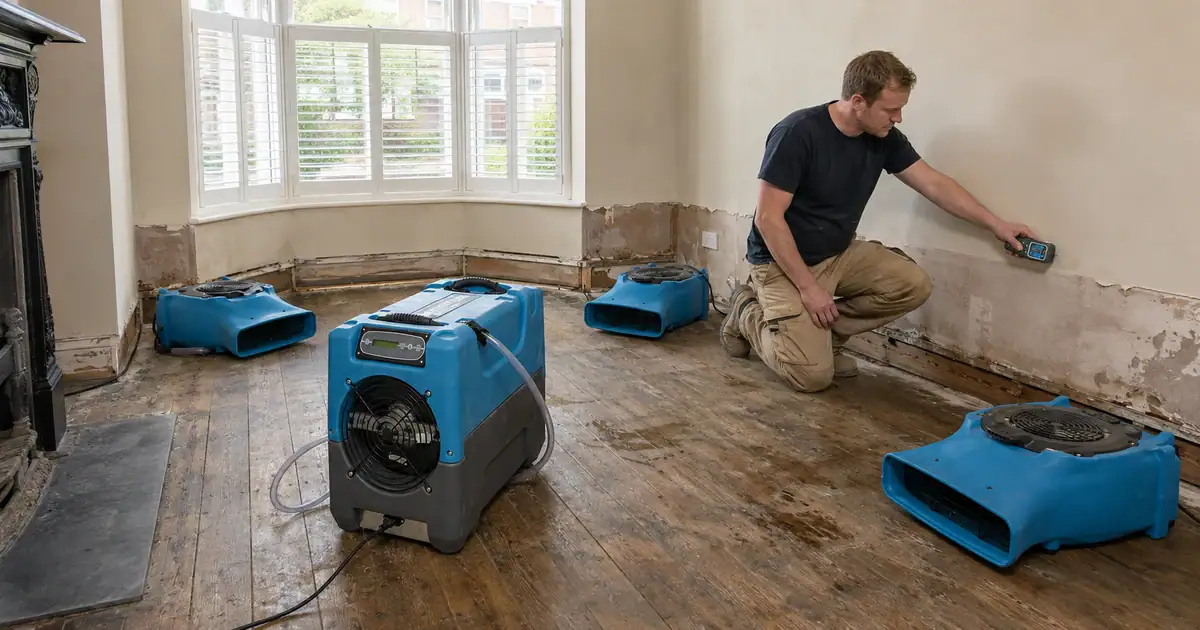
Water in the house is a race against the clock. Here is how to dry it out properly, in the right order, with the same kit the professionals use — without paying a restoration firm to do it for you.
The short version
- Act within 24–48 hours. Clean water turns dirty and mould can start within two days — speed limits the damage.
- Order of work: make it safe (power off), then remove standing water, then ventilate and warm to 20–22°C, then run air movers + a dehumidifier together.
- You can do it yourself. For clean water in an accessible space, hiring the kit can cost a fraction of a restoration call-out and, when used promptly and correctly on clean-water jobs, can achieve the same drying effect.
- Call a professional for sewage, river or outside flood water, or structural damage.
Sources: Association of British Insurers; restoration-industry water categories (IICRC S500); UK hire vs call-out price anchors. Figures are typical, not guaranteed.
A burst pipe, a leak from the flat above, an appliance that has let go, or a flood — whatever the source, the longer water sits the deeper it soaks into floors, plaster and skirting, and the higher the chance of mould. The good news: for clean water in a space you can reach, this is a job you can do yourself with the right equipment.
Hireload supplies drying kit across London from our Greenford (UB6) base, with delivery and collection. See London delivery areas.
If you have water where it should not be, you are racing two clocks at once: the water spreading and soaking, and mould, which can take hold within 24 to 48 hours. Getting air moving and moisture out quickly is what limits the damage — and it is work you can largely do yourself, as long as the water is clean and the problem is not structural.
This is not just our advice. The UK government’s Flooding and health guidance states: “Heating, dehumidifiers and good ventilation can help to dry out your home.” Dehumidifiers, heaters and the air movers that drive that ventilation are exactly what we hire out.
First, stay safe
Before you touch anything, isolate the danger. If water has reached sockets, wiring or your consumer unit, switch off the electricity and gas at the mains and leave them off until a qualified person has checked them. Wear waterproof gloves and sturdy boots — standing water often carries contamination you cannot see. Then photograph everything before you move it: if you are insured, your insurer will want evidence before you strip anything out.
When not to do it yourself. If the water came from a sewer, a river or rising groundwater, treat it as contaminated and call a professional restoration firm. The same goes for any sign of structural movement, or water that has been standing for days. This guide covers clean-water drying — the kind you can safely tackle with hired kit.
Why the first 24 to 48 hours decide everything
Water does not stay the same. The restoration industry grades it in three categories, and clean water does not stay clean for long — once it sits against carpet, plaster and dust it picks up contamination and drops a grade, often within a day. That is why speed matters more than anything else.
| Category | What it is | Can it be dried? |
|---|---|---|
| 1 — Clean | From a clean source: a burst pipe, a tank overflow, rainwater. | Yes, usually — if you dry fast. |
| 2 — Grey | Some contamination: washing-machine or dishwasher water, or clean water left to sit. | Partly — soft items like underlay often come out. |
| 3 — Black | Grossly contaminated: sewage, river or outside flood water. | No — a professional job. Do not reuse. |
The drying method that actually works
Drying a building is not complicated, but the order matters — each step sets up the next.
1. Get the standing water out
Remove as much water as you physically can first. A submersible pump clears the bulk; a wet-and-dry vacuum picks up the rest. Shovel out any silt before it dries hard.
2. Open up and warm up
Open windows and internal doors to get air moving, and unblock any air bricks. If your heating is safe to use, hold a steady 20 to 22°C — gentle constant warmth dries better than blasting heat. Once a dehumidifier is running, close the windows and keep internal doors open so the machine works on dry-able air, not the damp outdoors.
3. Add air movers and a dehumidifier
This is where hired kit earns its keep. Air movers push a high-volume stream of air across wet surfaces so moisture evaporates far faster; a dehumidifier then pulls that moisture out of the air and collects it so it cannot soak back in. You need both: the air mover lifts the water out of the material, the dehumidifier takes it out of the room.
Drying Calculator
Two quick questions and we'll size the right dehumidifier — and tell you how long to hire it.
The mistake that costs people weeks: reaching for a small plug-in dehumidifier and hoping it copes. For a real wet-out it will not keep up — you will be emptying it every couple of hours and still losing the race. A proper commercial dehumidifier moves far more moisture, and for water in carpets and under floors you need air movers too, not a dehumidifier alone.
Which kit do you need?
It depends on how much floor area is wet and how saturated it is. As a rough guide:
 Small
SmallOne or two rooms
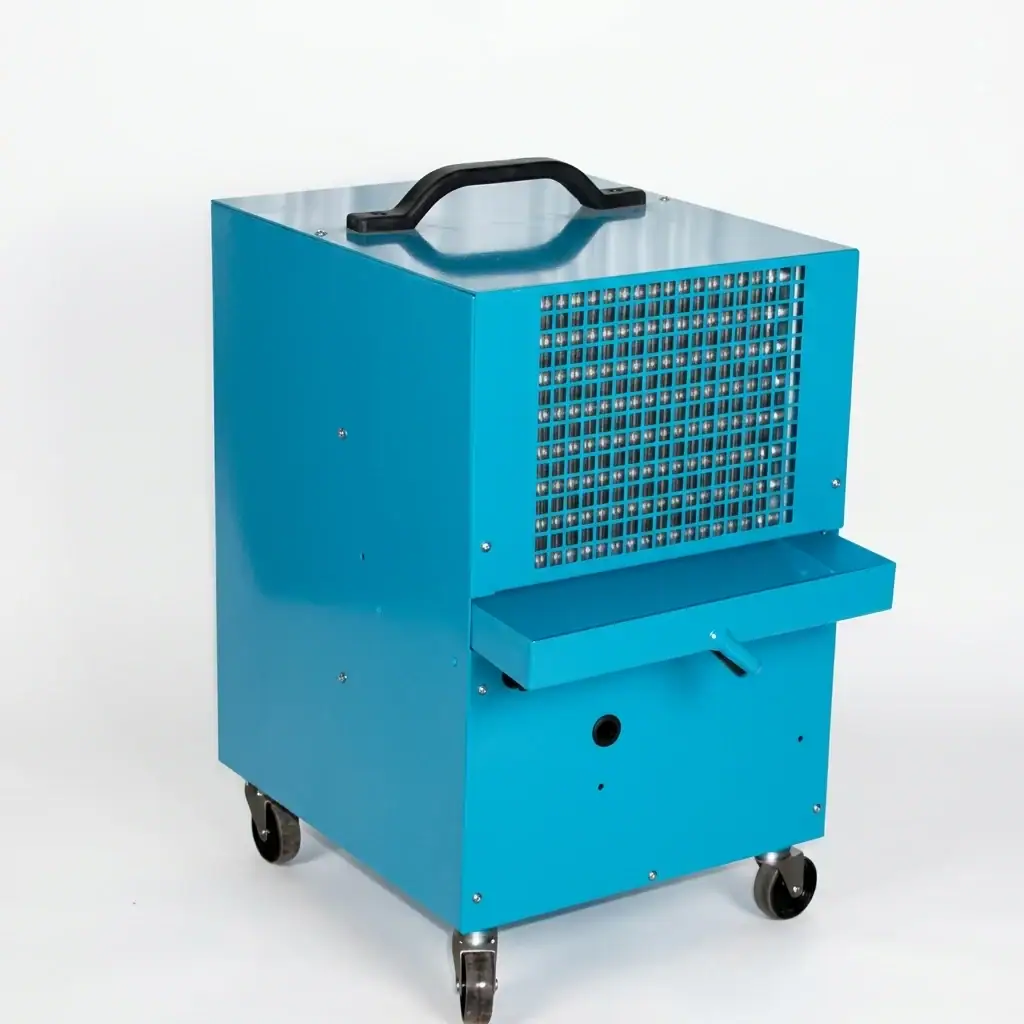
An air mover plus a 38L dehumidifier — the everyday burst-pipe set-up.
View the 38L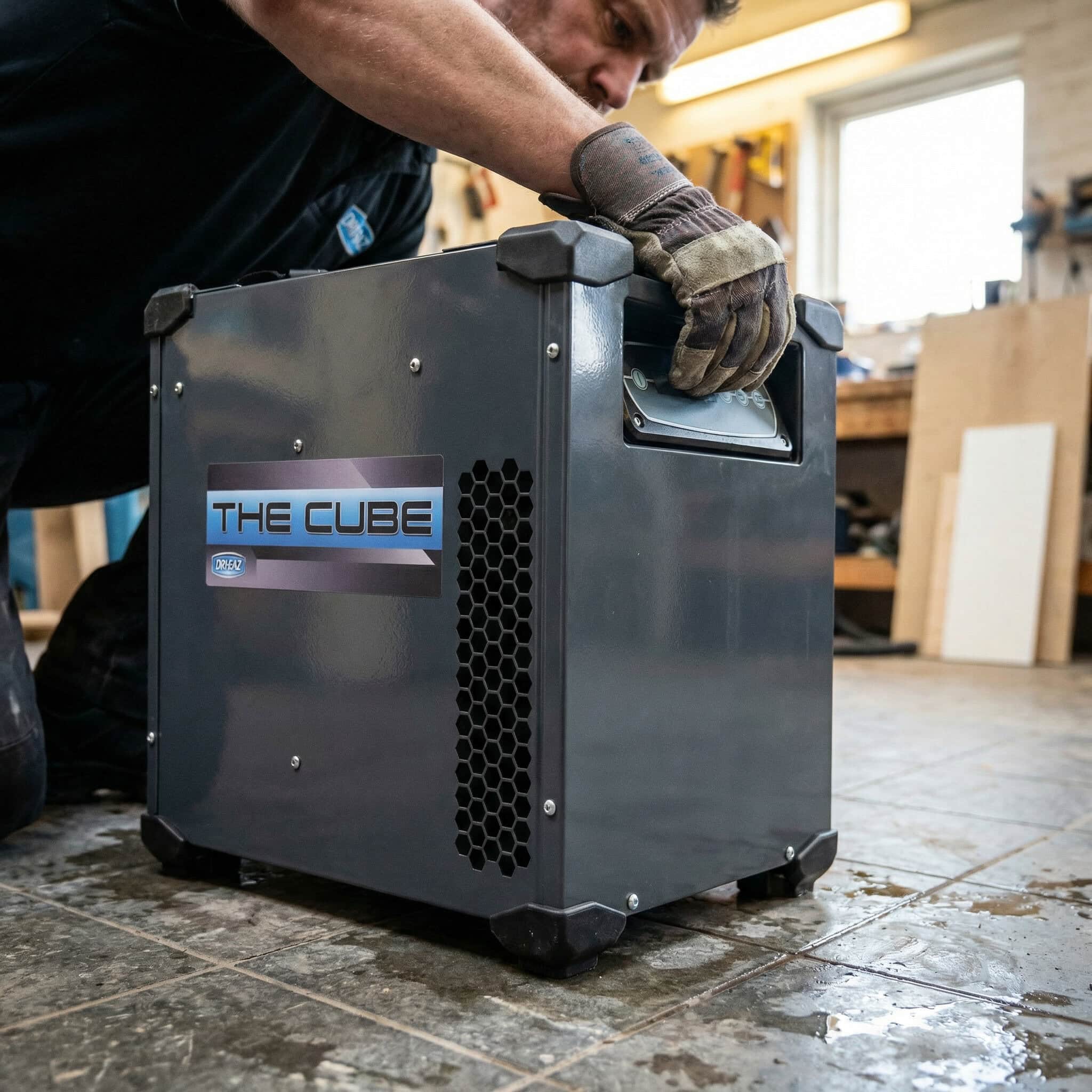 Medium
Several rooms / heavy soak
Two or more air movers and a higher-capacity 43L unit to keep pace with the moisture.
View the 43L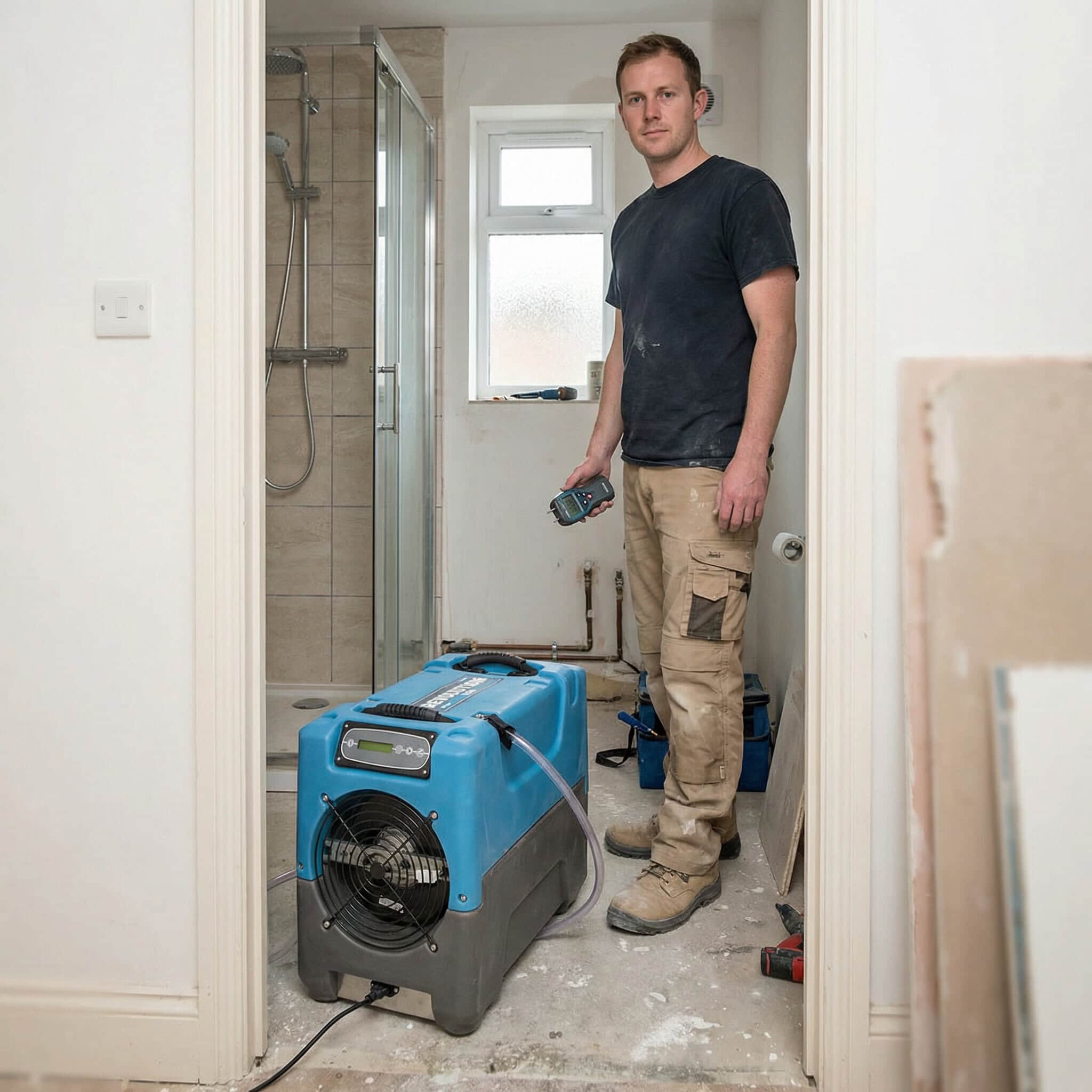 Large
LargeWhole floor / building
A building dryer such as the 63L LGR with multiple air movers for sustained drying.
View the 63LDIY drying vs a restoration company — the real cost
Restoration firms do excellent work, but you pay for a call-out, daily equipment, labour and a report. For a clean-water leak in a space you can reach, hiring the same class of kit and running it yourself costs a fraction. The work is the same physics, not magic — so done promptly and properly, it can dry the room just as effectively.
| Approach | What you are paying for | Typical, single room |
|---|---|---|
| Hire the kit & DIY | Dehumidifier + air mover hire, you run it | ~£150–£350 / week |
| Restoration call-out | Call-out + daily kit + labour + report | ~£700–£2,000+ |
UK price anchors (Checkatrade / Airtasker / hire market); figures are typical, not guaranteed, and savings depend on the job. The DIY route applies to clean water, source stopped, accessible, small scale only — not sewage, structural or large floods.
How long will it take?
Honestly, longer than most people hope. Surfaces can feel dry in a few days, but moisture trapped inside walls, screed and timber takes far longer to leave — commonly several weeks, and sometimes months, according to local-authority flood advice and the restoration trade. Anyone promising a fixed number of days without seeing your property is guessing. The single biggest factor in your control is running enough equipment, continuously. More in our guide on how long it takes to dry out a room.
What it costs to run
Two costs matter: the hire, and the electricity to run the kit while it works. Because a dry-out runs for days or weeks, the running cost is worth understanding up front — and a modern dehumidifier is cheaper to run than people expect. We break the numbers down in how much it costs to run a hired dehumidifier.
What the hire itself costs
Prices are ex-VAT and match each product page. A refundable deposit applies and comes back in full when the equipment returns undamaged.
| Equipment | 1 day | 2 days | Up to a week | Longer |
|---|---|---|---|---|
| 19L dehumidifier — one room | £19.99 | £24.99 | £34.99 | £4.50/day |
| 38L dehumidifier — a flat or a floor | £29.99 | £44.99 | £59.99 | £8.40/day |
| 63L LGR — heavy saturation, cold rooms | £59.99 | £89.99 | £119.99 | £16.80/day |
| Air mover — per unit | £19.99 | £24.99 | £29.99 | £4.80/day |
A worked example. One room, five days, a 38L dehumidifier plus an air mover: £89.98 + VAT. The Entry Drying Package bundles the same two machines at £84.99 + VAT for up to five days. Over a full week the two hired separately usually work out cheaper — worth checking both before you book. Delivery is £35 + VAT next working day, £59 before 11am, £69 same day, or free collection from Greenford UB6.
Insurance: who pays?
Water damage is one of the UK’s most common home-insurance claims — the ABI reports insurers pay out around £1.8 million every day for escape of water alone. If you are insured, a burst pipe or leak is usually covered, and your insurer may arrange the drying equipment — call them before you spend. If you are not insured, or you would rather start drying now than wait for an assessment, hiring the kit yourself is often the fastest way to limit the damage. Higher-risk flood homes are also helped by Flood Re (residential homes built before 2009, running to 2039; it does not cover commercial property or larger leasehold blocks).
Is your area at risk?
Flood risk in the UK is bigger, and more local, than most people realise. The Environment Agency’s 2024 assessment found 6.3 million English properties at risk from at least one source, 4.6 million of them from surface water — now the biggest single source — and nearly 320,000 high-risk surface-water properties in London, the largest share of any region. In London the surprise is that the main threat is not the Thames but surface water: flash flooding when heavy rain overwhelms the drains. Check your own postcode on the government’s Check for flooding service.
Source: Environment Agency, National Assessment of Flood Risk (December 2024); London figure via the Greater London Authority. The rise in the surface-water figure mainly reflects better mapping, not a sudden change in the weather.
When to call a professional. Hired kit is right for clean-water leaks and flooding you can reach and reason about. Bring in a specialist restoration firm for sewage, river or outside flood water, any contaminated (Category 3) water, unsafe or water-affected electrics, structural damage, or water that has been standing for days. Hireload supplies the drying equipment; we are not a restoration service.
If the water came in from outside rather than from a pipe, the job is bigger and slower. What to do when a house floods, and how long drying really takes covers the flood version — the strip-out, the timescales and the readings that prove it is dry.
Common questions
Do I really need both an air mover and a dehumidifier?
Is a normal plug-in dehumidifier good enough, or do I need a commercial one?
How many units will I need?
Can I dry a flooded carpet, or does it have to come up?
How soon should I start drying?
Do you deliver to my part of London?
Need drying kit in London today?
Air movers, dehumidifiers and building dryers — delivered and collected across London, same-day where scheduling allows. The kit the government’s own guidance points to, ready when you need it.
Or call 020 3375 4048 · same-day where scheduling allowsRelated guides
Useful if an insurer has appointed a restorer and you want to know what is coming. Read: what a professional drying company actually brings.

 Drone Survey & Mapping
 Drone Inspections