
 Drone Services
 Access Equipment
 Breaking & Drilling
 Cleaning Equipment
 Drying & Heating
 General Site Tools
Equipment Hire Guides
What Is a Genie Lift Used For?
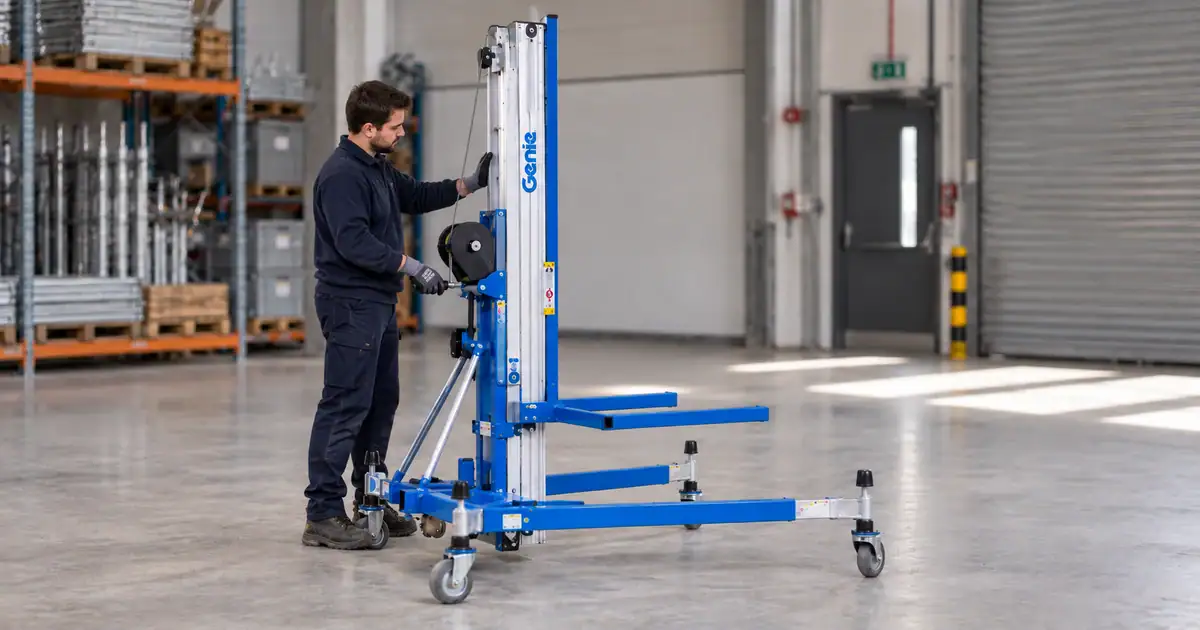
What a Genie lift is for, and the jobs it actually does
A Genie lift is a hand-winched mast on a wheeled base that raises loads, never people. It exists for one situation: something heavy has to go up, indoors, in a space a forklift cannot reach. This guide covers what it lifts, the trades that use it, what it will not do, and the checks that decide whether it suits your job.
What is a Genie lift used for?
A Genie lift — properly a material lift — is used to raise and hold heavy or awkward loads at height on site, so they can be fixed into position without anyone carrying them overhead. The common jobs are ductwork and ventilation, air conditioning and HVAC units, plasterboard and ceiling grid, shopfitting units and signage, pumps, cylinders and switchgear into plant rooms, and structural sections within the rated capacity.
It is used where a forklift or telehandler cannot go: finished interiors, occupied buildings, plant rooms with one narrow door, and floors reached by a passenger lift. It is a manual winch on castors, so it needs no fuel and no power supply. It lifts loads only — a material lift must never be used to raise or carry a person.
Four things worth knowing before you read the rest
Never a person. That single rule separates a material lift from a scissor lift or a tower, and there is no exception to it.
A hand winch and a mast. Nothing to plug in, nothing to fuel, so it works on a dead floor before the power is on.
Built for finished or near-finished interiors on a solid flat floor. Wind, slopes and soft ground are all outside what it is for.
LOLER applies. Thorough examination every 12 months, and the lifting operation has to be planned by someone competent.
Most people meet a Genie lift the same way: there is a fan coil unit, a run of ductwork or a stack of plasterboard that has to go up to soffit level, three people are holding it, and somebody says there has to be a better way. There is, and this is it — a mast you wind up by hand, on a base you push into position, that holds the load steady while it gets fixed.
The trade name has stuck the way Hoover did. People say Genie lift; the equipment category is a material lift. It is not a hoist, not a scissor lift and not a mini crane, and the differences matter for what you are allowed to do with it.
What a Genie lift actually is
Three parts, and understanding them explains most of what follows.
The three parts, and why each one matters to the job
Sections that raise a carriage by hand winch. No hydraulics and no engine, so it is quiet enough for occupied buildings and out-of-hours work with no exhaust and no noise limit problem.
Castors so one person can push it, and outriggers or a straddle base that spread the load and stop it tipping. The base width is what decides whether it gets through your doors.
Forks for pallets and boxed plant, a flat load platform for boards and panels, and a boom for slinging. The attachment changes both what you can lift and how much of it.
No platform for a person, no powered drive, no ability to travel with a raised load over rough ground. Every one of those absences is deliberate.
The jobs it gets hired for
Across our hires the same handful of jobs come up again and again. If yours is on this list, a material lift is very likely the right call.
| Job | What goes up | Why the lift wins |
|---|---|---|
| Ductwork and ventilation | Spiral duct, rectangular trunking, attenuators, grilles | Long sections held steady at soffit level while hangers are fixed — two people instead of four, and no overhead holding |
| Air conditioning and HVAC | Fan coil units, condensers, small air handling units | Dense, heavy and easily damaged. The lift positions it precisely instead of it being manhandled onto brackets |
| Drylining and ceilings | Plasterboard, ceiling grid, insulation, access panels | Board raised to the ceiling line so one person fixes instead of two holding. Cuts repeated overhead handling on a whole floor |
| Shopfitting and joinery | Wall units, gondola ends, signage, light boxes | Occupied retail, out of hours, through a shopfront. Nothing bigger gets in, and nothing else is quiet enough |
| Plant rooms and risers | Pumps, cylinders, valve sets, switchgear, distribution boards | One narrow door, no crane access and a floor above ground. The classic material lift job |
| Structural sections | Steel beams and sections, within the rated capacity | Only where the weight and balance are known in advance and confirmed against the unit supplied |
| Warehouse and racking | Stock into high bays, racking beams, fixtures | No forklift licence needed and no forklift charge for a one-off lift or a maintenance visit |
| Events, AV and lighting | Rigs, screens, speaker clusters, truss sections | Indoor venues where a load has to go up, be held, and come down again the same night |
The pattern is consistent: an indoor space, a load that is too heavy or too awkward to hold overhead safely, and no way to get powered plant to it. Where any one of those three is missing, something else is usually the better machine.
Trade by trade: who hires one, and why
The same machine, hired for six quite different reasons
The heaviest users. Ductwork, fan coils, pipework and plant into ceiling voids and risers on fit-outs, where the programme is tight and the space is finished.
Board and grid to the ceiling line. Here the value is not one heavy lift but hundreds of light ones — the repeated overhead handling is what wears people out.
Occupied units, night work, a shopfront for access. Quiet, no fumes, comes apart to get in, and leaves no marks on a finished floor.
A one-off lift in a building they run — a pump swap, a light fitting, a replacement unit — where calling in plant would cost more than the job.
Sections lifted into position within the rated capacity, with the weight and balance confirmed beforehand. Never a case for working it out on site.
Load in, hold, fix, load out. Indoor venues with floor loading limits and no forklift access are exactly the environment these were designed for.
What a Genie lift will not do
This is the half that gets skipped, and it is the half that matters. Every line here is a hard boundary, not a preference.
| Limit | Why | Use instead |
|---|---|---|
| It never lifts people | It is rated and designed to lift loads. There is no platform, no guard rail and no fall protection, and using one to raise a person is never acceptable | A scissor lift or a scaffold tower |
| Not for outdoor or windy work | Wind on a raised load and a mast on castors is a tipping risk. Soft or sloping ground makes it worse | Powered plant rated for outdoor use |
| Not for uneven or sloping floors | The base has to sit flat and the floor has to take the point loads. A gradient turns a controlled lift into an uncontrolled one | Level the area, or use plant designed for rough terrain |
| Nobody works under a raised load | The load sits on a winch and a mast, not on a mechanical support designed to be worked beneath | Lower the load, then work. Always |
| Not beyond the rated capacity | The rating on the machine is the rating. Load centre reduces it further, and there is no margin to borrow | A telehandler, forklift or lifting contractor |
| Not a stairs machine | Machine weight runs to a couple of hundred kilos. Stairs are a manual handling injury waiting to happen | Plan a passenger or goods lift route, or work at ground level |
Genie lift, scissor lift, tower or forklift?
These get mixed up constantly, and the distinction is simple. A material lift raises loads. A scissor lift or a tower raises people. Never swap one for the other.
| Method | Raises | Where it wins | Where it stops |
|---|---|---|---|
| Genie material lift | Loads only | Indoor, tight access, no power needed, no licence required | Never people. Indoor and level ground only |
| Manual handling | Loads | Light, low, occasional lifts | Heavy, repeated or overhead work — the main source of site back injuries |
| Scissor lift | People and their tools | Working at height for a period — wiring, fixing, finishing | Not a load lift. Needs trained, authorised operators |
| Scaffold tower | People | Longer static tasks, decorating, repeated access to one spot | Slow to reposition; not for lifting loads |
| Forklift or telehandler | Loads | Heavier loads, greater reach, moving loads distances | Cannot get into finished interiors or through standard doors |
In practice two of them often work together: the material lift puts the duct or the unit at height and holds it, and the operatives fix it from a platform alongside. If you are choosing the platform side of that pair, which scaffold tower do I need and the scissor lift licence rules cover it.
Three numbers decide which unit you get
Material lifts come in a range of mast heights, and the taller the mast the less the machine is rated to lift. Tell us these three things and we will confirm a suitable unit rather than you picking a model name off a list.
Work them out in this order — each one narrows the next
Not floor to ceiling. The height the underside of the load has to sit at, plus room to slide it into position. Sometimes that is well below the soffit; occasionally it is above it.
Including the frame, brackets, packaging and anything going up with it. An unknown weight is a reason to stop and weigh it, not a reason to try the lift and see.
The load centre — the horizontal distance from the mast to the centre of gravity. This is the one that catches people out, and it is explained below.
Doors, lift cars and corridor turns. This stops more jobs on the day than lift height ever does, so it gets its own section.
Load centre: the number nobody expects
Load centre is how far the weight sits out from the mast. A compact pump sitting tight against the carriage has a short load centre. A three-metre length of ductwork, a wide cabinet, or a steel that has to project past the forks has a long one. The further the weight sits out, the more leverage it puts on the mast, and the less the machine is rated to take.
The effect is not marginal. On Genie’s own published figures for the Superlift Advantage range, moving the load centre from 460 mm to 1,065 mm cuts a unit’s rated capacity by roughly 60% — same machine, same day, same mast height. A load that is comfortably inside the rating held close in can be well outside it held out.
What a long load centre looks like on site, and what to do about it
A 3 m spiral section cannot sit tight to the mast whatever you do. Rate the lift on the long load centre, not the short one.
A distribution board, or plasterboard on edge, puts mass well forward. Turning the load so the short side faces out helps, where the fixing position allows it.
A pump, a compact AC unit, a pallet of fixings. These sit close in and get the full rating — which is why the headline capacity figure always looks generous.
Rotate the load, use the correct attachment for its shape, and centre it on the carriage. If it still will not come in, you need a different machine, not optimism.
Will it get into the building?
This is the check that gets skipped and the one that wastes a delivery. A material lift stows at around two metres tall with a base around 800 mm wide. A standard UK internal door is 1,981 mm high and most commonly 762 mm wide. Both of those are smaller than the machine.
| Opening | Typical size | Against the machine | Verdict |
|---|---|---|---|
| Standard UK internal door | 1,981 mm high × 762 mm wide | About 2 m stowed, ~800 mm base | Tight both ways — tilt it back on the wheels and check the base against the frame |
| Wider internal door | 1,981 mm × 838 mm | ~800 mm base | Base clears; height still needs the machine tilted |
| Part M accessible doorway | 750–800 mm clear opening | ~800 mm base | Measure the clear opening, not the door leaf — ironmongery eats into it |
| Passenger lift car | Commonly 1.1 m × 1.4 m, 2.0–2.3 m high | Up to ~2.1 m base length on taller units | The longer units often will not stand in a small car. Check car depth and load limit |
| Goods lift | Varies widely | Base length and machine weight | Usually fine, but confirm the car length and the kg limit |
| Stairs | — | Roughly 120–200 kg | Not a stairs machine. Plan a lift route or work at ground level |
Weight matters here as much as size. On an occupied building — a working office, a school, a hotel — the route to the room is almost always a bigger constraint than the lift height. Measure it before you book, not after the van arrives.
Measure these before booking
LOLER, competence and what to check on delivery
A material lift is lifting equipment, so LOLER 1998 applies both to the machine and to how you use it. Two duties reach the person hiring it.
The duties that land on the hirer, not the hire company
HSE requires lifting equipment to be thoroughly examined by a competent person at least every 12 months — and every 6 months for lifting accessories, and for anything used to lift people. Ask for the report and check the date on it.
Lifting operations must be planned, supervised and carried out safely. For a straightforward repeated lift that plan can be short, but it has to exist and it has to cover the load weight and the exclusion zone.
There is no legal ticket for a manual material lift the way there is for some powered plant. PUWER still requires the user to be trained and competent, and that duty sits with the employer.
HSE recorded 511,000 workers in Great Britain with a work-related musculoskeletal disorder in 2024/25, and handling is the most commonly reported cause of over-seven-day injuries in construction. A winch does the lift a back would otherwise do.
Check these in the first five minutes on site
Never under a raised load, and never a person on the lift. A material lift holds its load on a winch and a mast, not on a mechanical support designed for anyone to work beneath. Set an exclusion zone under and around the raised load, keep everyone outside it while the load is moving, and lower the load before anyone works underneath. It is not used to raise or carry a person under any circumstances, and it is not used outdoors in wind unless the unit and the conditions have been confirmed as suitable. Follow the site RAMS and the instructions issued with the machine.
What Genie lift hire costs in London
Rates from our Greenford UB6 depot, ex-VAT. We confirm the unit against your load, your lift height and your access route before the booking is taken.
| Period | Rate | Works out at | Notes |
|---|---|---|---|
| 1 day | £79.99 | £79.99/day | A single lift or a one-day install |
| 2 days | £109.99 | £55.00/day | Weekend, or a job needing two visits |
| Up to a week | £139.99 | From £20.00/day | Best value on any fit-out running past two days |
| Longer | From £19.60/day | — | Priced on your dates at booking |
| Delivery & collection | £35 | Both trips | Or collect free from Greenford UB6 with a suitable van |
| Damage deposit | £250 refundable | — | Returned in full once the machine is checked back in undamaged |
The shape of that table is the same as most of our kit: a week costs barely more than two days. If a fit-out might run on, book the week from the start rather than extending it. A refundable deposit applies to every item we hire and comes back once the machine is inspected — what happens if you damage hired equipment explains where you stand if something goes wrong, and trade accounts cover repeat hires on terms.
Six mistakes that cost a day
None of these are equipment faults — they are planning faults
The biggest number on any spec sheet is the shortest mast at the closest load centre. Rate your lift at your actual load centre and your actual height.
Taller mast, lower rating, heavier machine, harder access. If you need four metres, a shorter unit gives you more capacity and an easier route in.
What matters is the height the underside of the load must reach, plus room to manoeuvre it into place.
Doors, lift cars and corridor turns stop more material lift jobs than lift height does. Measure clear openings with the door open.
Around 120 to 200 kg depending on the unit, and up to about two metres long. Bring a van with a ramp or tail-lift, or book delivery.
The load is on a winch. Nobody stands under it, nobody reaches through it, and it comes down before anyone works underneath.
Genie lift questions
What is a Genie lift used for?
Raising and holding heavy or awkward loads at height indoors, so they can be fixed into position without anyone carrying them overhead. The usual jobs are ductwork and ventilation, air conditioning and HVAC units, plasterboard and ceiling grid, shopfitting units and signage, and pumps, cylinders and switchgear into plant rooms. It lifts loads only, never people.
Where is a Genie lift used?
Indoors, on firm level floors, in spaces powered plant cannot reach — commercial fit-outs, plant rooms and risers, occupied retail units out of hours, schools and hotels during closures, warehouses, and event and exhibition venues. Anywhere a forklift cannot get through the door but a load still has to go up.
Is a Genie lift the same as a material lift?
Yes. Genie is a manufacturer whose name became the everyday term, the way people say Hoover for a vacuum. The equipment category is a material lift, sometimes called a duct lift, panel lift or load lift depending on the trade using it.
Can a Genie lift lift people?
No, never. It has no platform, no guard rail and no fall protection, and it is rated to lift loads only. If people need to work at height, use an electric scissor lift or an aluminium access tower instead.
How much can a Genie lift lift?
It depends on the unit and, just as much, on the load centre — how far the weight sits from the mast. On Genie’s published figures, moving the load centre from 460 mm to 1,065 mm cuts rated capacity by around 60% on the same machine. Tell us the load weight, its dimensions and the height, and we will confirm a suitable unit and its rated capacity before you book.
Does a Genie lift need power?
No. It is a hand-winched mast on castors, with no engine and no electrical supply. That makes it usable on a floor before the power is on, and quiet enough for occupied buildings and night work.
Does a material lift need a LOLER inspection?
Yes. HSE requires lifting equipment to have a thorough examination by a competent person at least every 12 months, and every 6 months for lifting accessories or anything used to lift people. Ask to see the report of thorough examination and check it is in date before you use the machine.
Do I need a licence or a ticket to use one?
There is no specific legal licence for a manual material lift. PUWER still requires that the user has been trained and is competent, and LOLER requires the lifting operation to be planned and supervised. Those duties sit with the employer, not the hire company.
Will it fit through a standard doorway?
Not comfortably. These stow at around two metres tall with a base around 800 mm wide, against a standard UK internal door of 1,981 mm high and commonly 762 mm wide. The machine tilts back on its wheels to move, but the base width against the frame is a real check. Measure the clear opening with the door open before you book.
Can I collect one from Greenford, or do you deliver?
Both. Collection from our Greenford UB6 depot is free if you bring a suitable van — the machine runs to a couple of hundred kilos and up to about two metres long, so a car is not an option. London delivery and collection is £35 + VAT for both trips. Photo ID is required for every hire.
Related guides
Hire pages linked from this guide
Tell us the load and we will confirm the lift
Send us what you are lifting, roughly what it weighs, the height it has to reach and the route into the building, and we will confirm a suitable unit rather than leaving you to guess from a model name. Material lift hire from £79.99 + VAT a day across London and the M25. A refundable deposit applies to every item.

 Drone Survey & Mapping
 Drone Inspections