
 Drone Services
 Access Equipment
 Breaking & Drilling
 Cleaning Equipment
 Drying & Heating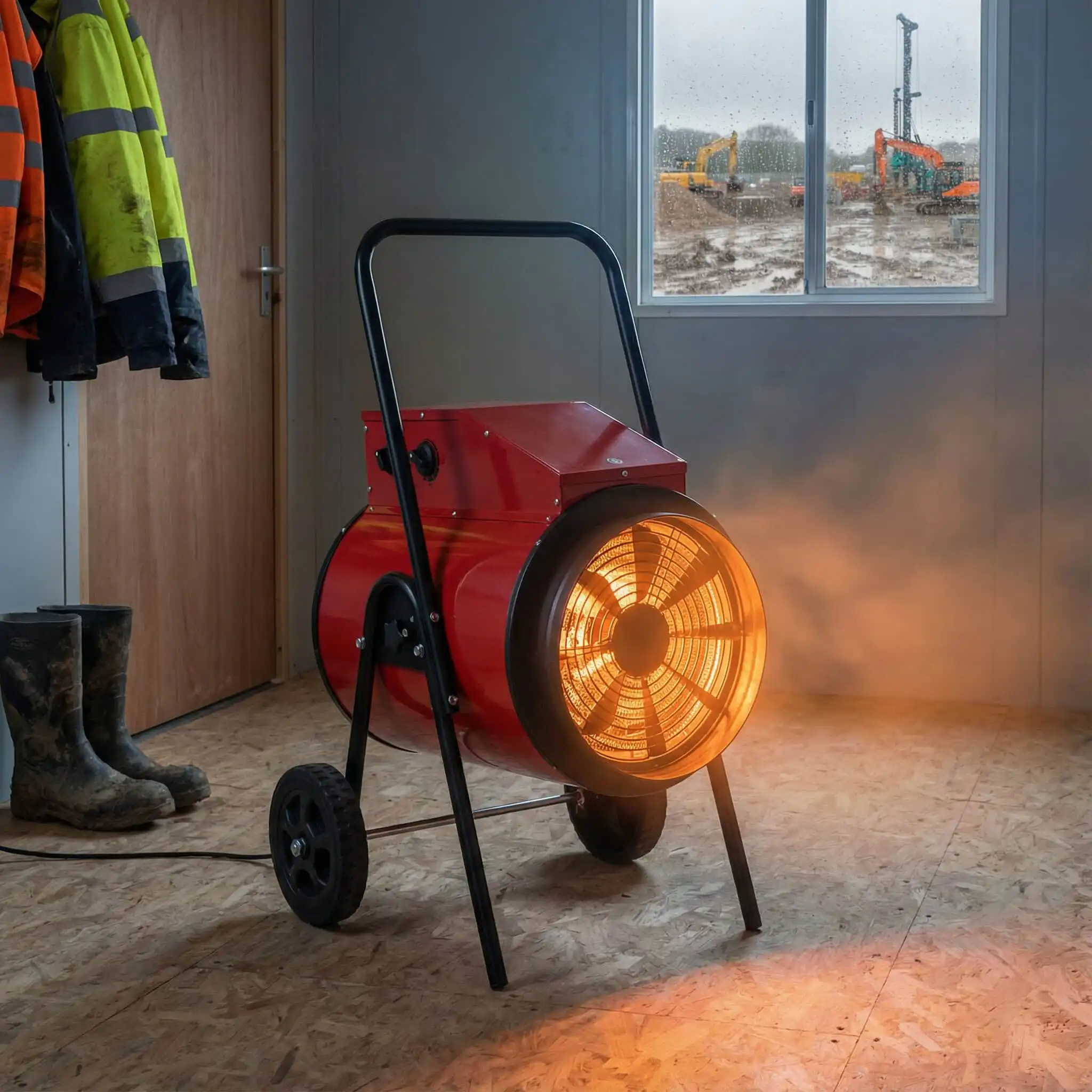
 General Site Tools
Equipment Hire Guides
Why Your Dehumidifier Stops Working in a Cold Room
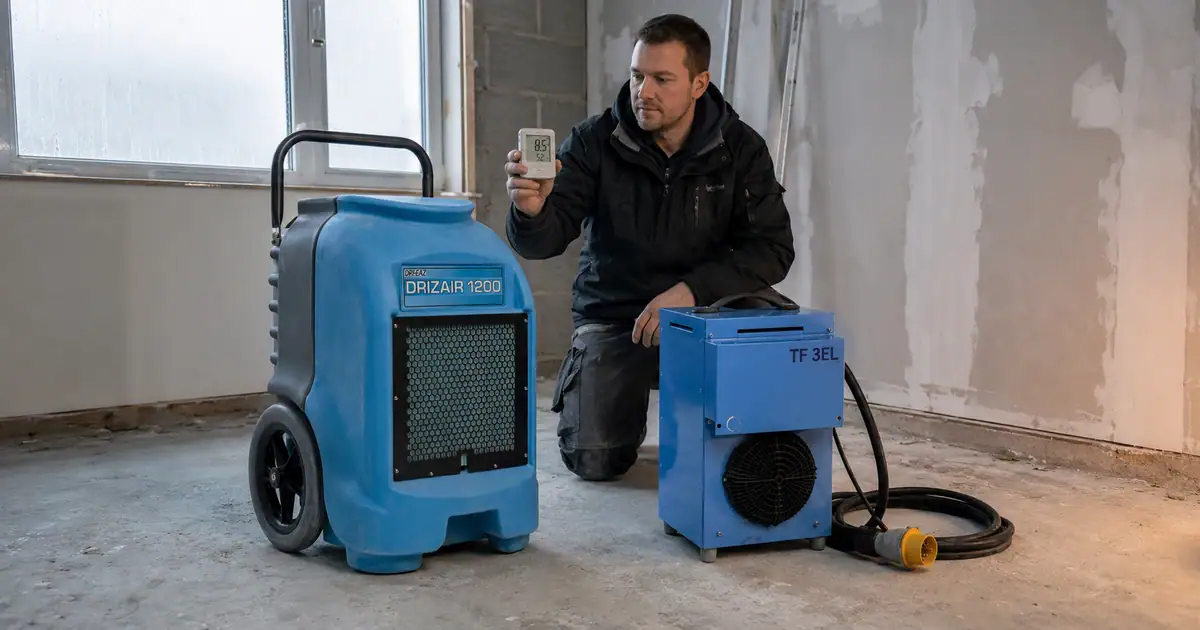
Short answer: a standard refrigerant dehumidifier is designed to work at roughly 15 to 28°C. Below about 15°C its output falls away sharply and the coil starts to frost, so it spends its time defrosting instead of drying. The machine is almost certainly not faulty — the room is too cold for it.
The fix is to warm the space to about 18 to 22°C and hold it there, and to use a unit built for cold work. Our 55L DrizAir 1200 has hot-gas bypass defrost and keeps going down to around 1°C. A 3kW heater is £19.99 a day — far cheaper than losing a week of drying.
On this page
Every winter we get the same call. The dehumidifier has been running for four days in an empty new build, a garage or an unheated site room, the tank is barely wet, the walls are still damp, and the customer is sure the machine is broken. It almost never is. It is doing exactly what the physics allows at that temperature.
Why cold stops a dehumidifier
A refrigerant dehumidifier works by making a surface colder than the air, so moisture condenses on it and runs away as water. Two things go wrong when the room is cold.
- Cold air holds far less moisture to begin with. Air at 20°C can hold roughly twice as much water vapour as air at 10°C. Even at the same relative humidity, there is simply less water in the air for the machine to catch — so the tank fills slowly and it looks like nothing is happening.
- The coil ices up. To condense moisture out of already-cold air, the coil has to run below freezing. Frost forms, blocks the airflow, and the machine has to stop drying and run a defrost cycle. On a cold morning a basic unit can spend more of the hour defrosting than extracting.
This is not a fault and it is not a brand problem. UK government guidance on drying buildings gives the working ranges plainly: refrigerant dehumidifiers 15 to 28°C, and desiccant dehumidifiers — a different technology that uses a moisture-absorbing wheel instead of a cold coil — 0 to 25°C. Below about 15°C you are outside what a refrigerant machine was built for.
Two features push that limit down. Hot-gas bypass defrost clears the frost using the machine’s own heat instead of shutting down, which is why the Dri-Eaz DrizAir 1200 keeps working to around 1°C. And an LGR (low grain refrigerant) unit like our 63L LGR keeps pulling water out of air that is already dry, which is the other place standard machines give up.
What happens at each temperature
Is it broken, or is it just cold?
Six symptoms, and what each one usually means. If you recognise the first four, the room is cold, not the machine.
| What you see | Usually means | What to do |
|---|---|---|
| Tank is barely wet after 24 hours | Cold air simply has less water in it to remove | Check the room temperature before you check the machine |
| White frost or ice on the coil | Coil is running below freezing in cold air | Warm the room, or swap to a unit with hot-gas defrost |
| Unit keeps stopping and starting | It is running defrost cycles, not faults | Same fix. Constant cycling in a cold room is normal behaviour |
| Humidity reading stuck around 70% | Extraction cannot keep up at that temperature | Add heat. 70% RH sustained is where mould starts |
| Air from the outlet feels cold | A dehumidifier normally blows slightly warm air | If the room is cold, this is expected rather than a fault |
| Tank fills fast but walls stay wet | The air is drying, the fabric is not | Add air movement. See dehumidifier versus air mover |
The fix, in order
- Measure the room temperature. Not the outside temperature, not how it feels. A cheap thermometer settles the argument in five minutes.
- Get the space to 18 to 22°C and hold it. UK drying guidance suggests running central heating at around 22°C during a drying job. In an empty building that means hiring heat.
- Close the space up. Heating a room with the door open to an unheated hallway is heating the hallway. Drying only works as a closed system.
- Use a machine built for the conditions. Hot-gas defrost for cold rooms, LGR for the late stage when the air is already dry.
- Add air movement. Warm air sitting still does nothing. Air movers put it against the wet surfaces.
- Give it a steady week before you judge it. Turning the heat off overnight resets the building every morning.
Find your situation
Open the one that matches the building. Each gives the kit and the real daily hire price, delivered across London from our Greenford UB6 depot.
Which heater to pair with it
The heater is not there to make the room comfortable. It is there to lift the air into the band where the dehumidifier works. Prices are per day from our Greenford depot; a refundable deposit applies and comes back in full when the equipment returns undamaged.
| Heater | Per day | Power | Suits |
|---|---|---|---|
| a 3kW oil-filled radiator | £19.99 | 230V 13A plug | Occupied and finished rooms — silent, no fan noise, safe to leave running |
| 3kW fan heater (Broughton) | £19.99 | 230V 13A plug | Fast warm-up in a single room, garage or workshop |
| a 110V 3kW site fan heater | £19.99 | 110V 32A | Construction sites running on transformer power |
| 3kW infrared heater on tripod | £19.99 | 230V | Warming a work area or a wall face directly rather than the whole air volume |
| 9kW industrial fan heater | £24.99 | 3-phase | Larger rooms, small units, a floor of an empty building |
| 15kW industrial fan heater | £29.99 | 3-phase | Medium warehouse and site space heating |
| 40kW industrial fan heater | £64.49 | 3-phase | Warehouse-scale volumes where a 3kW heater would never catch up |
Not sure which output you need for the room size, our heater sizing guide works it out from volume rather than guesswork. And if you are wondering whether you need both machines at all, heater versus dehumidifier for drying explains why the answer is almost always both.
What the heater actually costs you
The objection is always the same: another machine, another hire line, more electricity. Look at it as time instead.
A dehumidifier running in a 10°C room is not doing nothing — it is doing a fraction of its rated work, and you are paying full hire for it. Adding £19.99 a day of heat to get that room into its design band is the difference between a job that finishes and a job that drifts. On a two week hire, a heater that saves a single week has more than paid for itself.
The electricity side is a fair question and we have worked it through properly in what it costs to run a hired dehumidifier.
Five mistakes on cold jobs
- Judging the machine in the first 24 hours. In a cold building the first day is spent warming the fabric, not drying it. Give it a settled week.
- Heating in bursts. Six hours on, eighteen off, and the walls never come up to temperature. Steady and continuous beats hot and intermittent every time.
- Leaving the door to a cold hallway open. You are heating and drying the whole building instead of the room you booked the kit for.
- Blaming the dehumidifier for a ventilation problem. A trickle vent or a broken window undoes both machines at once.
- Using a gas or paraffin heater indoors to dry a room. Burning fuel produces water vapour — roughly a litre for every litre of fuel. You are adding moisture while trying to remove it, as well as taking a carbon monoxide risk. Electric heat only for drying work.
Cold-weather drying questions
Related guides
- Heater or dehumidifier for drying — what each one actually does to the moisture.
- What size heater do I need — output by room volume, not by feel.
- Winter construction hire checklist — the rest of the cold-weather kit list.
- Condensation on the windows every morning — the domestic version of the same physics.
- How long it takes to dry out a room — realistic timescales once the temperature is right.
- How many dehumidifiers do I need — for jobs bigger than one room.
A pool hall closed down for the winter combines both problems: a cold room and a constant moisture source. Holding a closed pool room under 60% RH covers what to run and why.
Cold building holding your job up?
Heaters from £19.99 a day and industrial dehumidifiers from £19.99 a day, delivered together across Greater London.
See drying & heating kitTell us the room size and what power you have on site and we will put the right pair together. Call 020 3375 4048 or message us on WhatsApp.

 Drone Survey & Mapping
 Drone Inspections