
 Drone Services
 Access Equipment
 Breaking & Drilling
 Cleaning Equipment
 Drying & Heating
 General Site Tools
Equipment Hire Guides
Do I Need a Dehumidifier With a Pump?
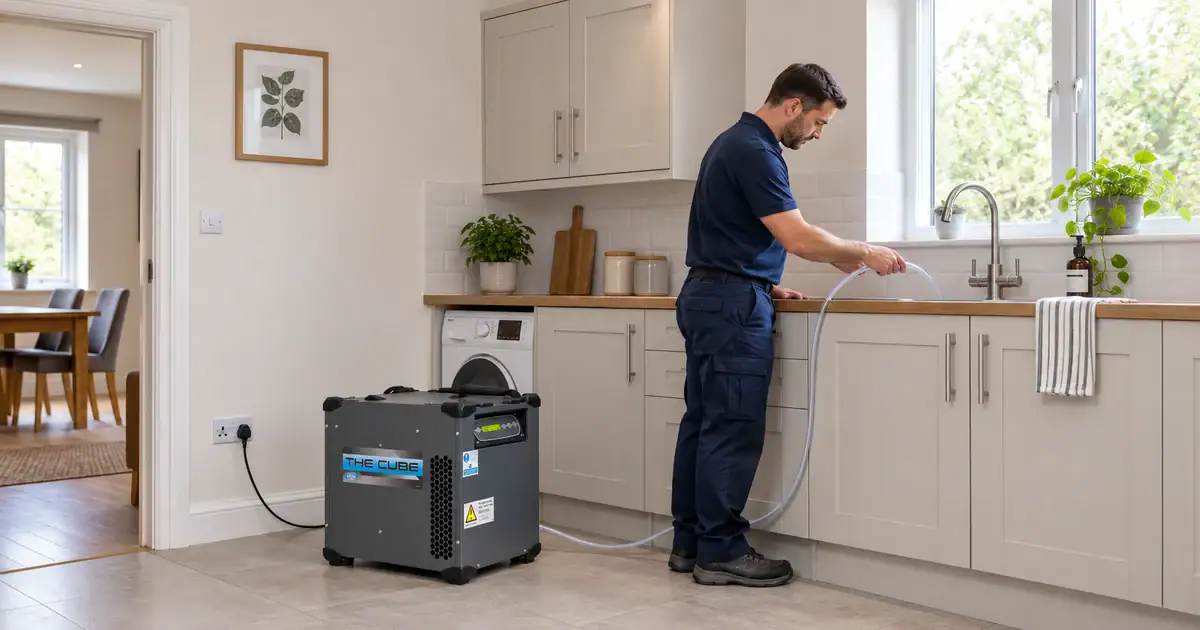
Do you need a dehumidifier with a pump, or will a tank do?
A pump is the feature people either need badly or do not need at all, and the difference is worth about £15 a week. This guide gives you the arithmetic to decide: how often you would actually be emptying a tank, what a pump changes and what it does not, and the situations where we would tell you to save the money and take the cheaper machine.
Do I need a dehumidifier with a pump?
You need one if the machine has to run unattended — overnight, or in an empty property — and there is no drain below it to run a gravity hose into. That is almost always the case upstairs and in flats, where the nearest waste is a basin, a bath or a kitchen sink, all of them above floor level. A pump pushes the collected water up and out through a hose, so the machine never stops and nobody has to be there.
You do not need one if somebody is on site anyway and can empty a tank a few times a day, if the moisture load is light, or if you are on a ground floor with a gully or a utility drain the hose can fall into. A pump does not make a dehumidifier extract faster per hour — it removes downtime and it removes a chore. If neither of those is costing you anything, buy the cheaper machine and spend the difference elsewhere.
What a pump actually does — and what it does not
Worth being precise about this, because the feature gets oversold. A dehumidifier pulls moisture out of the air and condenses it into liquid water. Every machine does that the same way. What differs is only what happens to the water afterwards.
A pump does not change the extraction rate. A machine rated at 22 litres a day is rated at 22 litres a day whether the water lands in a tank or goes down a hose. What a pump changes is continuity: the machine keeps running instead of shutting off when a float switch says the tank is full, and it keeps running when the room is empty and locked.
Three things a pump gives you, and one thing it does not.
No float switch cutting the machine out mid-afternoon or at 2am. On a wet room, the unattended hours are where a lot of the drying happens.
A gravity hose has to run downhill into a drain. A pump lifts, so a basin, a bath, a sink or a gully above the machine all become valid destinations.
Nobody carrying a full tank of dirty water across a carpeted landing twice a day. On a tenanted or empty property, nobody having to attend at all.
Faster extraction. More airflow. A shorter drying programme on its own. If your problem is area or airflow rather than drainage, a pump is not the answer you are looking for.
That last point matters when people compare machines. If you are drying several rooms, the thing to buy is airflow and reach, not a pump. Our 55L DrizAir 1200 has a pump too, plus a 12.2 m hose and 325 m³/h of airflow — but it weighs 36 kg. Choosing between machines is covered properly in what size dehumidifier do I need.
The three ways the water leaves the machine
| Method | What it needs | What it costs you |
|---|---|---|
| Collection tank | Nothing — it is built in | Somebody present to empty it, and lost running time every time it fills while nobody is there |
| Gravity drain hose | A drain lower than the machine, and a fall the whole way | Nothing, when you have one. Above the ground floor you usually do not |
| Built-in pump | A hose route to a basin, bath, sink or gully within the manufacturer’s discharge height | A little more on the hire rate, and five minutes of thought about the hose route |
The gravity option is the one people assume they have and then discover they do not. A hose has to fall the entire way to the drain. In a ground-floor utility room with a gully in the floor, easy. In a first-floor bedroom, the nearest waste is a basin at roughly 800mm above the floor, and water does not climb.
How often would you actually be emptying it?
This is the calculation that settles the argument, and it takes thirty seconds. Take the machine’s extraction figure for realistic room conditions — not the maximum label — divide by 24 to get litres per hour, then divide the tank size by that.
So a machine collecting 22 litres a day is collecting about 0.9 litres an hour. Against a 5-litre tank, that is a full tank every five and a half hours.
| Tank size | At 11 L/day (light damp) | At 22 L/day (one wet room) | At 28 L/day (warm, wet room) |
|---|---|---|---|
| 4 litres | About 8.5 hours | About 4.4 hours | About 3.4 hours |
| 5 litres | About 10.7 hours | About 5.5 hours | About 4.3 hours |
| 6 litres | About 12.8 hours | About 6.5 hours | About 5.1 hours |
| 8 litres | About 17 hours | About 8.7 hours | About 6.9 hours |
Now apply that to a real day. Nobody is in the room for the eight hours you are asleep, or the nine hours you are at work. At 22 litres a day with a 5-litre tank, the machine fills at hour five and a half and then stands there doing nothing for the rest of the night. That is roughly two and a half hours of drying lost, every night, before you count the working day.
What those lost hours actually cost.
A machine that has cut out is not using electricity, so your bill does not rise. But the room is not drying either, and the hire clock keeps running — you pay for the day regardless.
Two or three idle hours a night across a seven-day hire is most of a day of drying gone. On a marginal job that is the difference between finishing on the booked hire and extending it.
Carrying five litres of water from an upstairs bedroom to a bathroom, several times a day, for a week. In a tenanted flat or an empty property, that means somebody has to attend at all.
Set against that, the pumped option on our range is £15 more for a hire of up to seven days. If the tank would be costing you two or three hours of drying a night, the arithmetic is not close. If it would be costing you nothing, do not pay it.
Light damp is the honest counter-example. At around 11 litres a day, a 6-litre tank runs nearly 13 hours — you empty it morning and evening and it never cuts out. That is exactly the job the 38L Broughton CR40 is there for, and it is our cheapest machine.
When you need a pump
If any two of these are true, stop reading and book the pumped machine. If three are true it is not a decision at all.
The clearest case is a bathroom or ensuite leak that has been repaired. The room is small, the moisture load is high, and the basin is a metre away — a pump turns the nearest obstacle into the solution. The same applies to a kitchen or utility leak, where the sink is right there. Our guide to drying a flat or upstairs room works through those jobs end to end.
When you honestly do not
We would rather you hired the right machine than the dearer one. These are the situations where the pump earns nothing.
If a hose can fall the whole way to a drain, gravity does the job for free and never fails. Fit the hose and forget it.
A building site with trades on it, an office in use, a home you are living in. If emptying a tank fits into a routine that already exists, it is not costing you anything.
General household damp, condensation, a room that feels musty rather than one that had water in it. At low extraction rates a tank runs most of a day. Condensation is a ventilation and heating problem more than a drainage one.
A weekend, a one-day dry-off, a room that is nearly there already. Two or three empties over the whole hire is not a problem worth £15.
Several rooms or a large open space. Airflow and reach are what you are short of. Look at the 55L, or at more than one unit — how many dehumidifiers do I need covers sizing across rooms.
Standing water, an unrepaired leak, mould with a structural cause. No dehumidifier of any specification fixes those, and the pump is irrelevant.
Where the water can actually go
A pump is not unlimited. It has a maximum discharge height stated by the manufacturer, and the hose has rules. Getting these wrong is the commonest reason a pumped setup fails, and it always looks like a broken machine when it is not.
| Destination | Workable? | Notes |
|---|---|---|
| Bathroom basin | Yes | The standard answer upstairs. Secure the hose end so it cannot lift out of the bowl |
| Bath or shower tray | Yes | Plenty of capacity and the outlet cannot easily fall out |
| Kitchen sink | Yes | Ideal for a kitchen or utility leak — the drainage is in the room already |
| Washing machine waste standpipe | Usually | Check it is free and not shared with an appliance that is running |
| Outside gully or drain | Yes | Ground floor, or through a window where the run is safe and the hose cannot be trodden on |
| Toilet | No | Not a fixed, secure outlet. The hose can be dislodged and the cistern cycle interferes |
| A bucket | Defeats the point | You have reinvented the tank, with more to go wrong |
| Up a staircase to another floor | No | Exceeds sensible lift and creates a trip hazard on the stairs |
| Any point above the stated maximum height | No | Check the manual for the machine you have. The pump has a limit and exceeding it stalls the flow |
Three hose rules that decide whether it works:
What the pump costs in our range
Here is the decision priced up, on a hire of up to seven days. Prices exclude VAT.
| 38L Broughton CR40 | Dri-Eaz Cube | 55L DrizAir 1200 | |
|---|---|---|---|
| Up to 7 days | £59.99 + VAT | £74.99 + VAT | £89.99 + VAT |
| Drainage | Continuous drain setup — configuration to be confirmed | Built-in pump, 6 m hose | Built-in pump, 12.2 m hose |
| Humidity control | Hire configuration to be confirmed | Built-in digital humidistat | No humidistat |
| Published indoor-condition figure | 11.25 L/day at 20°C/70% RH | 22 L/day at 20°C/60% RH | 28 L/day at 26.7°C/60% RH |
| Airflow | Not stated in the source brochure | 220 m³/h | 325 m³/h |
| Weight | 23 kg | 22.7 kg | 36 kg, wheeled |
| The case for it | Cheapest way to deal with general damp | Pump, humidity control and a body you can carry upstairs | Airflow and reach for larger or multi-room jobs |
The step from the 38L to the Cube is £15 for the week, and it buys three things: the pump, a digital humidistat so you can set a target and watch progress, and a stronger published figure at normal indoor conditions. The step from the Cube to the 55L is another £15, and it buys airflow and hose reach — at the cost of 13.3 kg and roughly double the floor footprint.
If you only read one thing, read this.
All prices exclude VAT. A refundable security deposit is taken on every hire and returned once the equipment comes back in the condition it went out. Drying time and product suitability depend on temperature, moisture load, airflow, containment, drainage and whether the source of water has been resolved.
Running costs are a separate line and people forget them when comparing hire rates — what a hired dehumidifier costs to run has the electricity side.
Pump mistakes we see
The single most common one. Water sits in the loops, the pump works against it, and the flow looks weak or stops. Run the hose out flat, in full, every time.
A door closing on a hose flattens it. If the run has to cross a doorway, wedge the door or take the hose round.
Tape or clip the hose end so it cannot lift out of the basin. A hose that jumps out overnight puts everything it collected onto the floor.
A pump removes the emptying, not the method. The door still has to be shut, the room still has to be warm, and the readings still have to come down.
If you are trying to dry three rooms with one compact machine, drainage is not your bottleneck. More airflow or more units is.
Every pump has a maximum lift in the manual. A basin is fine, a floor above is not. Check the figure rather than guessing.
Frequently asked questions
Do I need a dehumidifier with a pump?
You need one if the machine has to run unattended and there is no drain below it for a gravity hose — which is almost always the case upstairs and in flats, where the nearest waste is a basin, bath or sink. You do not need one if somebody is on site to empty a tank anyway, the moisture load is light, or you are on a ground floor with a gully the hose can fall into.
What does a pump on a dehumidifier actually do?
It moves the water the machine has collected out through a drain hose, pushing it upwards rather than relying on gravity. That means the discharge point can be higher than the machine — a basin, a bath, a sink — and the machine never stops to have a tank emptied. It does not increase how much moisture the machine extracts per hour.
Does a pump make the room dry faster?
Not per hour, no. Extraction is the same either way. What it changes is how many hours the machine actually runs. A tank that fills at hour five and a half stops there until somebody empties it, so on an overnight run you can lose two or three hours of drying. Over a week that adds up, which is where the real time saving comes from.
How often do you have to empty a dehumidifier tank?
Divide the machine’s realistic daily extraction by 24 to get litres per hour, then divide the tank size by that. At 22 litres a day — about 0.9 litres an hour — a 5-litre tank fills in roughly five and a half hours, so around four times in 24 hours. At a lighter 11 litres a day the same tank lasts about ten and a half hours.
Can a dehumidifier drain into a sink?
With a pump, yes — a basin, bath, shower tray or kitchen sink are all normal destinations, as long as the outlet is secured so the hose cannot lift out and the discharge point is within the manufacturer’s stated maximum height. Without a pump, no: a gravity hose has to fall the whole way, and every waste outlet in a flat sits above floor level.
How high can a dehumidifier pump the water?
It depends on the machine, and the figure is in its manual. On the Dri-Eaz Cube we hire, the 6 m hose can discharge up to 6 m above the base of the unit, which covers a basin, a bath or a sink comfortably. What it does not cover is running the hose up a staircase to another floor.
Why is my dehumidifier pump not pushing water out?
The usual cause is the hose rather than the pump. Check it is completely uncoiled, that there are no kinks, that nothing is resting on it or trapping it in a doorway, and that the outlet is not above the machine’s stated discharge height. If all of that is right and it still will not clear, stop and tell us rather than working around it.
Is a pump worth the extra cost?
On our range it is £15 more for a hire of up to seven days, and that also brings a digital humidistat. If a tank would be cutting the machine out for two or three hours a night, or if nobody can attend the property, it pays for itself in drying time. For light damp on a ground floor with someone in the building, it does not, and we would tell you to take the 38L.
Which of your dehumidifiers have a pump?
The Dri-Eaz Cube has built-in automatic pump-out with a 6 m hose, and the 55L DrizAir 1200 has a pump with a 12.2 m hose. The drainage configuration on our 38L Broughton CR40 should be confirmed with us before you book if pumped drainage is essential to your job.
Can I use a pumped dehumidifier in a bathroom?
After a bathroom or ensuite leak has been repaired and any standing water removed, yes — and the sink nearby is exactly what makes a pumped machine suited to it. The unit must stand on a dry, level floor away from any splash zone, be kept dry, and run from an earthed, RCD-protected supply. It is not equipment to place in a wet area or to run while a leak is ongoing.
Related guides
More on drying and water damage:
Not sure which side of the line you are on?
Tell us three things and we will answer it in a sentence: which floor the room is on, whether anyone can be there to empty a tank, and where the nearest sink or drain is. If a pump would not earn its keep on your job, we will say so and quote you the cheaper machine.
Figures, sources and limits: Dri-Eaz Cube values are the manufacturer’s published figures for the F571 230V model — 22 L/day at 20°C/60% RH, 28 L/day at 27°C/60% RH, 220 m³/h airflow, 22.7 kg including cable and hose, built-in automatic pump-out with a 6 m hose and a stated maximum discharge height, digital humidistat, 230V/2.4A. Figures for the Broughton CR40 and the Dri-Eaz DrizAir 1200 are the respective manufacturers’ published values. Published extraction figures use different test conditions and are not a direct laboratory comparison. The emptying table is illustrative arithmetic: it divides a daily extraction rate by 24 and then by a tank size, and the tank capacities shown are examples rather than the capacity of any particular machine — check the figure for the unit you are hiring. Real extraction varies with temperature, humidity and moisture load, so treat all of it as planning guidance rather than a guarantee. Always follow the machine’s operating manual, including its maximum discharge height and electrical requirements.

 Drone Survey & Mapping
 Drone Inspections