
 Drone Services
 Access Equipment
 Breaking & Drilling
 Cleaning Equipment
 Drying & Heating
 General Site Tools
Cleaning Equipment, Equipment Hire Guides
What Is a Floor Scrubber Dryer Used For?
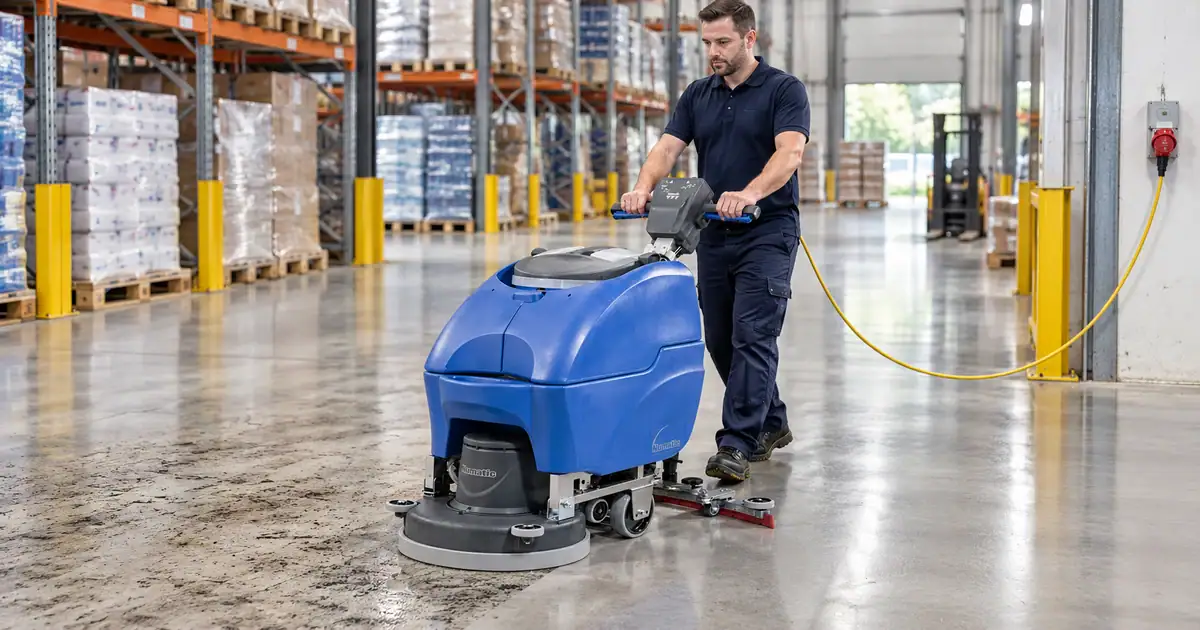
What a floor scrubber dryer is used for, and where it earns its keep
Schools, airport terminals, warehouses, gyms, supermarkets, kitchens, care homes, showrooms. A scrubber dryer is the machine that cleans a hard floor and leaves it walkable in the same pass — which is why it turns up wherever a floor has to be cleaned without closing the building. This guide covers where they are used, what each kind of site actually needs, and how to work out whether one will do your job.
What is a floor scrubber dryer used for?
A floor scrubber dryer is used to clean large areas of hard floor quickly and leave them dry enough to walk on straight away. It does three jobs in one pass: it lays down water and detergent, a rotating brush scrubs the dirt off the floor, and a squeegee and vacuum lift the dirty water straight back into a recovery tank. That last step is what separates it from a mop or a rotary scrubber, and it is why the machine is used in buildings that cannot be closed while the floor dries.
In practice that means schools and colleges (corridors, dining halls, sports halls), airport terminals and transport hubs, warehouses and distribution centres, supermarkets and retail units, gyms and leisure centres, hospitals, GP surgeries and care homes, food production areas and commercial kitchens, car showrooms, office lobbies, community halls and event venues, and post-construction handovers. The common thread is not the industry — it is a hard floor big enough that mopping it is too slow, in a building where a wet floor is a hazard, a liability, or simply not allowed.
What a floor scrubber dryer actually does — and why “dryer” is the important word
Most people picture a floor scrubber and think of the machine polishing a supermarket aisle. What they are usually picturing is a scrubber dryer, and the distinction matters commercially, because the second half of the name is the half you are paying for.
A mop moves dirty water around and leaves the floor wet for fifteen to thirty minutes. A rotary scrubber agitates the floor properly but has no squeegee and no recovery tank, so you still have to wet-vac or mop up afterwards. A floor scrubber dryer scrubs and recovers in the same pass, so the strip of floor behind the machine is walkable by the time the operator has turned round. In a school corridor at 8:20am, in a terminal at any hour, or in a warehouse aisle with an FLT due through it, that is the entire value proposition.
It also matters for safety, which is what most facilities managers are really buying. In 2024/25, slips, trips or falls on the same level were the most common cause of employer-reported non-fatal injuries at work in Great Britain, accounting for 30% of them. The Health and Safety Executive puts the cost of slips and trips at over £500 million a year to employers, £133 million a year to the health service, and over £800 million a year to society. A wet floor left to air-dry in a public building is not a neutral choice.
| Method | What it does | Floor afterwards | Where it fits |
|---|---|---|---|
| Mop and bucket | Spreads solution, lifts some soil, redeposits the rest | Wet for 15–30 minutes | Small areas, spot cleans, spaces under about 100m² |
| Rotary floor scrubber | Mechanical agitation, no water recovery | Wet — needs a wet vac or mop after | Stripping, polishing, small or awkward areas |
| Floor scrubber dryer | Lays solution, scrubs, squeegees and vacuums in one pass | Walkable straight away | Anything from roughly 200m² upwards, especially where the floor cannot stay wet |
If you want that comparison in more depth, floor scrubber vs mop vs steam cleaner works through the break-even point, and walk-behind vs ride-on scrubbers covers what happens when the area gets big enough to justify a ride-on.
Floor scrubber dryer specs: will it fit your building?
Every spec on a floor scrubber dryer datasheet corresponds to a question about your site. These are the ones that actually decide the booking, using the machine we hire — a mains-powered Numatic TwinTec TT 3450S.
| Spec | Figure | What it decides on your site |
|---|---|---|
| Scrub width | 450mm brush, 400mm pad | How fast you cover ground, and whether it fits between fixed shelving, seating or racking |
| Cable reach | 42m from a 13A socket | Your working radius from each socket. In a corridor that is roughly 40m in each direction from one plug — enough for most school and office corridors without moving the lead |
| Power | 220–240V, standard 13A socket | No generator, no 110V transformer, no three-phase. If there is a normal socket, the machine runs |
| Clean water tank | 30 litres | Roughly 20–30 minutes of scrubbing per fill. Plan where the nearest tap and drain are before you start, not during |
| Weight | 57kg dry, 87kg with a full tank | It does not go up stairs. A lift or level access is required, and two people or a tail-lift to load it |
| Maximum gradient | 2% | Flat floors and gentle slopes only. It will not do a multi-storey car park ramp, which is typically 10–20% |
| Noise | 78–80 dB(A) | Sits right at the 80 dB(A) lower exposure action value in the Control of Noise at Work Regulations 2005. Fine in a warehouse; not something to run next to a classroom in session or a ward at night |
| Footprint | 1,150 × 1,030 × 740mm | It goes through a standard double door and most single doors, but check the lift and any turnstiles |
Two of those catch people out. The 2% gradient limit rules out car park ramps — the deck of a car park is fine, the ramp between decks is not. And the 42m cable is a genuine planning constraint in a big open space: in a 3,000m² warehouse you will be moving the lead between sockets, which is time on the clock.
Where floor scrubber dryers are used, sector by sector
The machine is the same everywhere. What changes is the floor, the window you are allowed to work in, and what happens if the floor is still wet when the building fills up.
Corridors, dining halls, changing rooms and sports halls. The constraint is the timetable: cleaning happens before 8am, after 3:30pm, or in the holidays, and the floor has to be dry before the first child walks on it. Summer and half-term deep cleans are the classic short hire — a week or two on a scrubber dryer instead of a term of mopping.
A record 302 million passengers passed through UK airports in 2025, with 84.5 million through Heathrow’s four terminals alone. Terminals, rail concourses and coach stations never close, so there is no drying window at all. Entrances are the worst spot — wet weather walked in off the apron or the forecourt is exactly where slips happen.
Dust, tyre marks and pallet debris on power-floated concrete, with forklift traffic that cannot stop for a wet floor. Aisle width and racking spacing decide the machine size. We have a full guide to cleaning a warehouse floor if that is your site.
Trading-hours spillages plus an overnight or early-morning full clean. Retail is where slip liability is most visible — a customer on a wet aisle is a claim, and “we mopped it” is a weaker defence than a floor that was dry within seconds.
Rubber gym floors, studio floors, wet-side changing rooms and poolside surrounds. High sweat and body-soil load, heavy footfall, and members arriving from 6am. Sealed sports floors have their own manufacturer rules — check before you scrub.
Vinyl and safety flooring in corridors, waiting rooms and day rooms. Infection control means the recovery of dirty water matters as much as the scrubbing, and residents or patients are walking the floor all day, so it cannot stay wet.
Grease, flour, and the drains that go with them. Scrubber dryers are used between shifts and at close-down, often as part of a documented cleaning schedule. Detergent choice is dictated by the site’s food-safety regime, not the machine.
Hard-floor receptions, atriums, canteens and car showroom floors, where appearance is the product. Showrooms in particular want a finish with no mop streaks and no standing water under the stock.
Booked back to back, cleaned in the gap. A hall that has to host a toddler group at 9am and a wedding at 2pm needs a floor that is dry in minutes, not a floor with wet-floor signs on it.
The final pass on a new or refurbished hard floor before the client walks it. This is a hire-for-a-fortnight job rather than an ongoing one — the post-construction cleaning equipment guide sets out the full three-phase sequence.
| Sector | Typical floor | Cleaning window | The constraint that decides it |
|---|---|---|---|
| Schools and colleges | Vinyl, terrazzo, sealed concrete, sports timber | Before 8am, after 3:30pm, or in holidays | Floor must be dry before pupils arrive. Noise rules out running it beside a room in use |
| Airport terminals and stations | Terrazzo, granite, large-format tile, vinyl | None — the building never closes | No drying window at all, and entrances take the worst of the wet-weather ingress |
| Warehouses and distribution | Power-floated concrete, resin | Between shifts, or alongside operations | Aisle width, racking spacing and forklift traffic |
| Supermarkets and retail | Vinyl, tile, sealed concrete | Overnight or pre-open, plus spill response in trading hours | Slip liability while customers are on the floor |
| Gyms and leisure centres | Rubber, vinyl, sealed timber, poolside safety flooring | Early morning or after close | Manufacturer rules on sealed sports floors; wet-side surfaces need slip resistance kept up |
| Healthcare and care homes | Safety vinyl, sheet vinyl | Any time — but the floor must stay walkable | Infection control, plus residents and patients moving continuously |
| Food production and kitchens | Non-slip resin, quarry tile, safety vinyl | Between shifts and at close-down | Grease load and the site’s food-safety cleaning schedule |
| Offices and showrooms | Porcelain, polished concrete, LVT | Out of hours | Finish quality — no streaks, no standing water |
| Halls and event venues | Sealed timber, vinyl, sealed concrete | The gap between two bookings | Turnaround time measured in minutes |
| Post-construction handover | New hard floor of any type | Before handover | Removing screed dust and residue without damaging a new finish |
One sector deliberately not on that list is the multi-storey car park. The decks are fine. The ramps are not — a mains scrubber dryer with a 2% maximum gradient will not climb them, and dragging a 42m lead up a vehicle ramp is not a plan. Car parks are a ride-on or a specialist job.
What the people who hire these actually search for
Facilities managers, caretakers, cleaning contractors and site managers all describe this machine differently, and the words they use say a lot about what they actually need. If you have landed here from one of these searches, this is what you are probably after.
| What they search | What they usually mean | What they need |
|---|---|---|
| Floor scrubber dryer hire | They already know the machine and want a price and a date | A day rate, a delivery slot and the tank and cable specs |
| Floor scrubber hire London | Could be a scrubber dryer or a rotary machine | To know the difference before booking — recovery tank or no recovery tank |
| Industrial floor cleaning machine hire | A large hard floor, probably a warehouse or a hall | Coverage rate and whether one machine will finish in the window they have |
| School floor cleaning machine | A caretaker or bursar planning a holiday deep clean | A one to two week hire, and reassurance the floor is dry before term |
| Commercial floor scrubbing machine | A cleaning contractor pricing a contract | Consistent availability and a rate that works into a quote |
| Floor cleaning machine for gym | Rubber or sports flooring, member hours | Confirmation the surface can be machine-scrubbed and what pad to use |
| How to clean a large warehouse floor | Concrete, dust, forklift marks | Method as much as machine — the warehouse floor guide answers this properly |
| Wet floor cleaning machine that dries | They have been caught out by a wet floor before | Exactly this machine — the squeegee and vacuum are the point |
| Floor scrubber hire cost | Budgeting, comparing, or building a quote | A full price ladder — see what floor cleaning machines cost to hire |
| Hire or buy a floor scrubber | Recurring need, deciding on capex | Break-even maths on hire days per year |
The single most common misunderstanding in that list is the first two rows. “Floor scrubber” is used for both machines, and people book a rotary expecting a dry floor, or book a scrubber dryer for a 40m² kitchen where a rotary and a mop would have been cheaper and easier to carry. If you are not sure which you need, our guide to choosing cleaning equipment starts from the job rather than the machine.
Which floors it suits, and which it does not
A floor scrubber dryer is a hard-floor machine. Inside that, the answer varies more than people expect, and the expensive mistakes are all at the edges.
| Floor | Suitable? | Notes |
|---|---|---|
| Power-floated or sealed concrete | Yes — ideal | The machine’s natural home. Warehouses, workshops, plant rooms |
| Vinyl and LVT | Yes | Standard in schools, healthcare and offices. Use the pad grade the floor finish calls for |
| Porcelain, ceramic and quarry tile | Yes | Grout lines need a brush rather than a pad if the soil is in the joints |
| Terrazzo and polished stone | Yes, with care | Common in terminals and lobbies. Neutral detergent only — alkaline products can dull the surface |
| Rubber gym flooring | Usually yes | Check the manufacturer’s sheet. Some rubber finishes have specific pad and chemical restrictions |
| Safety and anti-slip vinyl | Yes — and it needs it | The grit that gives these floors their slip resistance also traps soil that a mop cannot lift |
| Sealed sports timber and sprung floors | Only if the manufacturer allows it | Follow the floor manufacturer’s instructions, not general advice. Water volume and chemical choice are the risk |
| Unsealed timber and laminate | No | Water and timber do not mix. Sanding and refinishing is a different job — see sanding a wooden floor |
| Carpet and carpet tiles | No | Wrong machine entirely. That is a carpet extractor job |
| Deep-textured or profiled surfaces | No | The squeegee cannot seal against the floor, so the water is not recovered |
| Ramps steeper than 2% | No | Exceeds the machine’s gradient limit |
Where slip resistance is part of the reason you are cleaning — and in a school, a terminal, a kitchen or a poolside it always is — it is worth knowing how it is measured. UK floors are assessed with the pendulum test to BS 7976, and the resulting Pendulum Test Value classifies the surface: a PTV of 36 or above is low slip potential, 25 to 35 is moderate, and 0 to 24 is high. Soil, grease and polish build-up all pull that number down. Cleaning a safety floor properly is not cosmetic — it is what keeps the surface performing the way it was specified.
How long the job will actually take
This is the calculation to do before you book, because it tells you whether you need one day or one week — and whether one machine is enough at all.
Start with the theoretical rate. A 450mm scrub width at a normal cleaning walking pace of about 3km/h covers 3,000 × 0.45, or roughly 1,350m² an hour. Nobody achieves that. Real sites have turns, door thresholds, furniture, tank refills and emptying, edges the machine cannot reach, and an operator who is not marching. A realistic planning figure is 50 to 60% of theoretical, so around 700 to 800m² an hour in open space, and considerably less in a room full of tables.
Then check the tank. Thirty litres of solution is roughly 20 to 30 minutes of scrubbing, so on a big floor you are refilling two or three times an hour. Where the tap and the drain are will change your real coverage rate more than the machine spec does — a warehouse with one tap at the far end is a much slower job than the same warehouse with a cleaner’s sink in the middle.
| Site | Rough area | Realistic scrubbing time | Sensible hire |
|---|---|---|---|
| Primary school hall and corridors | 600–900m² | About 1–1.5 hours per pass | 1 day, or a week for a holiday deep clean |
| Secondary school circulation and dining | 2,000–3,000m² | 3–4 hours per pass | 1–2 weeks over a holiday |
| Gym or leisure centre floor plate | 800–1,500m² | 1–2 hours per pass | 1–2 days, or ongoing |
| Small warehouse or trade counter | 1,000–2,000m² | 1.5–3 hours per pass | 1–2 days |
| Large distribution floor | 5,000m²+ | 7 hours+ per pass | Consider a ride-on, or several days |
| Retail unit or showroom | 400–1,000m² | About 1 hour per pass | 1 day, repeated |
| Community hall between bookings | 200–400m² | 20–35 minutes | 1 day |
| Post-construction handover | Varies | Two or three passes, not one | 1–2 weeks |
Two practical notes. Heavily soiled floors and post-construction floors need more than one pass — the first pass lifts the bulk, the second gets the finish, and budgeting for one pass is the most common scheduling mistake. And if your area is over roughly 3,000m² on a regular basis, the arithmetic starts pointing at a bigger machine: the walk-behind versus ride-on comparison has the crossover point.
Booking it: how long, and what to have ready
Sort these before the machine arrives and the hire does what you paid for:
On timing, the pattern we see is simple. Schools and colleges book a week or a fortnight around a holiday. Contractors and builders book one to two weeks for a handover clean. Halls, showrooms and small retail book a day at a time, repeated. Warehouses and gyms with a regular need tend to hire monthly and then work out whether buying makes sense — the long-hire rate is where that decision gets made.
Floor scrubber dryer hire in London: cost, deposit and delivery
The floor scrubber dryer we hire is a mains-powered Numatic TwinTec TT 3450S with a 450mm scrub width. Prices exclude VAT.
| Hire period | Price | Typical use |
|---|---|---|
| 1 day | £99.99 + VAT | Hall turnaround, showroom, one-off deep clean |
| 2 days | £149.99 + VAT | Weekend clean, small warehouse |
| Up to 7 days | £199.99 + VAT | Half-term school clean, handover clean |
| 8–14 days | £319.99 + VAT | Summer holiday school clean, post-construction |
| 15–28 days | £499.99 + VAT | Extended site clean or contract cover |
| 29+ days | £17.99 per day + VAT | Long-term or seasonal contract work |
| Damage deposit | £150, refundable | Taken on every hire and released once the machine is back and checked |
| Delivery | Booked by location across London | From our Greenford UB6 depot — see delivery and collection areas |
| Collection | Free from Greenford UB6 | Needs a van with a ramp or tail-lift, or two people, plus photo ID |
What is not included is the detergent. Scrubber dryers need a low-foam floor detergent — ordinary washing-up liquid or a high-foam cleaner will foam through the recovery tank and into the vacuum motor, which is exactly the kind of damage a deposit exists for. If you hire regularly, how tool hire trade accounts work explains how the account side is handled, and what happens if you damage hired equipment covers the deposit honestly.
Mistakes that cost sites money
The most expensive misunderstanding in floor cleaning. A rotary has no squeegee and no recovery tank. If your reason for hiring is that the floor cannot stay wet, you need the scrubber dryer.
Grit, screws and packaging debris tear the squeegee blade, block the vacuum path and get dragged across the floor under the brush. Five minutes with a dust mop protects both the machine and the finish.
High-foam product fills the recovery tank with foam, the float cuts the vacuum, and in the worst case foam reaches the motor. Low-foam floor detergent, at the dilution on the bottle.
Post-construction floors, kitchen floors and floors that have been mopped for years all need two passes. Budget the time or the finish will disappoint.
A 30-litre tank on a 3,000m² floor means a lot of walking to the tap. Find the nearest fill and empty points before the machine arrives, not after.
At 78–80 dB(A) the machine sits at the lower exposure action value in the Control of Noise at Work Regulations 2005. It is not a problem in a warehouse; it is a problem outside a classroom, a consulting room or a ward.
Sealed timber and sprung sports floors have manufacturer-specific rules on water volume and chemicals. Get it wrong and you are looking at a resand, not a re-clean.
It smells, it grows things, and it is the single most common reason a machine comes back needing work. Empty, rinse and leave the lid off.
Frequently asked questions
What is a floor scrubber dryer used for?
A floor scrubber dryer is used to clean large areas of hard floor and leave them dry enough to walk on immediately. A brush scrubs the floor with water and detergent, and a squeegee and vacuum lift the dirty water back into a recovery tank in the same pass. It is used in schools, airport terminals and stations, warehouses, supermarkets, gyms, hospitals and care homes, commercial kitchens, showrooms, offices and event venues — anywhere a hard floor is too big to mop and cannot be left wet.
What is the difference between a floor scrubber dryer and a floor scrubber?
A floor scrubber dryer has a squeegee and a recovery tank, so it removes the dirty water as it goes and the floor is walkable straight away. A rotary floor scrubber only agitates the floor — there is no water recovery, so you still have to wet-vac or mop afterwards and the floor stays wet. People use the phrase “floor scrubber” for both machines, which is where most booking mistakes come from.
How much floor can a floor scrubber dryer clean in an hour?
On a 450mm machine the theoretical rate is around 1,350m² an hour, but the realistic planning figure is 700 to 800m² an hour once you allow for turns, obstacles, edges and refilling a 30-litre tank. In a room full of furniture it will be less. For a heavily soiled or post-construction floor, plan two passes rather than one.
Can a floor scrubber dryer be used in a school?
Yes — schools are one of the most common users. Corridors, dining halls, changing rooms and sports halls all suit the machine, and the fact the floor is dry immediately is why it is used before the school day starts. Two things to plan for: at 78–80 dB(A) it is too loud to run beside a room in session, and sealed sports hall floors must be cleaned to the floor manufacturer’s instructions.
Are floor scrubber dryers used in airports?
Yes. Terminals, concourses and transport interchanges are a textbook application because the building never closes, so there is no window in which a floor can be left to air-dry. With a record 302 million passengers through UK airports in 2025 and 84.5 million through Heathrow’s four terminals alone, terminal floors are cleaned around live passenger flow, and entrances take the worst of the wet-weather ingress.
Can you use a floor scrubber dryer on a wooden floor?
Only on a sealed floor, and only if the floor manufacturer allows machine scrubbing. Sealed sports timber and sprung floors have specific rules on water volume and chemical choice, and getting it wrong can mean sanding and refinishing rather than re-cleaning. Unsealed timber and laminate should not be scrubbed at all.
Does a floor scrubber dryer need special detergent?
It needs a low-foam floor detergent. High-foam products, including household washing-up liquid, fill the recovery tank with foam, trip the shut-off float and can push foam into the vacuum motor. Our hire does not include chemical, so bring a low-foam detergent suitable for your floor type and dilute it as the label says.
Will a floor scrubber dryer go up stairs or a car park ramp?
No to both. The machine weighs 57kg dry and 87kg with a full tank, so it needs level access or a lift. Its maximum gradient is 2%, which covers a gentle slope but not a car park ramp — those are typically 10 to 20%. The decks of a car park are workable; the ramps between them are not.
How much does floor scrubber dryer hire cost in London?
Our rates start at £99.99 + VAT for one day, £199.99 + VAT for up to seven days and £319.99 + VAT for 8 to 14 days, with a £17.99 per day rate beyond 29 days. A refundable £150 damage deposit is taken on every hire and released once the machine is returned and checked. Delivery across London is booked by location from our Greenford UB6 depot, and free click & collect is available if you have a van with a ramp or tail-lift.
Should I hire or buy a floor scrubber dryer?
It comes down to how many days a year you use it. A school that cleans in three holiday blocks, a contractor with occasional large jobs, or a hall that deep-cleans quarterly will almost always be better off hiring — no capital outlay, no servicing, no storage, and no machine sitting idle for ten months. A site cleaning several thousand square metres every week is a different calculation, and the 29+ day rate is usually where that conversation starts.
Related guides
More cleaning equipment guides:
Tell us the floor and we will tell you the machine
Send us the approximate area, the floor type and the window you have to work in — a school holiday, an overnight shift, the two hours between hall bookings. We will tell you whether the scrubber dryer covers it, how long it will take, and how many days to book.
Sources and further reading: HSE, kinds of accident in non-fatal injuries to workers, Great Britain 2024/25 (slips, trips and falls on the same level as the most common cause, 30% of employer-reported non-fatal injuries); HSE, what slip and trip accidents cost (over £500m a year to employers, £133m to the health service, over £800m to society); Control of Noise at Work Regulations 2005 (lower exposure action value 80 dB(A), upper 85 dB(A)); BS 7976 pendulum test and the UKSRG Pendulum Test Value classification (36 and above low slip potential, 25–35 moderate, 0–24 high); UK Civil Aviation Authority, record 302 million UK air passengers in 2025; Heathrow 2025 passenger figures. Machine specifications are those of the Numatic TwinTec TT 3450S that Hireload hires and are correct at the time of writing. Coverage rates are planning estimates, not guarantees. Always follow your floor manufacturer’s cleaning instructions and the machine’s operating manual.

 Drone Survey & Mapping
 Drone Inspections