
 Drone Services
 Access Equipment
 Breaking & Drilling
 Cleaning Equipment
 Drying & Heating
 General Site Tools
Equipment Hire Guides
Mag Drill or Diamond Core Drill: Which One Do I Need?
Quick answer
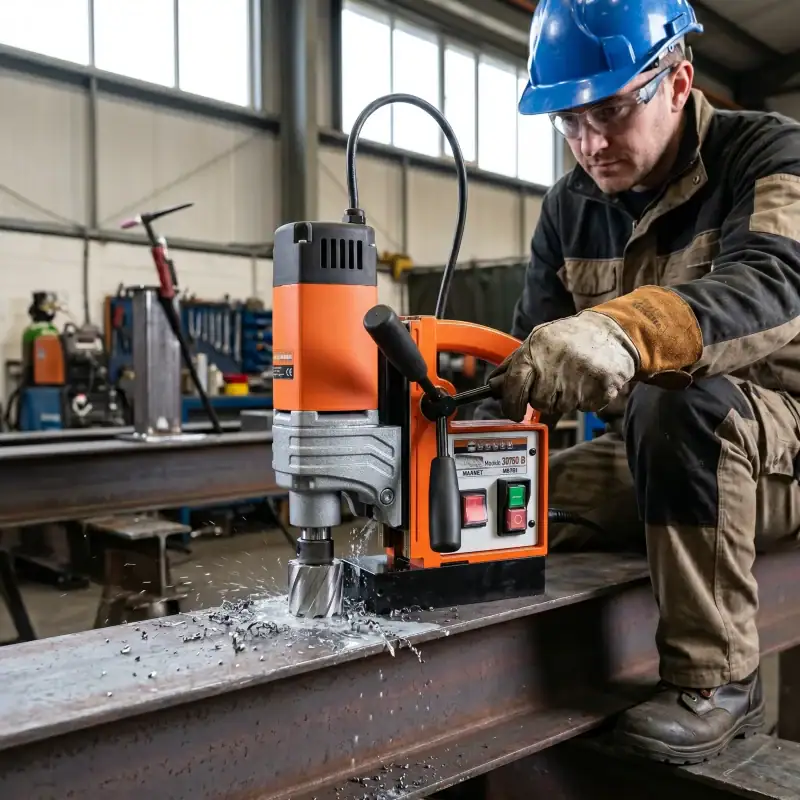
Mag drill for steel, diamond core drill for masonry. A magnetic drill clamps itself to steel with an electromagnet; a diamond core drill cuts brick and block. They are not alternatives. Neither hire includes the cutting tool — you supply your own annular cutters or core bits.
Key takeaways
- Material decides the machine. Steel or masonry, never both.
- Cutters are not supplied. Work out your hole diameter before you book.
- SDS Plus and SDS Max do not interchange. All our breakers are SDS Max.
- Check the voltage. A 110V unit on 230V mains needs a transformer, and transformers are not included.
| Your job | Machine | Bring |
|---|---|---|
| Hole through a steel beam, column or base plate | Mag drill yes | Annular cutters. Check 110V or 240V. |
| Hole through brick or block for a pipe, duct or cable | Diamond core drill yes | A 30-152mm dry core bit |
| Hole through reinforced concrete | Usually neither no | Heavy reinforcement may need a wet system. Ask first. |
| Several small holes in masonry | SDS drill mid | Faster and cheaper |
Why does neither hire include the cutting tool?
You supply your own cutters and core bits. This is the single most important line in this guide.
The dry diamond drill accepts any standard dry diamond core bit from 30mm to 152mm. The bit is not supplied. The mag drill takes standard annular cutters. Also not supplied.
What does the magnetic drill do?
The mag drill is a Rotabroach magnetic drill available in 110V or 240V, supplied in the medium class at 11 to 16kg with 40mm capacity.
The electromagnet in the base clamps the machine to the steel you are drilling, which lets it apply real cutting pressure to a beam, a column, a base plate or a bracket without a bench.
Read more: the power mismatch that costs a Saturday
What does the diamond core drill do?
The dry diamond drill is a Makita 8406, 240V, accepting any standard dry diamond core bit from 30mm to 152mm for clean holes in brick and masonry.
This is the machine for a soil pipe penetration, an extractor duct, a boiler flue, a cable route through a wall, or a core through blockwork.
What is the difference between SDS Plus and SDS Max?
This is the specification people skip and then discover on site.
SDS Plus is the smaller shank, used on lighter rotary hammers. SDS Max is the larger shank on heavier machines. All our breakers are SDS Max.
What should I check before I drill?
Know the diameter. Both machines are sized by the hole, not by the machine.
Know the material, properly. “A wall” is not enough. Solid brick, cavity blockwork, concrete and steel all behave differently, and reinforcement inside concrete will stop a standard dry core bit.
Check what is inside the wall. Cables, pipework and structural elements do not announce themselves. Have the area scanned where there is any doubt.
Read more: when the hole is a structural question
Frequently asked questions
Does the hire include the core bit or cutters?
Can a mag drill cut through a brick wall?
Is the mag drill 110V or 240V?
What size holes can the Makita 8406 do?
Will a diamond core drill go through reinforced concrete?
Do I need to check the wall before drilling?
Harun Uchak — founder, Hireload. Runs the fleet from Greenford and takes the delivery calls himself.
Related guidance
- What size breaker do I need?
- Winter construction hire checklist
- How tool hire trade accounts work
- What happens if I damage hired equipment?
Specifications were verified from our live product pages and may vary by the unit supplied. This is general practical guidance, not structural, electrical or health and safety advice. For holes in load-bearing walls, take advice from a structural engineer or building control. For dust control and respiratory protection, follow current HSE guidance.

 Drone Survey & Mapping
 Drone Inspections