
 Drone Services
 Access Equipment
 Breaking & Drilling
 Cleaning Equipment
 Drying & Heating
 General Site Tools
Equipment Hire Guides
Carpet Dryer or Air Mover: What Is the Difference?
Quick answer
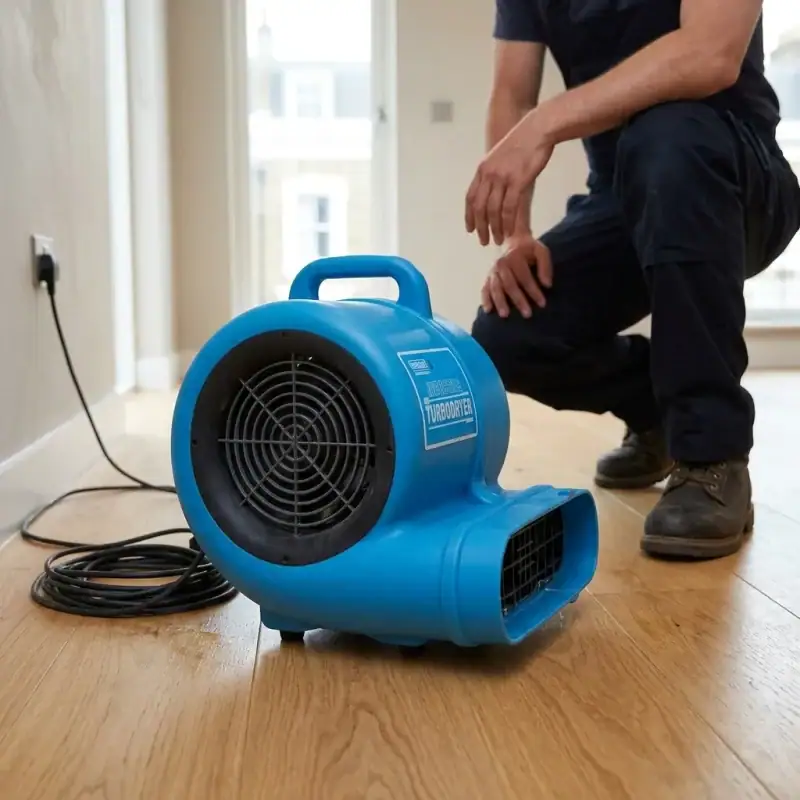
There is no difference. Carpet dryer, air mover, air blower and drying fan all describe the same category of machine: a fan that pushes high-velocity air across a wet surface. What actually differs is the four machines we hire, and they differ by airflow, profile height and where each one can physically sit.
Key takeaways
- The name tells you nothing. Four words, one category of machine. The specification is what decides.
- Ask where it has to sit. Open room, corridor, staircase, hard floor or under furniture — that one question picks the machine.
- It does not remove moisture. An air mover moves water into the air; ventilation or a dehumidifier is what takes it away.
- All four run on 240V. A standard domestic socket, no transformer, so they work in flats, houses and offices.

| Where does it have to sit? | Machine | What you get |
|---|---|---|
| Open room, wet carpet, dry it fast | High airflow carpet dryer | 2,700 CFM, 3 speeds, stackable |
| Corridor, staircase, under furniture | Low-profile Velo | 22.9cm high, 9.5kg |
| Hard floor after wet cleaning | Air mover floor dryer | Floor-level airflow |
| Not sure, general damp room | Standard air mover | The sensible default |
What does an air mover actually do, and what does it not do?
An air mover moves moisture out of the surface and into the air. That is the whole job. It sweeps a fast, shallow stream of air across wet carpet, floorboards or plaster, and that moving air lifts water out of the material far faster than still air ever would.
What it does not do is remove that moisture from the room. The water is still there; it is now vapour instead of liquid. Unless something takes it away, room humidity climbs, the air gets closer to saturated, and drying slows or stalls entirely.
Read more: the pairing that actually dries a room
How do I choose between the four?
Ask one question, and it is not about the name on the machine: where does it have to sit? That single constraint eliminates most of the choice for you.
The high airflow carpet dryer puts 2,700 CFM across a floor on three speeds, and it stacks, so several units fit into a room without filling it. It is the right answer for an open room with a soaked carpet where speed matters more than discretion.
The low-profile Velo at 22.9cm and 9.5kg goes where taller units cannot: under a kitchen unit, along a staircase, tight against a corridor wall where a full-height unit would be a trip hazard. One person repositions it without stopping the drying.
How many air movers do I need?
There is no formula that survives contact with a real room, but the working logic is consistent:
- Air movers sweep air across the wet surface at a shallow angle, not down onto it. The airflow should skim the carpet, not hit it.
- They usually sit around the perimeter, each pointing along the wall, so the air circulates around the room rather than colliding head-on in the middle.
- More machines in a room with no moisture removal will not dry it faster. It only raises the humidity more quickly, and then everything stalls.
Read more: why perimeter placement beats pointing everything at the wet patch
What should I do before the air movers arrive?
Air movers are the third step, not the first. Getting the order wrong is the most common reason a drying setup underperforms.
- Stop the water. Nothing dries while a leak is still running, and a hire machine will not fix a plumbing fault.
- Extract standing water with a wet and dry vacuum. Minutes of work removes what a drying setup would otherwise spend days evaporating.
- Then set up airflow and moisture removal together.
Will they keep people awake?
These are fans, and fans are audible. In a home with people trying to sleep, or an office during working hours, that is a real constraint rather than a detail.
Power rarely is. All four run from a standard 13A domestic socket, so there is no transformer to arrange and no site supply to wait for. The low-profile unit is the quietest practical option for occupied spaces and overnight running.
Frequently asked questions
Is an air mover the same as an air blower?
Do I need 240V power or a site transformer?
Can I use one in a flat or an office?
Will an air mover alone dry my room?
Which one is best for stairs and corridors?
Should I vacuum the water up first?
Harun Uchak is the founder of Hireload. He runs the fleet from Greenford and takes the delivery calls himself.
Related guidance
- Dehumidifier vs air mover: which one do you need?
- How to dry a room after a leak
- How to dry a wet carpet without ripping it up
- How long does it take to dry out a room?
Airflow and dimension figures were verified from our live product pages and may vary by the unit supplied. This is general practical guidance, not professional advice. Where water damage involves an insurance claim, a building’s structure, or contamination from drainage, arrange a professional moisture assessment rather than relying on hire equipment alone.

 Drone Survey & Mapping
 Drone Inspections