Quick answer
For almost any real floor, you need both. The drum sander does the open floor and physically cannot reach the last few inches against a skirting board. The edging sander does that border. Booking only one is the most common and most expensive mistake on a floor sander hire.
Key takeaways
- Two zones, two machines. The middle of the room and the border need different kit, and neither machine does the other’s job.
- The pack is one delivery. Drum plus edger, dust collection on both, one drop and one collection.
- Grit sequence beats speed. Skipping grits leaves scratches that only show once the finish goes on.
- Book two days, not one. One room with both machines is a full day for a first-timer.
8in200mm drum for the open floor
7in178mm edger for the border
230230V mains on both, no transformer
1dFrom £64.99 + VAT, one day
| Your job |
Book |
Why |
| Whole room or whole floor, back to bare wood |
The pack |
Both zones covered, one delivery |
| Large open area, borders hidden under fitted units |
Drum only |
Borders that stay covered may not need doing |
| Borders only, after a previous drum sand |
Edger only |
Finishing an incomplete job |
| Small patch, cupboard floor, single stair tread |
Neither |
Hand sanding is faster than setting up |
The machine for this job
Floor sander and edger pack — the whole floor, middle and border, in one delivery
Buy one
£1,000s
for two machines you use once, then service and store
Hire from
£64.99 + VAT
1 day, delivered across London
2 days £94.99 up to a week £149.99
Pick your dates on the product page for your exact price.
Check availability and book online
Secure checkout · Refundable damage deposit applies · Free Click & Collect from Greenford UB6
What does the drum sander actually do?
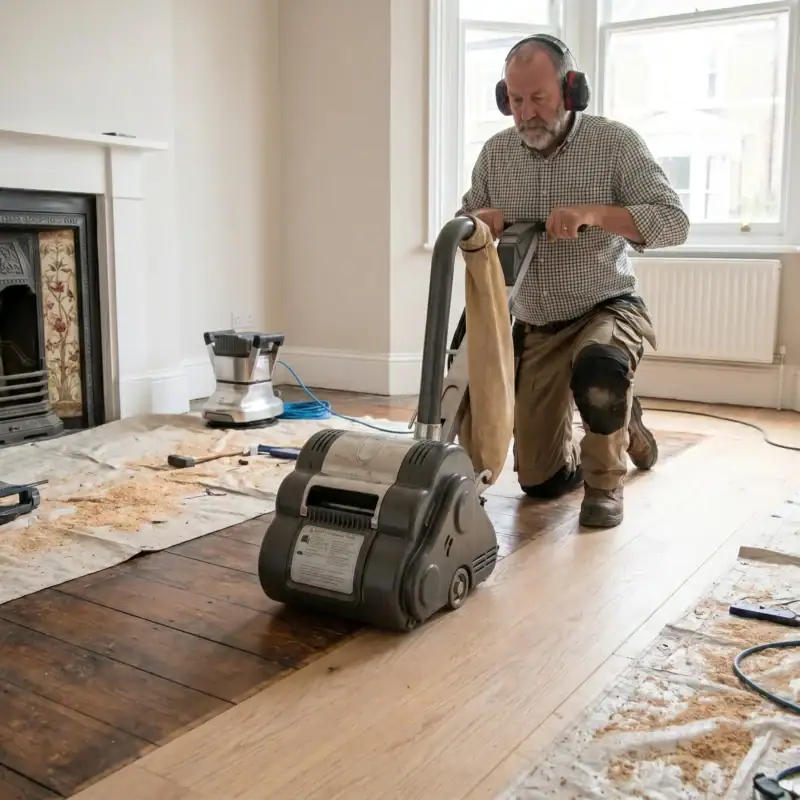
The drum floor sander is the machine that does the volume of the work: a 200mm (8-inch) drum running on 230V standard mains, suitable for solid boards, parquet and wood block.
It strips a floor back to bare wood far faster than an edger can, and it carries dust collection, which matters more than most people expect on an occupied property.
The limit: a drum sander cannot reach the last few inches against a wall. That is not a fault in the machine; it is what a drum inside a housing is.
Read more: why the uncovered border is so obvious
The border a drum sander leaves is usually somewhere between 50mm and 150mm wide, depending on the machine and how close you can bring it to the wall. On a bare floor that strip reads as a dark frame around a pale room, and it is the first thing anyone notices when they walk in. It also behaves differently under finish: old sealer or wax still sitting in the border will reject stain and varnish that the stripped middle accepts, so the frame stays visible even after two coats. Sanding the border by hand is possible on a very small area, but on a full room it is hours of work on your knees for a result that rarely matches the machine-sanded middle.
What does the edging sander do that the drum cannot?
The floor edging sander in our fleet is a Hiretech HT7, from Hiretech of Watford. You work behind it and guide a spinning 178mm disc flat against the wood, so the border can be brought to the same standard as the freshly sanded middle.
| Machine |
Hiretech HT7, Hiretech of Watford |
| Disc |
178mm (7 inch), grits 24 to 120 |
| Disc speed |
3,300 rpm |
| Motor |
1.5hp four-brush, 13,000 rpm geared 3:1 |
| Power |
230-240V, 8A average, standard 13A plug |
| Weight |
16.4kg, a one-person carry |
| Noise |
100 dB(A) at 1 metre |
| Safety |
Dead-man switch |
Hearing protection: 100 dB(A) is not background noise. Wear ear defenders, and be realistic about what your neighbours will tolerate on a Sunday morning.
Read more: the fleet detail that decides your border finish
On our HT7s the backing pad is replaced before its tread wears below Hiretech’s 4mm service limit, so the disc sits flat against the floor. A worn pad is what puts swirl marks into a border, and it is one of the most common reasons a hired edger produces a disappointing finish. It is worth knowing what to look for whoever you hire from: turn the machine over before you start and check the pad face is even, with no dished centre and no hard glazed patches. The second thing that decides the border is how you hold the machine. Let it sit flat and keep it moving along the wall; leaning on one side of the disc is what cuts a groove parallel to the skirting.
Why does the grit sequence matter so much?
Both machines take grits from 24 to 120. The usual mistake is starting too fine, or skipping steps to save time.
- Coarse, 24 to 40. Removes old finish, levels boards, takes out heavy damage. It will dig if you let the machine stop moving.
- Medium, 60 to 80. Removes the scratches the coarse grit left behind.
- Fine, 100 to 120. Final preparation before the finish goes on.
The rule: each grit exists to remove the marks of the one before it. Jumping from 40 straight to 120 leaves 40-grit scratches under your varnish, and they show clearly once the light catches the floor.
Read more: keeping the drum moving, and matching the border to the middle
Keep the drum moving whenever it is in contact with the floor. A stationary drum with the motor running will cut a hollow into the boards within seconds, and that hollow cannot be sanded out, only made wider. Start the machine with the drum lifted, lower it while you are already walking, and raise it before you stop at the end of the run. Run the edger through the same grit sequence as the drum, so the border and the middle arrive at the same finish together. A border sanded to 80 sitting next to a floor sanded to 120 takes stain differently, and the join between them is visible for the life of the floor. If you are staining rather than clear-finishing, it is worth testing your stain on an offcut or an area that will sit under furniture before you commit to the whole room.
What do I need to do before the machines arrive?
- Punch every nail below the surface. A proud nail head tears an abrasive instantly and can damage the drum.
- Lift carpet grippers, tacks and staples. All of them, including the ones under the door threshold.
- Check the boards are sound. Sanding will not cure movement, and a loose board will chatter under the drum.
- Clear the room completely, curtains included.
- Seal the doorways with sheeting and tape. Dust collection is good, not perfect.
- Have a standard 13A socket available, ideally through an RCD.
Older properties: if the building predates the 1980s and you do not know what coating is on the floor, have it identified before you start creating dust from it. The HSE publishes guidance on lead paint and on asbestos-containing materials in older buildings, and a test is far cheaper than the alternative.
How long does a floor actually take?
One average London reception room in reasonable condition is usually a full day with both machines if you are working alone and it is your first time. A whole flat is a weekend at minimum, and more if the boards need levelling.
The time goes on the things nobody budgets for: clearing and masking, punching nails, changing abrasives between grits, and hoovering between passes so the next grit is cutting wood rather than old dust.
The common error: booking a one-day hire for a two-day job. Running out of time with a half-sanded floor and a machine due back is worse than paying for the extra day at the start.
Our guide on how to sand a wooden floor covers the working method in more detail.
Frequently asked questions
Will a drum sander do the edges too?
No. The drum sits inboard of the machine housing, so it cannot reach the last few inches against a skirting board. That is what the edger is for. Any job with visible borders needs both machines.
Will they run off a normal mains socket?
Yes. Both run on 230V standard mains, the normal domestic supply. No transformer and no special supply are needed. A standard 13A socket, ideally RCD-protected, is enough.
How heavy is the edging sander?
16.4kg, which makes it a one-person carry, including up a flight of stairs. The drum machine is considerably heavier and is better handled by two people or moved on its wheels.
What grits do I need?
Both machines take 24 to 120 grit. Most floors need three passes: coarse to strip, medium to remove those scratches, fine to prepare for finish. Skipping grits leaves scratches that appear once the finish is applied.
Is a floor sander noisy?
Yes. The edger measures 100 dB(A) at one metre, so ear defenders are required, not optional. Consider the neighbours and the time of day, particularly in a flat or a terrace.
Can I sand a parquet or engineered floor?
Parquet is usually fine but takes longer, because the blocks run at different angles. Engineered boards with a thin wear layer may not have enough material to sand at all. Check the wear layer thickness before you book.
Harun Uchak runs Hireload’s fleet from the Greenford depot and takes the delivery calls himself.
Book the drum and the edger together
One delivery, one collection, dust collection on both machines. The complete kit for a whole floor, middle and border.
Check pack availability
Or call 020 3375 4048 and describe the floor
Related guidance
Specifications were verified from our live product pages and may vary by the unit supplied. This article is general guidance, not a substitute for professional advice on a specific property. If you suspect an older floor carries a historic coating or adhesive of unknown type, have it identified before sanding rather than after; HSE guidance covers safe working with lead paint and asbestos-containing materials.

 Drone Services
 Access Equipment
 Breaking & Drilling
 Cleaning Equipment
 Drying & Heating
 General Site Tools

 Drone Survey & Mapping
 Drone Inspections