
 Drone Services
 Access Equipment
 Breaking & Drilling
 Cleaning Equipment
 Drying & Heating
 General Site Tools
Cleaning Equipment, Equipment Hire Guides
How to Deep Clean Office and Commercial Carpet
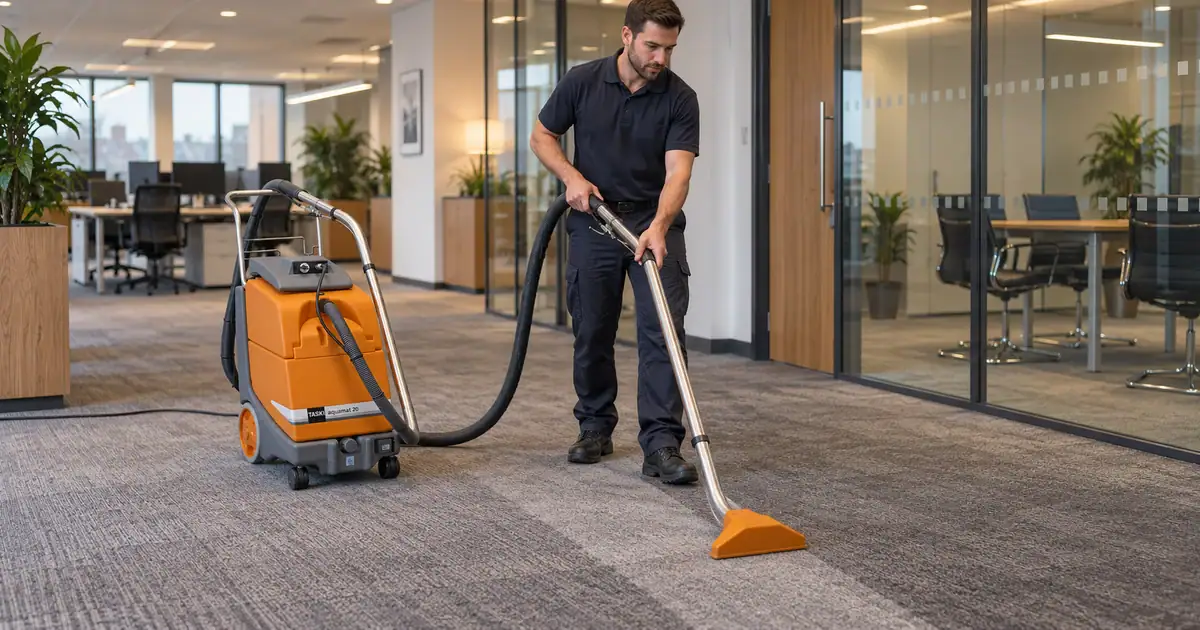
One room is a carpet clean. A whole floor is a logistics job.
On a living-room carpet the cleaning is the job. On an office floor, a hotel corridor or a run of classrooms it is not — the cleaning is the easy part. What decides whether you finish on time is how often you stop to refill and empty, how wet you leave the carpet, and whether the space can go back into use on Monday morning. This guide is about commercial carpet cleaning done properly, by you, with the right machine.
How do you deep clean office carpet?
Vacuum it thoroughly first, pre-treat the traffic lanes and spots, then spray-extract the whole area in slow, overlapping passes with a low-foam extraction detergent at the label dose. Finish every lane with a pass with the spray off, get air moving across the floor, and keep people and furniture off until it is dry. That is the whole method, and it is the same one a contract cleaner uses.
What changes on a commercial floor is scale. A domestic-size machine runs out of water halfway down a corridor, and you spend the shift walking to the nearest tap. For large areas you want a commercial carpet extractor with a big tank — our TASKI aquamat 20 holds 22 litres of solution and 18 of dirty water, roughly twice what most hire-shop carpet cleaners carry. It does not suck harder than those machines. It just stops far less often, and on a big floor that is what saves the day.
Why commercial carpet is a different job
Most carpet cleaning advice online is written for a lounge with a wine stain. Office carpet cleaning, hotel carpet cleaning and school carpet cleaning share a different set of problems, and knowing them before you start is most of the battle.
Commercial carpet rarely gets one dramatic spill. It gets hundreds of people walking the same line every day, so the soiling concentrates in traffic lanes, doorways, around desks and in front of lifts. That grey path is ground-in, oily soil, and it needs pre-treatment and slow passes, not a quick once-over.
Offices, schools and hotels mostly use synthetic contract carpet or carpet tiles. Both clean very well with spray extraction. Both are also easy to over-wet, and on tiles the water can reach the adhesive underneath — so technique matters more than chemical strength.
You are working out of hours, over a weekend, in a half-term, or between hotel changeovers. The floor has to be clean and dry by a set time, which makes drying a planning job from the start rather than an afterthought.
On one room, any carpet cleaner is fine. On 300 square metres, the limit is not suction — it is how many times you stop to empty dirty water, refill clean water, and walk back. That is the problem a big-tank commercial machine exists to solve.
Commercial carpet cleaning, building by building
The method is the same everywhere. What changes is when you can do it, who is in the building, and what goes wrong if the floor is still damp when people come back. These are the buildings that hire a commercial carpet cleaner from us most, and what each one needs you to plan for.
Open-plan carpet tiles with heavy lanes between desks, kitchens and meeting rooms. The window is a Friday evening or a weekend, and the floor has to be dry and furniture back by Monday. Work in zones, move chairs off each zone before you start, and put air movers on the last zones you clean, because those have the least time to dry.
Corridors plus a run of bedrooms, usually cleaned in sections so rooms can be turned round between guests. Corridors are long and narrow with no furniture to move, which is exactly where a big tank earns its keep. Check the carpet specification first: some hotel carpet is wool or wool-blend and needs a patch test and gentler chemical.
Classrooms, libraries and reading corners, cleaned during half-term or the summer holiday. The soiling is heavy and the rooms are many, so this is refill-heavy work. Allow drying time before staff come back in to set up, and pay attention to nursery floors where children sit and play directly on the carpet.
Stairs, landings and corridors in blocks and shared houses, often done at the end-of-year turnover between tenancies. The corridors suit the big machine; the stairs do not, because this hire includes a floor wand only. Plan the stairs with a machine that has a hand tool.
Several flats or a whole portfolio handed over at once. One commercial machine on a weekly hire, moved from unit to unit, is usually simpler than one small machine per property. For a single flat on its own, our guide to end-of-tenancy cleaning equipment covers what inspectors actually check.
Lounges, corridors and bedrooms that never fully empty. The machine is quiet — the manufacturer rates it at 66 dB(A) — so it can run near people, but wet carpet cannot be walked on. Work one area at a time, keep a dry route open, and follow your own infection-control policy on chemicals and timing.
Large open carpet with bar, buffet and entrance soiling, reset after a busy weekend or ahead of an event. Big, uninterrupted areas are the ideal job for a large tank, and a hall with doors open and air movers running dries far better than a closed room.
Periodic deep cleans across a client site, where the price is fixed and every minute spent walking to a tap is unpaid. This is who the machine was designed for. If you run several sites, a weekly hire lets you move it between jobs without buying and maintaining one.
| Building | Usual window | Plan for | Best machine |
|---|---|---|---|
| Office floor | Friday evening or weekend | Chairs and desks moved zone by zone; dry and back in place by Monday | TASKI aquamat 20 plus air movers |
| Hotel corridor and rooms | Rolling, between changeovers | Long runs with no furniture; wool carpet needs a patch test | Big-tank extractor on a weekly rate |
| School or nursery | Half-term or summer holiday | Many rooms, heavy soiling, children on the floor afterwards | Big-tank extractor, several days |
| Communal stairs and landings | Tenancy turnover | Stairs need a hand tool; corridors do not | Big tank for corridors, hot water machine with an upholstery tool for stairs |
| Single flat or one office | Any day | The tank advantage is worth nothing on one room | Compact carpet cleaner |
| Hall or function room | Before or after an event | Open space, fastest drying with doors open | Big-tank extractor plus a high-airflow dryer |
Why tank size matters more than suction on a big floor
This is the part most hire shops will not tell you, and it is the most useful thing to understand before you book. On paper, the 20-litre commercial carpet extractor we hire does not have more suction than the 10-litre machines that most London hire shops stock. The vacuum figures are about level. What it has is roughly double the water.
Every time the solution tank runs dry or the recovery tank fills, you stop. You carry the machine or the tank to a sink or a drain, empty the dirty water, rinse, refill with clean water and chemical, and walk back. On one room that happens once and nobody notices. On a whole floor, it is the thing that decides how long the job takes.
| Example job | Solution used | 10 L-class machine | TASKI aquamat 20 (22 L) | Stops saved |
|---|---|---|---|---|
| A few rooms | 44 litres | 5 fills | 2 fills | 3 |
| An office floor | 110 litres | 11 fills | 5 fills | 6 |
| A school block or hotel floor | 220 litres | 22 fills | 10 fills | 12 |
Put your own number on each stop. If a round trip to the sink, emptying, rinsing and refilling takes you five minutes, the office floor above saves you half an hour, and the school block saves you an hour — on every visit. For a contract cleaner that is margin. For a facilities manager it is the difference between finishing on Saturday and coming back on Sunday.
The honest other side: on a single room, the big tank is worth nothing. You would be carrying a 25 kg machine to do a job a lighter, cheaper one does just as well. If your job is one room or one flat, take the compact machine and save the money — we would rather tell you that now than on the phone.
Which commercial carpet cleaner to hire
We hire four carpet machines, and each one is the right answer for a different job. Pick by the size of the area and the kind of soiling, not by which one sounds most professional.
Prices are from, per day, plus VAT. Hard floors are a different machine: a scrubber dryer for vinyl, tiles and concrete. If you are unsure which one fits, send us the size of the area and the carpet type and we will tell you.
Cleaning carpet tiles: what is different
Carpet tile cleaning is the most common commercial carpet job in London offices, and tiles clean very well with spray extraction. The risk is not the dirt; it is the water. A tile is a separate square sitting on adhesive, and if you soak it, water finds the joins and runs underneath.
What to do differently on carpet tiles:
The method, step by step
This is the order a professional works in, and it is the same whether you are doing one meeting room or a whole floor. Skipping steps is what causes streaks, slow drying and blocked machines.
1. Plan the water, the power and the order
Before you switch anything on, find three things: a sink or drain you can empty into, a socket on an RCD-protected supply, and the order you will clean the rooms in. Start at the far end and work back towards the exit, so you never walk over carpet you have just cleaned. The machine has a 15 m cable, which covers most rooms from one socket.
2. Clear and dry-vacuum properly
Move chairs, bins and anything light. Then vacuum everything, slowly, with a proper upright or tub vacuum. Loose grit and hair turn to sludge the moment they meet water, block the filter within minutes, and leave the carpet looking worse than when you started.
3. Pre-treat the lanes and spots
Traffic lanes, doorways, and the area around coffee points and printers hold oily soil that plain extraction will not shift in one pass. Apply a suitable carpet pre-spray to those areas and give it the dwell time on the label. Test a hidden patch first, especially on wool or patterned carpet.
4. Mix a low-foam extraction detergent at the label dose
Use a proper low-foam carpet extraction chemical, never household carpet shampoo or washing-up liquid. Foam floods the recovery tank and can reach the vacuum motor. More chemical does not clean better either: it leaves sticky residue that attracts dirt back within days.
5. Extract in slow, overlapping passes
Spray on the pull stroke, walking backwards slowly, and overlap each pass slightly so you do not leave clean and dirty stripes side by side. The slower you pull the wand, the deeper the clean. Release the spray about 10 cm before the end of each pass and keep vacuuming.
6. Finish every lane with the spray off
Go back over each run with the spray trigger released. A dry pass pulls out a surprising amount of water, and it is the single habit that does most for drying time. On carpet tiles, do two.
7. Empty the recovery tank before it is full
When the recovery tank fills, a float closes and suction stops. That is protection, not a fault — empty it and carry on. Do not let foam or water climb past the float, because that is how motors get damaged.
8. Get air moving and keep people off
Air movers across the floor, windows or doors open where you can, heating on if it is cold. Put signs up and keep one dry route through the building. Furniture goes back only when the carpet is dry, or on plastic protectors, because damp carpet takes marks and dye from feet and castors.
If you have never used an extraction machine before, our step-by-step guide on how to use a hired carpet cleaner walks through setting it up and returning it, and the hire desk will talk you through chemical and dilution before you start.
Drying, and getting the space back into use
Extraction always leaves carpet damp. Anyone who gives you a fixed drying time without seeing the room is guessing, because it depends on how wet you worked, the carpet and its backing, the temperature and, above all, how much air is moving. What you can control is this.
A dry pass after every wet pass. Air movers running across the floor. Doors and windows open, heating on. Synthetic carpet or carpet tiles on a permeable base.
Over-wetting or going over one spot again and again. A closed, cold, unventilated room. Thick wool pile, or foam-backed carpet laid on a solid floor.
For commercial floors, air movers are not optional if the space has to reopen quickly. On long corridors and stairwells the low-profile Velo air mover sits flat along the floor and pushes air down the run. On open-plan floors and halls, the 2,700 CFM high-airflow carpet dryer covers more ground per unit. Place them so the air skims across the carpet surface rather than blowing at a wall, and move them as each zone dries.
If a carpet has been properly soaked rather than cleaned — a leak, a burst pipe, a flooded ground floor — that is a drying job, not a cleaning job, and it needs a dehumidifier as well. Our guide on drying a wet carpet without lifting it covers that separately.
Six mistakes that cost you the job
It foams. Foam fills the recovery tank, reaches the vacuum motor, and turns a cleaning job into a repair bill. Low-foam extraction chemical only.
Overdosing does not clean deeper. It leaves residue in the pile that grabs dirt, and the traffic lanes come back grey within a week.
More water is not more clean. It extends drying time, can smell, and on carpet tiles it reaches the adhesive. Slow passes and dry passes do the work.
Grit and hair go straight into the recovery tank and filter. The machine loses suction and the carpet dries patchy.
A 25 kg commercial extractor on a single office is wasted money and effort. Match the machine to the area.
The job is not finished when you switch off. It is finished when the floor is dry and people can walk on it. Book the air movers with the machine, not after.
What commercial carpet cleaning costs to do yourself
These are our current commercial carpet cleaner hire prices in London for the TASKI aquamat 20 carpet extractor and the things that go with it. Prices exclude VAT, and the exact price for your dates shows on the product page before you commit.
| Item | Price | Notes |
|---|---|---|
| Extractor, 1 day | £79.99 | Enough for a single floor if you plan the drying |
| Extractor, 2 days | £119.99 | Clean one day, second pass or a second area the next |
| Extractor, up to a week | £149.99 | Several floors, a school block, or moving between sites |
| Longer hires | £20.99 per day | Ask about long-term rates for contract work |
| Delivery and collection | from £35 | Both trips, priced by postcode; free if you collect from Greenford UB6 |
| RCD power breaker | £7 | Required with this hire, for safety on wet work |
| Refundable deposit | £150 | Plus photo ID; returned after the machine is checked back in, normally within 2–3 working days |
| Air mover | from £15.49 per day | One or two per zone if the floor must reopen quickly |
| Chemical | Your choice | Bring a low-foam carpet extraction detergent; the hire desk can advise |
A full week of the extractor delivered and collected comes to £184.99 plus VAT. Whether that beats paying a contractor depends on the size of the area and how much of your own time you have — we have laid out that comparison honestly in carpet cleaner hire versus a professional. For a contract cleaner, the sum is simpler: the hire is a fixed cost, and every refill stop the big tank saves is time you can bill.
Commercial carpet cleaning: common questions
Can I use a carpet cleaner on office carpet tiles?
Yes. Spray extraction is the normal way to deep clean carpet tiles. Work drier than you would on broadloom carpet: slow passes, less water at the joins and edges, and a dry pass on every lane, so water does not reach the adhesive underneath. If a single tile is badly stained, lifting and swapping it is often better than soaking it.
How long does office carpet take to dry after cleaning?
It depends on how wet you worked, the carpet and its backing, the room temperature and the airflow, so there is no honest fixed figure. What reliably shortens it is a dry pass after every wet pass, air movers across the floor, and doors or windows open. Plan for the area to be out of use and put furniture back only when the carpet is dry.
Is it cheaper to hire a commercial carpet cleaner or pay a cleaning company?
For a large area where you have the people and the time, hiring usually costs less, because the machine price is fixed however many square metres you clean. A contractor brings skill, chemicals and labour, which is worth it if you have none of those. We compare both honestly in our guide to carpet cleaner hire versus a professional.
What is the difference between a carpet extractor and a carpet cleaner?
Most carpet cleaners you hire are extractors: they spray solution into the pile and vacuum it straight back out, taking the dirt with it. Commercial carpet extractor usually means a larger machine built for bigger areas and daily contract use. It is different from shampooing, which works detergent into the pile with a brush or pad, and from steam cleaning, which uses vapour and is not a carpet deep-clean method.
Does the TASKI aquamat 20 heat the water?
No. It runs at tap temperature, which is fine for routine soiling and traffic lanes. If the carpet has greasy, stubborn soiling, or you need to clean stairs, upholstery or car interiors, our hot water carpet cleaner is the better hire because it heats the water and comes with a hand tool.
What detergent should I use in a commercial carpet extractor?
A low-foam carpet extraction detergent, at the dose on the label. Never use household carpet shampoo or washing-up liquid: they foam, flood the recovery tank and can damage the vacuum motor. Overdosing also leaves residue that makes the carpet re-soil faster. Our hire desk can advise on chemical before you start.
Can I clean carpet while the building is occupied?
Yes, with planning. The TASKI aquamat 20 is rated at 66 dB(A) by the manufacturer, which is quiet for a professional extractor, so it can run near people. The limit is the wet carpet, not the noise. Clean one zone at a time, sign it off, and keep a dry route open through the building.
How often should commercial carpet be deep cleaned?
There is no single rule. Busy entrances, corridors and areas around kitchens need it far more often than quiet offices. Set the frequency by how heavy the traffic is, the carpet manufacturer’s maintenance guidance and any cleaning standard in your lease or contract, and keep up regular vacuuming in between, which does more to extend carpet life than anything else.
Can one person move it between floors?
It weighs 25 kg dry and most people lift it into a car on their own. Between floors, use the lift where you can. On stairs, empty both tanks and take the accessories off first, then take it step by step; on a long flight, use two people, and never carry it with water inside.
Do you deliver to offices and buildings across London?
Yes. Standard delivery and collection across London starts from £35 for both trips, with priority and same-day options on selected West London routes, or you can collect free from our Greenford depot. A £150 refundable deposit and photo ID apply, returned after the machine is checked back in.
Related guides
More cleaning guides and equipment:
Tell us the building and we will size the job
Send us the type of building, roughly how many square metres or rooms, the kind of carpet, and when it has to be back in use. We will tell you whether the big-tank extractor is the right machine, how many days to book, and how many air movers to put with it. If a smaller machine would do the job, we will say so.
Specifications, sources and limits: machine figures are TASKI’s published values for the aquamat 20 (TASKI is a Solenis brand, formerly Diversey): 22 L solution and 18 L recovery tank, 1,050 W motor, 47 L/s airflow, 22 kPa vacuum, 24 cm floor wand, 230–240 V, 15 m cable, 25 kg, 66 dB(A), unheated. The refill table uses example solution volumes to show the effect of tank size; it is not a coverage figure, and real use depends on the carpet, the soiling and how wet you work. Drying time varies with carpet, backing, temperature and airflow, so no fixed time is given. Check the carpet manufacturer’s care guidance and test a hidden area before cleaning wool, wool-blend, patterned or older carpet. Follow the label and safety data sheet for any chemical. Hire prices are correct at the time of writing and exclude VAT; the live price for your dates is shown at checkout.

 Drone Survey & Mapping
 Drone Inspections