
 Drone Services
 Access Equipment
 Breaking & Drilling
 Cleaning Equipment
 Drying & Heating
 General Site Tools
Equipment Hire Guides
Which Carpet Cleaner Can Actually Clean a Sofa?
Quick answer
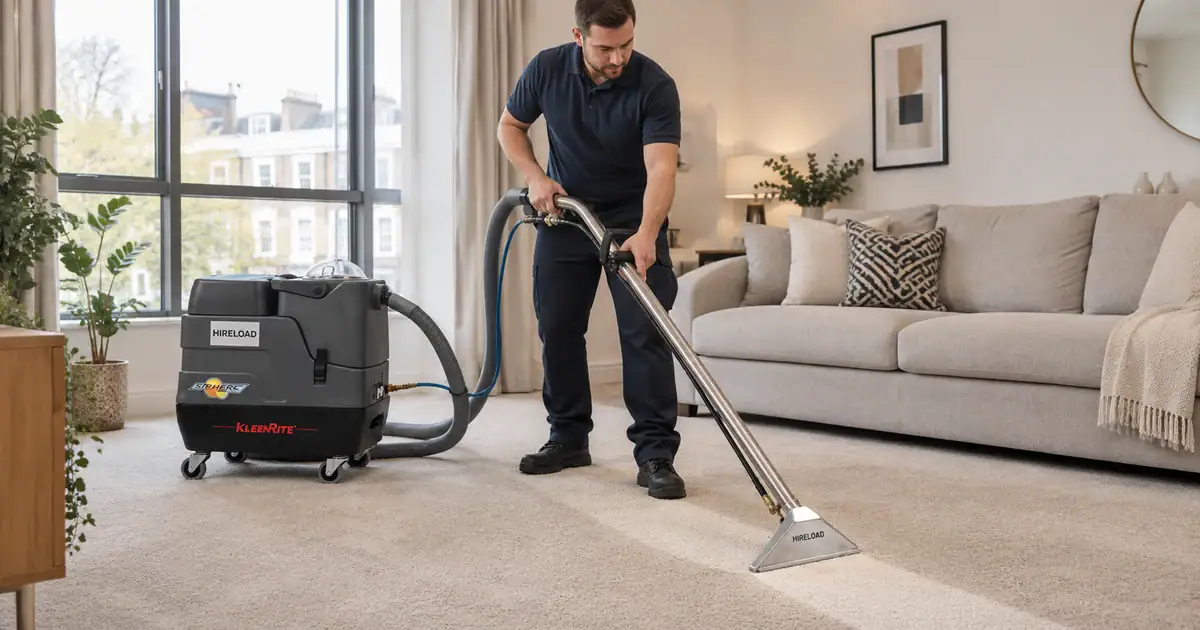
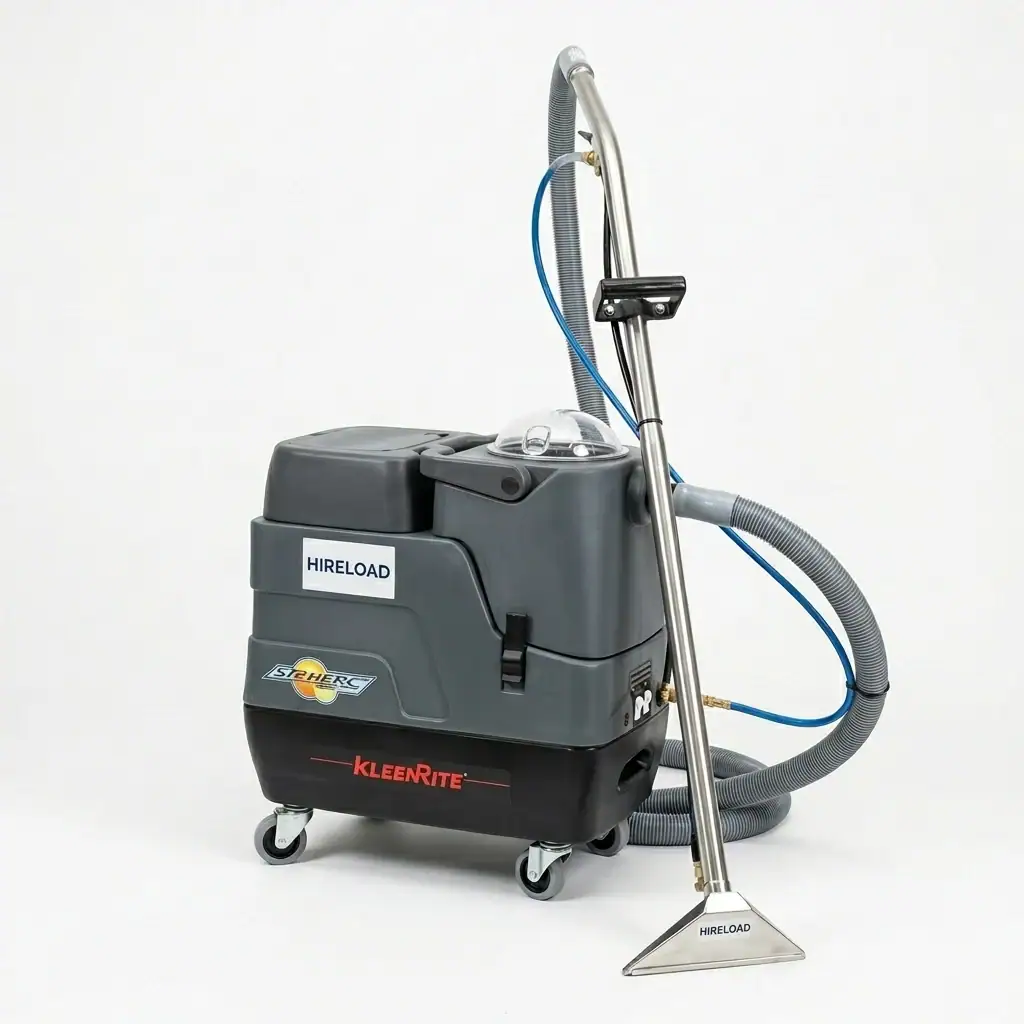
Only a machine that comes with an upholstery hand tool. Of our four carpet cleaners, the KleenRite SPHERE includes one as standard; the TASKI commercial extractor does not supply one at all. A floor head cannot clean a sofa back, a stair riser or a car seat, whatever the product title says.
Key takeaways
- The hand tool decides it. Not tank size, not motor count, not water temperature.
- Read the fabric label first. An S or X code means no wet cleaning at all.
- Drying is half the job. Foam cushions stay wet long after the surface feels dry.
- Allow an afternoon. A three-seater and two armchairs is not an hour’s work.
| Machine | Upholstery hand tool | What it can reach |
|---|---|---|
| KleenRite SPHERE hot water | Included | Sofa backs, stair risers, car seats and floors |
| Numatic CTD570-2 twin motor | Confirm at booking | Carpets and rugs; fabric only if a tool is supplied |
| Truvox HC250 brush type | Confirm at booking | Carpet, with a rotary brush for ground-in soil |
| TASKI aquamat 20 | Not supplied | Open floor areas only, no fabric and no stairs |
Why does the hand tool matter more than anything else?
A carpet machine without a hand tool can only clean what its floor head can sit flat on. That is fine for a room. It is useless on a sofa back, a stair riser or a car seat.
The hand tool is the small handheld head on its own hose that lets you spray and extract on a vertical or contoured surface. Everything else about the machine matters far less than whether that one accessory travels with it.
Read more: what “and upholstery” really means in a hire listing
The hand tool is a separate accessory. Some hire fleets include it as standard, some treat it as an add-on, and some do not carry it at all for a given model. If you book on the strength of the words “and upholstery” in a product title, you can end up with a machine on your floor that physically cannot reach the thing you hired it for.
So the question to settle before booking is narrow and specific: does this particular hire include the hand tool, and is the hose long enough to reach where you need it? On the KleenRite SPHERE the answer is yes on both counts, with the tool included as standard and 4.5m vacuum and solution hoses supplied. On the other machines in our fleet, ask us at the point of booking rather than assuming.
What do the W, S, WS and X labels on my sofa mean?
Upholstery usually carries a cleaning code on a label under a cushion, on the base frame, or inside a zip. It is the single most useful thing you can find before you book anything.
- W — water-based cleaning is generally acceptable
- S — solvent only. Water-based extraction is not appropriate
- WS — either water-based or solvent methods may be suitable
- X — vacuum only. No wet cleaning of any kind
Read more: fabrics that are usually better left to a specialist
If the label reads S or X, hiring a wet extraction machine will not help you and may damage the piece. That is worth discovering before you pay for a hire, not after.
If there is no label at all, or the piece is antique, leather, silk, viscose or a loose-weave natural fibre, treat it as unknown. Those materials can shrink, watermark or lose colour in ways that are difficult to reverse. Seek advice from an upholstery specialist rather than experimenting on a piece you care about. The manufacturer’s own care instructions, where you still have them, take precedence over any general guidance including ours.
Does hot water actually matter on fabric?
Heated extraction tends to help where the soiling is greasy or body-oil based, which is exactly what accumulates on the arms, headrest and seat cushions of a well-used sofa.
It is not a universal rule. Heat can be unhelpful on some fibres and on certain dyes, and a heated machine used carelessly on a delicate fabric can do more harm than a cold one used patiently. The SPHERE takes hot tap water at up to 60°C and its built-in heater carries it on from there, so the temperature at the tool is not something to treat casually.
Our guide on hiring a carpet cleaner versus booking a professional covers where the line usually sits on bigger jobs.
What will a machine not fix?
Hire equipment is good at removing soil sitting in the fibre. It is much less effective against damage that has already changed the fibre itself.
- Permanent dye loss from bleach, some cleaning products or sunlight will not come back
- Old set stains that have been through previous wet cleaning are often chemically bound
- Pet urine that has reached the foam or frame is beyond the reach of surface extraction
- Wear and pile crush on seat cushions is mechanical damage, not soiling
How long does a sofa take to dry?
Upholstery holds a surprising amount of water. Foam cushions in particular stay damp well after the surface feels dry to the hand, and a sofa left to dry slowly in a closed room is a reliable way to produce a musty smell that was not there before.
Extract more passes than you think you need, with the solution switched off, to pull water back out. Then get air moving across the piece.
Read more: the drying setup that makes the difference
Open windows where the weather allows, and keep the room ventilated rather than sealed. Warm still air does much less than cool moving air, which is why a closed room with the heating on is usually the slowest option of all.
On a larger job, or a room with poor ventilation, an air mover running alongside the clean makes a real difference to how quickly the fabric comes back. Point it across the face of the cushions rather than straight at them, and move it every few hours. Our note on how long drying actually takes applies to fabric as much as it does to building materials.
What is the right sequence for cleaning a sofa?
- Find and read the label. If it says S or X, stop and call an upholstery specialist.
- Vacuum thoroughly first, including under and behind the cushions.
- Test a hidden area and let it dry completely before continuing.
- Work in sections — one cushion, one arm, one back panel at a time.
- Extract dry. Several passes with no solution, until the tool stops pulling water.
- Ventilate and air-move until the foam is dry, not just the surface.
How do I book the right hire?
If the job includes any furniture, stairs or a car interior, book a machine that comes with the hand tool and say so when you book. If the job is purely open carpeted floor across a large commercial area, the commercial extractor is the faster tool for that work.
If you are unsure which side of that line your job sits on, call us on 020 3375 4048 and describe the job rather than the machine. It is a faster conversation and it avoids a wasted delivery.
Frequently asked questions
Can I clean a sofa with any carpet cleaner?
How long does a sofa take to dry after cleaning?
What do the W, S, WS and X labels mean?
Will hiring a machine remove pet urine odour?
Can I use the same machine for carpeted stairs?
Do I need hot water or is cold enough?
Harun Uchak is the founder of Hireload. He runs the fleet from Greenford and takes the delivery calls himself.
Related guidance
- Carpet cleaner hire or a professional clean: how to decide
- How to use a carpet cleaner properly
- End of tenancy cleaning equipment checklist
- How to dry a wet carpet without ripping it up
This guide is general practical guidance based on our own hire fleet and the common upholstery cleaning codes. It is not professional advice and it is not a substitute for the manufacturer’s care instructions for your specific furniture. For antique, leather, silk or unlabelled pieces, seek advice from an upholstery specialist before any wet cleaning.

 Drone Survey & Mapping
 Drone Inspections