
 Drone Services
 Access Equipment
 Breaking & Drilling
 Cleaning Equipment
 Drying & Heating
 General Site Tools
Equipment Hire Guides
Will Carpet Cleaning Kill Moths? An Honest Answer — and What Actually Works
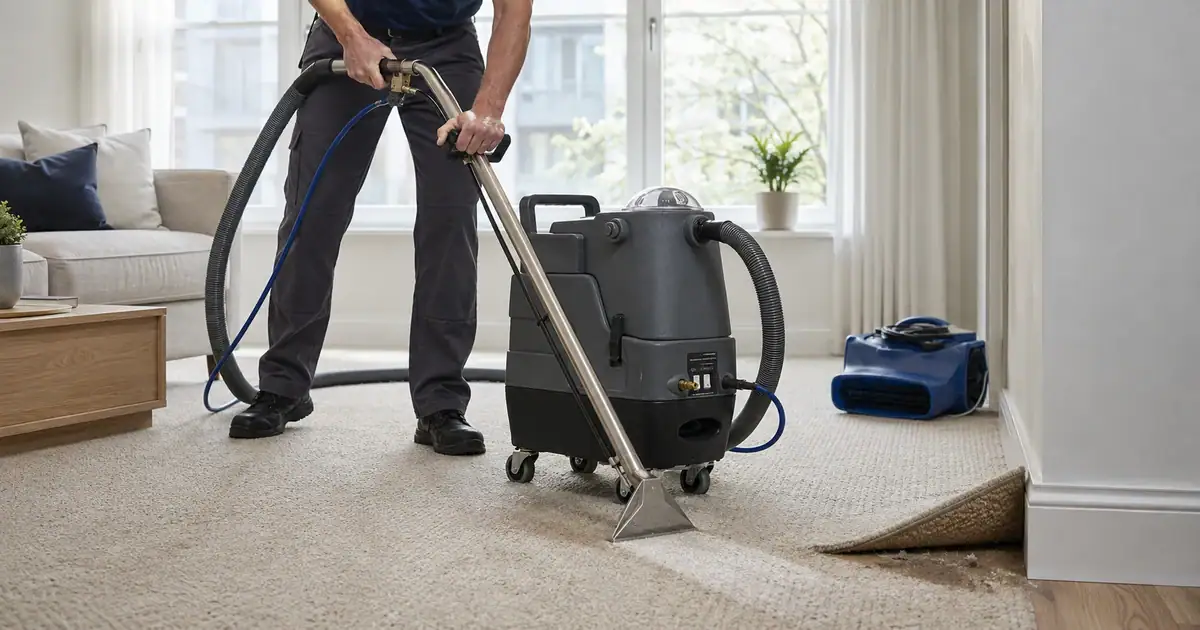
An honest, evidence-led look at whether carpet cleaning actually kills moths — what works, what doesn’t, and the temperature science behind it. No pest control sales pitch, just the facts.
Same-day and next-day carpet cleaner delivery across London. Browse floor cleaners
Quick answer: Hot water extraction at sustained temperatures above roughly 50°C will kill carpet moth eggs and larvae present in the carpet at the time of cleaning. Commercial-grade extractors are built to reach these temperatures comfortably. However, cleaning the carpet alone will not eradicate a heavy infestation — moths also live under skirting boards, behind furniture, and beneath floorboards where no cleaning machine reaches. For light damage, deep cleaning is often enough. For heavy damage, combine cleaning with a proper treatment plan.
What Carpet Moths Actually Are (And Why It Matters)
The “carpet moth” in UK homes is most often the common clothes moth (Tineola bisselliella) — a small beige-gold moth whose adults you sometimes see flying near skirting boards or curtains. Adults do not eat carpet. They lay eggs, and it is the larvae that do the damage, eating wool fibres, silk, and natural-blend carpets over weeks to months.
The lifecycle matters because each stage has a different vulnerability:
Eggs: Tiny, cream-coloured, laid in undisturbed corners and beneath furniture. They usually hatch in 4–10 days depending on temperature and humidity.
Larvae: The destructive stage. They feed for 2–3 months in warm homes, sometimes much longer in cooler conditions, and hide deep in carpet pile, under furniture, and along skirting edges.
Pupae: Wrapped in cocoons, usually in cracks, corners, or beneath dense pile. This stage typically lasts around 8–10 days, sometimes longer.
Adults: Live just a few weeks. They don’t eat — their job is reproduction.
Carpet cleaning targets primarily the eggs and larvae present in the carpet itself. It does not reach pupae cocooned behind skirting boards or eggs laid in hidden cracks. This is the boundary that defines what cleaning can and cannot do.
The Temperature That Kills Moth Eggs and Larvae
This is the part most articles skim over. The actual science:
Sustained exposure above approximately 50°C denatures the proteins in moth eggs, larvae, pupae, and adults — they die. This threshold is consistent across entomology and pest control sources, with around 30 minutes of sustained heat commonly cited for a reliable kill.
Domestic steam cleaners and light-duty machines often don’t sustain this temperature deep into the pile. Commercial-grade hot water extraction machines — the kind you hire rather than buy — are built with heaters designed to bring tank water well above that threshold.
Key point: Tank temperature is not the same as the temperature that reaches the carpet fibre. Heat is lost through the hose, and the spray atomises as it leaves the nozzle, cooling on the way down. The temperature at the actual fibre is lower — but a heated commercial extractor still delivers contact temperatures well above what a domestic steamer or a bucket of hot water can manage.
In practical terms: a heated commercial extractor used properly will kill the eggs and larvae sitting in the carpet pile at the moment of cleaning. It will not magically reach the eggs that were laid under the skirting board last week.
Cleaning Methods Compared — Which Ones Work
Not all “carpet cleaning” is the same. Here’s what each method actually does to a moth problem:
| Method | Effect on moths | Reach | Verdict |
|---|---|---|---|
| Vacuuming alone | Removes loose eggs, larvae and the food debris they feed on | Surface to mid-pile | Essential, but not enough on its own |
| Domestic steam cleaner | Some kill at the surface, inconsistent at depth | Surface only | Helpful for spot treatment, not whole-carpet |
| Carpet shampoo (rotary) | Dislodges some larvae and eggs | Mid-pile | Moderate effect, doesn’t reliably kill |
| Hot water extraction (commercial hire) | Kills eggs and larvae in the carpet at contact temperature | Full pile depth | The strongest cleaning-only approach |
| Dry compound cleaning | Mechanical agitation, no heat | Surface only | Not recommended for moth treatment |
| Professional pest control plus deep clean | Chemical kill across hidden areas plus thermal kill in carpet | Whole room including hidden voids | Required for heavy infestation |
The honest hierarchy: vacuum first, then hot water extraction, then professional treatment if the problem persists. Each step does more than the last.
If the pile is badly flattened or heavily soiled, running a brush-type carpet cleaner over the carpet before extraction lifts the fibres, so the hot water can reach deeper into the pile where larvae hide.
What Carpet Cleaning Cannot Do
This is the part most cleaning company websites leave out.
Cleaning does not reach under skirting boards. Eggs and pupae deposited in the gap between carpet edge and skirting are protected from any extraction machine. They hatch later, recolonising a freshly cleaned carpet within weeks.
Cleaning does not reach beneath the carpet. Underfelt and floorboard cavities are common hiding spots for larvae. A machine cleans the pile, not what’s underneath.
Cleaning does not address adult moths in flight or eggs laid elsewhere. Wool clothing, blankets, and upholstery are also potential breeding sites that won’t be touched by carpet cleaning.
Cleaning does not stop reinfestation from outside the room. Moths fly. A neighbouring untreated room or a moth source somewhere else in the home will repopulate the cleaned area.
Warning: Anyone telling you that one round of carpet cleaning will permanently solve a moth problem is overpromising. The honest claim is narrower: cleaning kills what’s in the carpet pile right now. Whether that’s enough depends on how localised your problem is.
The Real-World Method — Step-by-Step
If you have a light-to-moderate moth problem and want to handle it without calling pest control, this is the sequence that actually works:
Step 1: Vacuum thoroughly first. Use the crevice tool along skirting edges, under furniture, and in corners. Empty the vacuum into a sealed bag and dispose of it outside the home immediately — eggs and larvae are still alive in the vacuum bag.
Step 2: Move all loose furniture out of the room. Moths breed where it’s dark and undisturbed. You must reach every square inch of carpet.
Step 3: Hire a commercial hot water extractor. A domestic spot cleaner or steam mop is unlikely to sustain the temperature you need across a whole room. Our carpet cleaner hire is a heated extraction model built for this kind of deep clean.
Step 4: Work in slow, overlapping passes. Slower is hotter and wetter. A fast pass cools the contact zone and reduces the kill effect. Treat the edges (the last 10cm to the skirting) as carefully as the open carpet.
Step 5: Treat the room more than once. One pass kills what’s exposed. A second pass two weeks later catches whatever hatched from eggs the first pass didn’t reach. This two-pass approach is the difference between “reduced” and “knocked back hard”.
Step 6: Address the perimeter. A residual moth deterrent or insecticide along skirting and under heavy furniture is what closes the gap. Always follow the product label. Cleaning alone is incomplete here.
Pro tip: Plan the clean for a day when you can leave the room alone for 6–8 hours afterwards. Leaving the room undisturbed during drying gives you a cleaner finish, and opening windows on the drying side speeds up airflow.
When DIY Cleaning Is Enough vs When to Call a Pro
| Situation | DIY hire cleaning | Professional treatment |
|---|---|---|
| You’ve spotted 1–2 adult moths, no visible damage | Yes — deep clean handles it | Not usually needed |
| Bare patches in a single area, localised damage | Yes — hire plus perimeter treatment | Optional second opinion |
| Damage across multiple rooms | Possibly — DIY first, escalate if it returns | Likely needed |
| Wool rugs and upholstery also affected | Hire alongside professional rug treatment | Recommended |
| Recurring infestation after past cleaning | Unlikely to be enough on its own | Required |
| Listed property, antique rugs, or expensive carpets | Hire for routine maintenance only | Required for active infestation |
The economic logic: a one-day carpet cleaner hire costs a fraction of professional pest control. For light problems, DIY is the right call. For anything that has been growing for months or covers multiple rooms, the cleaning is one part of a bigger plan — not the whole plan.
Your Action Plan by Infestation Level
| Infestation level | Your action | Equipment needed |
|---|---|---|
| Suspected — moths seen, no damage | Vacuum, then hire a commercial extractor for one room | Heated carpet cleaner |
| Light — small bare patch | DIY clean both affected and adjacent rooms, plus perimeter treatment | Heated carpet cleaner and insecticide spray |
| Moderate — damage in one room, spreading | Two-pass DIY clean two weeks apart, plus perimeter treatment | Heated carpet cleaner (multi-day hire) and insecticide |
| Heavy — multiple rooms, recurring | Combine DIY clean with professional pest control | Hire plus external service |
FAQ
Does steam cleaning kill carpet moths?
How hot does the water need to be to kill moth eggs?
Will one carpet clean get rid of moths completely?
Can I just vacuum carpet moths away?
Should I call pest control or hire a carpet cleaner first?
How long after carpet cleaning will moths return?
Related guides: Carpet cleaner hire vs professional | How to use a hired carpet cleaner | Which cleaning equipment do I need?
Our heated commercial extractors are built for the kind of deep clean that reaches the bottom of the pile. Browse the range, or call 020 3375 4048 to talk through your job.
Browse Floor Cleaners

 Drone Survey & Mapping
 Drone Inspections