
 Drone Services
 Access Equipment
 Breaking & Drilling
 Cleaning Equipment
 Drying & Heating
 General Site Tools
Equipment Hire Guides
Data Centre and Server Room Humidity Control
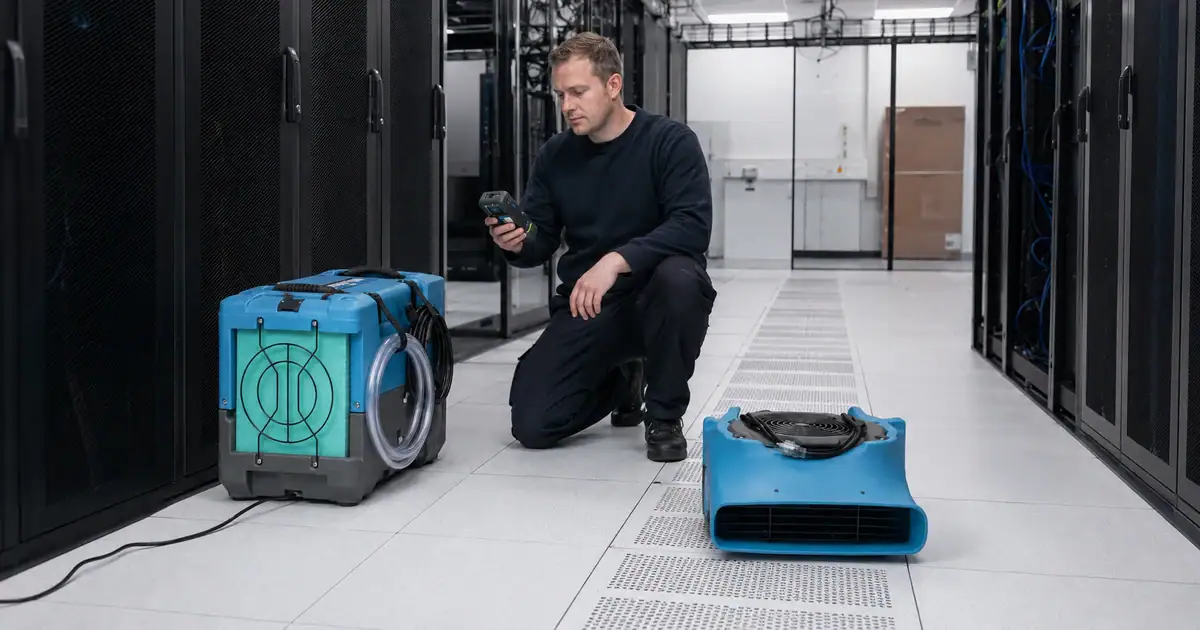
Data centre and server room humidity — the numbers, and when to hire temporary drying
ASHRAE recommends 18 to 27°C dry bulb with a dew point between −9°C and +15°C, capped at 60% RH. Serious facilities control to dew point, not RH. A live hall holds that with fixed plant — portable dehumidifiers are for construction, fit-out, commissioning, cooling failure and water ingress. Availability and suitability confirmed before hire.
What humidity should a data centre or server room be kept at?
ASHRAE TC 9.9 recommends 18 to 27°C dry bulb with a dew point between −9°C and +15°C and a secondary cap of 60% relative humidity. That recommended envelope applies to all equipment classes A1 to A4; the wider allowable envelopes are what the hardware tolerates, not where you would choose to run. Control to dew point rather than RH, because dew point reads the same number across the hall while RH changes between the cold aisle and the hot aisle.
In plain terms this covers data centre humidity control, server room humidity levels, comms room and UPS battery room conditions, and temporary dehumidifier hire for data centre construction, fit-out, commissioning, CRAC failure cover and water ingress across London, Slough and the Thames Valley.
The market this guide is written for
Capacity in the Slough cluster — Europe’s largest
Operational data centres in that one cluster
RH above which ferrous metal corrodes quickly
Moisture in 27°C air at 50% RH versus 16°C air at 50% RH
West London and the Thames Valley hold the densest concentration of critical facilities in Europe. Slough alone runs around 1 GW of capacity across more than 30 data centres, including 675 MW of hyperscale, and roughly 8,000 construction jobs went into building it between 2010 and 2025. Every one of those halls spent months as a wet concrete box before it held a single server.
This guide covers the numbers a data centre actually runs to, why dew point is the control variable, what goes wrong at each end of the envelope, and the specific phases where temporary dehumidification is the right answer rather than a substitute for proper plant.
Why dew point, not relative humidity
Relative humidity is a ratio, not a quantity. It tells you how full the air is relative to what it could hold at that temperature — and since a data hall deliberately runs a cold aisle and a hot aisle, the same air reads two different RH figures depending on where you put the sensor. That makes RH useless as a single control point.
Dew point is an absolute measure. Take a reading in the cold aisle and one in the hot aisle and, allowing for measurement error, you get the same dew point. That is why guidance from Lawrence Berkeley National Laboratory recommends dew point as the control variable: one number, one set point, valid across the whole hall.
The scale of the difference is easy to underestimate. Air at 27°C and 50% RH holds close to twice the moisture of air at 16°C and 50% RH. Two rooms reading “50%” can be carrying completely different amounts of water.
The same air, described two ways
Changes with temperature. Varies between cold aisle and hot aisle in the same room. Useful as a secondary cap, not as the control variable.
The temperature at which the air would start to condense. Uniform across the hall regardless of local temperature. This is what you set and monitor.
Condensation forms on any surface below the dew point — a chilled water pipe, a cold riser, a steel purlin. Control the dew point and you have controlled every one of them at once.
The envelope converted to numbers you can read off a gauge
| Dry-bulb | RH at the +15°C dew point ceiling | RH at the −9°C dew point floor | Dew point at the 60% RH cap | Which limit binds first |
|---|---|---|---|---|
| 18°C | 83% | 15% | 10.1°C | 60% RH cap |
| 20°C | 73% | 13% | 12.0°C | 60% RH cap |
| 22°C | 65% | 12% | 13.9°C | 60% RH cap |
| 24°C | 57% | 10% | 15.8°C | +15°C dew point |
| 27°C | 48% | 9% | 18.6°C | +15°C dew point |
Read the last column first, because it is the part people miss. At the cool end of the recommended range the 60% RH cap is what stops you — the dew point limit is nowhere near. From about 23°C upward it flips, and the +15°C dew point ceiling becomes the binding constraint while RH still looks comfortable. A hall at 27°C and 55% RH reads fine on an RH gauge and is already over the dew point limit.
Values calculated from the Magnus formula over water. They are the arithmetic behind the guideline, not a substitute for reading it.
Recommended and allowable, in full
ASHRAE TC 9.9 publishes one recommended envelope that applies to all classes, and then wider allowable envelopes per class. Equipment will run in the allowable band; the recommended band is where you keep it if you want long-term reliability and predictable energy.
| Envelope | Dry-bulb | Humidity | Max dew point |
|---|---|---|---|
| Recommended (all classes) | 18 to 27°C | −9°C DP to 15°C DP, 60% RH cap | 15°C |
| Class A1 allowable | 15 to 32°C | −12°C DP and 8% RH to 17°C DP and 80% RH | 17°C |
| Class A2 allowable | 10 to 35°C | −12°C DP and 8% RH to 21°C DP and 80% RH | 21°C |
| Class A3 allowable | 5 to 40°C | −12°C DP and 8% RH to 24°C DP and 85% RH | 24°C |
| Class A4 allowable | 5 to 45°C | −12°C DP and 8% RH to 24°C DP and 90% RH | 24°C |
Two practical notes. First, the class is a property of the equipment, not of the room — check what the hardware in that hall is rated to before anyone quotes a wider band at you. Second, the 60% RH cap on the recommended envelope is a separate limit that applies alongside the dew point band, not instead of it.
What goes wrong at each end
The envelope is not arbitrary. Each edge exists because something fails outside it.
Six failure modes, and which end of the envelope causes each
The direct failure. Chilled water pipework, cold risers, incoming metalwork — anything below the dew point collects water. In a hall full of energised equipment that is the fault nobody wants to explain.
Ferrous metal corrodes rapidly above 60% RH, and it accelerates further where airborne contamination is present. It attacks fixings, cabinet frames and terminations, and it is usually found late.
Dust that has absorbed moisture becomes conductive. Guidance from LBNL identifies corrosion and hygroscopic dust failure as the two principal high-humidity risks where moisture combines with gaseous or particulate contamination.
The traditional low-humidity worry. Worth knowing: ASHRAE-funded research found no significant increase in ESD or equipment failure at the lower limit of the 2015 guideline, around −9°C dew point. The dry end is a real limit, but the panic around it is dated.
Humidifying and dehumidifying against each other is one of the classic data centre energy faults. The recommended band is wide enough to be a dead band — inside it, neither should be running.
Before the plant runs, the risks are ordinary building ones: mould germinates on surfaces around 70% RH, screed will not accept flooring until it reads 75 to 80% RH, and wet insulation left in place can add 10 to 12 weeks to a drying programme.
Where the moisture comes from
| Route in | Phase it matters most | What it does | What controls it |
|---|---|---|---|
| Goods doors and loading bay | Fit-out and rack delivery | Brings outdoor air straight into the space. UK winter air frequently arrives above 85% RH. | Door discipline, a lobby where one exists, and temporary drying near the opening while doors are in constant use. |
| Slab, screed and blockwork | Shell and core through fit-out | Releases construction water into the air for months. This is the single largest load on a new hall. | Building dryers sized on volume, plus heat and air movement across the slab. |
| Chilled water pipework in the floor void | Commissioning onward | Condensation forms on any pipe surface sitting below the dew point. It collects out of sight. | Dew point control and intact pipe insulation. Inspect the void, not just the room. |
| Roof and building envelope | All phases | Rain ingress after a failure, and vapour transmission through the fabric year-round. | Building fabric repair, then dry out and monitor rather than assume. |
| Fresh air makeup and free cooling | Live operation | Deliberately brings outdoor air in. Its moisture comes with it. | AHU design and the dew point set point. This is a design decision, not a site one. |
| People and works traffic | Fit-out and commissioning | Occupant moisture and open routes in a space with no conditioning yet running. | Ventilation strategy plus temporary dehumidification for the duration. |
Note which column the answers sit in. Two of these are design and fabric problems that belong to the M&E consultant and the main contractor. The other four are managed on site with temporary equipment during the phases when no permanent plant is running.
When temporary dehumidification is the right tool
Let us be straight about this, because it saves a phone call: a live data hall does not run on portable dehumidifiers. Humidity in an operating hall is held by the CRAC or CRAH units and the air handling design, and nothing on a trolley replaces that.
What portable industrial dehumidifiers are genuinely the right answer for is every phase where that plant is absent, offline, or not yet yours.
| Project phase | What controls humidity | The risk if nothing does | Typical hire |
|---|---|---|---|
| Shell and core | Nothing — no plant commissioned | Slab moisture with nowhere to go; programme slips before fit-out starts | 95L building dryers, heat, air movers |
| Fit-out, pre-energisation | Nothing, or temporary only | Installed metalwork exposed above 60% RH; corrosion begins before handover | 63L LGR units |
| Commissioning and IST | Plant, but cycled off for testing | Environment drifts during exactly the periods you are meant to be evidencing it | 55L units with pump-out, plus logging |
| Live operation | CRAC or CRAH plant | — (this is what the plant is for) | None — portables are not the answer here |
| Cooling failure or planned maintenance | Nothing, until plant returns | Dew point follows the weather while load stays on | 95L or several LGR units as cover |
| Water ingress event | Nothing designed for it | Standing water and a hall above 70% RH within hours | LGR plus air movers, run as a closed system |
| Mothballed or decommissioned | Nothing — plant switched off | Slow corrosion of racks, containment and terminations | One 38L unit on a humidistat |
The row that matters commercially is the fourth one. If a hall is live and the plant is healthy, we are not the answer and we will say so. Every other row is a phase where the building has a moisture problem and no permanent system addressing it.
Find your phase
Open the one that matches. Each gives the kit, the daily hire price and the thing that usually goes wrong at that stage.
Open the phase you are in — each gives the kit, the target and what it is actually for
New-build data hall — shell and core
Slab poured, envelope closed, no permanent cooling. The building is releasing water continuously and there is nothing to remove it.
Kit: multiple 95L building dryers at £77.99 a day for the volume, with air movers from £15.49 to keep air moving across the slab. On a hall of any size this is a multi-unit, multi-month hire — ask us for a project rate rather than working off the day price.
Watch for: heat. A cold shell slows a refrigerant unit right down — see why dehumidifiers stall below 15°C.
Fit-out with equipment already installed
Cabinets, containment and busbar in place, power not yet live. Metal is now exposed to whatever the air is doing.
Kit: 63L LGR units at £59.99 a day. LGR matters here because the job is holding a low dew point once the easy moisture has gone — the exact point where a standard refrigerant unit stalls.
Watch for: the 60% RH line. Above it, ferrous fixings corrode whether or not anything is energised.
Commissioning and integrated systems testing
Plant deliberately cycled off for testing. The environment still has to be held and, increasingly, evidenced.
Kit: 55L DrizAir 1200 units at £49.99 a day with pump-out drainage so they run unattended through the weekend. Log dew point weekly and keep the record.
CRAC or CRAH failure in a live hall
Cooling down, load still on, dew point climbing with the outside air.
Kit: a 95 litre building dryer or several LGR units, positioned clear of walkways, drained to a gully, on an RCD-protected supply. Same or next day delivery across London and the Thames Valley.
Watch for: where the cold surfaces are. Condensation appears on pipework and risers long before the room average looks alarming.
Water ingress into white space
Roof, chilled water, or sprinkler discharge. The clock is the same as any escape of water — mould germinates around 70% RH.
Kit: LGR plus air movers, run as a closed system. The sequence is in the flood drying guide; the principles do not change because the building is a data centre.
Office comms room or edge cabinet
A cupboard with a split unit and no dedicated humidity control. Common, and ignored until something corrodes.
Kit: a 20L compact unit at £19.99 a day, or a 38L unit at £29.99 for a larger room, on a humidistat.
UPS and battery room
Battery rooms have their own ventilation requirements, and humidity affects terminal corrosion and battery life.
Kit: a 43L Dri-Eaz Cube at £39.99 a day suits most battery rooms on footprint alone. Co-ordinate with the room’s ventilation design rather than fighting it — check with the M&E designer before changing the air pattern in that room.
Mothballed hall or decommissioned suite
Cooling off, doors shut, racks and containment still installed.
Kit: a 38 litre unit set to hold the space under 60% RH. Same logic as protecting stock in a warehouse — you are protecting metal, not people.
Live-hall note. Nothing portable goes into an energised white space without the facility’s own permit-to-work, an agreed drain route and positions signed off by the shift engineer. Hoses are never run across escape routes or under cabinet aisles, and units are never sited where a pump failure could discharge toward energised equipment. Where a hall is live, the safe default is to dry the adjacent space and control what enters the hall, not to place kit inside it.
Sizing, power and drainage
On a critical site the sizing question is rarely the hard part. The hard parts are power, drainage and who is responsible for the kit at 3am on a Sunday.
Four things that decide the sizing, in order of how often they are got wrong
A hall with a freshly poured slab needs far more capacity than the same hall two months later. Sizing on floor area alone under-reads the construction phase badly. Our sizing guide and how many units you need cover the arithmetic.
Every unit here runs from a standard 230V supply. On a 16-unit hire that is a real distribution question — agree the circuits and the RCD arrangement with the electrical contractor before delivery, not on the day.
Pump-out drainage to a gully is non-negotiable at this scale. The 55L DrizAir ships with a 12.2 m hose. Nobody is emptying sixteen tanks twice a day for six months.
Clear of walkways and escape routes, hoses run so nothing crosses a route, and away from anything that would be damaged if a hose let go. On a live site, agree positions with the facility before delivery.
A dew point logger per zone, read weekly. On a commissioning job that log becomes part of the handover evidence, and it is what tells you when to reduce the unit count.
Long hires drift. Agree in advance which units come off at which milestone — when the slab is signed off, when cooling is commissioned — so you are not paying for sixteen machines to hold an already-dry building.
Match the unit to the job — all four hire from our Greenford UB6 depot
Not sure which line to take? Work through the sizing guide, or tell us the hall volume and the phase and we will size it for you.
What arrives, and what has to be ready
What it costs to hire
Daily hire from our Greenford UB6 depot, delivered across Greater London and out to the Thames Valley. A refundable deposit applies and comes back in full when the equipment returns undamaged. For multi-unit or multi-month projects, ask for a project rate — the day price is not the right basis for a job like that.
| Equipment | Per day | Extraction | Typical use on a critical site |
|---|---|---|---|
| 20L compact dehumidifier | £19.99 | 20 L/day | Comms cupboards, small plant rooms |
| 38L dehumidifier | £29.99 | 38 L/day | Mothballed suites and larger comms rooms — around 63 dB |
| 43 litre Dri-Eaz Cube | £39.99 | 43 L/day | Battery and UPS rooms, tight access, stackable |
| 55L Dri-Eaz DrizAir 1200 | £49.99 | 55 L/day | Commissioning; pump-out with 12.2 m hose, works down to about 1°C |
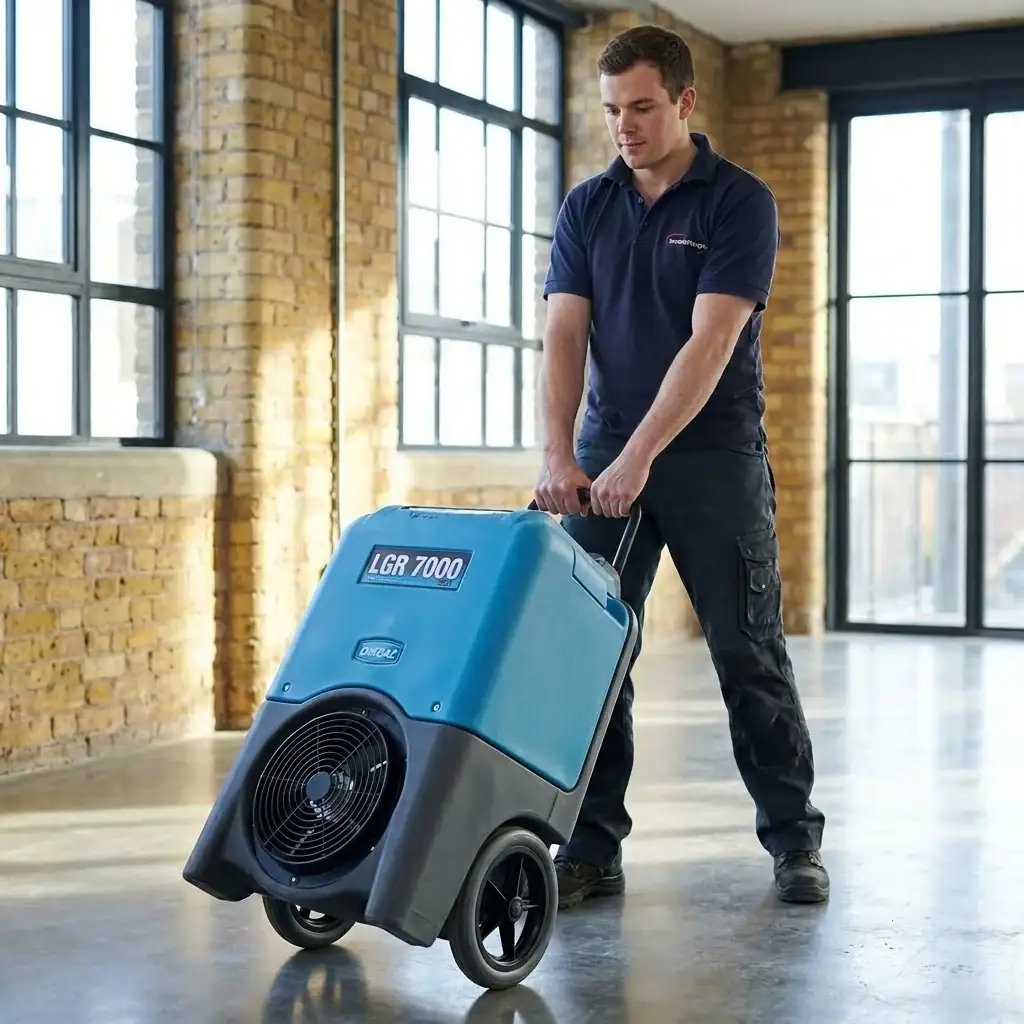
| 63L LGR industrial dehumidifier | £59.99 | 63 L/day | Fit-out and low dew point work — keeps extracting once the air is dry |
| 95L building dryer | £77.99 | 95 L/day | Shell and core, large halls, cooling failure cover |
| Air mover | from £15.49 | — | Moving air across slab and into dead corners |
| 3kW heater | £19.99 | — | Lifting a cold shell into the range where refrigerant units work |
Running cost is worked through in what it costs to run a hired dehumidifier, and if you are hiring at this scale a trade account is usually the sensible route — how tool hire trade accounts work explains the terms.
Six mistakes on critical sites
Six things that go wrong on critical sites — none of them are equipment faults
Two sensors, two answers, endless argument. Dew point gives one number for the whole hall.
Allowable is what the equipment tolerates. Recommended is where you run it. Living at the edge of allowable is a decision, and it should be a deliberate one.
Different units fighting each other across a hall is a classic energy fault. Inside the recommended band, neither should be running.
Cold pipework in a warm void is exactly where condensation forms, and it is the last place anyone looks.
Below about 15°C a refrigerant machine loses most of its output. On a winter shell you need heat as well, or the hire achieves very little.
On a commissioning job, an environment you cannot evidence is an environment you did not control. A weekly dew point reading per zone costs nothing and settles arguments later.
Data centre humidity questions
What humidity should a data centre be kept at?
ASHRAE TC 9.9 recommends 18 to 27°C dry bulb with a dew point between −9°C and +15°C, subject to a secondary cap of 60% relative humidity. That recommended envelope applies to all equipment classes A1 to A4. The wider allowable envelopes are what the hardware tolerates, not where you would choose to run.
Why do data centres control dew point instead of relative humidity?
Because relative humidity depends on temperature, and a data hall runs a cold aisle and a hot aisle by design — the same air reads two different RH values. Dew point is an absolute measure and reads the same across the hall, so it works as a single control point. Guidance from Lawrence Berkeley National Laboratory recommends exactly this. For scale: air at 27°C and 50% RH holds close to twice the moisture of air at 16°C and 50% RH.
What happens if humidity is too high in a server room?
Three things. Condensation forms on any surface below the dew point — chilled water pipework, cold risers, incoming metalwork. Ferrous metal corrodes quickly above 60% RH. And dust that has absorbed moisture becomes conductive, which is the hygroscopic dust failure mode that LBNL identifies alongside corrosion as the main high-humidity risk.
Is low humidity really a static risk?
It is a genuine limit, but the fear around it is dated. ASHRAE-funded research found no significant increase in electrostatic discharge or equipment failure at the lower limit of the 2015 guideline, around −9°C dew point. Stay inside the envelope and it is not the thing to worry about; the wet end causes far more real damage.
Can you use portable dehumidifiers in a live data hall?
Not as the primary control — that is the job of the CRAC or CRAH plant. Portable units are the right answer when that plant is absent or offline: construction, fit-out, commissioning, a cooling failure, water ingress, or a mothballed hall. In a live hall they are cover while something is repaired, and they need positioning and drainage agreed with the facility first.
What do you need during data centre construction and fit-out?
Volume capacity and heat. A new hall holds months of water in the slab, screed and blockwork with no permanent cooling to remove it, and in a cold shell a refrigerant dehumidifier loses most of its output below 15°C. The usual answer is several 95 litre building dryers plus heat and air movers, then LGR units later in the programme as the dew point target drops.
How long does a data centre hire usually run?
Longer than people expect. Construction drying is measured in months, and commissioning a facility can itself run for months with the environment held throughout. Multi-unit hires over several months are normal on this kind of work — which is why the day rate is the wrong basis for quoting one. Tell us the phase and the duration and we will price it as a project.
Do you deliver to data centres in Slough and the Thames Valley?
Yes. We deliver from our Greenford UB6 depot across Greater London and out through the Thames Valley, with same and next day delivery available. Slough is Europe’s largest data centre cluster at around 1 GW across more than 30 facilities, so it is a route we run regularly. Site inductions and delivery windows are no problem — tell us the access requirements when you book.
What about UPS and battery rooms?
Battery rooms have ventilation requirements of their own, and humidity affects terminal corrosion and battery life. A compact industrial unit such as the the compact 43L Cube suits most battery rooms on footprint. Co-ordinate with the room’s ventilation design and check with the M&E designer before changing the air pattern — we hire the equipment, we do not design battery room ventilation.
Can you supply 10 or more units for a single project?
Yes, and that is a conversation rather than a checkout. For multi-unit, multi-month hires we look at unit mix by phase, power and drainage on site, a delivery and demobilisation schedule, and a project rate. Call 020 3375 4048 or message us on WhatsApp with the site, the phase and the duration.
Related guides
Hire pages linked from this guide
Critical site, multi-unit hire, or plant down?
Industrial dehumidifiers with pump-out drainage from £39.99 a day, delivered across London and the Thames Valley. Tell us the phase, the hall size and the duration and we will price it as a project rather than a day rate. A refundable deposit applies to every item.

 Drone Survey & Mapping
 Drone Inspections