
 Drone Services
 Access Equipment
 Breaking & Drilling
 Cleaning Equipment
 Drying & Heating
 General Site Tools
Equipment Hire Guides, Scaffold Towers
Scaffold Tower Hire for Builders and Contractors: The Right Tower for Every Trade
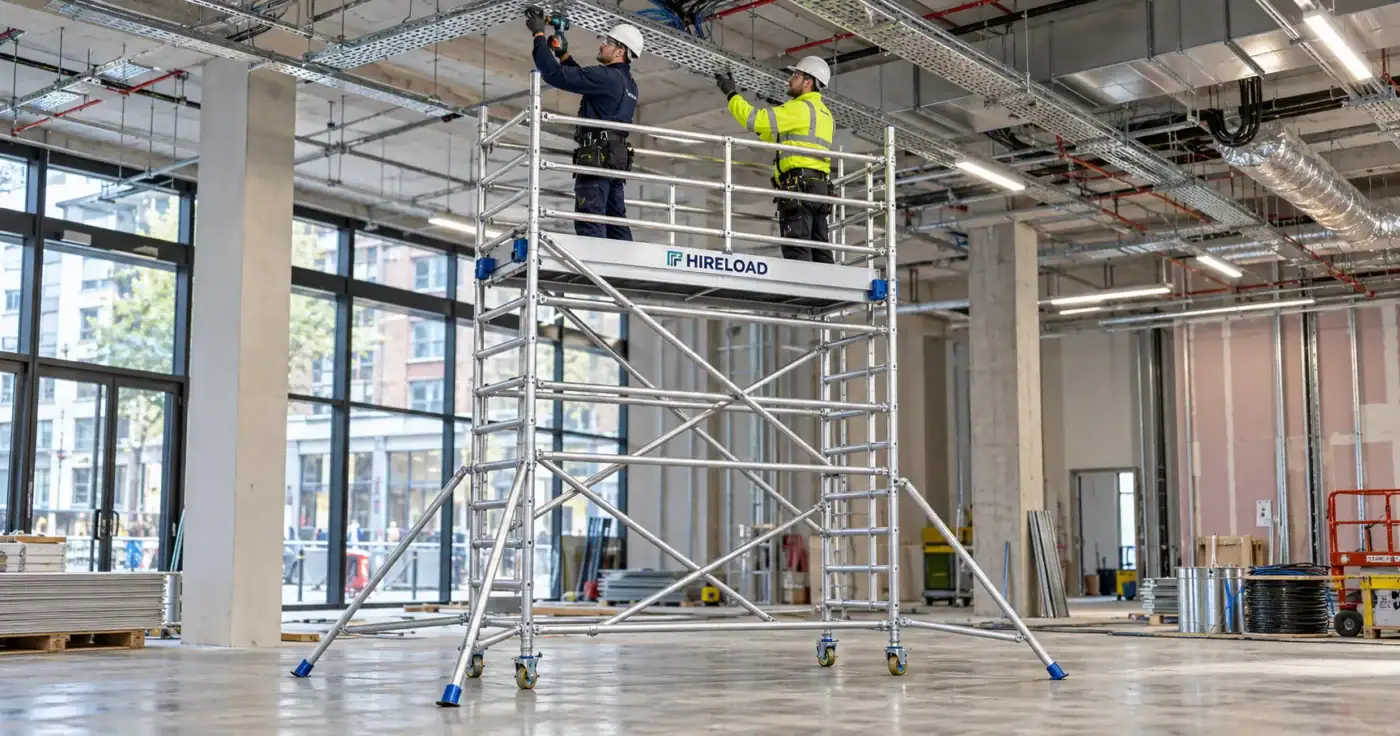
The right tower for every trade on your site.
On a busy job, the wrong tower costs more than its hire. A crew queues at one ladder, a dryliner cannot fit boards on a narrow platform, a decorator waits for a tower that will not go through the door. This guide is for builders, main contractors, fit-out firms, decorating contractors, M&E, dryliners, shopfitters and facilities teams. It sets out which scaffold tower suits which trade and task, what matters on a commercial site, and how to hire towers on a trade account.
Which scaffold tower should a contractor hire?
Most contractors run a mix rather than one model. Twin-access or double-width 3T towers suit crews, materials and high-traffic areas. Folding and one-person towers suit indoor fit-out, occupied buildings and tight doorways. Stairwell towers cover stair cores and landings. Pick by the trade, the working height, the access route and how many people need to be on the platform.
Hireload is a CHAS-verified supplier delivering scaffold towers across London from our Greenford depot. Towers start from £41.99 + VAT, and a free trade account takes 15% off every hire.
Which tower for which trade
These are the trades that hire towers from us most, the work they do from them and the tower that usually suits. Heights are typical; always measure the area you are working in.
| Trade | Typical work at height | Tower that usually suits |
|---|---|---|
| Builders and main contractors | First fix at height, making good, pointing, lintels and inspections across several areas of a site | Twin-access or 3T, double width |
| Refurbishment and fit-out contractors | Strip-out, high walls, bulkheads, ceilings and services in offices, shops and flats | 3T double width; folding tower where doorways are tight |
| Painting and decorating contractors | Commercial repaints, stairwells, atriums, high ceilings and external elevations | Folding tower indoors; 3T or twin-access outside |
| Dryliners and ceiling fixers | Plasterboard ceilings, MF ceilings, suspended grid and tiles, bulkheads | 3T double width with a 2.5 m platform, for boards and two fixers |
| Electricians and M&E | Lighting, containment, cable tray, ventilation and pipework at high level | 3T or twin-access in open areas; single width or folding in corridors |
| Shopfitters and signage installers | Signage, displays, lighting and ceiling features, often out of hours | Folding tower or 3T |
| Roofing and external maintenance | Gutters, fascias, soffits, downpipes and small roof repairs | 3T with stabilisers; twin-access for higher eaves |
| Window, glazing and cladding repairs | Replacing upstairs frames and panels, sealing and small cladding repairs | Twin-access or 3T double width, with room for two and the frame |
| Facilities management and maintenance | Reactive repairs, lamp changes, CCTV and alarms in schools, offices and warehouses | Folding tower or MiTower for quick jobs; 3T for warehouses |
| Any trade working in stair cores | Decorating, lighting and repairs above stairs and landings | Stairwell tower |
What matters on a commercial site
A homeowner picks a tower by height. On a site, the platform has to suit the crew, the materials and the building. These are the points that change which tower you order.
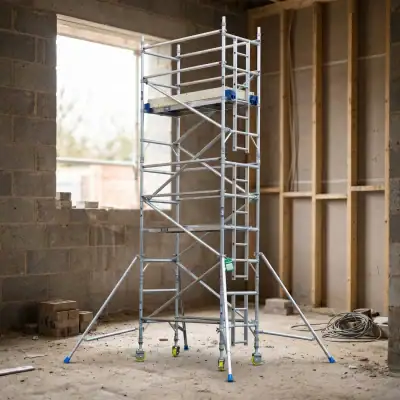
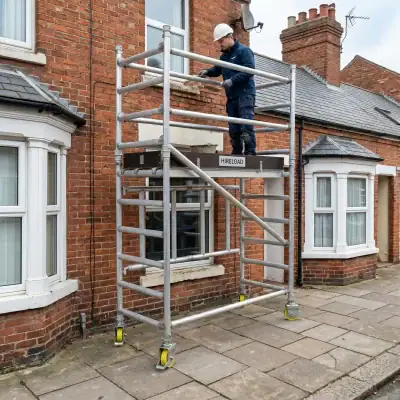
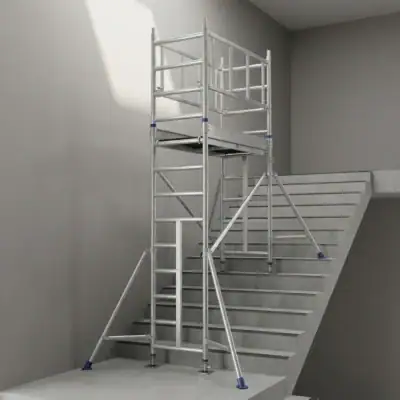
Ceiling and high-level work: getting the height right
Ceiling fixers, dryliners, electricians and M&E fitters work above their heads, so they want the platform closer to the ceiling than a decorator does. A common rule of thumb in the trade is a platform roughly 1.6 to 1.8 m below the finished ceiling, so you can fix overhead without stretching.
| Finished ceiling height | Approximate platform height | Typical setting |
|---|---|---|
| 2.4 to 3 m | About 0.6 to 1.4 m | Offices, flats, classrooms |
| 3 to 4.5 m | About 1.2 to 2.8 m | Shops, period buildings, reception areas |
| 4.5 to 6 m | About 2.8 to 4.2 m | Halls, atriums, showrooms |
| Above 6 m | Above 4.2 m | Warehouses, sports halls, churches |
For suspended ceilings, measure to where the grid will actually sit, not to the slab, because the grid is often hung well below it. Work in bays: fix the area you can reach, come down, clear the platform, move the tower and lock it again, rather than overreaching. Our industrial tower lists platform heights against each working height if you want to match the two exactly. For the general rule, see working height vs platform height.
Cards and paperwork sites ask for
Every site sets its own rules, but these are the questions we hear most from contractors before a tower goes up.
For a fuller checklist, read our guide to scaffold tower safety.
Planning towers for a job
1. List the areas and heights
Walk the job and note every area that needs work at height, the highest point in each and what is underfoot: slab, finished floor, stairs or sloping ground.
2. Match the crew to the platform
One operative: single width. Two, or materials on the deck: double width. A busy area with people up and down all day: twin-access.
3. Check the route and the footprint
Measure doors, corridors, lifts and stairs from the drop-off point, and leave room for stabilisers where the tower will stand.
4. Book by phase
Order towers for when each trade needs them rather than all at once, so you are not paying for kit that is waiting on another trade.
5. Extend or off-hire as the job moves
Message the hire desk to extend, swap a tower for a different height, or arrange collection when an area is finished.
Running towers in offices, shops or across several sites at once? See our London guide for facilities, fit-out and retail teams.
Hiring towers on a trade account
If towers are a regular cost, a trade account pays for itself on the first job. It is free to open and there is no commitment.
Trade pricing on every order from your first hire, applied automatically. Delivery and the refundable deposit are excluded.
Trade orders get priority routing, same-day across London where availability allows, with live order tracking.
A dedicated WhatsApp and phone line to the hire desk to book, extend or off-hire without queuing.
On £600 of hire a month, 15% is £90 a month, or £1,080 a year. Your rate is confirmed when your account opens.
Frequently asked questions
Can you supply several towers for one site?
Yes. Tell the hire desk how many towers you need, the heights and the dates, and we will confirm availability when you book. Booking by phase helps if different trades need towers at different times.
Which tower is best for two operatives?
A double-width tower. Our twin-access tower adds a second climb face so two people are not waiting on one ladder, and our 3T tower also comes in double width with a 2.5 m platform.
How high do your towers go?
Our 3T tower goes up to a 10.2 m working height, and our twin-access tower up to a 12.2 m platform height. Stabilisers are needed at height and are included with the twin-access tower.
Do operatives need a PASMA card?
Many sites ask to see one, and it is the recognised tower training in the UK. Check your site’s rules and your own risk assessment.
Do you deliver to sites across London?
Yes, from our Greenford depot. Trade orders get priority routing, with same-day delivery across London where availability allows.
Do I get trade pricing on scaffold towers?
Yes. With a free trade account you get 15% off hire rates on every order, including towers. Delivery and the refundable deposit are not discounted.
Planning towers for a site?
Send the trades, heights and dates. The hire desk will put the towers together and schedule delivery across London.
Limits: this guide is general information for planning scaffold tower hire. It is not a risk assessment, a method statement or advice on any site’s rules. Heights are typical examples. Always follow the instruction manual supplied with the tower and your site’s own procedures. Trade account terms are confirmed when your account opens.

 Drone Survey & Mapping
 Drone Inspections