
 Drone Services
 Access Equipment
 Breaking & Drilling
 Cleaning Equipment
 Drying & Heating
 General Site Tools
Equipment Hire Guides, Scaffold Towers
What Is a Scaffold Tower? Parts, Uses and Who Hires One
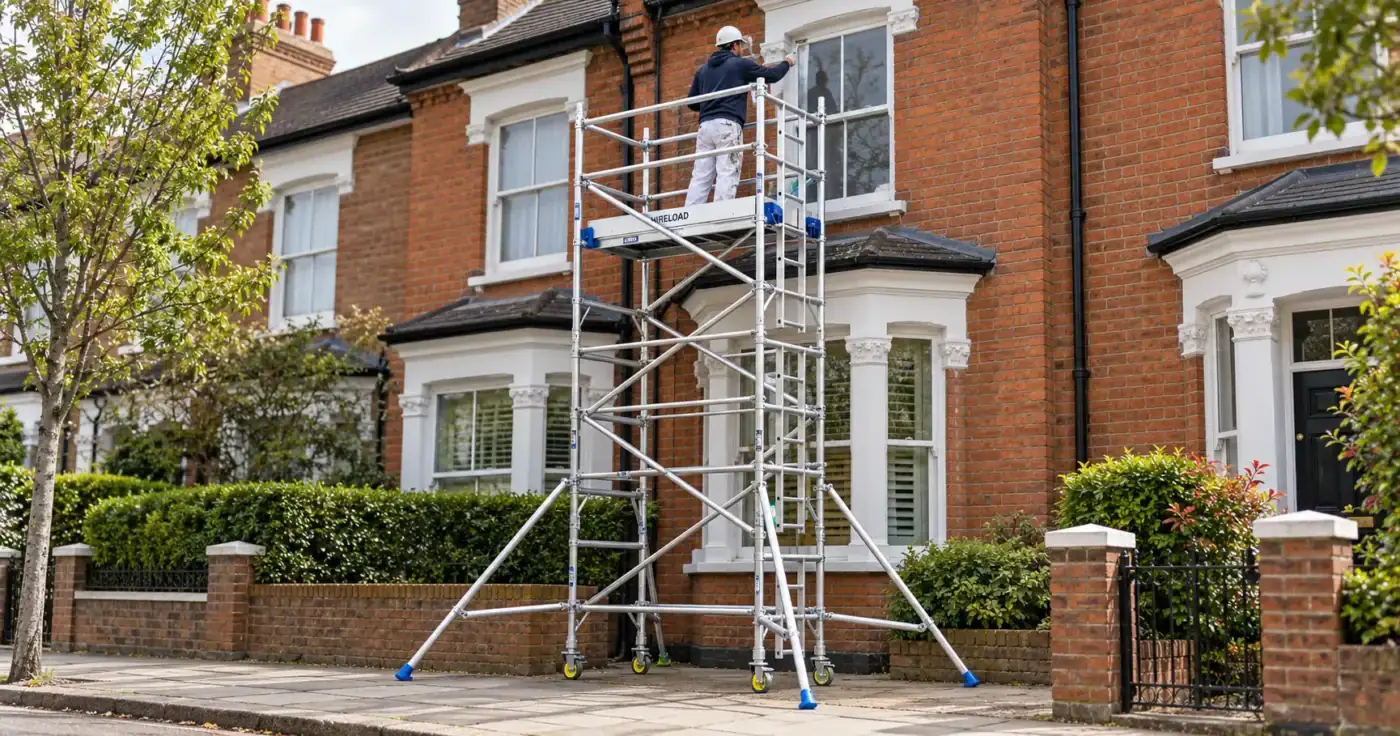
A safe platform at height, with both hands free.
A scaffold tower is the piece of kit roofers, decorators, window fitters, electricians and homeowners hire when a ladder is not enough and full scaffolding is too much. This guide explains what a scaffold tower is, what each part does, what the 3T method means, which jobs people hire one for, and how high you need to go.
What is a scaffold tower?
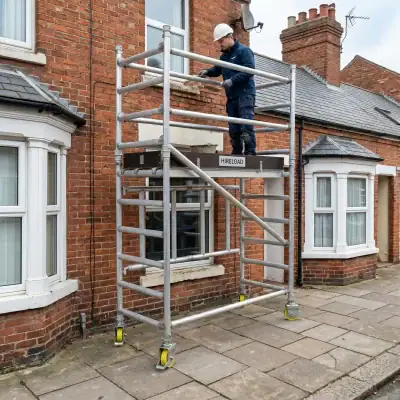
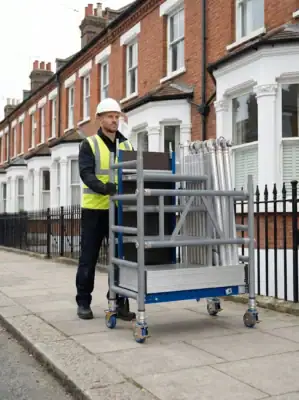
A scaffold tower, also called a mobile access tower, tower scaffold or aluminium tower, is a freestanding frame built from lightweight aluminium sections. It stands on lockable castors or base plates and has a working platform at the top, protected by guardrails and toe boards. You build it to the height the job needs, roll it along the wall when you move on, and work from it with both hands free.
People hire scaffold towers for jobs at height that take longer than a few minutes or need tools and materials close by: gutters, fascias, painting, windows, ceilings, lighting and maintenance. Hireload hires 3T scaffold towers with working heights up to 10.2 m from £45.49 + VAT for weekly hire, delivered across London from our Greenford depot.
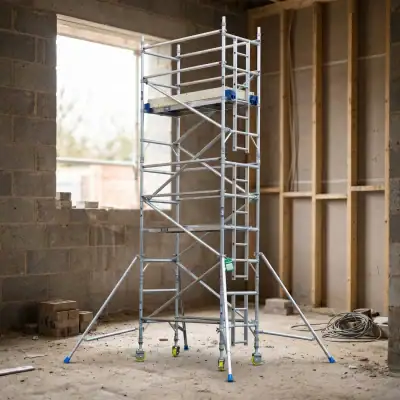
Scaffold tower, access tower, tower scaffold: one thing, many names
If you have been searching and getting slightly different results, it is because the same equipment goes by several names. They all describe a freestanding tower with a guarded platform, not the tube-and-fitting scaffolding that a scaffolding firm bolts to the front of a house.
The parts of a scaffold tower and what each one does
Every tower is a kit of the same basic parts. Knowing what they are makes it much easier to follow the build guide and to spot when something is missing.
| Part | What it does |
|---|---|
| Castors | Wheels with brakes so the tower can be moved. The brakes stay locked at all times except while the tower is being moved. |
| Base plates and adjustable legs | Base plates are used when the tower stays in one place or stands on uneven ground or stairs. The adjustable legs level the tower. They are never used to gain extra height. |
| Frames | The ladder-like end sections that make up the main structure. They come in single and double widths and stack to build height. |
| Horizontal and diagonal braces | Tie the frames together and keep the tower rigid. The bracing pattern is set by the manufacturer’s manual. |
| Platforms with trapdoors | Aluminium decks with a slip-resistant surface. The trapdoor lets you climb up through the platform from inside the tower. |
| Guardrails | Rails around the working platform that stop you falling off the edge. |
| Toe boards | Boards around the platform edge that stop tools and materials being kicked off onto people below. |
| Stabilisers | Arms clamped to the corners that widen the base so the tower can be built higher safely. They are fitted as early as possible during the build. |
What 3T means, and why it matters
3T stands for Through The Trap. On a 3T tower, the person building it sits in the trapdoor of the platform below and fits the guardrails for the next level from that protected position, before standing up on the new platform. Taking it down reverses the order. The point is simple: you are never standing on a platform that does not already have guardrails around it.
It is the build method set out in manufacturers’ instruction manuals, including those hosted by PASMA, the tower industry body, and it is why we hire 3T scaffold towers for most outdoor and higher jobs. Every tower comes with a build guide, and our WhatsApp helpline is open 7 days if you get stuck.
What a scaffold tower is used for, trade by trade
These are the jobs we see scaffold towers hired for most often in London, who hires them and the tower that usually suits.
Clearing and replacing gutters, fixing fascias and soffits, and small roof repairs at the eaves of a two-storey house. A 3T tower gives a guarded platform at gutter height. See scaffolding for fascias and guttering.
Exterior walls, window frames and render, and inside, high ceilings and stairwells. Outdoors a 3T tower; indoors a folding tower that fits through doorways. See painting a two-storey house.
Removing and fitting upstairs windows, where you need both hands, room for the frame and somewhere to put tools.
High-level lighting, cable runs and fittings in shops, halls, warehouses and offices with tall ceilings.
CCTV, alarms, satellite dishes, signage and external lights fixed high on a wall.
Ceilings and high walls, where a tower gives a wide, steady platform for boards and buckets.
Schools, offices, churches and warehouses, for repairs, cleaning and lamp changes at height.
Cleaning high gutters, painting, fixing a loose fascia or getting at a window. See how to clean high gutters.
Hiring for a business, a facilities team or a fit-out? Our guide to scaffold towers for businesses covers each sector, London area and weekly trade prices.
Why people hire a tower instead of a ladder or full scaffolding
A ladder is fine for a quick look or a short task. Full scaffolding makes sense when the whole front of a building needs work for weeks. For most jobs in between, a tower is the practical choice. Our guide ladder, tower or scaffold goes through the decision in more detail.
How high you need to go
Towers are sold by working height, which is the platform height plus about 2 m, the height an average adult can comfortably reach while standing on the platform. So to work at a gutter about 5 m up, you want a platform a little under that, which means a working height of around 6 to 7 m. Our guide on working height vs platform height explains the 2 m rule with examples.
| Job | Typical working height | Tower |
|---|---|---|
| High ceiling or hallway indoors | About 3 to 5 m | Folding tower or MiTower |
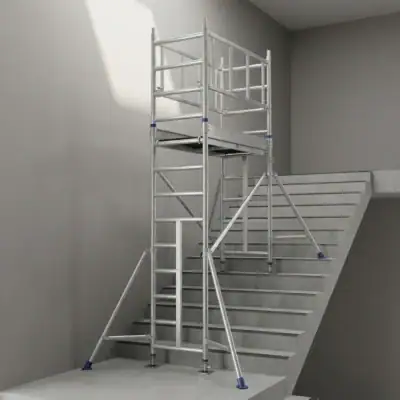
| Stairwell or landing | Depends on the drop from the top of the stairs | Stairwell tower |
| Bungalow eaves, single-storey extension | About 3.5 to 5 m | 3T tower or folding tower |
| Two-storey gutters, fascias and upstairs windows | About 6 to 7.5 m | 3T tower |
| Tall gables, three-storey work, warehouse lighting | Up to 10.2 m | 3T tower with stabilisers |
Measure the actual height before you book, from the ground where the tower will stand to the point you need to work at. If the ground slopes, the adjustable legs take up the difference, not extra height. For houses, our guide on what size scaffold tower a two-storey house needs goes into more detail.
Five rules every tower user follows
These come straight from tower instruction manuals. They are not optional extras; they are how towers are designed to be used. Always follow the manual supplied with your tower.
Frequently asked questions
What is the difference between scaffolding and a scaffold tower?
Scaffolding is tube-and-fitting or system scaffolding built against a building by a scaffolding firm, usually for weeks. A scaffold tower is a freestanding aluminium tower you build yourself from a kit, move on castors and hire by the week.
How much does it cost to hire a scaffold tower in London?
At Hireload, 3T and folding towers start from £45.49 + VAT for weekly hire, with the price rising with height. There is a £100 refundable deposit and ID is required. See our full scaffold tower hire cost guide.
Can one person build a scaffold tower?
Some towers are designed for it. The MiTower and the Miniscaff Solo are built by one person. Standard towers are quicker and easier with two.
Do I need training to use a scaffold tower?
You need to understand how to build, use and move the tower safely, and follow the manual. PASMA runs recognised tower courses, and trades who use towers regularly often take one. Every Hireload tower comes with a build guide, and you can call or WhatsApp us with questions.
Which scaffold tower do I need?
Start with the job and the height. Outdoors and above about 6 m, a 3T tower. Indoors, a folding tower or a one-person tower. On stairs, a stairwell tower. Our guide which scaffold tower do I need walks through it.
Do you deliver scaffold towers?
Yes. We deliver across London from our Greenford depot, or you can collect.
Not sure which tower or height?
Tell us the job and roughly how high you need to work. We will suggest the tower and deliver it across London.
Limits: this guide is general information about scaffold towers. Heights in the tables are typical examples, not measurements of your building. Always follow the instruction manual supplied with the tower, check every part before use, and stop if anything is damaged or missing. For complex or high-risk work, use a trained tower erector.

 Drone Survey & Mapping
 Drone Inspections