
 Drone Services
 Access Equipment
 Breaking & Drilling
 Cleaning Equipment
 Drying & Heating
 General Site Tools
Equipment Hire Guides
Which Machine Cleans Block Paving, and What Happens to the Sand?
Quick answer
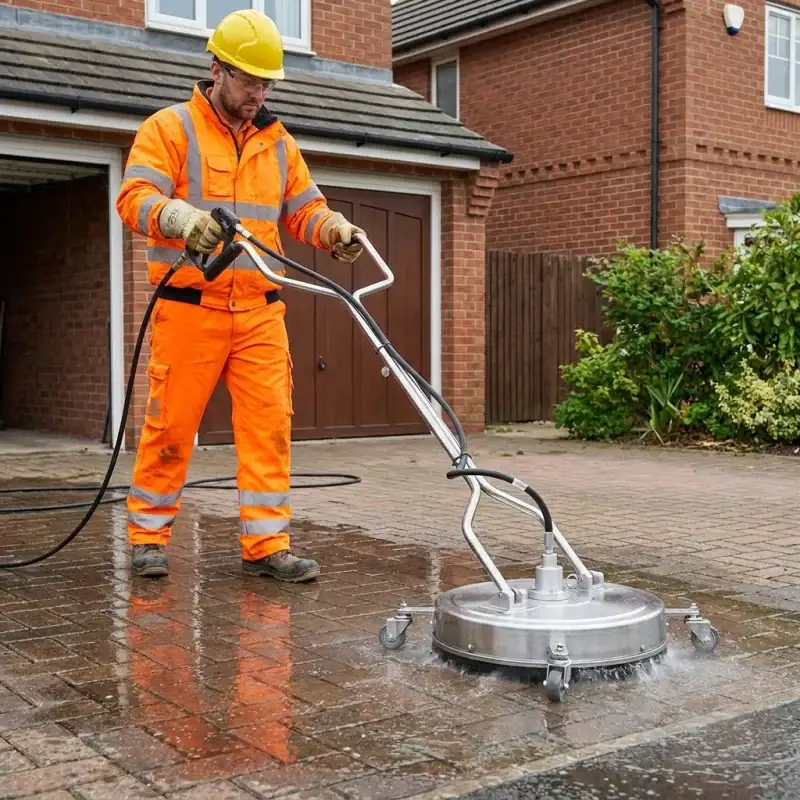
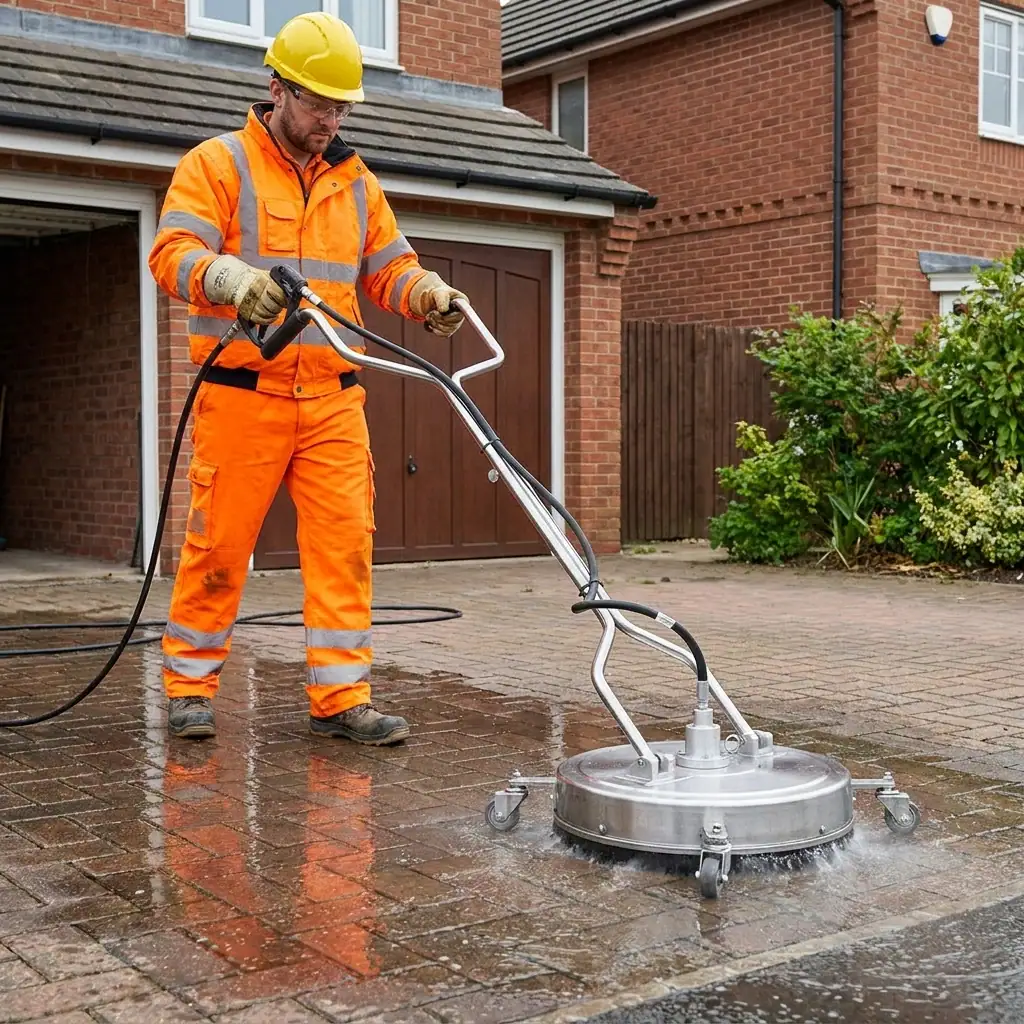
Use a pressure washer with a surface cleaner attachment. It is several times faster and far more even than a lance. Pressure washing removes the kiln-dried jointing sand from block paving, so budget for re-sanding as part of the job, not as an optional extra.
Key takeaways
- The surface cleaner is an attachment, not a machine. Hire the washer and the attachment together.
- The sand comes out. Empty joints mean moving blocks and easy weeds.
- Re-sand on a dry day, once the paving has dried fully.
- Natural stone and resin need caution. Test a corner before committing.
| Your surface | Approach | Caution |
|---|---|---|
| Concrete block paving | Surface cleaner | Re-sand the joints afterwards |
| Large flat concrete or slabs | Surface cleaner | Tolerates cleaning well |
| Indian sandstone, natural stone | Reduced pressure | Softer, so it can be pitted permanently |
| Resin-bound driveway | Manufacturer guidance first | Can dislodge the aggregate |
Why does the jointing sand matter so much?
Block paving works because kiln-dried sand in the joints locks the blocks against each other. That interlock is what stops blocks rocking, sinking and spreading under vehicle weight.
Pressure washing removes that sand. Not some of it: most of it, from the top portion of every joint you clean.
Read more: how to put the sand back properly
You will need kiln-dried jointing sand, a stiff broom and a dry day. Work the sand into the joints with the broom, in more than one pass, and expect to top it up again after the first rain settles it.
Some installations also use a plate compactor over the surface with a protective mat to settle the sand, though whether that suits your paving depends on the blocks and the base. Check with the installer if unsure. If it is going to rain for the next week, wash the driveway another week.
Why is a surface cleaner better than a lance?
With a lance, you point a narrow high-pressure jet at the surface and work across it. It is slow, it soaks you and everything around you, and it is very easy to carve stripes into the blocks or blast the jointing sand out in seconds.
With a surface cleaner, a shrouded rotating bar sweeps a wide path at a consistent distance from the ground.
Which pressure washer do I need with it?
| Machine | Power | Suits |
|---|---|---|
| Electric pressure washer 240V | Standard socket | Domestic driveways and patios |
| Heavy duty 240V | Standard socket | Larger or heavier soiling |
| Cold water 240V | Standard socket, 100 bar | General commercial cleaning |
| Petrol, 2,450 PSI | No mains needed | Yards, remote sites |
Which surfaces need caution?
Not everything outside your house wants the same treatment.
- Indian sandstone and natural stone. Softer than concrete. Reduce pressure, keep moving, test in a corner first.
- Porcelain paving. Very hard wearing, but the grout between slabs is not.
- Resin-bound surfaces. Excessive pressure can dislodge aggregate and the repair is not simple.
- Tarmac and asphalt. A high-pressure jet can lift the surface binder.
- Old or poorly laid paving. Pressure washing exposes a failed base rather than curing it.
Where does the run-off go?
Worth thinking about before you start rather than while it is happening. On a domestic driveway, run-off carrying silt and organic debris should usually go to a suitable drain, not into a neighbour’s property or a watercourse. If you use any chemical treatment, that matters considerably more.
What is the realistic method and timing?
- Clear the area. Cars, bins, furniture, anything that will be soaked.
- Sweep first. Pull established weeds by the root; a jet takes the tops and leaves the roots.
- Protect what matters. Close windows, check where the neighbours’ washing is.
- Test a small area at your planned pressure.
- Work in overlapping passes, keeping the cleaner moving.
- Rinse the debris off rather than letting silt dry back on.
- Let it dry fully.
- Re-sand the joints with kiln-dried sand, brushed in, more than one pass.
Frequently asked questions
Do I need to put sand back after pressure washing block paving?
Is a surface cleaner better than a lance for a driveway?
Is the surface cleaner a separate machine?
Can I pressure wash Indian sandstone or porcelain?
Can I use it on a resin-bound driveway?
How long does a driveway take?
The Hireload team runs the hire fleet from our Greenford depot in west London and handles the delivery calls.
Clean the driveway properly, in a fraction of the time
Surface cleaner attachment and pressure washer together. London delivery, or free Click & Collect from Greenford UB6.
Check availability and book online
Or call 020 3375 4048 and describe the surface.
Related guidance
- How to clean a driveway
- How to pressure wash a patio
- Pressure washing mistakes to avoid
- What PSI pressure washer do I need?
General guidance, not professional advice. Cleaning methods vary by surface type and condition, so follow the paving manufacturer’s own guidance where available and test an inconspicuous area first. Requirements for the discharge of wash water, particularly where chemicals are used or on commercial premises, vary by location; check with your local authority or the Environment Agency before commercial cleaning work.

 Drone Survey & Mapping
 Drone Inspections