
 Drone Services
 Access Equipment

 Breaking & Drilling
 Cleaning Equipment
 Drying & Heating
 General Site Tools
Drying & Heating, Equipment Hire Guides
How Long Should a Dehumidifier Run For?
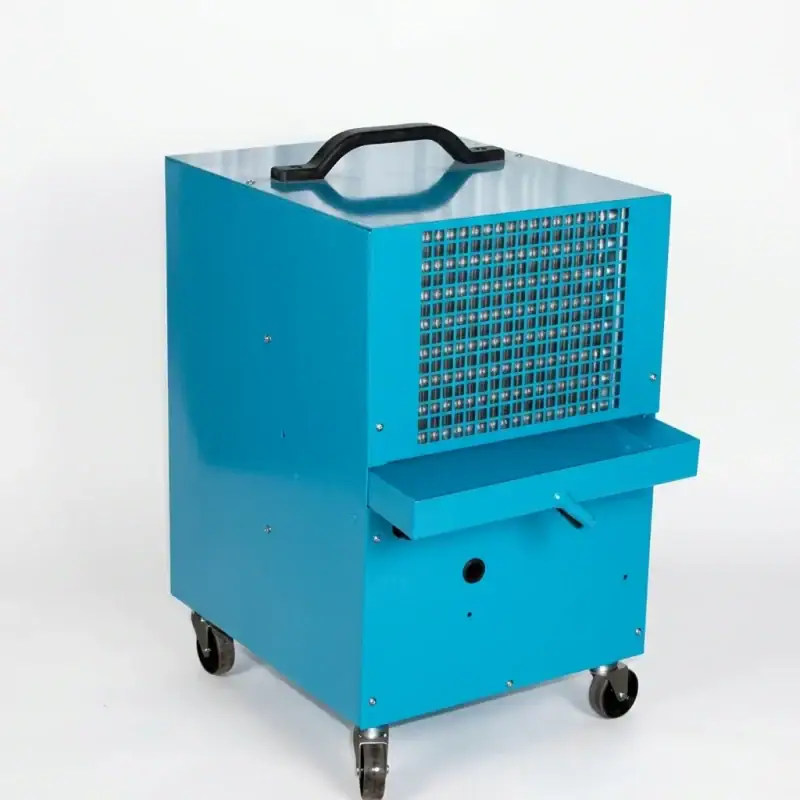
Continuously, until the materials stop giving water back.
The question we get most often from people mid-hire is how long to leave the machine on. The short answer is longer than feels necessary, and without switching it off at night. The useful answer is that the room tells you when it is finished, and there is a simple test that proves it. Here is how to run a hired dehumidifier properly, what to expect day by day, and how to know when to stop.
How long should a dehumidifier run for?
On a drying job — a leak, fresh plaster, a soaked floor — run it continuously, day and night, with the room closed, until the materials stop releasing moisture. That is usually days rather than hours, and often one to three weeks on anything that was genuinely wet. Switching it off overnight gives the materials eight hours to even out again, which is why stop-start drying takes so much longer.
On a maintenance job — a damp flat, condensation, a wardrobe that goes mouldy — you are not drying anything out, you are holding the humidity down. Set the humidistat to around 50 to 55% and let the machine cycle itself on and off. It will run a lot at first and much less once the house has come down.
We will not give you a guaranteed number of days. Anyone who does, without seeing the room, is guessing: it depends on how much water is in the material, the temperature, the airflow and the size of the space.
How long, honestly
Four things set the timescale, and only two of them are under your control.
| Factor | Why it matters | What you can do |
|---|---|---|
| How much water went in | A wet ceiling patch and a flooded ground floor are different jobs by an order of magnitude | Nothing, but be realistic when you book the hire |
| What got wet | Air dries in hours. Plaster, screed, timber, underlay and insulation give water back slowly from the inside out | Remove what is beyond saving, such as soaked underlay or insulation |
| Temperature | Warm materials release moisture faster, and refrigerant machines work better in warmer air | Keep the heating on at a normal level; do not let the room go cold |
| Airflow across the wet surface | Still air leaves a damp layer sitting on the surface that stops evaporation | Add an air mover; this is the single biggest difference most people are missing |
As a planning figure rather than a promise: the air in a room improves within a day, surfaces take several days, and materials with water inside them — plaster, screed, a soaked floor — take one to three weeks with the right equipment running continuously. Our guide on how long it takes to dry out a room goes through the same ground with worked examples.
What to expect, day by day
This is the shape of a typical one-room drying job with a correctly sized machine and an air mover running. Yours will not match it exactly, but if it is going very differently, something in the set-up is wrong. You can hire a dehumidifier in London from us in every size we stock.
Day 1
The machine runs hard and collects a lot. Humidity in the closed room climbs at first as moisture comes out of the materials into the air, then starts to fall. Nothing looks different yet. This is normal and it is the most common moment people ring us thinking the machine is faulty.
Days 2 to 3
Humidity drops noticeably, the room stops smelling as damp, and surfaces start to feel dry to the hand. The tank or hose is still taking real water. Do not stop here: the surface is dry, the material underneath is not.
Days 4 to 7
Collection slows down. The room feels normal. Skirtings, the bottom of walls, under carpet and anything thick are still giving water back slowly. This is where the switch-off test below starts to be worth doing.
Week 2 and beyond
Needed on plaster, screed, solid floors and anything that was soaked rather than damp. Collection is low but steady. The job finishes when the humidity in the closed room stays down after the machine has been off for a day.
If nothing at all is happening by day two — no water, no change in humidity — the usual causes are a room that is not closed, a machine that is too small for the space, a cold room, or a full tank that stopped the machine overnight. Our guide on dehumidifiers in cold rooms covers the temperature side.
Settings and placement
Most of the difference between a five-day job and a ten-day job is in this section, not in the machine.
If the room is occupied, noise and placement matter more than the last 5% of performance. Running a dehumidifier overnight in an occupied home covers the practical side of living with one.
How to know it is finished
Not by looking at it. These, in order of how much they tell you.
Turn everything off for 24 hours with the room still closed, and watch a hygrometer. If the humidity climbs back up, the materials are still releasing water and the job is not done. If it stays flat, you are finished. This is the test we recommend to every customer.
A few pounds, and it turns guesswork into a number. Write the reading down each morning; what matters is the trend and where it settles, not any single figure.
A machine still pulling noticeable water out of a closed room is telling you the room is not finished. Collection slowing to almost nothing is a good sign, as long as the room is still closed.
Skirtings, the bottom 30 cm of a wall, under carpet at the edges, inside cupboards on outside walls. If those are dry and stay dry, the rest almost certainly is.
Stopping too early is the most expensive mistake on a drying job, because the repair goes over material that is still wet: plaster, paint and flooring laid on damp substrate all fail later and cost more than the extra week of hire. Our guide on plaster that is still wet after a week is the classic version of this.
Running cost, and extending the hire
Two practical things people ask at the same time as the how-long question.
Electricity. A dehumidifier running continuously for a fortnight is a real line on the bill, and a big machine costs more to run than a small one. That is an argument for sizing it correctly rather than for switching it off: an undersized machine running twice as long costs more, not less. Our running cost guide works it out for your tariff. Air movers are cheap to run by comparison, which is another reason to use one.
Extending. If the switch-off test says you are not finished, extend rather than returning the kit and re-hiring later. The long-hire daily rate applies from day six, so the second week always costs less than the first. Call or email before the return date and we will push it back.
| Machine | 1 day | 2 days | Up to a week | Longer hires |
|---|---|---|---|---|
| Compact 19 L | £19.99 | £24.99 | £34.99 | from £4.50 a day |
| 38 L dehumidifier | £29.99 | £44.99 | £59.99 | from £8.40 a day |
| Dri-Eaz Cube with pump | £39.99 | £59.99 | £74.99 | from £11.20 a day |
| 63 L LGR dehumidifier | £59.99 | £89.99 | £119.99 | from £16.80 a day |
| High-airflow air mover | £15.49 | £23.49 | £29.99 | from £4.20 a day |
A refundable deposit and photo ID apply to every hire. Delivery and collection across London can be added at checkout, or collection from our Greenford UB6 depot is free.
Running a dehumidifier: common questions
Should I leave a dehumidifier on all night?
On a drying job, yes. Materials release moisture around the clock, and a machine switched off at bedtime gives the room eight hours to even back out. On a maintenance job in a bedroom, set the humidistat to around 50 to 55% so it cycles rather than running flat out, and place it where the noise is tolerable.
How many hours a day should it run?
Twenty-four, while you are drying something. Once you are just holding a house at a sensible humidity, the humidistat decides, and in practice that often works out at a few hours a day in winter and almost nothing in summer.
Is it safe to leave it running when I go out?
It is designed to run unattended, which is what every drying job in the country relies on. Use the drain hose so a full tank cannot stop it, keep it on a sensible socket rather than a daisy chain of extension leads, and give it clear space around the intake and outlet.
Why is the humidity going up, not down?
Usually because moisture is coming out of wet materials into the air, which is exactly what you want on day one. It should start falling within a day in a closed room. If it does not, the room is not closed, the machine is too small, or the space is too cold.
How do I know when to stop?
The switch-off test: turn everything off for 24 hours with the room still closed and watch a hygrometer. Humidity climbing back up means the materials are still wet. Flat means you are done. It is the closest thing to a free answer there is.
Does a dehumidifier need a break?
No. These machines are built to run continuously and most have automatic defrost cycles for cold conditions, so a machine pausing by itself is usually not a fault. What it does need is a clear intake, a tank that is not full and a room that is closed.
Will running it longer dry things faster?
Running it continuously is faster than running it in bursts, but beyond that the limit is airflow and temperature, not hours. If a job feels stuck, add an air mover alongside it and keep the heating on rather than simply waiting longer.
How long after a leak before I can redecorate?
After the materials are dry, not after they look dry, which usually means the switch-off test has passed. Painting or plastering over damp substrate is the most common reason a repair fails and has to be done twice.
Can I move it between rooms?
You can, but a machine moved daily dries two rooms slowly instead of one room properly. If two rooms are genuinely wet, it is usually better to hire a second machine or a bigger one — our guide to how many machines covers it.
Can I extend my hire if it is not finished?
Yes, and it is cheaper than re-hiring later because the long-hire daily rate applies from day six. Call or email before the return date and we will move it. We would rather extend than have the kit come back with the job half done.
Related guides
More drying guides:
Mid-hire and not sure? Call us
Tell us what the hygrometer says, how much water the machine is still taking and what got wet in the first place. We will tell you whether to keep going, add airflow, change the setting or stop. If you need the kit for longer, we will extend it at the daily rate rather than starting a new hire.
Limits: no drying time is guaranteed. How long a dehumidifier needs to run depends on how much water is in the material, what that material is, the temperature, the airflow and the size of the space, which is why this guide gives a method and a test rather than a number of days. Follow the instructions supplied with the machine, keep the intake and outlet clear, and use a socket in good condition rather than a chain of extension leads. Persistent damp with no obvious source, or any sign of structural or electrical damage, needs a professional inspection rather than more drying. Hire prices are correct at the time of writing, exclude VAT, and the full price for your dates is shown at checkout.

 Drone Survey & Mapping
 Drone Inspections