
 Drone Services

 Access Equipment

 Breaking & Drilling
 Cleaning Equipment
 Drying & Heating
 General Site Tools

Drying & Heating, Equipment Hire Guides
How Long Does Screed Take to Dry Before Flooring?
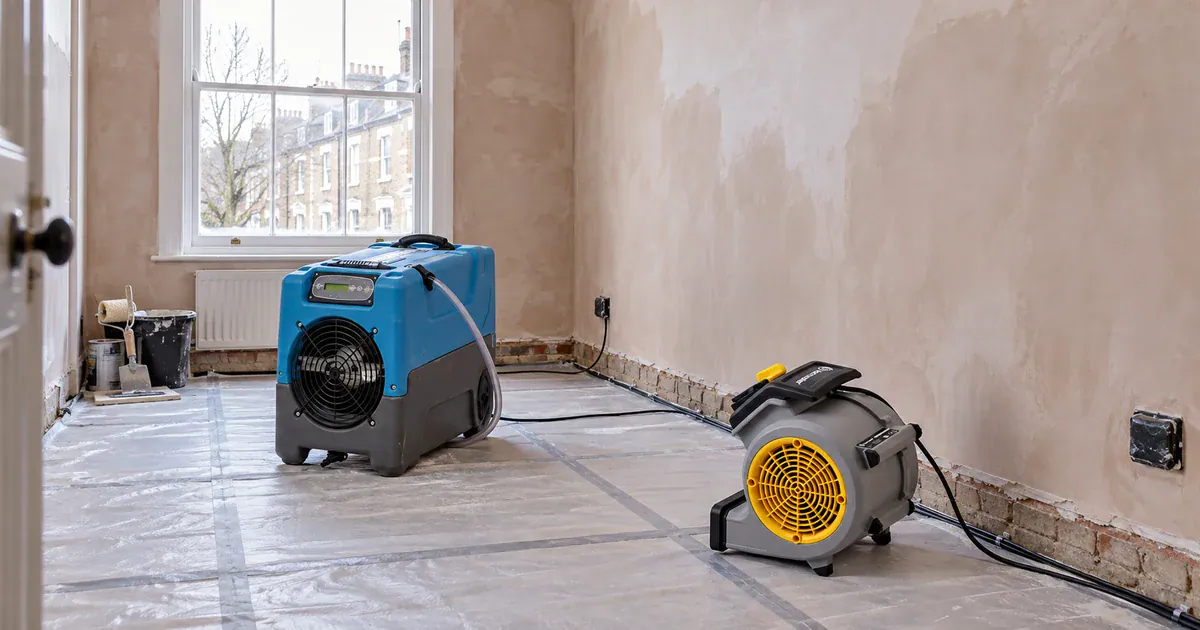
Flooring goes down when the screed is dry, not when the programme says.
Screed that looks dry on top can still be wet in the middle, and a floor laid over it is the most expensive mistake on a refurbishment. This guide covers the drying rates everyone quotes, how to actually test rather than guess, what controls the speed in a cold London winter, and how to use drying equipment without damaging the screed.
How long does screed take to dry before flooring can go down?
The industry rule of thumb for a traditional sand and cement screed is about one day per millimetre of thickness for the first 40 to 50 mm, and considerably slower beyond that. On that basis a 50 mm screed is roughly seven to eight weeks in good conditions, and a 75 mm screed is a great deal longer. Liquid calcium sulphate screeds can dry faster, but only when the conditions let them.
That is an estimate, not an answer. The answer comes from a test: a hygrometer reading taken on the slab, with most floor finishes requiring 75% relative humidity or lower before they go down. Dehumidifiers and air movers are what turn a wet winter programme into a passed test — but they are used after the screed has cured, not while it is still green.
The rule of thumb, and where it falls apart
Every screed conversation starts with one millimetre a day. It is a reasonable planning figure and a terrible promise, because it assumes a building at a normal temperature with air moving through it and humidity that is not already at the ceiling. A London site in January is none of those things. For prices and sizes, see our dehumidifier rental in London page.
| Screed | Typical estimate | What slows it badly |
|---|---|---|
| Sand and cement, 50 mm | About 1 mm a day for the first 40 to 50 mm — roughly 7 to 8 weeks | Cold slab, closed-up damp building, no air movement |
| Sand and cement, 75 mm | Much longer: the rate drops away after the first 40 to 50 mm | Thickness itself, plus any of the above |
| Liquid calcium sulphate screed | Can be faster, often quoted around 1 mm a day in good conditions | High humidity stalls it; the surface laitance must be removed |
| Any screed over a damp-proof membrane | Dries one way only, upwards, so it takes longer than the same thickness on a drying substrate | A sealed slab underneath doing nothing to help |
| Screed with underfloor heating | Commissioned heating can help once the screed has cured | Starting the heating too early or ramping it too fast |
If someone has promised you a floor can go down because it has been four weeks and the screed looks dry, the right question is not how long it has been, but what the reading is.
Testing instead of guessing
The standard test in the UK is a surface hygrometer: an insulated box sealed to the slab, left long enough for the air inside it to come into balance with the moisture in the screed, then read. British Standard BS 8203, the code of practice for installing resilient floor coverings, is where the method and the usual 75% relative humidity limit come from.
What a sensible test looks like on site:
Two honest points. First, a cheap pin-type damp meter pressed on the surface tells you about the surface, not the slab, and it is not what the standard asks for. Second, the reading can go back up: a slab that passed before Christmas and then sat in an unheated building through January can read higher in February. Test near the time the floor goes down.
What actually controls the speed
Screed gives water up to the air above it. Everything that makes that air able to take more water, and keeps replacing it, speeds the job up. Everything that leaves wet air sitting on the slab stops it.
| Factor | Why it matters | What helps |
|---|---|---|
| Humidity of the air in the room | Wet air cannot take water from a wet slab, which is why a closed-up winter building stalls | A dehumidifier, running continuously, holding the space well below the outside level |
| Air movement across the surface | Still air leaves a damp layer sitting on the screed that stops further evaporation | Air movers at low level, aimed across the slab rather than straight down at it |
| Temperature | Warm screed releases moisture faster, and refrigerant dehumidifiers work better in warmer air | Keep the building reasonably warm and steady rather than hot and swinging |
| Thickness | The rate falls away sharply beyond the first 40 to 50 mm because the water has further to travel | Nothing, except planning for it honestly at programme stage |
| What is under the slab | Screed over a damp-proof membrane can only dry upwards | Accept the longer timescale; do not seal the top as well |
| Openings and the weather | An open building in a London winter brings in air as wet as the slab | Close it up, then dehumidify. Ventilation alone is a summer strategy |
| Other wet trades | Fresh plaster and render put litres of water into the same air | Sequence the work, and size the drying for everything that is wet, not just the floor |
This is the same physics as drying a room after a leak, and our guide on how long it takes to dry out a room goes through it with worked examples. On a site with fresh plaster as well as screed, drying new plaster with a dehumidifier covers the other half of the job.
Drying it without wrecking it
Forced drying is normal practice on a programme, but the order matters. Hitting a green screed with heat and high airflow is how you get surface cracking and curling, and no flooring contractor wants that slab either.
1. Let it cure first
A screed needs its curing period before anyone forces anything, and the screed manufacturer sets that period — commonly the first week for a sand and cement screed, longer for some systems. Follow the data sheet for the product that was actually laid rather than a general rule off the internet.
2. Close the building up
Once forced drying starts, the building wants to be closed: doors shut, openings sheeted, trickle vents closed. A dehumidifier cannot hold a space dry if the space is open to a wet London winter.
3. Put the dehumidifier in and leave it running
Continuous running, somewhere central, with clear space around the intake and outlet. Use the drain hose rather than the tank on a slab job — a 63 L machine on a wet screed will fill a tank faster than anyone wants to empty it.
4. Add air movers at low level
This is the part people skip, and it is the part that moves the needle. Air movers sitting on the slab and aimed across it, not down at it, lift the damp layer off the surface so the screed keeps releasing moisture. On a large floor, several spaced along the space beat one powerful one in a corner.
5. Keep the temperature steady
Steady and reasonable beats hot and swinging. Big temperature swings are hard on a new screed, and a cold slab under warm damp air just collects condensation on the surface.
6. Commission underfloor heating properly
Where there is underfloor heating, it is commissioned to the manufacturer instruction: start low, raise the flow temperature gradually over days, hold it, then bring it back down the same way. It is a drying aid at the end of the process, not a way to rush the beginning.
7. Test, then test again before the floor goes down
Let the building settle at a stable temperature and humidity, take the hygrometer reading, and only then let the flooring go in. If the programme has slipped and the floor is landing weeks later, read it again.
What you should not do: blast a gas or diesel heater into a closed building to dry a floor. Direct-fired heaters put water into the air as they burn, so you can end up adding moisture to the space you are trying to dry. If heat is needed, use something that does not vent its combustion products into the room, and let the dehumidifier remove the water.
Which machines for a screed or slab
Floor drying is a volume job: the machine is sized by the space above the slab, and the air movers are sized by the area of wet floor. Most refurbishment flats are one dehumidifier and two or three air movers; a large open floor plate is a bigger machine and more of them.
Pick by the floor area you are drying:
Not sure how many? How many machines for the space, sizing by room and what each machine actually does cover the usual questions. On winter sites generally, our winter construction hire checklist is worth a look.
What it costs
Screed drying is a weeks-long hire rather than a weekend one, so the daily rate on a long booking is the number that matters. Current London prices, before VAT:
| Machine | 1 day | 2 days | Up to a week | Longer hires |
|---|---|---|---|---|
| 63 L LGR building dryer | £59.99 | £89.99 | £119.99 | from £16.80 a day |
| Dri-Eaz Cube with pump | £39.99 | £59.99 | £74.99 | from £11.20 a day |
| 38 L dehumidifier | £29.99 | £44.99 | £59.99 | from £8.40 a day |
| Compact 19 L | £19.99 | £24.99 | £34.99 | from £4.50 a day |
| High-airflow air mover | £15.49 | £23.49 | £29.99 | from £4.20 a day |
Pick your dates on the product page and the exact total appears before you book. A refundable deposit and photo ID apply to every hire, and we are happy to invoice trade accounts. Delivery and collection across London can be added at checkout, or collection from our Greenford depot is free. Electricity on a long hire is a real cost and our running cost guide works it out properly. Against a flooring contractor standing down for a week, or a floor lifting six months after handover, the hire is usually the cheap part.
Screed drying: common questions
How long does 50 mm of screed take to dry?
On the standard planning figure of about one day per millimetre for the first 40 to 50 mm, roughly seven to eight weeks in good conditions. In a cold, closed-up building with no drying equipment it can be considerably longer, and in a warm building with dehumidifiers and air movers running it can be meaningfully shorter. The hygrometer reading is what settles it.
Can I speed screed drying up?
Yes, once the screed has cured: close the building, run a dehumidifier continuously, put air movers across the slab and keep the temperature steady. That combination is exactly what drying companies do. What you cannot safely do is force it in the first days while the screed is still curing.
What relative humidity do I need before laying flooring?
Most floor finishes want 75% RH or lower measured with a surface hygrometer on the slab, which is the figure that underpins BS 8203 for resilient floorings. Some wood floors and some adhesives are stricter, so the flooring and adhesive manufacturer instruction is the one that counts.
Will a dehumidifier damage the screed?
Not once the screed has cured. What damages a screed is forcing it too early or too hard: heat blasted at a green slab, or large swings in temperature. A dehumidifier holding a steady, drier atmosphere is gentler than an open building in changeable weather.
Should I open the windows instead?
In summer, ventilation can do a lot. In a London winter it usually does the opposite, because the outside air is nearly as wet as the slab. Close the building and let the machines hold the humidity down.
Do I need air movers as well as a dehumidifier?
On a floor, yes. The dehumidifier dries the air in the room; the air mover is what strips the damp layer sitting on the slab so the screed keeps giving water up. A dehumidifier on its own dries a floor far more slowly than the pair together.
Is a damp meter enough?
A pin or pinless meter is useful for a quick comparison between areas, but it reads the surface. The test that flooring contractors and manufacturers accept is a surface hygrometer box left to equilibrate on the slab.
What about liquid or anhydrite screed?
Liquid calcium sulphate screeds can dry faster than sand and cement in good conditions, but they stall badly in high humidity and the surface laitance usually has to be removed before they will dry or bond properly. Follow the screed manufacturer instruction.
Can I use a gas heater to dry the floor?
Not a direct-fired one in a closed space. Burning gas or diesel releases water vapour into the room, so you add moisture while trying to remove it, along with the ventilation and safety requirements that come with combustion. Use indirect heat and let a dehumidifier take the water out.
Can you deliver to a site in London?
Yes. We deliver and collect across London, and long hires are priced on a daily rate. Tell us the floor area, the screed type and thickness, and when the flooring is booked, and we will tell you what to run and for how long.
Related guides
More drying guides:
Tell us the slab and the deadline
Floor area, screed type and thickness, how long it has been down, whether the building is heated and when the flooring is booked. We will tell you what to run, how many air movers, and whether the date is realistic. If it is not, we would rather say so now than after the floor is down.
Sources and limits: the one millimetre a day planning figure and the 75% relative humidity limit measured with a surface hygrometer are the standard UK figures used for floor coverings, with the method and limit set out in BS 8203, the code of practice for the installation of resilient floor coverings. Figures for specific products, and all curing and commissioning periods, come from the screed, adhesive and flooring manufacturers, and their instructions take precedence over any general guidance here. No drying time is guaranteed: it depends on thickness, screed type, temperature, humidity, airflow and what else on site is wet. Hireload hires drying equipment and does not lay, test or certify screeds. Hire prices are correct at the time of writing, exclude VAT, and the full price for your dates is shown at checkout.

 Drone Survey & Mapping
 Drone Inspections