
 Drone Services

 Access Equipment

 Breaking & Drilling

 Cleaning Equipment
 Drying & Heating

 General Site Tools

Drying & Heating, Equipment Hire Guides
Water Coming In After a Storm: What to Do and How to Dry It
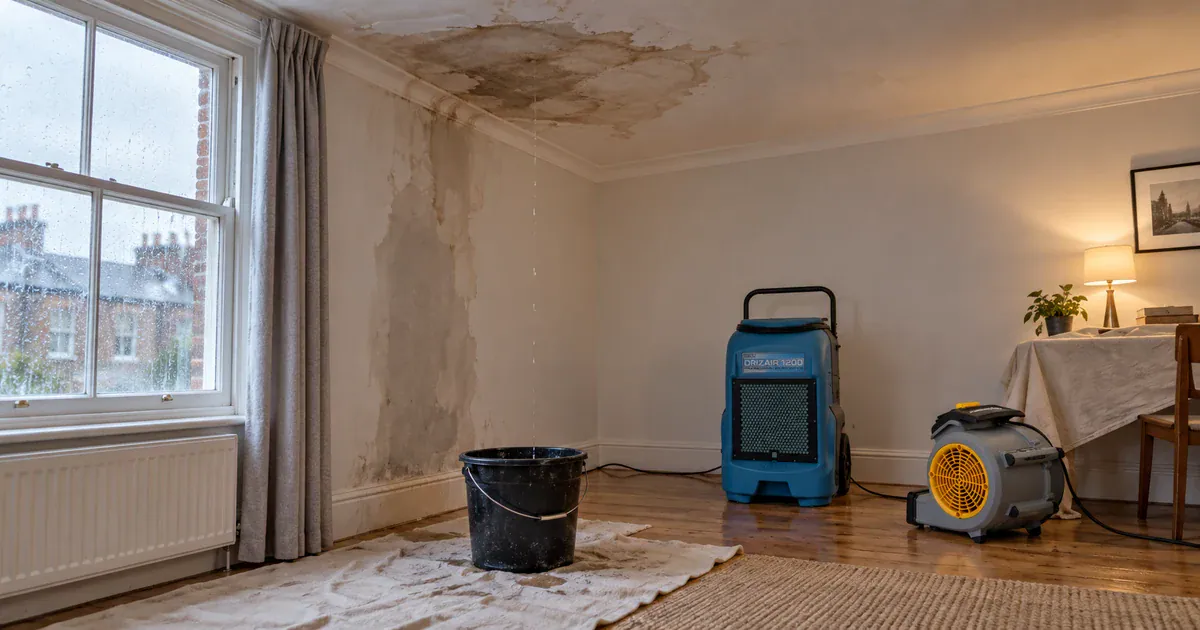
Stop the water first. Dry the building second.
A stain spreading across the ceiling during a storm, water running down a chimney breast, a wet patch appearing halfway up a wall in driving rain. Storm water finds a way in through things that were fine all summer. This guide covers what to do in the first hour, where the water is actually getting in, and how to dry the building out properly once the hole is closed.
What should you do when storm water gets into the house?
Make it safe, catch the water, record it, then stop it. Keep people away from anything electrical that is wet, put containers and sheets under the drips, move furniture and stored items clear, and photograph everything before you start mopping — your insurer will want to see it as it was.
Drying comes after the water has stopped coming in. Running machines while the roof is still open wastes the hire, and plaster and timber that look dry on the surface can still be soaked behind. Once the defect is covered or repaired, a dehumidifier and one or two air movers will pull the water back out of ceilings, walls and floors — and that is the part that decides whether you get mould in six weeks.
The first hour
Nothing on this list needs a tradesman. All of it makes the next few weeks cheaper.
If the water is coming from a pipe rather than the weather, the first move is different — turn the stopcock off and work through our burst pipe checklist instead.
Where storm water actually gets in
Heavy rain on its own rarely beats a sound building. What does the damage is rain arriving sideways on a gale, or arriving faster than the gutters can take it away. These are the places it finds, in roughly the order we hear about them after a London storm. For every size we stock, see our dehumidifier hire London page.
| Entry point | What you see inside | Who deals with it |
|---|---|---|
| Slipped, cracked or missing tiles | A stain or drip in one spot on an upstairs ceiling, during and just after rain | Roofer; a temporary cover or tarpaulin stops it until the repair |
| Flat roof or a failed seam | A wide damp patch spreading across a flat area of ceiling, often above an extension | Flat roofing contractor; standing water on the roof makes it worse |
| Chimney, flashing or parapet | Water running down a chimney breast, or a damp line where an extension meets the main wall | Roofer; flashing and pointing are the usual culprits |
| Blocked or overflowing gutters | Water running down the outside wall, and a damp band inside at the same height | Often clearable from a ladder or from the ground with a pole |
| A downpipe discharging against the wall | A persistent wet column on the wall, worst in heavy rain | Reconnect or redirect the pipe; cheap and often ignored for years |
| Driving rain through solid walls | A broad damp area on a wall facing the weather, appearing hours after the rain starts | Pointing, render repair or a breathable water repellent, as advised |
| Window and door seals | Water on the sill or the floor directly below the opening | Resealing; often the perished bead rather than the frame |
| Blocked ground gullies and drains | Water rising at the base of a wall, or coming under a door | Clear the gully; recurring flooding needs a drainage look |
| Airbricks below floor level | Water under floorboards and a cold, musty smell afterwards | Clear what is blocking the airbrick; keep ground levels below it |
Two useful tests. If the water appears while it is raining and stops within a few hours of the rain stopping, it is almost certainly coming in from outside. If it appears on cold mornings, spread evenly rather than in one track, it is condensation, and our guide on telling the three types of damp apart is the one you want.
What the water soaks on the way through
The patch you can see is the end of the journey, not the start. Water that comes through a roof travels along timbers, soaks insulation, sits on the top side of a ceiling and runs along joists before it finds a spot to come through. That is why a small stain can mean a large wet area above it.
What actually holds the water after a storm, and why it matters for drying.
Mineral wool holds a surprising amount of water and gives it back slowly into the ceiling below. Insulation that has been soaked is usually replaced rather than dried.
Board wicks water sideways, so the wet area is wider than the stain. A ceiling that has sagged or feels soft needs a builder to look at it before anyone decides it is fine.
Water tracks down inside a wall and sits at floor level. Skirtings, the bottom of the plaster and the cavity itself can be wet while the surface feels dry to the hand.
Carpet feels dry long before the underlay does, and a wood floor that got wet will cup before it dries flat. Lifting what you can early saves the floor.
None of this means panic. It means that the drying has to go on longer than the surface suggests, and that is exactly what hired equipment is for. Our guide on how long it takes to dry out a room sets out what actually controls the timescale.
Drying it out properly
The aim is to take the water out of the materials, not just out of the air you can feel. That means closing the room up, running a dehumidifier to drop the humidity, and using air movers to keep the air moving across the wet surfaces so they keep giving water back.
1. Wait until the water has stopped coming in
A tarpaulin over a damaged roof, a cleared gutter, a sealed window: whatever it takes. Drying a building that is still taking on water is money spent twice. If a contractor has made it watertight temporarily, that is good enough to start.
2. Take out what is beyond drying
Soaked loft insulation, sodden underlay and wet cardboard are better out than in. They hold water, slow the whole job down and smell. Anything you are keeping gets moved somewhere with air around it.
3. Close the room up
Windows shut, doors closed, trickle vents shut. This is the opposite of what feels right, but a dehumidifier can only work on air it can hold on to. Open windows just bring in more damp outside air in a British winter.
4. Run a dehumidifier and keep it running
Continuous, not a few hours a day. Put it somewhere central with space around the intake and outlet, set the humidistat to around 50% if it has one, and either empty the tank daily or run the drain hose to a sink or drain.
5. Point air movers at the wet surfaces
A dehumidifier dries air. An air mover is what gets that dry air to the wet material. Aim them along a wet wall or ceiling rather than straight at it, under lifted carpet, and into corners where air never moves.
6. Keep some heat on
Warm materials give water up faster, and a refrigerant dehumidifier works better in a warmer room. Normal heating is enough; nobody needs to roast the house.
7. Stop when the materials are dry, not when they look dry
Plaster, timber and screed can feel dry while the core is still wet. The honest test is whether the humidity in a closed room creeps back up after the machine is switched off for a day. If it does, it is not finished.
8. Repair after the drying, not before
Plastering, painting or laying flooring over material that is still wet traps the water in and the problem reappears through the new finish. Our guide on plaster that is still wet after a week explains why the wait is worth it.
One thing we will not do is give you a number of days. It depends on how much water went in, what it soaked, how warm the building is and how much equipment is running. Anyone quoting a guaranteed drying time without seeing the room is guessing.
How to tell when it is actually dry
This is where most self-managed drying jobs go wrong: the machine comes back to us a week early because the room feels fine. Feeling fine is not the test. These are, in rough order of how much they tell you.
If you want a proper answer rather than a judgement call, a damp meter reading on plaster and timber is what a drying company would use, and some insurers ask for readings before they will sign off a repair. For a single room in a house, the switch-off test is usually enough.
Which machines for storm damage
Most storm jobs in a house are one dehumidifier and one or two air movers. The size of the dehumidifier follows the volume of space you are drying, not the size of the stain.
Pick by the space you are drying:
Not sure what size? Sizing by room, how many machines for the space and what each machine actually does answer most of it.
If you would rather not pick the parts separately, the drying packages pair the machines in one booking: the entry package at £84.99 for up to five days covers a single room, and the leak and plaster drying package at £99.99 is the one most people take after water has been through a ceiling.
What it costs
Storm jobs are usually a one to two week hire. Current London prices, before VAT:
| Machine | 1 day | 2 days | Up to a week | Longer hires |
|---|---|---|---|---|
| Compact 19 L | £19.99 | £24.99 | £34.99 | from £4.50 a day |
| 38 L dehumidifier | £29.99 | £44.99 | £59.99 | from £8.40 a day |
| Dri-Eaz Cube with pump | £39.99 | £59.99 | £74.99 | from £11.20 a day |
| High-airflow air mover | £15.49 | £23.49 | £29.99 | from £4.20 a day |
| 63 L LGR building dryer | £59.99 | £89.99 | £119.99 | from £16.80 a day |
Pick your dates on the product page and the exact total appears before you book. A refundable deposit and photo ID apply to every hire. Delivery and collection across London can be added at checkout, or collection from our Greenford depot is free. Electricity is the other cost, and our running cost guide works it out for your tariff. If you are claiming, keep the hire invoice: equipment hire is often part of what gets reimbursed.
Storm water damage: common questions
Is it storm damage or damp?
Storm water arrives with the weather and stops soon after it. Damp from condensation appears on cold mornings, spread evenly across cold surfaces. Water that only appears in heavy, wind-driven rain and shows up on the weather side of the house is almost always coming in from outside.
Can I start drying before the roof is fixed?
You can run machines to stop things getting worse, but it is not the real drying job and the hire is partly wasted. As soon as the roof is covered, even temporarily with a tarpaulin, the drying starts working properly.
Should I open the windows to dry the room?
Not in a British winter. Outside air in December is often as wet as the air you are trying to dry, so opening up just replaces it. Close the room, run a dehumidifier, and let the machine do what the window cannot.
How long will it take to dry?
It depends on how much water went in, what it soaked, how warm the building is and how much equipment is running. The air improves within a day, surfaces take days, and plaster or a soaked floor takes longer. We will not quote a guaranteed number without seeing it.
Do I need an air mover as well as a dehumidifier?
On anything more than a small damp patch, yes. The dehumidifier dries the air; the air mover delivers that dry air to the wet material and takes away the damp layer sitting against the surface. Together they do in days what a dehumidifier alone does in a week.
Will the ceiling stain go away once it is dry?
The water will leave; the mark usually will not. Once the plasterboard is genuinely dry, a stain blocking primer and a repaint deals with it. Painting over a stain while the board is still wet brings the mark straight back through.
What about the smell afterwards?
A musty smell means something is still damp, usually underlay, insulation or the inside of a cupboard. Keep drying and find it, rather than covering it — our guide on why a house smells damp goes through it room by room.
Does insurance cover this?
Storm damage is treated differently from gradual damp by most policies, and equipment hire is often part of a claim. Policies vary, so ask your insurer what they want documented before you clear up. We set out the general picture in our guide to damp and insurance.
Can you deliver the same day?
Often, yes, depending on the time of day and where you are in London. Call and tell us the postcode and the room and we will tell you honestly what we can get to you and when.
What if the water came through a flat roof above a whole room?
That usually means a wider wet area than a tile leak, so plan on a larger machine and two air movers, or take the leak and plaster package. If a ceiling has sagged or feels soft, get a builder to look before anyone works under it.
Related guides
More drying guides:
Tell us what came in and where, and we will tell you what to hire
Say which room, how big it is, what got wet and whether the water has stopped. We will tell you which machine and how many air movers, and whether a package works out better than hiring the parts separately. If what you describe needs a roofer before it needs a dehumidifier, we will say so.
Sources and limits: this guide is about drying a building after water has come in from outside. It is not roofing, electrical or structural advice: wet electrics, sagging ceilings and roof repairs need the relevant qualified trade, and nobody should be on a roof in bad weather. Drying times are not given as fixed figures because they depend on how much water entered, what it soaked, the temperature and how much equipment is running. Insurance cover varies by policy and insurer, so check yours rather than relying on a general description. Hire prices are correct at the time of writing, exclude VAT, and the full price for your dates is shown at checkout.

 Drone Survey & Mapping
 Drone Inspections