
 Drone Services

 Access Equipment

 Breaking & Drilling

 Cleaning Equipment
 Drying & Heating

 General Site Tools

Drying & Heating, Equipment Hire Guides
Why Does My House Smell Damp?
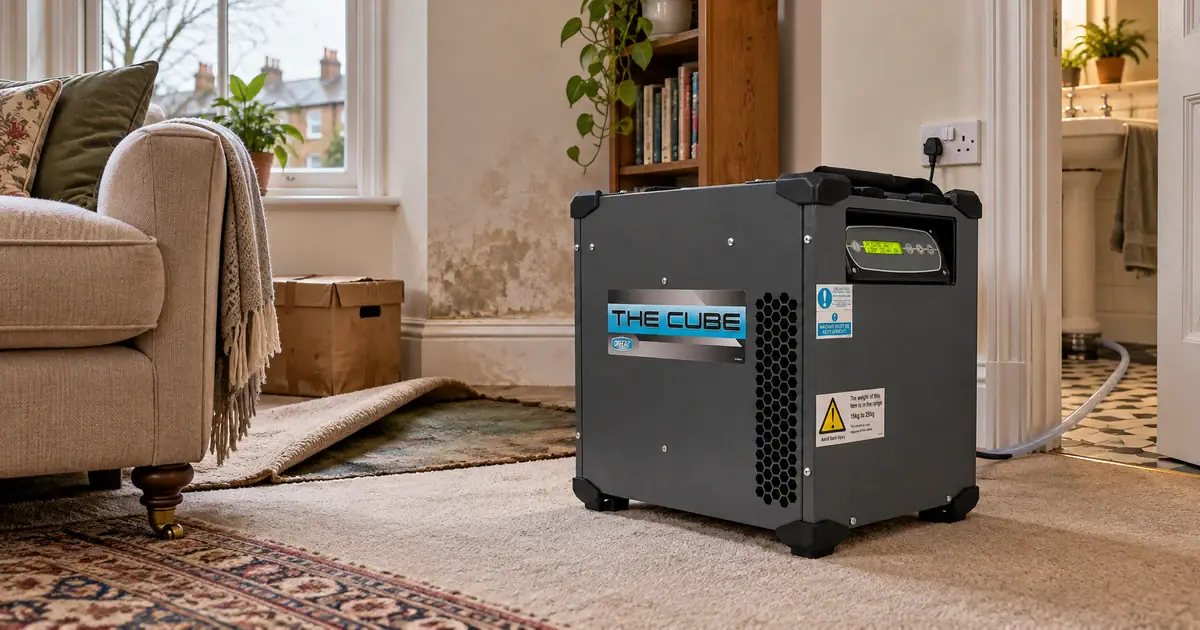
The smell is not the problem. It is the receipt.
A damp, musty smell is not dirt and it is not bad luck. It is the gas given off by mould and bacteria feeding on something that has been wet for a while — plaster, timber, carpet, underlay, a cardboard box at the back of a cupboard. Air freshener hides it for an hour. This guide shows you how to find what is wet, how to dry it out, and when the smell means something bigger than condensation.
Why does my house smell damp?
Because something in it is damp enough for mould and bacteria to grow, and those release the musty gases you can smell. The usual sources are condensation on cold surfaces, a slow leak nobody has found, water coming in through the building, or soft things — carpet, underlay, clothes, cardboard, old furniture — that got wet and never properly dried.
The fix is always the same three steps in the same order: find what is wet, stop it getting wet again, then dry out the material and the air around it. A dehumidifier does the third step well and the second step not at all, which is why a machine on its own sometimes fails. If the smell is in one room or one cupboard, a hired dehumidifier run for a week or two usually clears it. If it comes back, there is a source you have not found yet.
What that smell actually is
Musty is a specific smell, and it tells you something specific. It comes from mould and bacteria breaking down damp material and giving off gases as they do it. That is why the smell arrives before you see anything: colonies in a wall cavity, under a floor or behind a wardrobe are producing it long before a black spot appears on the paint.
By the time there is visible mould on a wall, the material behind it has usually been damp for weeks. A smell with nothing to look at is normal, and it means you are looking in the wrong place rather than imagining it.
Wardrobes, under the stairs, behind sofas, inside a cupboard on an outside wall. Still air lets the gases build up, which is why opening a cupboard door hits you with it.
Carpet, underlay, curtains, bedding, clothes and cardboard all hold the smell long after the room is dry. Dry the room and the smell drops; the last of it is usually sitting in something soft.
A sharp, sewer-like smell is usually a dried-out trap or a waste pipe, not damp. A musty, earthy, cellar-like smell is damp. Different problem, different fix.
Where the smell is strongest tells you the cause
Walk the house with the heating off and your nose working. Open every cupboard, pull back a corner of carpet in the worst room, and get low down — damp smells pool near the floor. Where it is strongest narrows the cause down fast.
| Strongest where | Usual cause | What to check | What it needs |
|---|---|---|---|
| A bedroom wall or corner, behind furniture | Condensation on a cold outside wall | Black speckling on the wall or ceiling, wet window frames in the morning | Ventilation, heat and a dehumidifier |
| Inside a wardrobe or a built-in cupboard | Still air against a cold wall | Damp-feeling clothes, mould on leather and the back panel | Move it off the wall, dry the room, air the contents |
| The hallway and ground floor, near skirting | A sub-floor or underfloor void that is not drying | Blocked air bricks outside, a lifting or cupping floor | Clear the air bricks, then dry the room |
| Under the stairs or in a cupboard with the stopcock | A slow leak on a pipe or joint | Green or white staining on pipes, a damp patch on the floor | Fix the leak first, then dry |
| A bathroom wall, or the ceiling under a bathroom | A leaking seal, waste or shower tray | Stains spreading from one point, bubbling paint | Repair, then dry the ceiling void |
| An outside wall after rain | Water getting in through the building | Overflowing gutters, cracked render, failed pointing | Fix outside, then dry inside |
| A cellar or basement | Ground water and poor ventilation | Salt deposits, powdery plaster, a constant cold damp | Ventilation plus a machine that copes with cold |
| Everywhere, mildly, all winter | Too much moisture and not enough ventilation | Windows wet most mornings, washing dried indoors | Habits, ventilation and a dehumidifier |
Why it turns up in October and stays until March
Almost every London home smells a little damper in winter, and it is not imagination. Four things change at once when the clocks go back.
Outside walls, window reveals and unheated corners drop in temperature. The moisture already in the air condenses on them, and anything resting against them — a wardrobe, a headboard, a stack of boxes — stays damp.
From October the trickle vents get closed and nobody opens a window after a shower. The moisture a household makes has nowhere to go, so it settles on the coldest surfaces in the house.
Drying clothes on radiators or an airer puts litres of water into the air every week. It has to end up somewhere, and it ends up on the cold walls.
Warm, moist air at 8pm, cold surfaces at 6am. That daily swing is what drives condensation, and it is why the smell is often worst first thing in the morning.
None of this means your house is defective. It means the balance between moisture going in and moisture going out has tipped, and in winter it tips the wrong way. Our guides on condensation on the windows every morning and drying clothes indoors without causing damp cover those two habits in detail.
Getting rid of the smell, step by step
In this order. Skipping to the last step is the most common mistake, and it is why some people run a machine for a month and still have the smell.
1. Find what is wet
Use the smell map above. Open cupboards, move furniture off outside walls, lift a corner of carpet in the worst room and feel the underlay, and look at the ceiling below any bathroom. You are looking for one thing: material that is wet or cold and damp to the touch.
2. Rule out a leak before anything else
Check around the stopcock, under sinks and baths, behind the washing machine and at radiator valves. Look outside too, at gutters, downpipes, render and pointing, ideally while it is raining. If you find water coming in, the drying only starts once it is fixed.
3. Put a humidity meter in the worst room
A cheap digital hygrometer tells you whether you have a damp-air problem or a wet-material problem. Readings that sit well above 60% point at the air. Normal readings with a strong smell point at something specific that is wet.
4. Get air moving
Open trickle vents, run extractor fans properly during and after showers and cooking, and open internal doors so the house shares its air. Pull furniture a few centimetres off outside walls. This costs nothing and it changes the conditions the mould depends on.
5. Dry the room with a dehumidifier
Run it with the windows shut and the doors to that room closed. Set it to around 50–55% and leave it on. Days, not hours — the air dries quickly, but the plaster, timber and underlay holding the smell take longer.
6. Clean the mould you can see
Drying stops it growing; it does not remove the staining or the spores already there. Wipe affected surfaces down properly rather than painting over them. Our guide to black mould on walls covers doing that safely.
7. Deal with the soft things last
Once the room is dry, the remaining smell is usually in carpet, underlay, curtains, bedding or stored clothes. Wash what can be washed, air the rest, and clean or replace carpet and underlay that stayed wet.
What you should see: a noticeable drop in the smell within a few days of the dehumidifier going on, and the room feeling warmer at the same thermostat setting, because dry air heats more easily than damp air. What you should not see is the smell returning a week after the machine goes back. If it does, step two was not finished.
Which dehumidifier clears a damp smell
You are not buying extraction figures here, you are buying enough machine for the space and enough time for the materials. These are the four we hire most for smell and damp-air jobs in London homes.
Prices are from, per day, plus VAT, and drop on longer hires. Not sure which one? Our guides on what size dehumidifier you need and how many you need size it properly, and what one costs to run covers the electricity.
Two things make more difference than the model you pick. Run it with the room closed, not with a window open, because you are drying the room rather than the sky. And give it time: the air in a room dries in hours, but the plaster, floorboards and underlay holding the smell give their moisture up over days.
If a carpet is the source — a spill, a pet, a washing machine that overflowed last year — drying the air will not be enough on its own. An air mover alongside the dehumidifier pushes air across and under the pile and cuts the drying time sharply. Our guide on drying a wet carpet without lifting it explains that set-up, and for a carpet that needs cleaning rather than just drying, a hot water carpet cleaner takes the soil out instead of pushing it around.
When the smell is not condensation
Most musty smells in London homes are condensation and poor ventilation. Some are not, and those will come straight back after a dehumidifier goes home. These are the signs worth knowing.
Treat the smell as something more than damp air if:
Our guide to rising damp, condensation and penetrating damp walks through telling those three apart, and solving a damp problem in a house covers the order to tackle them in. If the smell dates back to a leak, drying out a house after a leak is the one to read — drying stopped too early is the single most common reason a smell never leaves.
Carpets, wardrobes and the smell that will not leave
When the room is dry and the smell is still there in the background, it is in something soft. Soft materials hold both moisture and the smell itself, and they give it back slowly into a room that is otherwise fine.
| Item | Why it holds the smell | What works |
|---|---|---|
| Carpet and underlay | Underlay is a sponge. It stays damp long after the pile feels dry | Dry with a dehumidifier and an air mover together; clean the pile; replace underlay that stayed wet |
| Clothes in a wardrobe | Still air, a cold outside wall and fabric that was damp when it went in | Empty it, wash or air everything, dry the room, move the wardrobe off the wall before refilling |
| Curtains and blinds | They hang against the coldest surface in the room, the window | Wash or dry-clean, and deal with the condensation that wet them |
| Cardboard boxes and paper | Cardboard absorbs moisture and feeds mould better than almost anything | Throw out what is already musty; store the rest in plastic, off the floor and off outside walls |
| Sofas and mattresses | Thick foam dries from the outside in and can stay damp inside for weeks | Move away from walls, air both sides, run a dehumidifier in the room for several days |
| Books, leather and luggage | Porous surfaces hold mould and its smell easily | Wipe down, air thoroughly, and keep the room below about 60% humidity afterwards |
Two things that do not work, however often they are suggested: masking the smell with plug-ins and sprays, and leaving a bowl of crystals in the corner. The first changes nothing underneath. The second removes a token amount of moisture compared with what a house actually produces in a day — a small hired machine will take more water out in an hour.
What it costs to clear a damp smell
Most smell jobs in a flat or a single room are a one to two week hire, not a purchase. Current London hire prices, before VAT:
| Machine | 1 day | 2 days | Up to a week | Longer hires |
|---|---|---|---|---|
| Compact 19 L | £19.99 | £24.99 | £34.99 | from £4.50 a day |
| 38 L dehumidifier | £29.99 | £44.99 | £59.99 | from £8.40 a day |
| Dri-Eaz Cube with pump | £39.99 | £59.99 | £74.99 | from £11.20 a day |
| High-airflow air mover | £15.49 | £23.49 | £29.99 | from £4.20 a day |
| 63 L LGR building dryer | £59.99 | £89.99 | £119.99 | from £16.80 a day |
Pick your dates on the product page and the exact total appears before you book. A refundable deposit and photo ID apply to every hire. Delivery and collection across London can be added at checkout, or collection from our Greenford depot is free. If the smell came from a leak or a flood rather than condensation, one of our drying packages pairs a dehumidifier with air movers in a single booking — the entry package starts at £84.99 for up to five days, and the leak and plaster package at £99.99.
Damp smells: common questions
Why does my house smell damp but there is no visible mould?
Because the mould is somewhere you cannot see: inside a wall cavity, under floorboards, behind a wardrobe, in underlay, or inside a cupboard on an outside wall. The smell is a gas, so it travels through a room long before a stain appears. Follow the smell to where it is strongest and start looking there.
Will a dehumidifier get rid of a damp smell?
If the cause is condensation or material that is simply wet, yes — usually noticeably within a few days and fully within one to two weeks. If the cause is water still getting in, a dehumidifier only holds the smell back while it runs. The machine dries; it does not repair.
How long does it take for the smell to go?
There is no fixed figure, because it depends on how wet the material is, how cold the room is and how much air is moving. In practice: the air improves in a day or two, the smell drops noticeably in a few days, and anything soft that got wet takes longer. Nobody can give you an honest number without seeing the room.
Why does my bedroom smell musty in the morning?
Overnight, bodies add moisture to the air of a closed room while the outside walls cool down. The moisture condenses on the cold surfaces, and the smell is strongest before the room has been aired. Opening the window for a few minutes and keeping furniture off outside walls makes a surprising difference.
Why do my clothes smell damp in the wardrobe?
Still air, a cold outside wall behind it, and clothes that were not fully dry when they went in. Empty it, wash or air the contents, move the wardrobe a few centimetres off the wall, and dry the room with a dehumidifier before putting anything back.
Is a damp smell dangerous?
The smell itself is not the hazard; what causes it can be. Damp and mould in a home are worth dealing with promptly rather than living with, particularly where there are children, older people, or anyone with asthma or a breathing condition. If anyone in the house has symptoms they think are linked, that is a conversation for a doctor.
Does an air freshener or dehumidifier crystals help?
Air fresheners cover the smell for an hour or two and change nothing underneath. Moisture crystals remove a token amount of water compared with what a household produces in a day. A small hired dehumidifier will take out more in an hour than a tub does in a week.
Why does the smell come back every winter?
Because the underlying balance has not changed: the same walls get cold, the same moisture goes into the air, and the same cupboard has no air movement. Fix ventilation and the cold spots and it stops being an annual event; otherwise it returns every October.
What humidity should I aim for in the house?
UK building-services guidance recommends 40–60% relative humidity in homes. Setting a dehumidifier to hold around 50–55% keeps a house out of mould territory without over-drying it. A cheap hygrometer tells you where you actually are.
Can I hire a dehumidifier for just a few days in London?
Yes. Hires start at one day, and the daily rate drops for longer bookings. We deliver and collect across London, or you can collect free from our Greenford depot. Tell us the room and the problem and we will say which machine fits.
Related guides
More damp and drying guides:
Describe the smell and we will tell you what to hire
Tell us which room it is worst in, whether it follows rain, what the hygrometer says and roughly how big the space is. We will tell you which machine to take, how long to run it, and whether you need an air mover with it. If what you describe sounds like a leak rather than damp air, we will say that too.
Sources and limits: the 40–60% relative humidity range for homes is from CIBSE TM40:2020, Health and Wellbeing in Building Services. Musty smells come from gases released by mould and bacteria growing on damp material, which is why a smell can be present with no visible growth. Drying times are not given as fixed figures because they depend on how wet the material is, the temperature, and how much air is moving. A dehumidifier removes moisture from air and materials; it does not repair leaks, rising damp, penetrating damp or rot, and persistent damp in a home is worth a professional inspection. Hire prices are correct at the time of writing, exclude VAT, and the full price for your dates is shown at checkout.

 Drone Survey & Mapping
 Drone Inspections