
 Drone Services

 Access Equipment

 Breaking & Drilling

 Cleaning Equipment

 Drying & Heating

 General Site Tools

Drying & Heating, Equipment Hire Guides
Loft Condensation in Winter: Causes, Fixes and Drying
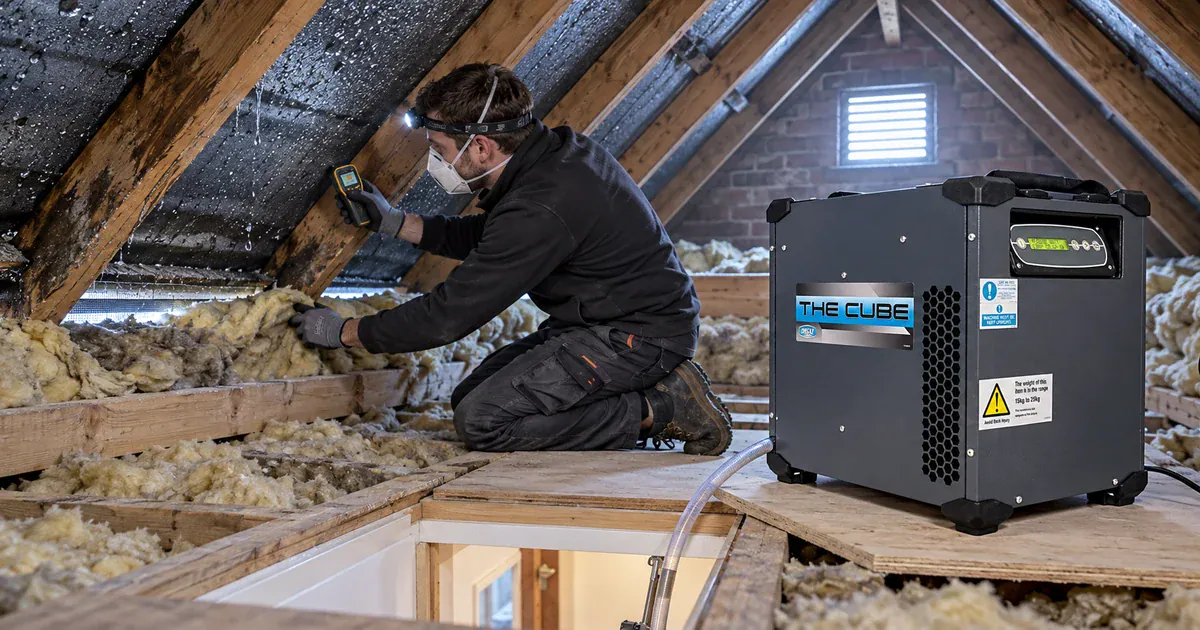
The water in your loft came from your kitchen.
Wet felt, black mould on the rafters, damp insulation, drips onto the bedroom ceiling. It looks exactly like a roof leak, and most of the time it is not one. It is the warm, moist air your household makes every day finding its way into a cold roof space and condensing on the first cold surface it touches. This guide shows you how to tell the difference, what actually fixes it, and the one part of the job a dehumidifier is genuinely for.
What causes condensation in a loft, and how do you stop it?
Warm, moist air from the house below leaks into the cold roof space — through the loft hatch, around downlights and pipes, or straight out of a bathroom fan that was ducted into the loft instead of outside. Up there it meets freezing felt, slates and nails, and turns back into water. If the roof cannot breathe, that water has nowhere to go, so it soaks the insulation, blackens the timbers and eventually drips through the ceiling.
Stopping it is two jobs, in this order: stop the moist air getting in, then let the roof ventilate. A dehumidifier is not the fix — you cannot dry a space that is deliberately open to outside air. What it does do, and does well, is dry the house below so less moisture travels upwards, and dry out the ceilings, insulation and timbers once the roof itself has been sorted out.
What you are actually looking at
Go up with a torch on a cold morning, ideally early, before the sun has warmed the roof. Condensation shows itself in ways a leak does not. For prices and sizes, see our dehumidifier rental in London page.
Water beaded across the whole underside of the felt or membrane, on nail points and on the cold side of the timbers. A leak makes one wet track; condensation wets a whole area evenly.
On a cold night the moisture freezes on nail tips and fixings, then melts and drips when the roof warms up. Homeowners often report a leak that only happens after a cold snap — that is this.
Insulation that feels cold and heavy, or has dark patches, has been soaking up condensation. Wet insulation stops insulating, which makes the loft colder and the condensation worse.
Mould grows on damp timber, and a musty smell when you lift the hatch usually arrives before any staining. Timber that is soft, or shows white or brown growth, is a different and more serious question — that one needs a surveyor, not a machine.
The ten-minute check, done properly. Go up on a cold morning before the house warms through, take a torch, and look at these six things:
One more clue. If the problem is worst above a bathroom, a kitchen or the loft hatch, you have found both the symptom and the cause in the same place.
How the moisture gets up there
A household puts litres of water into its air every day: showers, cooking, washing, drying clothes indoors, breathing. Warm air holds that moisture happily. The problem is that warm air rises, and a typical ceiling has more holes in it than people realise.
| Route | Why it matters | What closes it |
|---|---|---|
| The loft hatch | Usually the biggest single gap in the ceiling, and warm air goes straight up through it | Draught seals around the frame and insulation fixed to the back of the hatch |
| A bathroom or kitchen fan ducted into the loft | Pumps wet air directly into the coldest space in the house, all year | Duct it through the roof or wall to outside, with insulated ducting |
| Recessed downlights | Each fitting is a hole through the ceiling, and there can be dozens | Fire-rated, airtight fittings or purpose-made covers suitable for the fitting |
| Pipe, cable and soil-vent penetrations | Small gaps, but they are constant and often above a bathroom | Seal around them properly rather than stuffing insulation in |
| A hatch or door to a loft conversion | A heated room venting into an unheated void beside it | Seal and insulate the boundary between heated and unheated space |
| Too much moisture in the house generally | Drying washing indoors and poor extraction raise the moisture in every room | Extraction, ventilation, and a dehumidifier when the house is genuinely damp |
In other words, loft condensation usually starts in a bathroom or a kitchen, not on the roof. That is why re-roofing a house rarely cures it, and why sealing and ventilating almost always does. Our guides on stopping condensation on windows and walls and drying clothes indoors without causing damp deal with the moisture before it reaches the ceiling.
The ventilation a cold roof needs
A cold pitched roof is designed to be ventilated: outside air moves in at the eaves, across the roof space and out, carrying moisture with it. British Standard BS 5250 sets out how much of that airflow a roof needs, and roofing manufacturers publish it in the same terms.
| Where | Equivalent continuous gap | Applies to |
|---|---|---|
| At the eaves | 10 mm | Roof pitches above 15 degrees |
| At the eaves | 25 mm | Roof pitches of 15 degrees or less |
| At the ridge or high level | 5 mm, in addition to the eaves | Pitches above 35 degrees, spans over 10 m, and lean-to or mono-pitch roofs |
Three practical points follow from that table. First, the gap has to be continuous along the eaves, not a vent here and there. Second, insulation pushed tight into the eaves blocks it completely, which is how a well-meant top-up of loft insulation turns into a condensation problem the following winter — eaves trays keep the path open. Third, a breathable membrane changes the requirement but does not remove it; if the ceiling below leaks air, the roof still needs ventilating.
Loft conversions are their own case. A converted roof is usually built as a warm roof, with the insulation following the slope, and what is left is a smaller cold void above the flat ceiling of the new room and behind the stud walls at the sides. That void still needs ventilating, and it is now harder to see, harder to reach and sitting directly above a heated room. If your condensation appeared after a conversion, that boundary is the first place to look.
We hire drying equipment, not roof vents, and the vent work itself is a roofing job. What we can tell you is that the lofts we get called out to dry usually show the same two faults: a sealed-up ceiling that is not actually sealed, and eaves packed solid with insulation.
Condensation or a leak? Tell them apart first
Spending money in the wrong order is the expensive mistake here. A roofer called to a condensation problem will find nothing wrong with the roof. A ventilation contractor called to a slipped tile will not fix the drip. Five minutes with a torch usually settles it.
| What you see | Condensation | A leak |
|---|---|---|
| Where the water is | Spread evenly across the underside of the roof and on nails | Concentrated in one track, often down a rafter or at one fixing |
| When it appears | After cold nights, and worst in the early morning | During and just after rain, whatever the temperature |
| The felt or membrane | Wet underneath, across a wide area | Wet from above at one point, sometimes torn or sagging |
| Insulation | Damp over a broad area, often near the hatch or a bathroom | Soaked in one patch, directly under the entry point |
| The timbers | Black surface mould on the cold faces | Dark staining following the run of the water |
| After a dry, mild week | Dries back noticeably | Stays wet if the defect is still open |
If it is a leak, that is a roofing repair first and a drying job second — our guide on drying out a house after a leak covers the second half. If it is condensation, carry on below.
The fix, step by step
In this order. Steps one and two are the cure; step four is the clean-up. Doing step four first is why some lofts get dried twice.
1. Stop the moist air getting in
Seal the loft hatch with draught seals and insulate its back. Deal with downlights, pipe and cable penetrations. Most important of all, check where the bathroom and kitchen fans actually discharge: if a duct ends in the loft, or points vaguely at a vent it never reaches, that single fault can be the whole problem.
2. Open the ventilation back up
Check the eaves from inside: you should be able to see daylight or feel air. Insulation packed into the eaves needs pulling back, with eaves trays fitted to hold the path open. Where the roof needs more than the eaves can give, a roofer can add tile or ridge vents to meet the figures above.
3. Sort the insulation out
Wet insulation does not insulate, and it will not dry properly while it is squashed under boards or packed into corners. Lift it, let it dry or replace it, and lay it to an even depth without blocking the eaves. Boarded storage areas need the airflow kept under them.
4. Dry what got wet
Now the drying is worth doing: ceilings, timbers, insulation and anything stored up there. This is where a dehumidifier earns its keep, and it works best in the rooms below and in a loft that is closed up for the drying period rather than wide open.
5. Reduce the moisture at the source
Run extractor fans during and well after showers and cooking, dry washing where it can vent outside, and keep the house at a sensible humidity. A loft is the last place the moisture ends up, not where it starts.
6. Check it again next cold snap
The real test is the first hard frost after the work. Go back up with a torch on a cold morning. Dry felt, dry nails and dry insulation mean the job is done; anything else means one route is still open.
One warning worth repeating: adding more insulation on its own, without opening the ventilation back up, makes loft condensation worse rather than better. The loft gets colder, the airflow stays blocked, and the moisture keeps arriving.
What a dehumidifier does, and does not do, in a loft
This is the part most pages skip, so we will be blunt about it. Standing a dehumidifier in a properly ventilated loft is close to pointless: the machine is trying to dry the outside air, which keeps arriving through the vents, and in a cold loft a refrigerant dehumidifier works slowly anyway. There are three jobs where it genuinely earns its hire, and they are all slightly different.
Three real jobs for a hired machine on a loft condensation problem.
This is the big one. The moisture in your loft came up from the house. Running a dehumidifier in the kitchen, bathroom landing or wherever the washing dries cuts the humidity at source, which is the only thing that stops the loft wetting up again tonight.
Once the hatch is sealed, the fan is ducted outside and the eaves are clear, the ceilings, timbers and insulation still need to give their water back. That is a dehumidifier job, run in a closed-up loft for a few days rather than a wide open one.
Different problem, same machine. Water from a burst pipe, a failed cold water tank or a slipped tile soaks insulation and ceilings. Here you want a dehumidifier and an air mover together, and our leak and burst-pipe drying guide walks through it.
Two honest limits worth knowing before you book. First, a loft in January can sit near outdoor temperature, and refrigerant machines lose capacity as the air gets colder — the Dri-Eaz Cube is rated from 1°C but works properly above about 15°C, which is why we usually suggest working the rooms below rather than the loft void itself. We go into the detail in why a dehumidifier seems not to work in a cold room. Second, the biggest tank in the range is worth nothing on a single landing: capacity matters when the volume of air is large, not when the room is small.
Which machine for which part of the job:
Every hire includes a refundable deposit and photo ID check. Not sure which size? Our sizing guide and how many machines you need both help.
What it costs
A loft job is usually a one or two week hire while the house dries down and the fabric gives its water back, not a purchase. Current London hire prices, before VAT:
| Machine | 1 day | 2 days | Up to a week | Longer hires |
|---|---|---|---|---|
| Compact 19 L | £19.99 | £24.99 | £34.99 | from £4.50 a day |
| 38 L dehumidifier | £29.99 | £44.99 | £59.99 | from £8.40 a day |
| Dri-Eaz Cube with pump | £39.99 | £59.99 | £74.99 | from £11.20 a day |
| High-airflow air mover | £15.49 | £23.49 | £29.99 | from £4.20 a day |
| 63 L LGR building dryer | £59.99 | £89.99 | £119.99 | from £16.80 a day |
Pick your dates on the product page and the exact total appears before you book. A refundable deposit and photo ID apply to every hire. Delivery and collection across London can be added at checkout, or collection from our Greenford depot is free. If water came into the loft from a burst pipe or a failed tank, a drying package pairs a dehumidifier with air movers in one booking: the entry package is £84.99 for up to five days, and the leak and plaster package £99.99. Running costs are covered in what it costs to run a hired dehumidifier.
Loft condensation: common questions
Is some condensation in a loft normal?
A little moisture on the underside of the roof after a very cold night, which clears as the day warms up, is not unusual. Water running down the rafters, droplets dripping onto the insulation, frost on the nails or damp insulation in the morning are not normal, and they mean too much moist air is getting up there for the ventilation to carry away.
Will a dehumidifier stop loft condensation?
On its own, no. The air that is wetting your roof keeps arriving from the house and keeps being replaced through the roof vents, so a machine in the loft is fighting a losing battle. Seal the routes, open the ventilation, then use a dehumidifier to dry what got wet and to cut the humidity in the rooms below.
Does loft insulation cause condensation?
Insulation does not create moisture, but it changes where the cold surface is: a well insulated ceiling keeps the heat downstairs and leaves the loft much colder. That is fine as long as the loft is ventilated. The problem comes when insulation is pushed into the eaves and blocks the airflow, or when it is added without checking the vents.
Why are there rust marks and frost on the nails?
Nail points conduct cold straight through the roof covering, so they are the coldest spots in the loft. Moisture freezes on them first and rusts the heads over time. A loft full of frosted nail tips on a cold morning is the clearest signal there is that moist air is reaching the roof.
Should the bathroom fan vent through the roof or the soffit?
Outside, by the shortest sensible route, and never into the loft void. A tile vent or a soffit vent both work. What matters is that the duct is continuous to the outside, insulated where it crosses the cold loft so it does not condense inside itself, and as short and straight as the layout allows.
Is black mould on the rafters serious?
Surface mould on timber is a symptom rather than a structural emergency, but it tells you the wood has been damp repeatedly, and timber that stays wet for long periods can decay. Deal with the moisture first, then clean the growth off — the method in our guide on getting rid of black mould applies to timber as well.
Can I still use the loft for storage?
Yes, as long as you do not strangle the airflow. Keep boxes off the eaves, raise boarded areas so air can pass under them rather than laying boards straight onto the joists over the insulation, and use plastic boxes instead of cardboard. Cardboard and paper absorb moisture and go musty faster than almost anything else up there.
How long does a wet loft take to dry out?
There is no honest fixed figure. It depends on how wet the insulation and timbers are, how cold the loft is, whether the route for the moist air has actually been closed, and how much air is moving. In practice the air improves quickly, the surfaces take a few days, and soaked insulation is usually better replaced than dried.
What humidity should I aim for in the house?
UK building-services guidance puts 40 to 60% relative humidity as the sensible range for homes. Holding a house around 50 to 55% keeps it out of mould territory without over-drying it, and it is the single most useful thing you can do to keep the loft dry. A cheap hygrometer tells you where you actually are.
Can I hire a dehumidifier for just a few days in London?
Yes. Hires start at one day and the daily rate drops as the booking gets longer, which suits a loft job where the drying runs over a week or two. We deliver and collect across London, or you can collect free from our Greenford depot. Tell us the house and the problem and we will say which machine fits.
Related guides
More damp and drying guides:
Tell us what your loft looks like and we will tell you what to hire
Say whether the water is spread across the whole roof or running down one line, whether the insulation is wet, where your extractor fans go and roughly how big the house is. We will tell you which machine to take, where to put it, and how long to plan for. If what you describe sounds like a roof repair or a ventilation job rather than a drying job, we will say that instead of selling you a dehumidifier.
Sources and limits: the cold-roof ventilation figures quoted are the standard recommendations in BS 5250, the British Standard code of practice for the management of moisture in buildings, as published in manufacturer guidance: a continuous 10 mm equivalent gap at the eaves on both sides for roof pitches above 15°, 25 mm for pitches of 15° and below, and an additional 5 mm high-level allowance for pitches above 35°, spans over 10 m, and lean-to or mono-pitch roofs. The 40–60% relative humidity range for homes is from CIBSE TM40:2020, Health and Wellbeing in Building Services. Drying times are not given as fixed figures because they depend on how wet the material is, the temperature and how much air is moving. Hireload hires drying and air-moving equipment: we do not carry out roofing, ventilation or insulation work, and anything structural or a roof that is leaking needs a qualified contractor. Hire prices are correct at the time of writing, exclude VAT, and the full price for your dates is shown at checkout.

 Drone Survey & Mapping
 Drone Inspections