
 Drone Services

 Access Equipment

 Breaking & Drilling

 Cleaning Equipment
 Drying & Heating
 General Site Tools

Drying & Heating, Equipment Hire Guides
How to Keep an Empty House Dry Over Winter
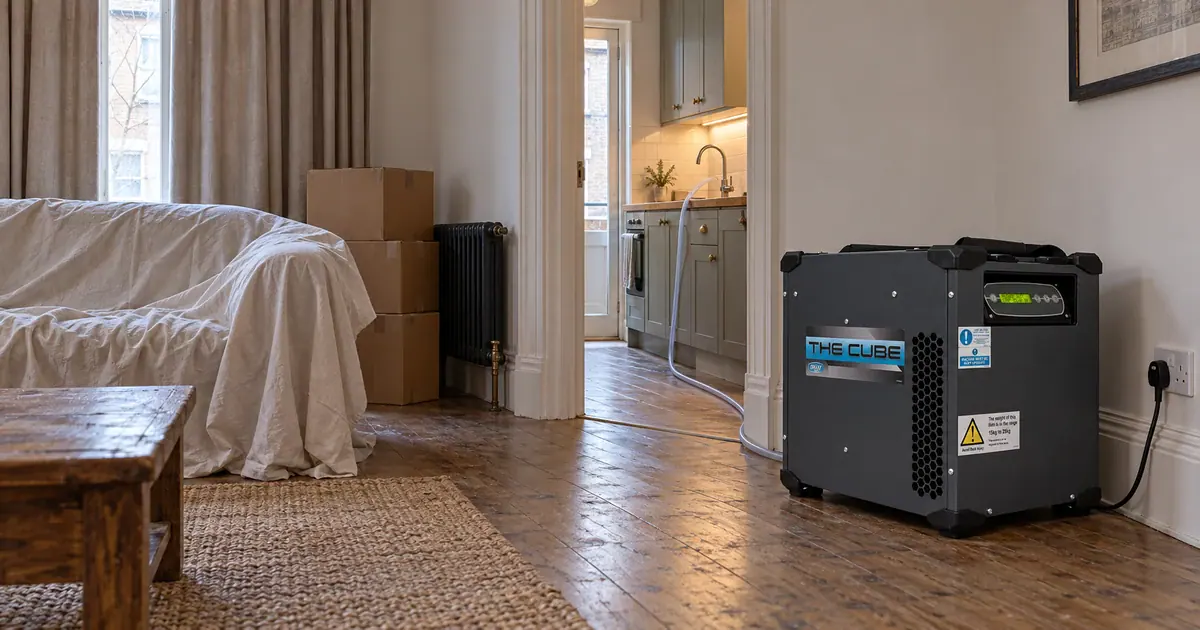
An empty house does not stay dry on its own.
When nobody is living in a home, nobody is heating it properly, opening a window, or noticing the first grey patch behind a wardrobe. Over a London winter that is how a clean, dry house becomes a damp one by spring. This guide covers how to keep an empty property dry — between tenants, while it is on the market, during a refurbishment, or while you are away — and how to set up a dehumidifier that looks after itself.
How do you stop an empty house getting damp in winter?
Keep a little heat in the building, keep air moving through it, and take the moisture out of the air with a dehumidifier that can run for weeks without anyone touching it. That means a machine with a humidistat, so it only runs when the air is damp, and a pump or drain hose, so the water goes down a sink or drain instead of into a tank that fills up and stops the machine on day two. Then check the property regularly, because the best set-up in the world will not tell you about a slipped roof tile.
For most empty homes and flats the simplest option is our Dri-Eaz Cube: it has a built-in pump with a 6 m hose and a digital humidistat, so you set it to around 50–55% and leave it. The rest of this guide explains why empty houses get damp, the two ways to winterise one, and exactly how to set everything up.
Why empty houses get damp
It seems backwards. Nobody is cooking, showering or drying washing, so there should be less moisture, not more. There is less moisture being made — but the house gets colder, and cold is what turns ordinary air into damp walls. You can hire a dehumidifier in London from us in every size we stock.
Warm air holds more water than cold air. When the heating goes off, the walls, window reveals and corners cool down, and the moisture already in the air condenses on them. The air did not get wetter; the surfaces got colder.
In a lived-in home, windows get opened, doors get used and air moves. In a closed-up house the air sits still, especially inside wardrobes, behind furniture and in rooms with the doors shut. Still, cool, humid air is exactly what mould likes.
A dripping overflow, a gutter blocked with leaves, a slow leak under a bath. In an occupied home someone spots it in a day. In an empty one it can run for weeks and soak a ceiling or a floor before anyone walks in.
Plaster, brick, timber, carpets and furniture all hold moisture from months of normal living. As the house cools, that moisture keeps coming out into the air. Without heat or a dehumidifier, it has nowhere to go.
The result is familiar to anyone who has opened up a house in March: a musty smell, spots of mould on window reveals and in corners, damp-feeling beds and sofas, and sometimes peeling wallpaper. Almost all of it is avoidable with a little planning in October.
Who this is for
Most homes left empty over a winter fall into one of a handful of situations. The set-up is much the same for all of them; what changes is how long the property is empty and how often someone can get there.
A few weeks between one tenancy ending and the next beginning, often with cleaning or small repairs in between. Keeping the property dry means it is ready to show and ready to let, without a mould clean before the new tenant moves in.
A vacant house that is being viewed over the winter. A musty smell at the front door or a dark corner in the bedroom is the first thing a buyer notices. A dehumidifier running quietly in the hallway is the cheapest staging you can do.
A house that belonged to a parent or relative, sitting empty for months while the family decides what to do with it. It usually still has furniture, carpets, clothes and books — all of which hold damp and pick up mould if the house is left cold and closed.
A property stripped back for works, with new plaster, new floors or fresh paint that need to stay dry. Here the building may be colder and wetter than a normal home, which changes which machine you want.
A flat in London kept for occasional use, or a family home left while you work abroad or spend the winter somewhere warmer. Weeks at a time, with nobody calling in.
Several empty units at once, each needing the same simple set-up and a short visit routine. One reliable routine across a portfolio saves far more than it costs.
Heating on low, or water off and drained?
There are two ways to prepare a house for a winter without anyone in it, and they have very different effects on damp. Which one suits you depends mainly on how long it will be empty and whether anyone can visit.
| What changes | Heating on low | Water off and system drained |
|---|---|---|
| What you do | Leave the heating on a low setting or timed bursts; water stays on | Turn off the stopcock, drain the pipes and hot water, heating off |
| Frozen pipes | Low risk while the heating runs | Very low risk — there is little water left to freeze |
| Damp and mould | Much lower — warm surfaces, less condensation | Higher — the house goes cold, surfaces stay damp |
| Dehumidifier | Works well; the house stays in its best temperature range | Still helps, but a cold house is harder work for most machines |
| Running cost | Some heating, plus the dehumidifier | Dehumidifier only |
| Best for | Weeks to a few months, homes being viewed or let | Long, unvisited periods, or when heating cannot be relied on |
For frost protection, insurer Aviva suggests setting the heating to come on for short periods at around 13°C, and recommends turning the water off and draining the system if a house will be empty for an extended period. Both are sensible; they simply trade one risk for another. Heating on low protects the fabric of the house from damp. Draining down protects it from a burst pipe but leaves it cold.
If you can, keep some heat in the building and run a dehumidifier alongside it. That is the combination that keeps a house closest to how it felt when people lived in it. If you are draining down, the dehumidifier matters even more — but choose it with the cold in mind, which is covered next.
One thing to avoid: leaving portable electric heaters running on their own in an empty property. A dehumidifier with a humidistat is designed to cycle on and off by itself; a fan heater left on for weeks with nobody there is a fire risk you do not need.
Which dehumidifier for an empty house
In an occupied home, almost any dehumidifier will do, because someone empties the tank every evening. In an empty one, three things matter far more than the headline litres-per-day figure.
The three must-haves for a machine that runs on its own:
Prices are from, per day, plus VAT, with lower daily rates on longer hires. We also hire the DrizAir 1200, which pumps its own water but has no humidistat and runs continuously, so it is better suited to active drying jobs than to a house left for weeks.
Two related guides go into more detail. If you are not sure the house will stay warm enough, read why a dehumidifier slows down in a cold room before you choose. And if you want to understand the pump itself — how far it lifts, and when you need one — see do I need a dehumidifier with a pump.
How many machines? For a typical flat or small house on low heat, one machine in a central spot with the internal doors open is usually enough. For a large house, or one split over several floors, one per floor works better than one large machine at the bottom of the stairs. Our guide on what size dehumidifier you need has the room-by-room detail.
Setting up a dehumidifier to run on its own
Twenty minutes of set-up on the last day you are there makes the difference between a machine that quietly works all winter and one that has been sitting full and switched off since the second night.
1. Pick a central spot and open the internal doors
A hallway or landing is usually best, because air from every room can reach it. Open all internal doors, and leave wardrobe and cupboard doors slightly ajar so the air inside them is part of the house, not a sealed box. Keep the machine clear of curtains and a little away from the wall so air can get in and out.
2. Run the hose to a sink, bath or drain
Lead the drain hose into a kitchen sink, a bath or a floor drain, and make sure it is held in place so it cannot flick out. Check it is not kinked or squashed under a door. A pumped machine like the Cube can push water up to a sink; a gravity hose has to run downhill all the way.
3. Set the humidistat to around 50–55%
That is comfortably inside the 40–60% range building-services guidance recommends for homes, and low enough to keep mould away without running the machine harder than it needs to. It will switch itself off when the air reaches the target and back on when it rises.
4. Plug straight into a wall socket
Use a proper wall socket, ideally on an RCD-protected circuit, not a coiled extension reel. Route the cable where nobody will trip on it when they come in, and make sure the plug is not behind a door that will be closed.
5. Set the heating, or drain down
Either set the heating to a low, timed setting for frost protection, or turn off the water and drain the system, as described above. If you drain down, remember the dehumidifier still needs somewhere for its water to go — a drain works with the water supply off.
6. Leave the vents open
Open trickle vents on windows and leave any air bricks and extractor vents clear. Close the windows themselves for security. A small amount of background ventilation plus a dehumidifier beats a sealed house every time.
7. Move things off cold outside walls
Pull sofas, beds, wardrobes and boxes a few centimetres away from external walls. Behind furniture against a cold wall is the single most common place to find mould in a house that has been empty.
8. Put a cheap hygrometer where you will see it
A small digital humidity meter costs very little and turns every visit into a quick reading. Note the number on the first day, so you know on later visits whether the house is getting drier or damper.
What to check on each visit
However good the set-up, someone should look in regularly. It does not need to take long. This is the list we would use.
What humidity to aim for
The CIBSE guidance for homes recommends a relative humidity of 40–60%, and notes that above that range damp and mould become more likely. In an empty house you want to sit comfortably inside the band, which is why we suggest setting the humidistat to around 50–55%.
| Reading | What it means | What to do |
|---|---|---|
| Below 45% | Drier than it needs to be | Nothing urgent; you can raise the humidistat target slightly to save electricity |
| 45–60% | The range you want | Keep the set-up as it is and carry on checking |
| 60–70% | Getting damper | Check the machine is running and draining; check heating, doors and vents |
| Above 70% for days | Damp conditions that suit mould | Look for a source: a leak, a blocked gutter, a cold room; consider a larger machine |
A dehumidifier deals with damp air. It cannot fix water getting in. If readings keep climbing despite a machine running, or a patch keeps coming back in the same place, the cause is usually a leak or a building defect. Our guide to rising damp, condensation and penetrating damp helps you tell them apart, and if you find mould already growing, how to get rid of black mould on walls covers the clean-up. If a pipe has burst while the house was empty, that is a different job — see drying out a house after a leak.
What it costs to keep an empty house dry
Hiring is usually the sensible choice for an empty property: you need the machine for a season, not for years, and you get one that is built to run unattended rather than a household unit with a small tank. Current London prices, before VAT:
| Machine | 1 day | 2 days | Up to a week | Longer hires |
|---|---|---|---|---|
| Dri-Eaz Cube with pump | £39.99 | £59.99 | £74.99 | from £11.20 a day |
| Compact 19 L | £19.99 | £24.99 | £34.99 | from £4.50 a day |
| 38 L dehumidifier | £29.99 | £44.99 | £59.99 | from £8.40 a day |
| 63 L LGR building dryer | £59.99 | £89.99 | £119.99 | from £16.80 a day |
Pick your dates on the product page and the exact price for the whole period shows before you book. A refundable deposit applies to every hire, and delivery and collection across London can be added at checkout, or you can collect free from our Greenford depot. Electricity is the other running cost; with a humidistat the machine only runs when it needs to, and our guide on what a hired dehumidifier costs to run shows how to work it out for your tariff.
Empty house damp: common questions
Should I leave the heating on in an empty house over winter?
If you can, yes, on a low or timed setting. It keeps pipes from freezing and keeps walls warm enough that moisture does not condense on them. Insurer Aviva suggests short periods of heating at around 13°C for frost protection. If you drain the system instead, the house will be colder and damper, and a dehumidifier becomes more important.
Is it safe to leave a dehumidifier running in an empty house?
A dehumidifier with a humidistat is designed to cycle on and off by itself, and a pumped machine does not need anyone to empty it. Plug it straight into a wall socket, ideally on an RCD-protected circuit, keep it clear of curtains and clutter, and check on it regularly. Do not leave portable heaters running unattended.
Where does the water go if nobody empties the tank?
Through a drain hose into a sink, bath or floor drain. Machines with a built-in pump, like the Dri-Eaz Cube, push the water through a hose up to around 6 m, so it can reach a sink from floor level. Gravity-drain machines need to sit above whatever they drain into.
What humidity should I set in an empty house?
Around 50–55%. Building-services guidance recommends 40–60% for homes, and setting the target in the middle of that range keeps mould away without running the machine harder than necessary.
Will a dehumidifier work in a cold, unheated house?
It will work, but most refrigerant dehumidifiers slow down noticeably as the room gets colder, typically below about 15°C. Keeping some background heat on helps a lot. For large or very cold buildings, a low grain refrigerant (LGR) dryer copes better with cooler conditions.
Should I turn the water off in an empty house?
It is one of the two sensible options. Turning off the stopcock and draining the system protects against burst pipes, especially for long, unvisited periods. The trade-off is a colder house with more condensation risk. If the water is off, a dehumidifier can still drain into a sink or drain.
How often should someone check an empty property?
Regularly, and more often in cold spells and after storms. A short visit to read the hygrometer, check the dehumidifier and hose, look for stains and run the taps catches almost every problem while it is still small.
Which dehumidifier is best for an empty flat?
For most flats, a machine with a built-in pump and a humidistat, like the Dri-Eaz Cube, because it can run for weeks without anyone touching it. If there is a sink or drain lower than where the machine can sit, a compact 19 L unit with a drain hose is a cheaper option.
Can I hire a dehumidifier for the whole winter?
Yes. Longer hires move onto a lower daily rate, and you can pick the full period on the product page to see the exact price before you book. If your plans change, call us and we will sort out the collection date.
Can you deliver to an empty property?
Yes, we deliver and collect across London, and you can choose delivery at checkout. Someone needs to be there to let us in and to show where the machine and hose should go, or you can collect it free from our Greenford depot and set it up yourself.
Related guides
More damp and drying guides:
Tell us about the property and we will pick the machine
Send us the size of the property, whether the heating will stay on, roughly how long it will be empty, and where the nearest sink or drain is. We will tell you which dehumidifier to leave running, how to set it, and whether one machine is enough.
Sources and limits: the 40–60% relative humidity range for homes is from CIBSE TM40:2020, Health and Wellbeing in Building Services. The frost-protection suggestion of short heating periods at around 13°C, and draining the system for extended absences, is from Aviva’s winter guidance on frozen and burst pipes. Machine details are from our product pages: the Dri-Eaz Cube has a built-in pump, a digital humidistat from 40–90% and a working range of 1–38°C, best above about 15°C. A dehumidifier controls damp in the air; it does not repair leaks, rising damp or penetrating damp. This guide is general information about keeping a property dry, and hire prices exclude VAT and are shown in full for your dates at checkout.

 Drone Survey & Mapping
 Drone Inspections