
 Drone Services

 Access Equipment

 Breaking & Drilling

 Cleaning Equipment
 Drying & Heating

 General Site Tools
Equipment Hire Guides
Is It Safe to Leave a Dehumidifier On Overnight or When You’re Out?
Quick answer
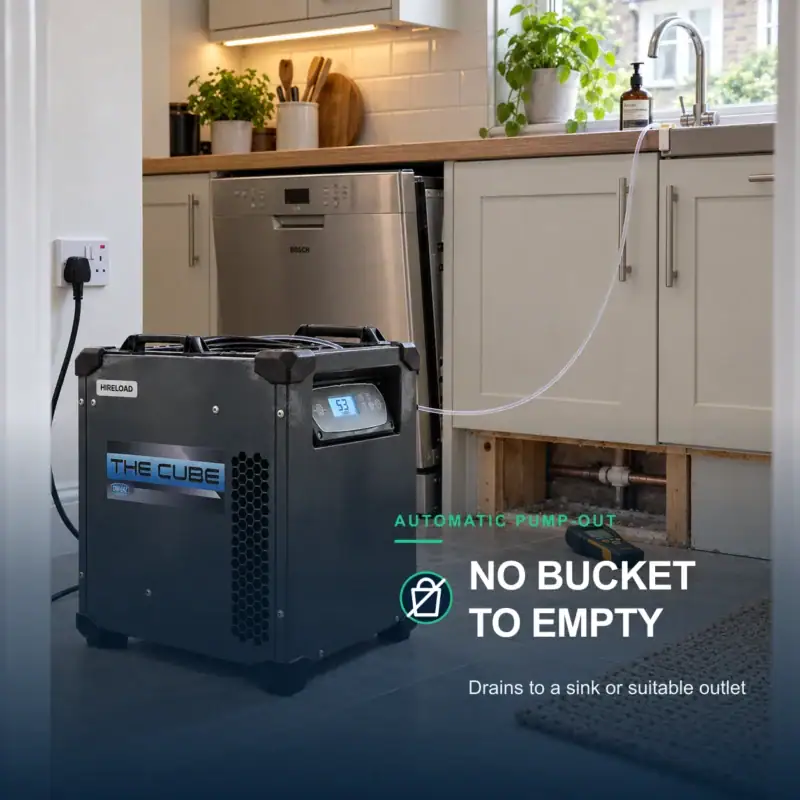
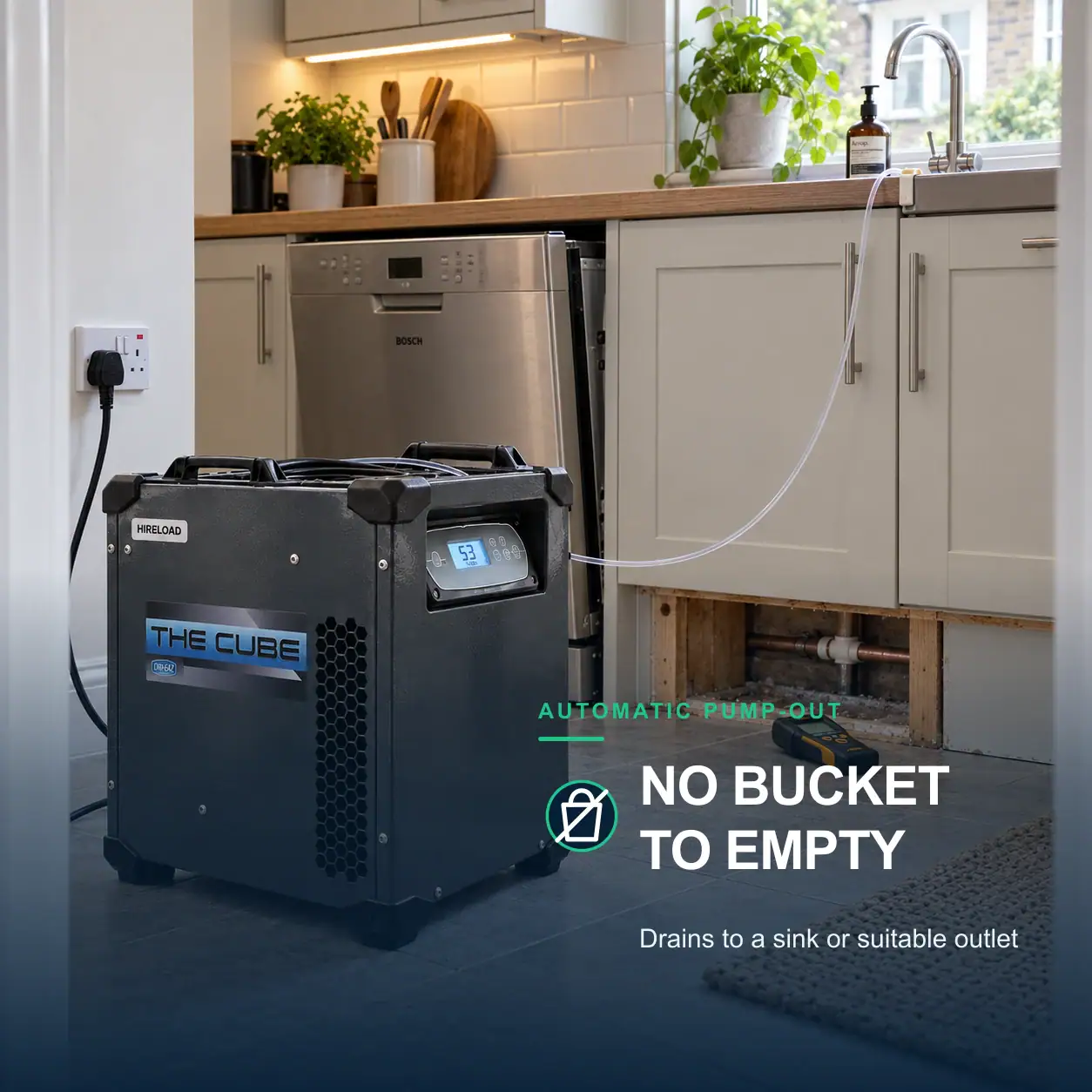
Yes, in most homes it is safe to leave a dehumidifier on overnight or while you are out, as long as three things are right: it is plugged straight into a wall socket on an RCD-protected circuit with the cable clear of water, it has space around it, and the water has somewhere to go. A tank-only machine switches itself off when the tank is full. A machine with an automatic pump and a hose to a sink or drain keeps working all night. For drying after a leak or new plaster, a professional unit with a pump, like our 55 L dehumidifier (from £89.99 + VAT for up to 7 days), is built to run unattended.
Key takeaways
- The tank is the limit, not the machine. A full tank at 2am means four hours of work and then nothing.
- A pump removes the problem. The Cube pushes water out through a 6m hose to a sink or drain.
- RCD-protected supply required. Plug into a wall socket, not a coiled extension lead.
- Close the door to the wet room. Better drying and better noise control at the same time.
| Your situation | What to do | Why |
|---|---|---|
| Drain, sink or shower within 6m | Run continuous drainage | Tank never fills, machine never stops |
| No drain within reach, someone home | Plan an emptying routine | Machine stops when the tank fills |
| Property empty during the day | Take the pump machine | Nobody there to empty a tank |
| Unheated garage or lock-up in winter | 63L LGR instead | Standard units ice up in cold air |
Why does the tank decide everything?
A refrigerant dehumidifier pulls water out of the air and has to put it somewhere. In most domestic machines that is a collection tank, and when the tank fills, the machine stops. For every size we stock, see our dehumidifier hire London page.
This is the biggest limitation on overnight running. A machine that fills at two in the morning has done four hours of work and then stood idle until someone empties it.
Read more: what the Cube does about it
What should I check on the power before bed?
The Cube runs from a standard 230V supply on a 13A plug, with a 7.6m cable. An RCD-protected supply is required.
- Plug directly into a wall socket wherever possible
- If you must use an extension lead, uncoil it fully. A coiled lead under load can overheat
- Do not daisy-chain leads or adaptors
- Keep the plug and socket away from standing water and from the hose route
- Check the machine has clear airflow around it
- Do not run a cable under a door that will be closed on it
Will it keep the household awake?
A dehumidifier is a compressor and a fan. It is not silent, and in a flat at night it will be audible. The answer is usually placement rather than switching it off.
- Put the machine in the room that is actually wet, with the door closed, rather than in a hallway serving bedrooms
- On a hard floor, a carpet offcut or mat under the machine reduces transmitted vibration
- In a flat or terrace, think about the neighbours and the party wall
- Point airflow towards the wet area, not towards a bedroom door
How much water will it actually remove overnight?
The Cube is rated at up to 43 L/day at 30°C and 80% relative humidity, the standard laboratory test condition. In a typical 20°C room it removes around 22 L/day.
That is not a criticism of the machine. Every refrigerant dehumidifier behaves this way, because extraction depends on how warm and how humid the air is.
Read more: why cold air changes the result
What are the safety points that actually matter?
- Never cover the machine or block its intake or outlet
- Keep the drainage hose route clear of walkways, particularly on stairs
- Do not run equipment unattended if the electrical installation has been affected by water and not checked
- Where children or pets are present, consider the hose, cable and position accordingly
- If the damage involves sewage, external flood water or contamination, treat it as a specialist job
What does a workable overnight routine look like?
- Close the door to the room being dried, and the windows in it
- Set up drainage: hose to a drain, or confirm the tank has capacity for the hours ahead
- Check the plug is in a wall socket on an RCD-protected supply
- Position for noise as well as for drying
- Take a humidity reading before bed and another in the morning
- Empty and reset in the morning if there is no continuous drainage
Frequently asked questions
Can I leave a hired dehumidifier running overnight?
Does it have to be emptied every day?
How much water will it actually remove?
Is it noisy enough to stop us sleeping?
Can I use an extension lead?
Should I use a heater as well?
The Hireload team runs the hire fleet from our Greenford depot in west London and handles the delivery calls.
A dehumidifier that runs while you sleep
Automatic pump-out through a 6 metre hose and a standard 230V plug, sized for flats and occupied homes.
Check Cube availabilityOr call 020 3375 4048 and describe the room
Related guidance
- Do I need a dehumidifier with a pump?
- Dehumidifier not working in a cold room
- Heater vs dehumidifier for drying
- How long does it take to dry out a room?
General practical guidance, not electrical or health advice. Follow the instructions supplied with your specific machine. Where a property’s electrical installation may have been affected by water, have it checked by a qualified electrician before running equipment unattended. Where water damage involves contamination or an insurance claim, arrange a professional assessment.

 Drone Survey & Mapping
 Drone Inspections